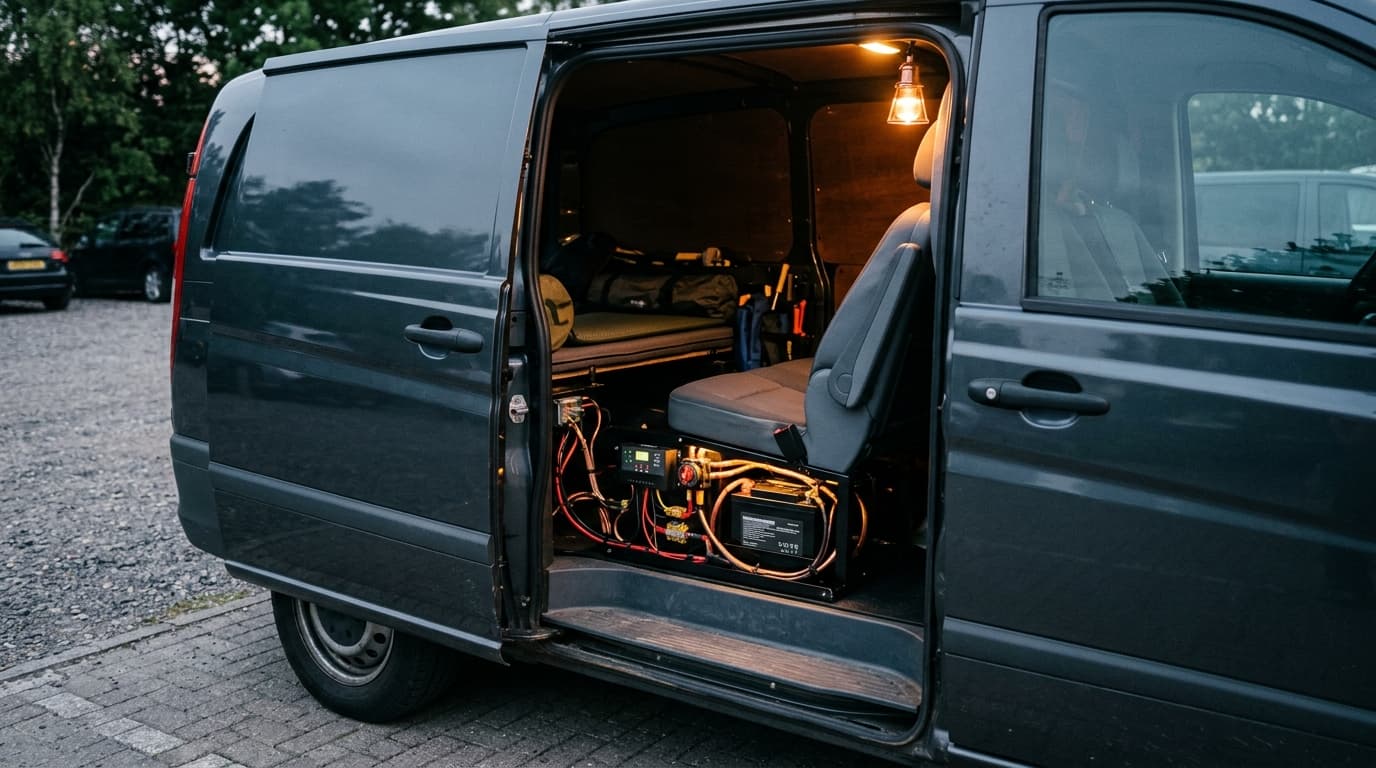
A split charge relay recharges the auxiliary battery while the engine runs and isolates it as soon as the engine stops. On a recent diesel city van it works poorly: the smart alternator drops below its closing voltage. In that case the right kit is a 20 or 30 A DC-DC charger, and the installation takes a day.
What does a split charge relay do?
It protects the starter battery. Everything else follows from that.
As soon as you add 12 V equipment to a van (a fridge, an inverter for tool batteries, load area lighting), you need a second battery. Without separation, the inverter left on on Friday evening drains the battery that starts the engine too, and on Monday morning the van won't start.
A split charge relay is a voltage-sensing switch. When the alternator charges, the voltage rises, the relay closes and the auxiliary battery recharges. When the engine stops, the voltage falls, the relay opens and each battery is on its own. The datasheet of Victron's Cyrix-ct 120 A gives the thresholds: closing between 13 and 13.8 V, opening between 11 and 12.8 V on a 12 V system, with trend detection to prevent chattering. Scheiber and CBE units work on the same principle.
Simple, sturdy, cheap. On a van from the 2000s, it was the obvious answer.
Relay or DC-DC charger on a Euro 6 van?
On a recent van, the DC-DC charger in the vast majority of cases. The reason is not the Euro 6 standard itself but the smart alternator that often comes with it: to save a few grams of CO₂, the engine computer cuts or reduces charging as soon as the starter battery is full. In the Orion-Tr Smart non-isolated manual, Victron writes that these alternators put out a variable 12.5 to 15 V. A relay only closes from 13 V. For much of the journey it stays open, and the auxiliary battery waits.
A DC-DC charger works differently. It takes whatever the alternator gives it, boosts the voltage and applies a charge curve suited to the battery type. The CTEK D250SE accepts 11.5 to 23 V input and delivers up to 20 A, with a built-in MPPT solar regulator. Victron's Orion-Tr Smart 12/12-30 delivers 30 A continuous at 40 °C, at 87% efficiency. By default it is set to "smart alternator": it starts at 14 V, or at 13.3 V held for two minutes, and stops below 13.1 V for one minute.
There is a trade-off. A 30 A DC-DC charger draws more than 30 A from the alternator: 430 W output at 25 °C, divided by 0.87 efficiency, is close to 500 W input, or about 37 A at 13.5 V. In winter, with headlights and demisting on, check that the vehicle's alternator can take it.
Lithium battery: is a relay enough?
No. A lithium iron phosphate battery accepts a huge current until it is full, and a relay limits nothing: it connects, that's all. The alternator then runs flat out for a long time, which it is not designed for.
A DC-DC charger caps the current and adapts the end-of-charge voltage (14.2 V in LiFePO4 mode on the CTEK). Victron also offers the Cyrix-Li, a relay controlled by the lithium battery's BMS rather than by voltage alone.
How long does it take to recharge the auxiliary battery while driving?
Longer than you think. The calculation below divides the energy to put back by the charger's current. It only counts the main constant-current phase: the slower end of charge comes on top (Victron sets it to two hours by default for lithium).
| Situation (100 Ah auxiliary battery) | Energy to put back | 20 A DC-DC charger (CTEK D250SE) | 30 A DC-DC charger (Victron Orion-Tr Smart) | Relay on a smart alternator |
|---|---|---|---|---|
| AGM drained to 50% | 50 Ah | 2 h 30 | 1 h 40 | unpredictable, often nil |
| Lithium drained to 80% | 80 Ah | 4 h | 2 h 40 | not recommended |
| Four 18 V 5 Ah tool batteries recharged through an inverter | 33 Ah | 1 h 40 | 1 h 05 | unpredictable |
The last row is our own calculation. Four 18 V, 5 Ah batteries hold 360 Wh; allowing 15% losses between the inverter and the tool charger, a cautious assumption, you draw about 424 Wh from the auxiliary battery, or 33 Ah at 12.8 V.
Scaled to a tradesperson's day, the conclusion is clear. A plumber who drives an hour and a half between jobs gets back about 30 Ah with a 20 A charger: enough to recharge three tool batteries, not a fridge running from 7 am to 6 pm. When I equipped refrigerated delivery city vans, that is exactly where the first installations failed: undersized charger, flat battery by Thursday.
Installation kit, rating by rating
| Item | Role | Value from the manufacturer's sheet | Indicative fitting time |
|---|---|---|---|
| 30 A DC-DC charger (Victron Orion-Tr Smart 12/12-30) | regulated charging from the alternator | 30 A continuous, 40 A for 10 s, 87% efficiency | 30 min |
| 20 A DC-DC charger (CTEK D250SE) | regulated charging, MPPT solar input | 20 A, 40 to 300 Ah, IP65, 193 × 110 × 65 mm | 30 min |
| 120 A split charge relay (Victron Cyrix-ct) | relay, conventional alternator and lead-acid | closes at 13 to 13.8 V, opens at 11 to 12.8 V | 20 min |
| 10 or 16 mm² flexible cable | link between batteries | 10 mm² up to 2 m, 16 mm² up to 10 m (Victron, 30 A charger) | 1 to 2 h depending on routing |
| Fuse at the battery | cable protection | 60 A for the 30 A charger (Victron) | 15 min |
| Battery tray or mounting plate | holds under braking and at the test | depends on battery format | 30 min |
We could not find a dated Belgian price on an official sheet for these products: ask a converter for a quote or compare at the counter. VAT on the equipment follows the van's deduction rules, covered in our guide to the real cost of a van.
Five mistakes keep coming back on installations I have seen in the workshop:
- a fuse fitted halfway along the cable instead of right at the battery, leaving the most exposed section unprotected;
- a 6 mm² cable "because it was easier to route", which heats up and drops voltage;
- an earth taken from a painted body bolt;
- an AGM battery sitting flat in a tray without a strap;
- a charger set to a lead-acid profile on a lithium battery, or the other way round.
How do you fit a charger or relay to two batteries?
Allow a day for a first installation on a city van, with the auxiliary battery under the passenger seat or behind the bulkhead. Tools: multimeter, crimper for tube lugs, heat-shrink, rubber grommets, cable ties.
- Disconnect the negative terminal of the starter battery. If an electronic unit is clipped onto that terminal (the battery sensor), leave it in place: it is what informs the smart alternator.
- Secure the auxiliary battery on a bolted plate, in a tray or with a strap, never loose. A 100 Ah AGM battery weighs around 30 kg, and it becomes a projectile if it breaks free under braking.
- Mount the charger or relay as close as possible to the auxiliary battery, on a dry, ventilated surface.
- Run the positive cable from the starter battery, with a fuse as close as possible to each battery and a grommet at every pass through sheet metal.
- Take earths from an original earth point or directly from the negative terminal, never from painted metal.
- Set the charge profile (lead-acid, AGM or LiFePO4) and, on a Victron charger, keep "smart alternator" mode.
- Check: with the engine running, the voltage must rise across the auxiliary battery; with the engine off, it must disconnect within the stated delay (one minute on the Orion).

The roadworthiness test checks mounting and wiring
The European checklist in Directive 2014/45, applied by roadworthiness test centres in Brussels, Wallonia and Flanders, has two items that concern your installation: low-voltage electrical wiring (item 4.11) and batteries (item 4.13). The inspector checks that each battery is firmly secured and not leaking, and that cables are fastened, insulated and not rubbing on an edge or a hot part. Nothing differs between the three Regions. For the rest of a van's inspection, see our guide to the roadworthiness test.
An auxiliary battery does not change the vehicle category either. A sleeping conversion does: then you are into converting a van into a camper and the paperwork at the DIV, the Belgian vehicle registration service.
Do you really need an auxiliary battery?
Often not. A tradesperson whose city van sleeps at the depot and who recharges three tool batteries a day can make do with a mains charger in the workshop. An auxiliary battery and its DC-DC charger make sense when you charge on site with no socket, when a delivery fridge runs all day, or when the van becomes a camper. For the vehicle itself, see our city van ranking.
Sources: Victron Energy, Orion-Tr Smart DC-DC charger non-isolated manual (current, efficiency, engine detection thresholds, cable sizes, fuse); Victron Energy, Cyrix-ct 12/24 V 120 A and 230 A datasheet (closing and opening thresholds); CTEK, D250SE product page (input voltage, current, battery profiles, dimensions); Directive 2014/45/EU on periodic roadworthiness tests, Annex I, items 4.11 and 4.13. Pages accessed on 26 October 2026. Recharge times and the tool battery budget are calculations, not measurements: real results depend on temperature, battery condition and the alternator.
Fourgonnettes & ludospaces comparator
Compare all fourgonnettes & ludospaces side by side.
Compare now →
Frequently asked questions

Damien, 44 ans, a géré pendant douze ans la flotte d'utilitaires d'une PME de second œuvre dans la région de Namur : achats, entretien, revente, et les galères de carrosserie qui vont avec. Il a vu passer des dizaines de Trafic, Transporter et Master, et il sait ce qui casse, ce qui se revend bien et ce qui coûte cher à l'usage. Il a lancé ce site pour comparer les utilitaires sur ce qui compte vraiment en Belgique : charge utile réelle, volume utile, TVA récupérable et coût au kilomètre — pas la brochure du concessionnaire.