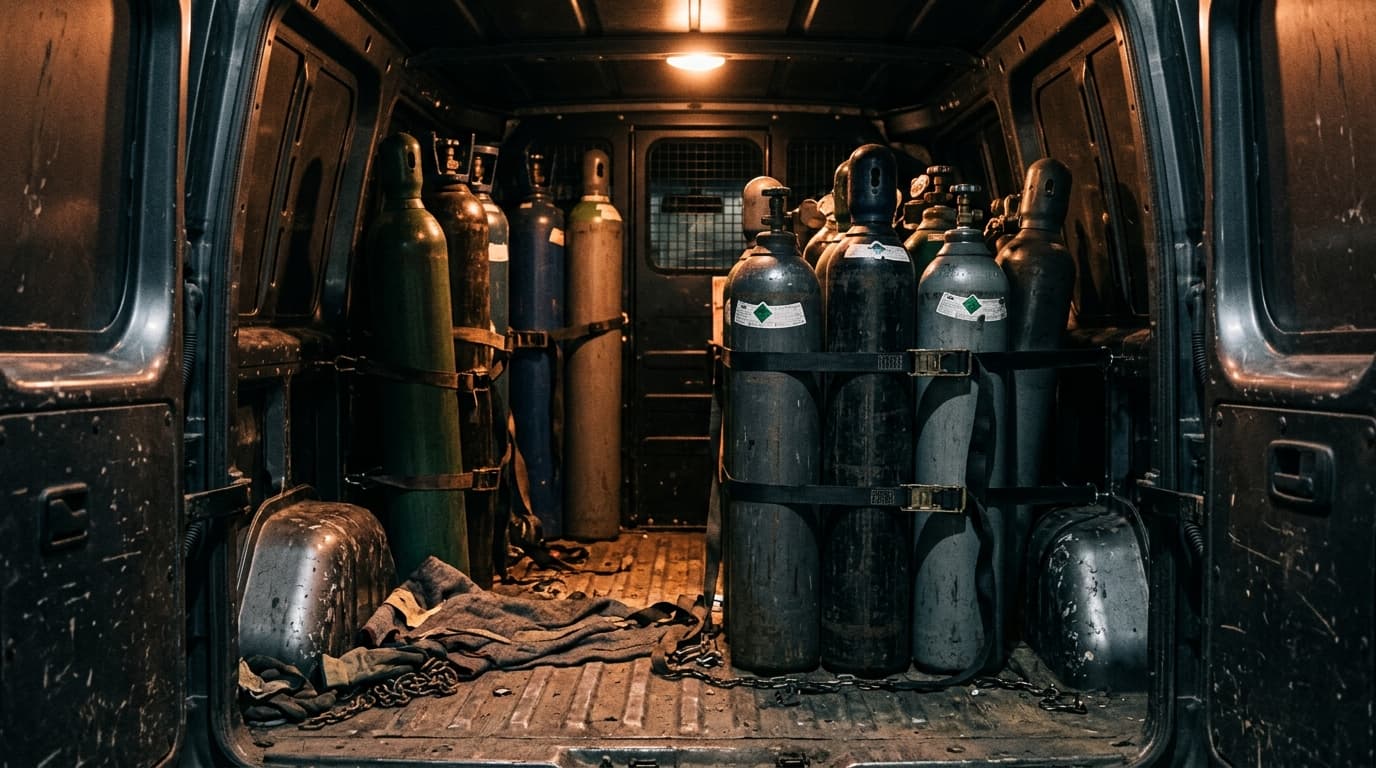
Yes, a tradesperson can carry gas cylinders in a van without orange plates or an ADR certificate, as long as the load stays under 1,000 points: 333 kg of propane, or twenty 50-litre oxygen cylinders. Upright, strapped, valve closed. And the rule changes depending on whether you are driving to a site or to the supplier's depot.
Can you carry a gas cylinder in a van?
Yes, in the two cases that concern most readers of this site. A private individual bringing home a Primagaz or Antargaz propane cylinder from the filling station for the patio falls under ADR 1.1.3.1 (a), the European agreement on the road transport of dangerous goods. A tradesperson taking a torch to a site falls under 1.1.3.1 (c).
In Belgium, the ADR applies through the Royal Decree of 28 June 2009 on the transport of dangerous goods by road or rail. It is a federal text.
No regional nuance, then: a heating engineer in Mons, a roofer in Hasselt and a welder in Anderlecht have exactly the same ceilings and the same obligations.
How many cylinders before full ADR rules apply?
The limit is counted in points, per vehicle, trailer included. Section 1.1.3.6 of the ADR, published in French by the Belgian Federal Agency for Nuclear Control, puts each substance in a transport category: flammable gases (propane, butane, acetylene) and petrol in category 2, capped at 333; oxygen, argon, nitrogen and diesel in category 3, capped at 1,000. Category 2 is multiplied by three, category 3 by one, and the total must not exceed 1,000.
There are two ways of counting the quantity, and they are easily confused. A liquefied or dissolved gas (propane, butane, acetylene) counts in kilos of net content. A compressed gas (oxygen, argon, nitrogen) counts in litres of water capacity of the cylinder, not in cubic metres of gas.
The table below applies that calculation to common sizes. It is our own calculation from the text, not a supplier's grid.
| Size, one substance on board | Category | Points per unit | Maximum under 1,000 points |
|---|---|---|---|
| Propane or butane, 5 kg content | 2 | 15 | 66 cylinders |
| Propane or butane, 10 kg | 2 | 30 | 33 cylinders |
| Propane or butane, 13 kg | 2 | 39 | 25 cylinders |
| Propane, 35 kg | 2 | 105 | 9 cylinders |
| Oxygen or argon, 50-litre water capacity | 3 | 50 | 20 cylinders |
| Oxygen or argon, 20-litre water capacity | 3 | 20 | 50 cylinders |
| 20-litre petrol jerrycan | 2 | 60 | 16 jerrycans |
| 20-litre diesel jerrycan | 3 | 20 | 50 jerrycans |
| Large acetylene cylinder | 2 | depends on the mass given by the supplier | 12 to 14 according to the AFGC, Air Products and FFB guides |
The figure that matters: a mixed load. A roofer setting off with three 35 kg propane cylinders (315 points), two 20-litre petrol jerrycans for the chainsaw (120 points) and one of diesel for the generator (20 points) totals 455 points. Plenty of margin. A heating engineer with two 10 kg cylinders, a small 20-litre oxygen cylinder and a 5-litre can of petrol stays under 100 points.
Air Products prints the point total on its delivery notes. Keep it, it saves you the maths.
Site or depot: the same load, two regimes
Take the same Berlingo, the same four cylinders. In the morning, the plumber leaves the workshop for a renovation in Namur: that is transport incidental to the main activity, to a site, covered by 1.1.3.1 (c). The ADR then only asks him to "take measures to prevent any leakage in normal conditions of carriage", within the 1,000 points and 450 litres per packaging.
In the afternoon, he stops at the supplier's depot to swap his empties and restock the workshop. That trip is no longer covered, because the text expressly excludes carriage by such firms "for their supply or external or internal distribution". He switches to the partial exemption in 1.1.3.6, which demands more, with the same load and the same van, three hours apart, without any sign or delivery note telling him so.
On the fleet we settled it simply: every vehicle that carried gas was equipped for the stricter regime. It costs an extinguisher and a sticker.
Which obligations remain under 1,000 points?
Under the 1.1.3.6 exemption, the text waives orange plates, the driver's ADR certificate and most of Part 8. It keeps several obligations, summarised by the UK Health and Safety Executive in its note on small-scale carriage of industrial gases, which comments on the same text:
- a portable dry powder fire extinguisher of at least 2 kg on board;
- driver awareness training on the risks, in the sense of Chapter 1.3, with a written record;
- in a closed vehicle, a warning on the load area doors stating there is no ventilation and asking to open with caution, in letters at least 25 mm high (provision CV36);
- cylinders keeping their hazard labels legible, never removed or covered;
- no smoking during handling or near the vehicle;
- the supplier's delivery note on board for the current trip, as Air Products asks in its leaflet.
CV36 also says packages should preferably be loaded in an open, sheeted or ventilated vehicle.
A panel van is none of those.
From barbecue to depot: nine cases settled
| Situation | Regime | What to do |
|---|---|---|
| Private individual, one 10 kg cylinder for the barbecue | Exempt, 1.1.3.1 (a) | Upright, wedged, valve closed, window slightly open |
| Tradesperson, workshop to site, under 1,000 points | Exempt, 1.1.3.1 (c) | Leak prevention, securing, ventilation |
| Tradesperson, trip to the supplier's depot, under 1,000 points | Partial exemption, 1.1.3.6 | 2 kg extinguisher, training, CV36 warning if the van is closed |
| Delivering cylinders to a customer for payment | 1.1.3.6 in principle, never 1.1.3.1 (c) | Same equipment, check your carrier status |
| Load above 1,000 points | Full ADR | Orange plates, ADR certificate, transport document, equipment |
| Propane and oxygen in the same load area | Depends on points | Keep them apart, full and empty cylinders separate |
| Acetylene cylinder carried lying down | Depends on points | Wait at least one day upright before opening |
| Toxic gas (ammonia, chlorine) | Category 1, ceiling of 20 | Avoid: ask the supplier |
| Cylinder still connected to an appliance | To be avoided in every case | Remove regulator and torch, cap screwed on |
How do you secure a cylinder in a small van?
Upright, against a side wall, strapped to a floor anchor point or a bolted rail. Never on a shelf, never lying between two crates.
Before loading, the French building federation lists the steps in its FAQ on carrying cylinders: check for leaks, close the valve even if the cylinder seems empty, screw on the cap, remove regulator, hose and torch. Engine off while loading, safety shoes and gloves. It recommends a vehicle ventilated high and low, with the cab isolated from the load area.
Propane is heavier than air. A leak sinks and pools on the floor, where the load area of a panel Kangoo or Berlingo usually has no opening at all.
For the strap itself, the forces and the EN 12195-2 standard are covered in our guide to securing a load in a van. A full 35 kg cylinder weighs much more than its content, and under emergency braking the anchor point must hold 0.8 times that weight forwards.
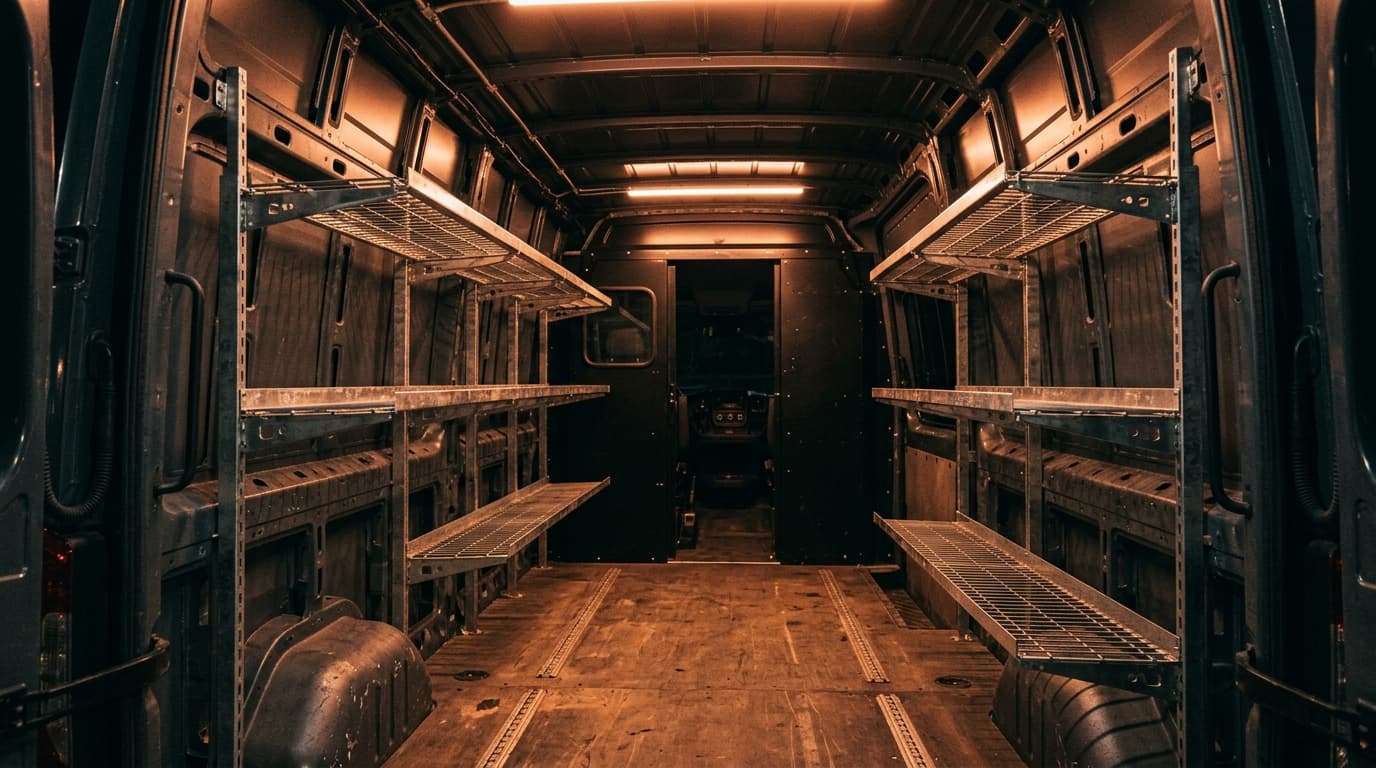
Van fit-out makers such as Bott or Sortimo build this kind of rail into their racking; our pointers for choosing are in the guide to van shelving.
What happens at a roadside check?
The 2009 Royal Decree names the competent officers: local and federal police, customs, and inspectors of the federal mobility department. They can check at the roadside. We found no public scale of fines specific to ADR offences, so we quote none. A loose cylinder in the load area, however, falls under Article 45 of the Highway Code like any badly secured load: 128 euros as an on-the-spot fine since 1 July 2026.
Can you leave cylinders in the van in the evening?
No text forbids it. The guide of the French compressed gas association, passed on by several distributors, nevertheless asks users not to leave cylinders in a vehicle without need, and to tell their insurer they carry industrial gases. I would leave nothing overnight in a small van parked in the sun or in a closed garage.
If you are still looking for the right vehicle for this trade, our small van ranking compares payload and volume, and the guide to which small van for a tradesperson covers bulkheads and fit-out.
Sources: Belgian Federal Agency for Nuclear Control, Jurion database, ADR, Annex A, section 1.1.3.6 (2013 version, categories and multipliers unchanged since); ADR 2025, volume I, section 1.1.3.1; Royal Decree of 28 June 2009, version in force since 27 November 2025; Health and Safety Executive, note on small-scale carriage of industrial gases; PreventAgri, Walloon green sectors mission, leaflet «Transport de bouteilles de gaz», 2022; Air Products, «Le transport de bouteilles de gaz»; AFGC, industrial gas transport leaflet; FFB-UMGCCP, FAQ dated 11 June 2019; SPF Mobilité et Transports, on-the-spot fines from 1 July 2026. Pages consulted on 14 October 2026. This article is for information and does not replace the advice of your gas supplier or an ADR safety adviser.
Fourgonnettes & ludospaces comparator
Compare all fourgonnettes & ludospaces side by side.
Compare now →
Frequently asked questions

Damien, 44 ans, a géré pendant douze ans la flotte d'utilitaires d'une PME de second œuvre dans la région de Namur : achats, entretien, revente, et les galères de carrosserie qui vont avec. Il a vu passer des dizaines de Trafic, Transporter et Master, et il sait ce qui casse, ce qui se revend bien et ce qui coûte cher à l'usage. Il a lancé ce site pour comparer les utilitaires sur ce qui compte vraiment en Belgique : charge utile réelle, volume utile, TVA récupérable et coût au kilomètre — pas la brochure du concessionnaire.