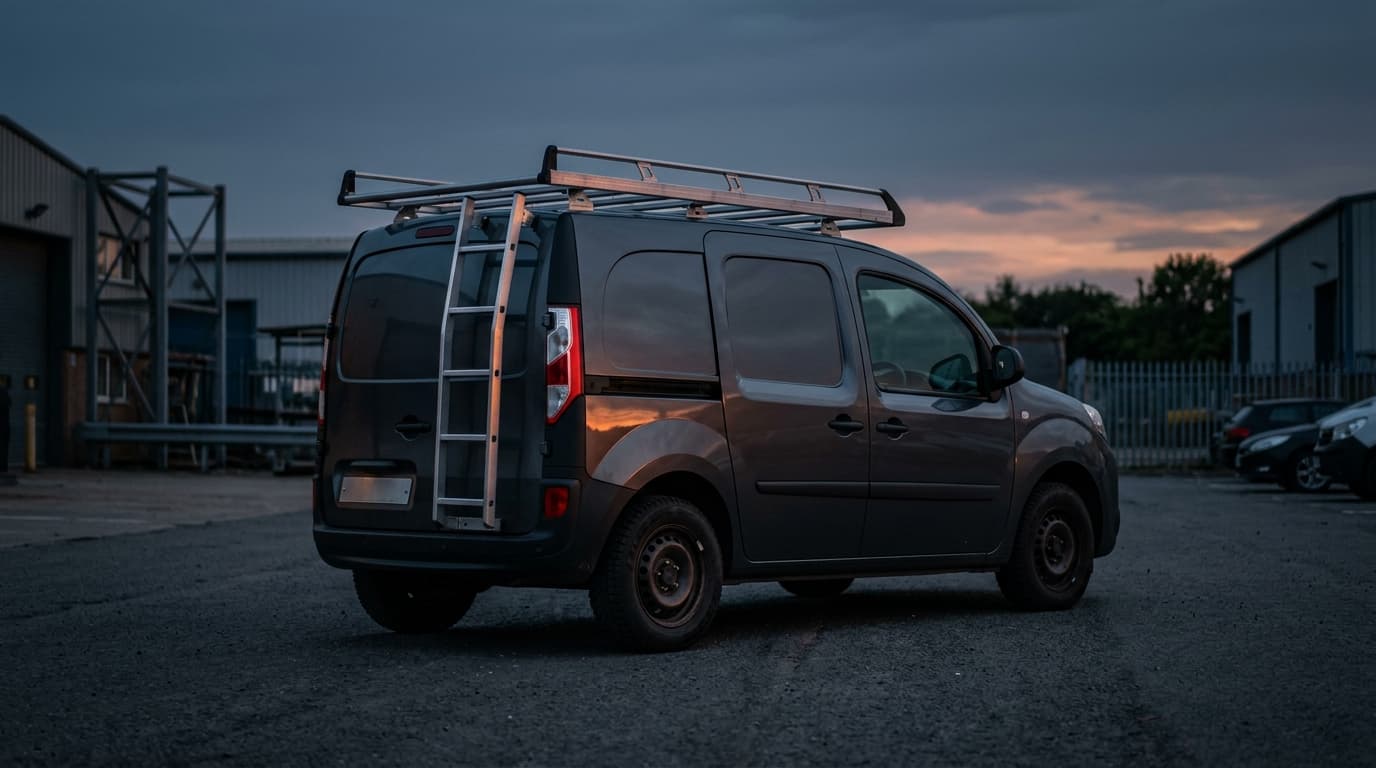
A professional rack often claims more than 150 kg of capacity. Your van roof stops far lower, rack included. The low figure is the one that governs, and it appears neither on the brochure nor on the manufacturer's plate. At the rear, a ladder may overhang by one metre with nothing to declare, and by three at most.
How much can a van roof rack really carry?
Three ceilings stack up, and the lowest one wins.
The first belongs to the rack. Syncro System, based in Fernelmont in the province of Namur, claims a capacity above 150 kg for both of its anodised aluminium racks, the Rhino built in the United Kingdom and assembled in Namur, and the Syncro System extruded in the province of Liège. The second ceiling belongs to the vehicle roof, set by the manufacturer, and it almost always sits lower. The third is the payload you have left once the shelving, the floor and the tools are on board.
Thule states the rule plainly in its documentation: maximum roof load is the weight of the bars, plus the weight of any accessories fitted to them, plus the weight of the load. Most of its bar sets carry up to 100 kg per pair, but the vehicle always sets the ceiling for the whole system.
The number that counts: on a roof rated at 100 kg, a 35 kg rack leaves only 65 kg of ladders, tubes and straps. A six metre aluminium extension ladder already weighs in the region of twenty kilos. Two ladders and a pipe carrier, and you are there.
Where do you find your van's roof load rating?
In the owner's manual, nowhere else.
Manufacturers do not publish it on their model pages, and it does not appear on the manufacturer's plate either, which gives the maximum authorised mass and the axle loads but stays silent on the roof. The figure lives in the vehicle handbook, in the chapter on carrying loads, and it sometimes varies between body sizes of the same model.
On a Kangoo, a Berlingo or a Caddy bought second hand with no manual, the only reliable route is the brand's after-sales service, chassis number in hand. A serious installer will ask you for it anyway before drilling anything.
If you are still choosing the vehicle, our comparison of city vans for tradespeople sorts on real payload rather than on quoted volume.
How far can a ladder overhang at the rear?
One metre with nothing to declare. Three metres at most, and only for indivisible items of great length.
The royal decree of 1 December 1975 on general traffic police regulations sets the rule in its article 46. At the front, the text is categorical: the load may under no circumstances extend beyond the end of the vehicle. A ladder creeping over the windscreen is unlawful before anyone even mentions visibility.
A ladder does fall inside the three metre derogation, because you do not cut one up to transport it. A bundle of battens does not: it divides, so it falls back under the one metre ceiling.
The Belgian subtlety fits in one line: Brussels and Wallonia share the same text, whereas Flanders wrote its own, with its own definition of an indivisible item, its own special cases for containers and truck-mounted forklifts, and its own way of measuring the overhang. The ceiling stays at one metre and the derogation at three, but two inspectors standing either side of the language border are not reading the same article.
| Loading limit | Brussels | Wallonia | Flanders |
|---|---|---|---|
| Overhang at the front | Not allowed | Not allowed | Not allowed |
| Rear overhang without signalling | 1 m | 1 m | 1 m |
| Maximum rear overhang, indivisible items of great length | 3 m | 3 m | 3 m, with its own definition of an indivisible item |
| Width of the loaded vehicle | 2.55 m | 2.55 m | 2.55 m |
| Height of the loaded vehicle | 4 m | 4 m | 4 m |
| Applicable wording of article 46.2.3 | Brussels-Capital and Walloon Region | Brussels-Capital and Walloon Region | Flemish Region, separate text |
When does the red and white panel become mandatory?
As soon as the load overhangs the rear by more than one metre.
The sign is a 0.50 metre square with alternating red and white stripes, fixed at the end of the load. The exact placement conditions are set out in article 47 of the same royal decree. A panel lying flat on the roof, invisible from behind, does not do the job and protects you from nothing.
128 euros. That is the second-degree on-the-spot fine since the FPS Mobility and Transport raised the amounts by 10 % on 1 July 2026, the first revision since 2017. First degree went to 64 euros, third to 191 and fourth to 520.
On a real job site, the panel costs less than a tank of diesel and lives in the cab all year. The tradespeople who get caught are almost never the ones who do not own one: they are the ones who left it at the workshop.
How do you load and secure a ladder in six steps?
Count three to five minutes once the rack is fitted, and twice that the first time.
- Measure before loading (1 min). Ladder length, overall vehicle length, overhang by subtraction. Past one metre, the panel comes out of the cab.
- Load from the rear, over the roller (1 min). A full-width stainless roller lets one person slide a six metre ladder up alone. Without a roller you need two people, or you accept scratching the rack and the tailgate.
- Push the ladder forward (30 s). Rear overhang whips at speed, and it gets counted by the metre at a roadside check. Win it on the right side.
- Strap both ends as a minimum (2 min). One strap per crossbar if the ladder is long. A bungee cord is not a securing device, and an inspector knows that perfectly well.
- Fit the lock (30 s). A ladder on a roof is stolen in twenty seconds in a supermarket car park, and the keyed clamps sold by van conversion firms exist for exactly that.
- Write the overall height in the cab (1 min). A city van sits at around 1.80 metres; a rack and a ladder easily add 20 to 25 centimetres, which takes it above the 2 metre barrier of many Belgian underground car parks. Our guide to L1H1, L2H2 and L3H3 body sizes sets out heights by silhouette.
Load securing itself, with the restraint forces and EN 12195-2 straps, is covered in our guide to securing a load in a van. The same principles apply on the roof, with one aggravating factor: a load that leaves the roof lands on the public road, in front of the vehicle behind you.
Two bars, a full rack or a ladder lift?
The deciding criterion is not the length of what you carry. It is the frequency.
Two bars are plenty for an electrician who pulls out a stepladder twice a week. A roofer loading and unloading six times a day pays back an assisted ladder carrier in a few months of spared back. Between the two, the full rack with a rear roller remains the Belgian fleet standard, and it is the roller, far more than the brand, that decides whether you load alone or in pairs.
| System | For what use | Fitting time in the workshop | The point that decides |
|---|---|---|---|
| Set of two or three roof bars | One ladder, a tube, a few profiles, two or three times a week | 30 to 60 minutes | The stated capacity per pair and the number of factory mounting points on the roof |
| Full rack with rear roller | Daily loading, long ladders, often with no help | Half a day | The rear roller and the number of mounting feet |
| Assisted ladder carrier | Heavy ladder handled several times a day, high roof | Half a day | The weight of the ladder and the roof height, not the price |
| Enclosed loading tube | Tubes, profiles, seals, guttering, materials that dislike rain | One to two hours | The usable internal length, to be measured before ordering |
What does a roof rack cost in Belgium?
Impossible to state to the cent, and that is already useful information.
No Belgian conversion firm publishes a public price for a complete rack. The figure depends on the vehicle model, the length, the number of feet and the fitting, and everything goes through a quote. Ask for three, fitting included, and compare the rear roller before you compare the euros.
Four checks before you drive off
They take a minute and are done standing next to the vehicle.
- Overall height measured with the rack and the load in place, written in marker on a sticker inside the cab
- Mounting feet retorqued after the first fifty kilometres, then once a quarter
- Two straps minimum, one at each end of the ladder, and never a bungee cord
- The 0.50 metre panel present in the vehicle, not at the workshop
Our verdict
In twelve years of fleet management, the rack is the accessory we ordered wrongly most often. A tradesperson asks for a full rack because a colleague has one, then carries a ladder twice a month and drags thirty kilos of aluminium profile around the rest of the time, wind noise included. Two bars and a lock would have done.
The purchase I would defend without hesitation, on the other hand, is the rear roller as soon as a full rack is decided. Loading a six metre ladder alone or in pairs is not the same working day, and that is the kind of detail no spec sheet shows.
If the vehicle is not settled yet, the van comparator sorts on real payload and volume, and what you can put on the roof follows from whatever is left.
Sources: royal decree of 1 December 1975 on general traffic police regulations, articles 45, 46 and 47, in the wordings applicable in the Brussels-Capital Region, the Walloon Region and the Flemish Region; FPS Mobility and Transport, increase of on-the-spot fines on 1 July 2026; Thule technical documentation on the load capacity of a roof bar system; Syncro System Belgium, public page for anodised aluminium roof racks, checked on 15 September 2026.
Fourgonnettes & ludospaces comparator
Compare all fourgonnettes & ludospaces side by side.
Compare now →
Frequently asked questions

Damien, 44 ans, a géré pendant douze ans la flotte d'utilitaires d'une PME de second œuvre dans la région de Namur : achats, entretien, revente, et les galères de carrosserie qui vont avec. Il a vu passer des dizaines de Trafic, Transporter et Master, et il sait ce qui casse, ce qui se revend bien et ce qui coûte cher à l'usage. Il a lancé ce site pour comparer les utilitaires sur ce qui compte vraiment en Belgique : charge utile réelle, volume utile, TVA récupérable et coût au kilomètre — pas la brochure du concessionnaire.