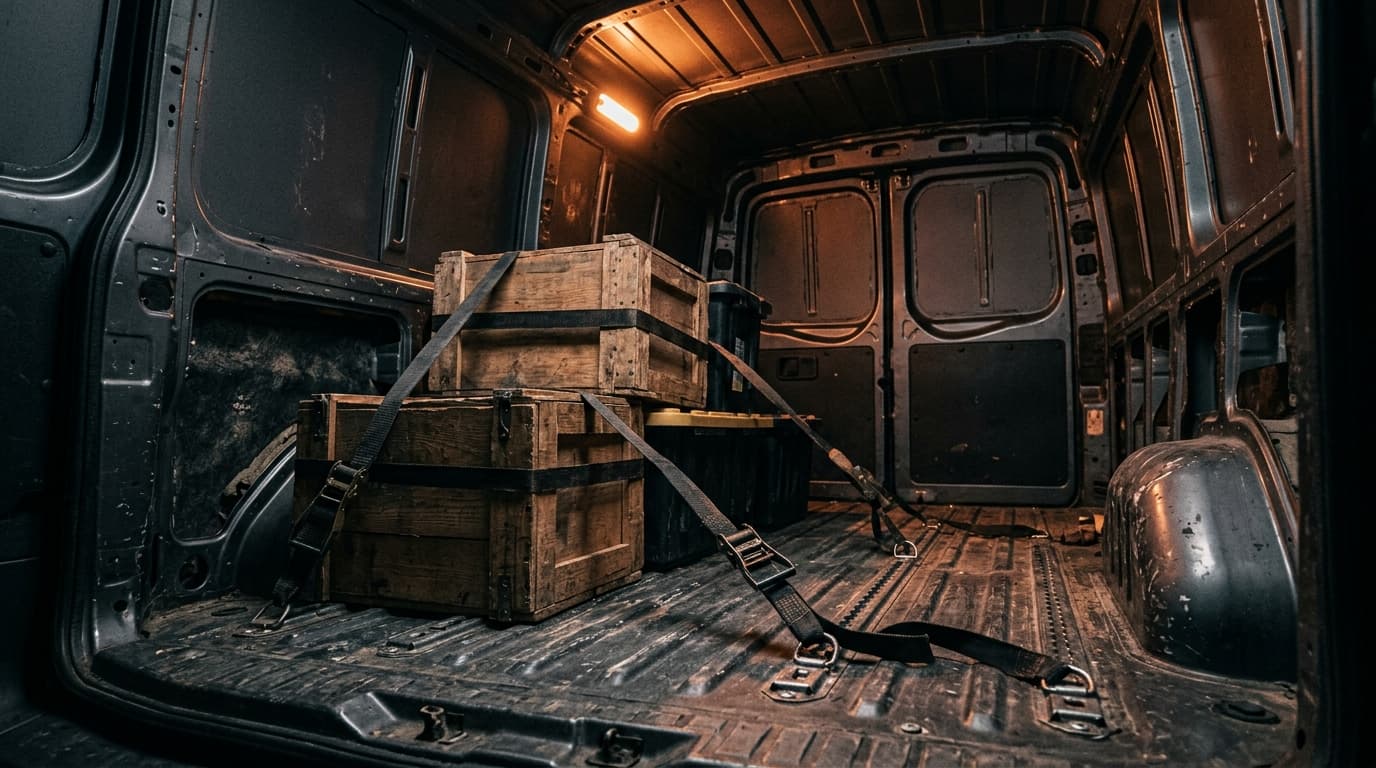
In Wallonia and Brussels, a category N1 van falls under the same load-securing rules as a truck: the system must restrain 0.8 times the weight of the load forwards and 0.5 times sideways. In Flanders, N1 vehicles sit outside article 45bis. Everywhere, a load that moves is still an offence.
Do you really have to secure a load in a light van?
Yes, and the answer is sharper in Wallonia and Brussels than in Flanders. This is the Belgian subtlety nobody explains to tradespeople: since roadside technical inspection was regionalised, the three Regions have written their own version of the load-securing rules, and they do not cover the same vehicles.
European directive 2014/47/EU, transposed into Belgian law, requires a load-securing system for categories N2, N3, O3, O4 and T in all three Regions. Wallonia and Brussels added categories N1, M2 and M3 — in other words your 3.5-tonne van, your company MPV and your minibus. Flanders stuck to the minimum text and did not bring N1 into the scope of article 45bis. The detail is documented by UPTR, the Belgian professional union for transport and logistics, which has compiled the three regional versions.
What we would avoid: concluding that a Flemish van drives without obligation. Article 45 of the royal decree of 1 December 1975 on general traffic police regulations applies everywhere and has done for fifty years: the load may not obstruct visibility, drag, fall onto the public road, or compromise the vehicle's stability. The difference between the Regions is about the inspection method and the shared-liability regime, not about the principle.
On a real job site, what changes is mainly who pays. The Walloon and Brussels texts spell out the roles: the carrier secures the load, the loader answers for its distribution on the load floor and for axle weights, the consignor supplies exact masses. An SME owner loading his employee's van is loader AND carrier — he carries both responsibilities.
What forces must the securing system withstand?
Three figures, and they are not negotiable: 0.8 times the weight of the load in the direction of travel, 0.5 times sideways, 0.5 times backwards.
These coefficients translate the deceleration of emergency braking. In normal driving, a load sees 0.3 to 0.4 g. Under full braking or a swerve, you reach 0.8 g forwards — 80 % of the load's weight turns into force against the cab bulkhead. An 800 kg pallet of tiles then pushes with 640 kg. A standard van bulkhead is not built for that.
The number that counts: for 500 kg of kit, you have to provide 400 kg of restraint forwards and 250 kg on each side. That is not a cautious estimate, it is the legal minimum.
| Load carried | Forward restraint (0.8 g) | Lateral restraint (0.5 g) | Rearward restraint (0.5 g) |
|---|---|---|---|
| 200 kg (tools, cement bags) | 160 kg | 100 kg | 100 kg |
| 500 kg (pallet of materials) | 400 kg | 250 kg | 250 kg |
| 800 kg (medium van payload) | 640 kg | 400 kg | 400 kg |
| 1,200 kg (large van payload) | 960 kg | 600 kg | 600 kg |
How should you distribute the load in a van?
Heavy items low down, against the bulkhead, centred between the wheels. That one sentence settles 80 % of the handling problems of a loaded van.
The low rule is about the centre of gravity. A van is tall and narrow; stacking 300 kg at shoulder height raises the centre of gravity by 40 to 50 cm and turns a roundabout taken at 30 km/h into a balancing act. The forward rule is about axle loads: pushing heavy items towards the rear doors unloads the front axle, therefore the steering and the braking, while risking an overload on the rear axle. Both values are on the manufacturer's plate, and the roadworthiness test checks them by weighing whenever a doubt comes up.
On a real job site, the classic case is the plasterer's van: bags of render at the back against the doors because that is easier to unload, mobile scaffolding in the middle, nothing up front. The vehicle floats at the rear, the steering goes light, and the first braking sends 400 kg of render into the back of the scaffolding. Loading in the reverse order costs five extra minutes in the morning.
One detail fleet managers underestimate: available payload drops with every fit-out. A full Sortimo or Bott metal racking set weighs 80 to 150 kg depending on the configuration, a reinforced floor 25 to 40 kg. On a medium van with a theoretical 1,000 kg payload, 800 kg of real capacity is often what is left. The subject is covered in our guide to payload on a category-B licence.
What kit do you need to secure a load properly?
Three families of equipment, and one standard: EN 12195-2 for textile lashing straps. A strap without a compliant label has no place in a professional van — the inspector treats it as absent.
Two values appear on that label. LC (Lashing Capacity) is the maximum permitted load in direct lashing, in daN. STF (Standard Tension Force) is the tension the ratchet actually applies to the strap, and it is the only figure that matters in friction lashing — the method used in 90 % of cases in a van. The manufacturers supplying the Belgian market (SpanSet, Dolezych, Kerman) print both on the sewn label; supermarket straps with no STF shown are made for DIY, not for site equipment.
| Equipment | What it does | Price range (2026) | Brands available in Belgium |
|---|---|---|---|
| EN 12195-2 ratchet strap, LC 500-2,500 daN | Main restraint, friction or direct lashing | €12 to €45 each | SpanSet, Dolezych, Kerman, Master Lock |
| Floor lashing point (350 daN) | Bolted, retractable anchor | €15 to €30 each, fitting included in a conversion | Sortimo, Modul-System, Bott |
| Telescopic load bar | Blocking a light load without strapping | €35 to €90 | Bott, Sortimo, Würth |
| Anti-slip mat (µ ≈ 0.6) | Multiplying friction, cutting the number of straps | €20 to €60 a roll | Dolezych, Würth |
| Cargo net | Holding loose items, bags, small parcels | €25 to €80 | SpanSet, Sortimo |
The anti-slip mat is the best-value purchase on the list, and the rarest in Belgian vans. On dry varnished wood flooring, the friction coefficient sits around 0.2; a rubber mat takes it to 0.6. In friction lashing, that factor of three cuts the number of straps needed by the same amount. Two straps instead of six is three minutes saved on every load.
How do you secure a load in eight steps?
Count ten to fifteen minutes for a mixed medium-van load, with the kit already on board. Here is the sequence we used on the fleet, in order.
- Weigh or estimate the load, and check the manufacturer's plate (2 min). Total mass, axle loads. An overloaded van cannot be rescued by good lashing.
- Sweep and dry the floor (2 min). Plaster dust, grit, damp: each one drops the friction coefficient and makes friction lashing an illusion.
- Lay anti-slip mats under the heavy items (1 min). This is the step people skip, and it costs four extra straps.
- Load heavy first, low, against the bulkhead, centred (5 min). Then light items above and to the rear. Leave no lateral gap over 15 cm: a load that gets a run-up before hitting the wall strikes far harder than a chocked one.
- Identify the approved anchor points (1 min). Floor rings, bolted rails, factory points. Never a bulkhead, never a door handle, never a shelving upright.
- Run the straps and tension them (3 min). One strap per 250 to 400 kg of restraint required, crossed if the load is tall. The ratchet spindle should take a minimum of one and a half and a maximum of three turns of webbing.
- Block the remaining gaps (2 min). Telescopic bar, chocks, or a secondary load that fills the space. A 30 cm gap in front of a 200 kg load cancels the benefit of the straps.
- Retighten at the first stop (1 min). After five to ten kilometres, the load has settled and the strap has taken up slack. This check is standard practice among professional hauliers and the number-one omission among tradespeople.
What we would avoid: lashing to the shelving rails because they fall nicely to hand. Racking rails are designed to carry bins, not to take 400 daN of lateral pull. In a crash they tear out of the wall and the load carries on.
What does an unsecured load cost in Belgium?
€128 on the spot, and sometimes far more. A badly secured load falling under article 45 is classed as a second-degree offence in the Belgian scale of traffic offences.
The amount changed this summer. The FPS Mobility and Transport raised on-the-spot fines by 10 % on 1 July 2026, the first revision since 2017: first degree goes from €58 to €64, second from €116 to €128, third from €174 to €191 and fourth from €473 to €520. A tradesperson checked in June and one checked in August for the same badly chocked bag of rubble no longer pay the same.
| Offence degree | On-the-spot fine before 1 July 2026 | Since 1 July 2026 |
|---|---|---|
| 1st degree | €58 | €64 |
| 2nd degree (load, art. 45) | €116 | €128 |
| 3rd degree | €174 | €191 |
| 4th degree | €473 | €520 |
The ticket is not the real cost. Two consequences weigh more. First, immobilisation: if the officer judges the load a danger to the driver, the passengers or other road users, the vehicle can be held until it is put right. Half a day of van downtime on a site is worth €300 to €500 of turnover. Second, shared liability: since directive 2014/47/EU was transposed, the federal road police can sanction the loader, the carrier or the consignor, not only the driver stopped at the roadside. An owner who loaded his employee's van himself does not hide behind his driver.
Then there is the most expensive case, and the rarest: the crash. An unsecured load that injures the driver or a third party opens the door to an insurance coverage dispute and to criminal proceedings. That is where five minutes of strapping shows its real value.
Which mistakes come up most often?
Five, and none of them is spectacular. They are routine habits gone wrong, not ignorance.
Confusing filling with securing. A van packed to the roof gives the impression nothing can move. Nothing moves at a standstill; at the first braking the whole lot compresses and takes up slack. Using the bulkhead as an anchor point. A standard mesh bulkhead holds a box, not 400 daN. Ignoring light items stored high. An 8 kg aluminium stepladder resting on bins becomes a projectile at neck height. Reusing a knotted strap. A knot drops a strap's strength by 30 to 50 % and voids the LC label. Forgetting to retighten. The most frequent mistake and the easiest to fix: one stop, thirty seconds per strap.
One last point, for the self-employed carrying their own kit: nothing forces you to pull out six straps to fetch three planks. But the question stays the same at every load — if I brake hard right now, what arrives behind me? A medium van separates the driver from the load with less than a millimetre of steel.
Our verdict
In twelve years of fleet management I never saw a roadside check penalise a properly loaded van, and I saw three loads end up against the bulkhead. The maths is quick: two compliant straps, an anti-slip mat, and the habit of loading heavy items low and against the cab. The rest — telescopic bars, nets, extra anchor points — gets added as the job actually demands it, not from a shopping list drawn up in one go.
The one purchase I would recommend to a self-employed tradesperson starting out: the anti-slip mat. Twenty euros, three minutes saved on every load, and a factor of three on restraint. If you are still choosing the vehicle, the van comparator sorts on real payload and volume, and the Belgian van guide places city vans, medium vans and large vans side by side.
Sources: UPTR — Belgian professional union for transport and logistics (load securing and weight distribution, regional scope and regulatory forces, updated 17 June 2025); directive 2014/47/EU of the European Parliament and of the Council on the technical roadside inspection of commercial vehicles; royal decree of 1 December 1975 on general traffic police regulations, article 45; FPS Mobility and Transport (increase of on-the-spot fines on 1 July 2026); standard EN 12195-2 (web lashing straps made from man-made fibres) and annex B of EN 12195 (friction coefficients); Sortimo Belgium (floor lashing point capacity).
Fourgons moyens comparator
Compare all fourgons moyens side by side.
Compare now →
Frequently asked questions

Damien, 44 ans, a géré pendant douze ans la flotte d'utilitaires d'une PME de second œuvre dans la région de Namur : achats, entretien, revente, et les galères de carrosserie qui vont avec. Il a vu passer des dizaines de Trafic, Transporter et Master, et il sait ce qui casse, ce qui se revend bien et ce qui coûte cher à l'usage. Il a lancé ce site pour comparer les utilitaires sur ce qui compte vraiment en Belgique : charge utile réelle, volume utile, TVA récupérable et coût au kilomètre — pas la brochure du concessionnaire.