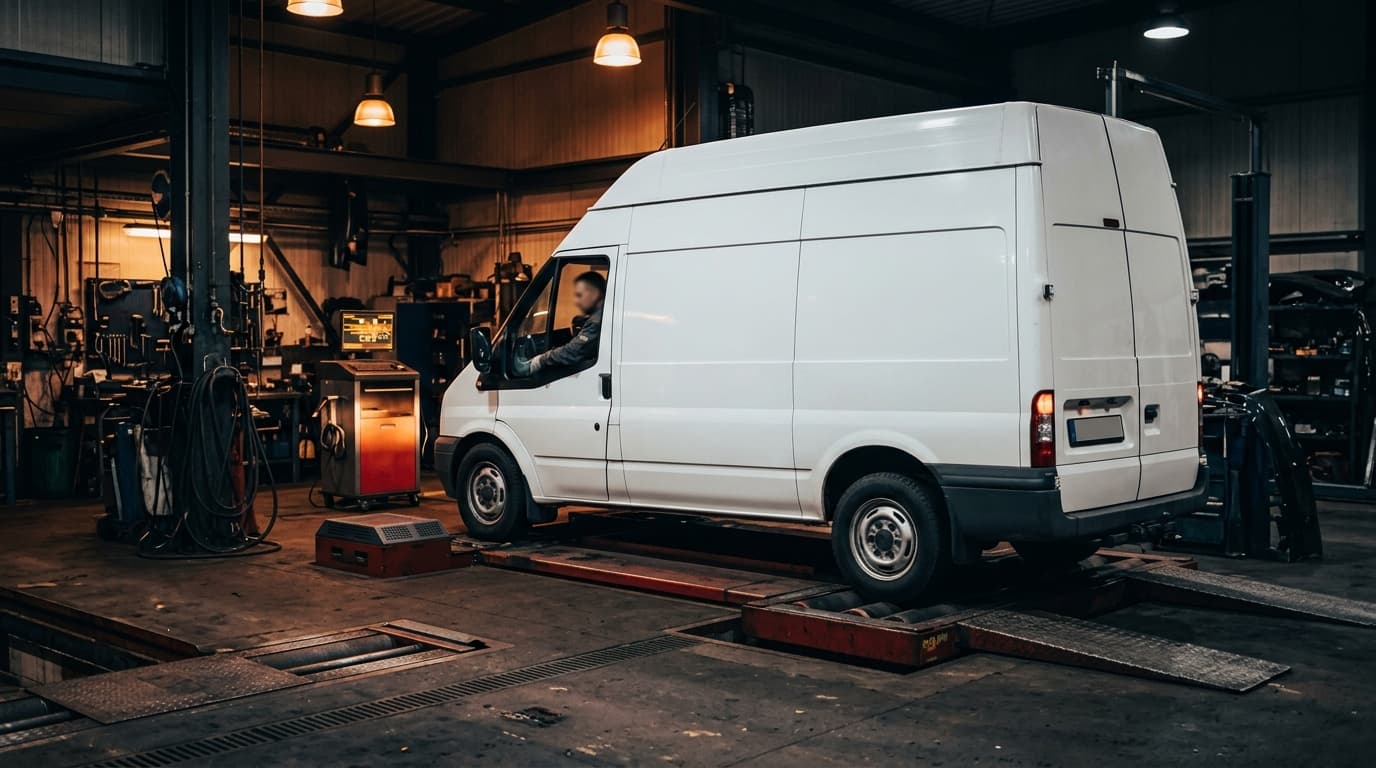
A Belgian light commercial vehicle is tested from the moment it is registered, then every year, without the four-year exemption private cars enjoy. Budget €64.70 in Brussels for a diesel and €77.00 in Wallonia on the 2026 scale. The rest comes down to paperwork and preparation.
How often must a van go through the roadworthiness test?
Every year, from the first one. This is the least known difference between a van and a car: a vehicle in category N1, designed to carry goods with a maximum authorised mass (GVW) of 3,500 kg or less, is called in as soon as it goes on the road, where a new private car waits four years.
The logic is simple: a van works. It loads, it drives, it brakes with weight behind, and it often changes driver. So Belgian law set the rhythm on use, not on the vehicle's age. In practice, a tradesperson buying a new Trafic in September brings it in the following year, and every year after that — a fleet Kangoo and a 200,000 km Sprinter follow the same calendar.
On a real job site, that means an annual appointment to book outside your busy season. Belgian stations work by appointment only, and the green reminder card sent by post asks you to turn up in the month before the expiry date shown on your last inspection certificate. That card is not a required document, just a reminder: if it gets lost, the deadline still runs.
How much does a van roadworthiness test cost in 2026?
Between €64.70 and €77.00 for a diesel van, depending on the region. The test has been regionalised, and the scales have diverged clearly since 1 January 2026.
In Brussels, the fee scale published by Autocontrole sets the base test for a van ≤ 3.5 t at €46.10, plus an emissions test charged at €18.60 for a diesel van — the most expensive supplement on the scale, above the €15.60 applied to a diesel car. Total: €64.70. In Wallonia, the AIBV scale in force on 1 January 2026 shows €77.00 for an N1 van, emissions test included, against €59.60 for a private car.
| Service (scale as of 1 January 2026) | Brussels | Wallonia |
|---|---|---|
| Periodic test, van ≤ 3.5 t (diesel) | €64.70 (46.10 + 18.60) | €77.00 |
| Periodic test, car (diesel) | €56.50 | €59.60 |
| First-visit supplement ≤ 3.5 t | €5.20 | included |
| Technical re-test | €16.40 | €16.50 |
| Second-hand test (sale) | station rate | €89.40 |
| Duplicate document | €16.40 | — |
The number that counts: €12.30 of difference between Brussels and Wallonia on the same diesel van. For a self-employed tradesperson with one van, that is trivia. For a fleet manager with fifteen vehicles, it is €185 a year — and one more reason to group appointments where you have a station nearby rather than chase the cheapest rate.
Which documents must you present at the test?
Four documents, all originals. Stations refuse photocopies and scans to prevent document fraud, and an incomplete file sends you home without a test.
The Belgian registration certificate — the pink or beige logbook, depending on the registration date — is issued by the DIV, the vehicle registration service. The certificate of conformity (COC) confirms the vehicle matches the type approval issued by the FPS Mobility; the manufacturer or importer handed it to you at purchase. The identification report carries the vehicle's identification data and was given to you after the first visit. The inspection certificate is the one received at your previous visit, green or red.
When one of these papers is missing there is always a way out, but it costs time. Registration certificate stolen or lost: report to the police, certificate of involuntary dispossession, then a duplicate request to the DIV. Identification report gone: you need a technical re-test with weighing to have a new one drawn up. Inspection certificate lost: duplicate at the station, €16.40 in Brussels.
How do you prepare your van in eight steps?
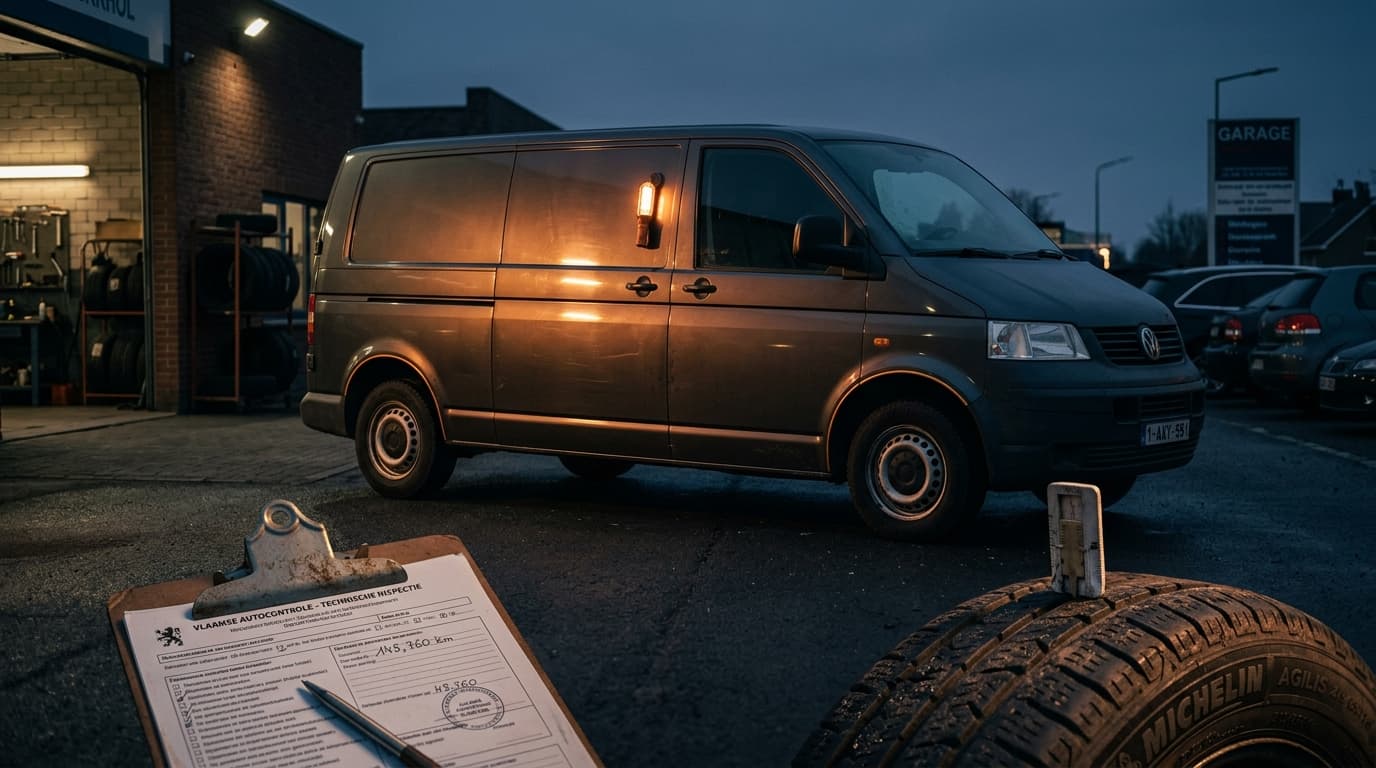
One hour of preparation the day before avoids the re-test. Here is the sequence we used on the fleet, in order, minimal kit and without lifting the vehicle.
- Book the appointment (10 min). Every Belgian station works by appointment. Book three to four weeks ahead, within the month before the deadline.
- Empty and clean the load area (20 min). The inspector needs access to the floor, the lashing points and the bulkhead. A van full of tools is a van that gets tested badly — and failed at the slightest doubt.
- Check every light (10 min). Dipped and main beam, indicators, brake lights, plate light, reflectors, and marker lights if the van has them. On a van, the third brake light and the rear plate light are the classic misses.
- Check tyres and pressures (15 min). At least 1.6 mm of tread depth, no bulges, pressure matching the manufacturer's plate. On a van, reinforced tyres (C rating) run at high pressures: under-inflation shows on shoulder wear.
- Walk the fluid levels and look for leaks (10 min). Oil, brake fluid, screenwash. A stain on the ground under the van is grounds for immediate refusal.
- Test wipers, horn and seatbelts (5 min). Blades that judder, a silent horn, a frayed belt on the centre seat: three defects worth €15 in parts that cost you a re-test.
- Gather the compulsory equipment (5 min). Warning triangle, hi-vis vest, fire extinguisher and first-aid kit — the last two remain required on vehicles registered in Belgium.
- Declare any modification (5 min). Towbar, roof conversion, fixed fit-out, conversion to a double cab: any change since the last test must be flagged to the inspector before the check.
What we would avoid: turning up with a loaded van "because there is a job straight after". A loaded van skews the brake test, and the inspector is entitled to refuse the check. Plan the slot empty, even if it costs you half a morning.
What should you do after a red certificate or a reduced validity?
You repair, then you come back. A re-test is compulsory in two cases: a red inspection certificate, or a green certificate whose validity is cut to three months.
The catch: a red certificate means going back to the same centre as the initial test. You cannot try your luck elsewhere, and that is deliberate — the inspector who logged the defect is the one who checks the repair. The green certificate with reduced validity flags minor defects: the vehicle stays road-legal for three months while you sort it out.
A re-test is cheap — €16.40 in Brussels, €16.50 in Wallonia — but the real cost sits elsewhere: another half-day off the road for a working vehicle. The number that counts: on a van generating €300 to €500 of turnover a day, an avoidable re-test costs ten to thirty times the price of the ticket.
Do you need a roadworthiness test to sell a van?
Yes, a second-hand test is compulsory before registration in the new owner's name, for any van with a GVW ≤ 3.5 t sold privately or by a trader. In Wallonia it is charged at €89.40, on top of the Car-Pass.
This test goes further than the periodic one: it examines the vehicle's general condition and produces a report handed to the buyer, which makes it the centrepiece of an honest transaction. One date to know: Flanders drops the second-hand test requirement on 1 September 2026 for non-imported vehicles. The Car-Pass stays compulsory everywhere in Belgium, and its link becomes mandatory in the advert.
At resale, a file with two or three consecutive green inspection certificates beats any speech about the vehicle's condition. It is the only third-party, dated proof a buyer can verify. If you are buying rather than selling, our guide to reliable used vans in Belgium sets out the checks to run before signing.
Which extra tests apply to a modified or towing van?
Three situations fall outside the standard periodic test: the towbar, an accident, and a major modification. Each triggers a specific visit, independent of the annual calendar.
The towing device must be presented as soon as it is fitted and at the first visit. The certificate issued carries the mention "normal use (coupling)" and lasts one year; afterwards, the towbar and its mounting are checked again at every full test. After an accident, a van may be required, on an expert's decision, to undergo an "after accident" check or a full roadworthiness test. Finally, any major modification — roof raise, fixed fit-out, cab conversion, change of load floor — means presenting the vehicle before putting it back on public roads.
This is the point van converters underestimate. A van turned into a camper or a mobile workshop does not just need a periodic test: the conversion has to be regularised, and it often changes the kerb weight, therefore the payload available. To frame that trade-off before converting, see our article on van payload and the category-B licence.
On the operator side, the Belgian landscape is shared between a few approved bodies grouped in GOCA: Autosécurité, AIBV and SBAT on the French-speaking side, Autocontrole (ACT) in Brussels, Autovision and Keurings- en Kontrolcentrum on the Flemish side. Since regional scales are set by the Region, the price does not vary from one body to another within the same region — no point comparing fees, compare appointment lead times instead. The registration and categorisation rules are set out by the FPS Mobility and Transport.
Our verdict
The roadworthiness test is the most predictable maintenance cost of a van, and yet the one that generates the most delays and re-tests. Three habits are enough: book the slot as soon as the reminder arrives, keep the four original documents on board, and walk around the vehicle the day before — lights, tyres, fluids, safety kit. On a fleet, it pays to keep a deadline table by number plate: it is the best way never to pay a late surcharge.
Still weighing up which segment you need before taking on the running costs? The van comparator sorts on payload, volume and running cost, and the Belgian van guide places city vans, medium vans and large vans side by side.
Sources: Autocontrole (fee scale for Brussels inspection stations, in force 1 January 2026; required documents and test types for vans ≤ 3.5 t); AIBV (roadworthiness test fee scale for Wallonia, 1 January 2026); FPS Mobility and Transport (registration of vans and light commercial vehicles); GOCA (approved bodies); Controle-technique.be (rules specific to N1 vehicles: re-test, second-hand test, towbar, after-accident check); FEBIAC (roadworthiness testing of light commercial vehicles).
Fourgons moyens comparator
Compare all fourgons moyens side by side.
Compare now →
Frequently asked questions

Damien, 44 ans, a géré pendant douze ans la flotte d'utilitaires d'une PME de second œuvre dans la région de Namur : achats, entretien, revente, et les galères de carrosserie qui vont avec. Il a vu passer des dizaines de Trafic, Transporter et Master, et il sait ce qui casse, ce qui se revend bien et ce qui coûte cher à l'usage. Il a lancé ce site pour comparer les utilitaires sur ce qui compte vraiment en Belgique : charge utile réelle, volume utile, TVA récupérable et coût au kilomètre — pas la brochure du concessionnaire.