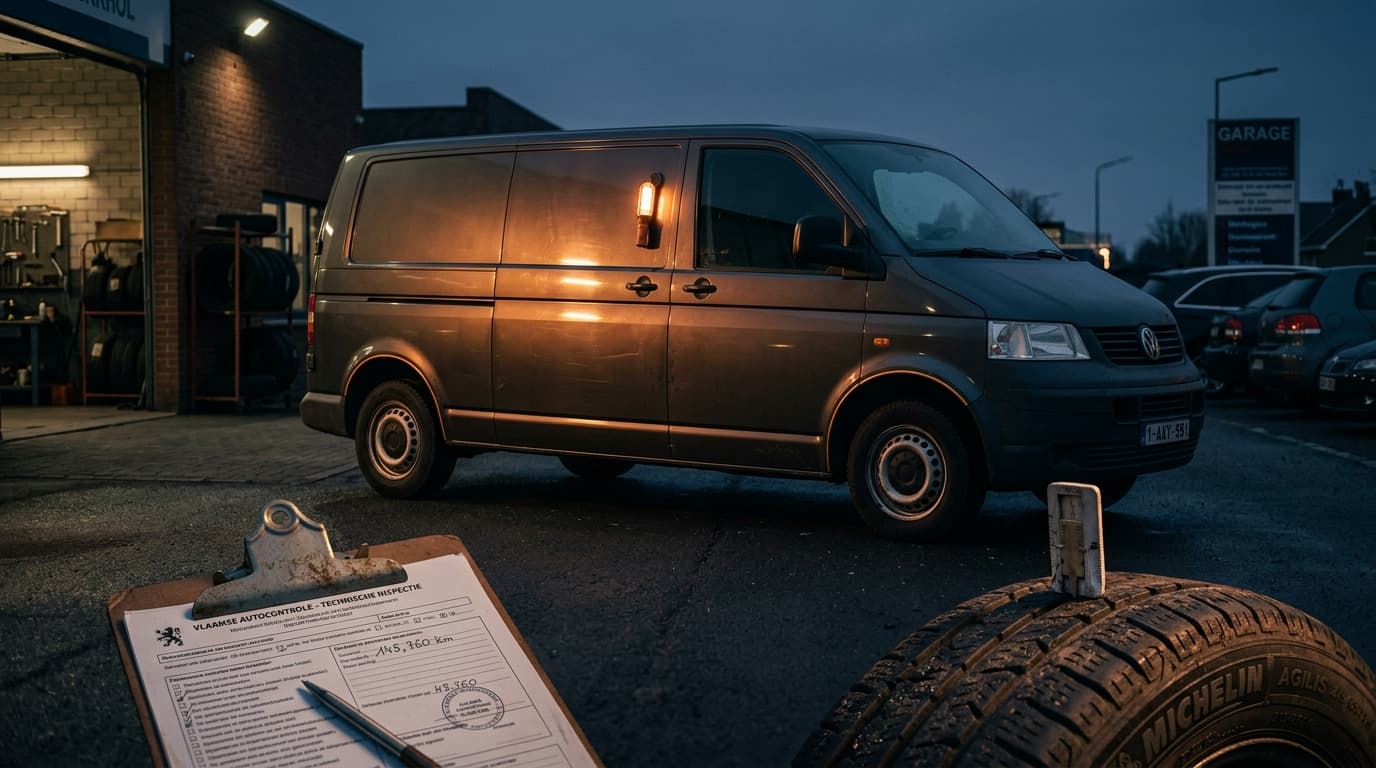
The best used van in Belgium is an ex-fleet diesel from 2015 on, under 150,000 km, with a consistent Car-Pass and a full service book. Renault Trafic, VW Transporter, Mercedes Sprinter and the Berlingo-Partner-Combo trio sit at the top of the pile. The rest comes down to history, not the badge.
Which used van to choose by budget?
Three tiers structure the Belgian market: under €10,000 for an older city van or a high-mileage medium van, €10,000 to €20,000 for a post-2017 ex-fleet medium van in good shape, and €20,000 to €30,000 for a recent model under three years old or a large van.
The first tier is the ground of the DIY private buyer and the tradesperson starting out. You find Berlingos, Kangoos and Partners eight to twelve years old, or tired Trafics and Transit Customs past 200,000 km. At that price, you are not buying a spec sheet, you are buying a history: a serviced vehicle at 180,000 km beats a mystery at 120,000 km. The second tier is the heart of the used market: ex-fleets arrive in numbers two to four years after registration. That is where the price-reliability ratio is best.
On a real job site, a sole tradesperson covers most needs with a second-tier medium van. The third tier is only worth it if you drive a lot, want the residual manufacturer warranty, or are after a recent large van for delivery rounds. The number that matters: below €5,000, always keep a reserve of at least €1,500 for the clutch, the DPF or the timing belt that can go within the year.
Which used vans are the most reliable?
On the Belgian market, four families come back as safe bets: the VW Transporter, the Mercedes Sprinter, the Renault Trafic, and the Stellantis trio Citroën Berlingo / Peugeot Partner / Opel Combo. The Iveco Daily and the Ford Transit round out the list for big volumes.
The VW Transporter carries a reputation for endurance backed by reliability rankings drawn from European fleet data, where it regularly tops the vans. The Mercedes Sprinter remains the benchmark for the unkillable large van, with diesel blocks built for very high mileage. The Renault Trafic plays the price-availability card: parts everywhere, dense network, mechanicals known to every garage. And the Berlingo / Partner / Combo trio — one vehicle under three logos — is the most rational used city van for town and local delivery, with rock-bottom running costs.
| Model | Segment | Reliability reputation | Used strong point | Indicative budget |
|---|---|---|---|---|
| VW Transporter | Medium van | Excellent | Endurance, residual value | €12,000–28,000 |
| Mercedes Sprinter | Large van | Excellent | Very high mileage | €10,000–30,000 |
| Renault Trafic | Medium van | Good | Parts and network everywhere | €9,000–24,000 |
| Berlingo / Partner / Combo | City van | Good | Cheapest upkeep | €6,000–18,000 |
| Ford Transit | Large van | Fair (post-2014) | Volume and payload | €9,000–26,000 |
| Renault Kangoo | City van | Good | Urban agility | €5,000–16,000 |
On the Belgian market, these models have another edge: they are so common that an independent mechanic fixes them without fuss and used parts abound. A rare van can be reliable on paper and cost a fortune at the first breakdown, for lack of parts. What we would avoid: a confidential or imported model with no network, however tempting the headline price.
Which models and model years to avoid used?
The golden rule: avoid the very first model years of a new generation and diesels that have only done city driving. Teething faults are paid for at resale, and a diesel particulate filter (DPF) that has never seen a motorway clogs fast.
A few known cases help filter. Ford Transits before 2013 pile up electrical and electronic issues. Mercedes Sprinters before 2010 suffer injection weaknesses. The early Renault Trafic dCi of the generation launched in the early 2000s had turbo trouble. Beyond the models, three components deserve systematic attention on any used diesel: the DPF and EGR valve (short city use = clogging), the clutch and dual-mass flywheel (jolts, judder), and the turbo (smoke, whistle on load).
What we would avoid: a van advertised "as new" that spent its life on urban delivery without ever driving far. A cold start test, engine not yet warm, reveals more faults than a lap of the block after the seller has warmed the engine. If the roadworthiness test is more than a few months old, ask for a recent one before signing.
How to check a used van in Belgium?
Four checks are enough to rule out 90% of bad deals: the Car-Pass, a recent roadworthiness test, a cold start test and an inspection of the bodywork and load floor.
The Car-Pass is mandatory for any light commercial vehicle up to 3.5 t sold in Belgium. It lists the chronological mileages recorded at every service, repair or roadworthiness test: the progression must follow a regular logic, with no gap or suspect drop. The document costs around €11 and cannot be more than two months old. Worth knowing: from June 2026, the Car-Pass link must appear in the listing, and its absence can void the sale by law.
On the roadworthiness test side, vans are subject to an annual test from the first year. Mind the regional change: in Flanders, the roadworthiness test will no longer be mandatory when selling a used vehicle from 1 September 2026 (except imports, which stay tested before registration). The Car-Pass stays required everywhere. In practice, ask for a recent test report and read the remarks: a "limited inspection" or faults marked in orange signal costs ahead.
Should you buy an ex-fleet or a private-owner van?
An ex-fleet van generally offers a tracked service record and invoices, at the cost of high mileage and intensive use. A private or tradesperson vehicle shows fewer kilometres, but more variable upkeep. The right choice depends on the quality of the history, not the origin itself.
The Belgian market is full of ex-fleets: leasing companies, technical services, delivery. These vehicles have worked, but they were almost always serviced on time, because a leasing contract requires it. A fleet Trafic or Transporter at 160,000 km, kept to the letter, is often a better buy than the same model from a private seller at 110,000 km with no invoices. Conversely, a careful tradesperson's van, low-mileage and paid cash, can be the rare gem — provided the book proves it.
At resale, a well-kept ex-fleet sells on without difficulty, because the next used buyer thinks like you: they look at the history before the odometer. What we would avoid: fixating on mileage alone. A van diesel engine is made to run; what kills it is the lack of maintenance and exclusively urban use, not motorway kilometres.
How many kilometres can a diesel van last?
A well-maintained van diesel commonly reaches 250,000 to 300,000 km, and some Sprinter or Transporter blocks go beyond. The good price-risk balance for a purchase sits under 150,000 km, with mostly motorway use.
Longevity is no accident: oil changes within the intervals, a tracked timing belt or chain, a DPF regenerated by long trips, and an engine that has not spent its life cold. A van that has done main roads and motorway often wears better than another, lower-mileage but confined to urban stop-start delivery. It is counter-intuitive, but the odometer lies more than the type of use.
The number that matters: a van at 180,000 mostly-motorway km, serviced, is a better bet than a van at 120,000 km of pure city with no history. To place a specific model in the new market and its engines, our best medium van in Belgium comparison details payloads and available blocks.
New or used: what do you recover on VAT?
On a used van, VAT is recoverable only if you buy with a VAT invoice from a VAT-registered dealer. Between private individuals, there is no VAT on the transaction, so nothing to recover. For a self-employed buyer, that detail changes the real cost of the vehicle.
In practice, a van homologated and used 100% for business opens the right to 100% VAT recovery — as when new — provided the seller charges VAT. Many garages specialised in used vans sell "VAT deductible" precisely for this pro clientele; a private seller of their own van does not. For mixed use, the Belgian administration applies the usual flat rate of 85% or 35% depending on the private share. As when new, light commercial vehicles stay outside the 2026 tax reform that hits company cars.
For a tradesperson, the gap is real: on a used van at €18,000 VAT included, the recoverable VAT share is several thousand euros that stay in the cash flow. Before choosing between two listings at the same headline price, check which is "VAT deductible". To compare segments and uses, see the general guide to vans in Belgium, the van comparator, and — if you hesitate on size — our Berlingo or Kangoo comparison.
Our verdict
Used remains the best calculation for a pro who does not drive 40,000 km a year: the big depreciation has already been paid by the first owner. The Belgian market, fed by a constant flow of ex-fleets, offers choice at every budget. The right reflex does not change from one model to the next: you buy a history before you buy a van. Consistent Car-Pass, full book, recent roadworthiness test, cold start test — and the rest, badge included, becomes secondary.
Not sure of the segment or size you need? The quiz points you in the right direction in two minutes, and the comparator puts the models side by side on payload, volume and cost.
Sources: Car-Pass and FPS Economy (Car-Pass obligation, mileage, June 2026 change); Autocontrole and Moniteur Automobile (roadworthiness test for vans, Flemish reform 1 September 2026); FEBIAC (light commercial vehicle registrations 2025, +7.6%; used market H1 2025); Test-Achats and specialist guides (reliability by model, diesel watch points); FPS Finance (VAT and deductibility of light commercial vehicles).
Fourgons moyens comparator
Compare all fourgons moyens side by side.
Compare now →
Frequently asked questions

Damien, 44 ans, a géré pendant douze ans la flotte d'utilitaires d'une PME de second œuvre dans la région de Namur : achats, entretien, revente, et les galères de carrosserie qui vont avec. Il a vu passer des dizaines de Trafic, Transporter et Master, et il sait ce qui casse, ce qui se revend bien et ce qui coûte cher à l'usage. Il a lancé ce site pour comparer les utilitaires sur ce qui compte vraiment en Belgique : charge utile réelle, volume utile, TVA récupérable et coût au kilomètre — pas la brochure du concessionnaire.