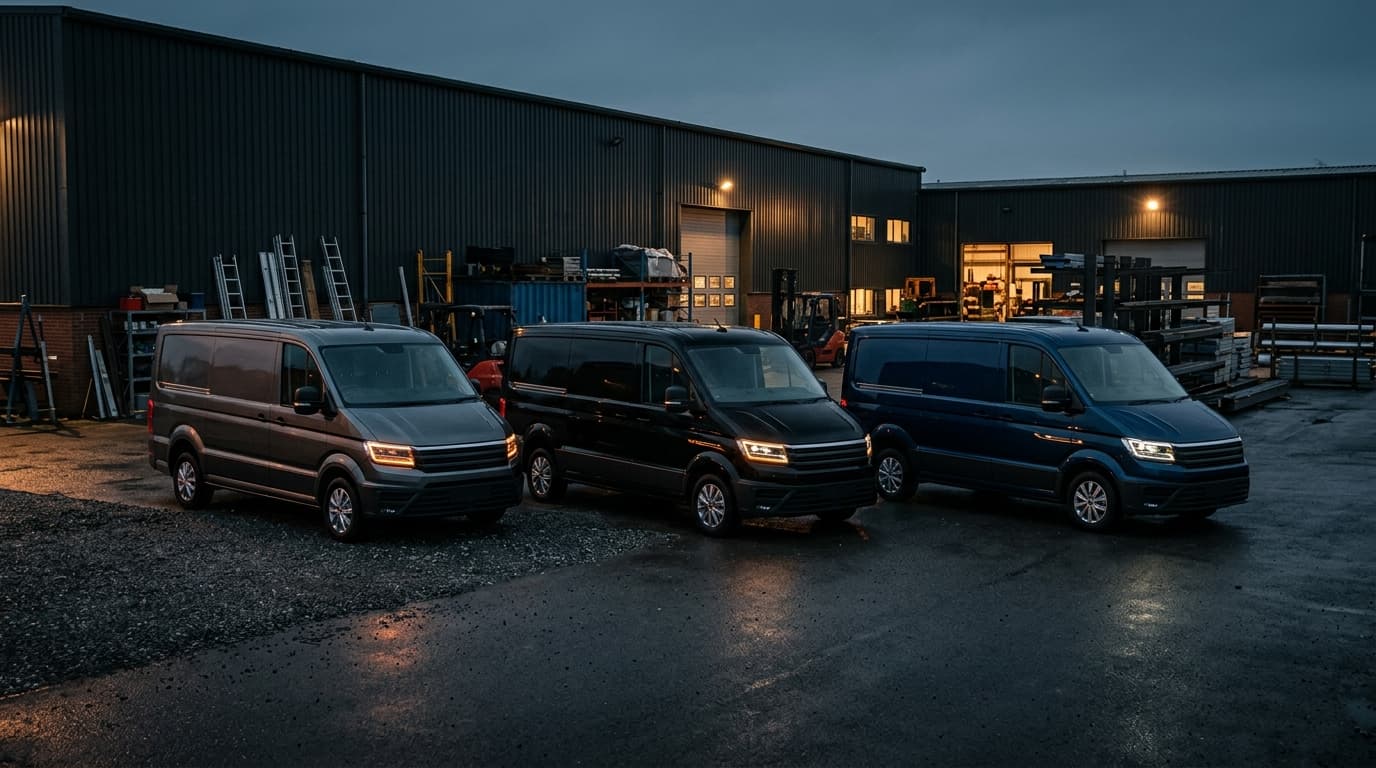
In Belgium, the medium van is the segment that keeps job sites running: compact enough for the city, big enough for pallets. Three families share the market — the Renault Trafic, the Ford Transit Custom and VW Transporter duo, and the Stellantis quintet. We compared them on what matters: payload, volume, ex-VAT price and taxation.
Which medium van to choose in Belgium, in short?
For the safe bet, take the Renault Trafic: good price-comfort ratio, a polished driving position and a dense network. To load the most for the least, look at the Stellantis quintet (Peugeot Expert, Citroën Jumpy, Opel Vivaro, Toyota Proace, Fiat Scudo), the most affordable and the strongest on payload. For the most modern, the Ford Transit Custom and its twin VW Transporter.
The segment's eight models boil down to three platforms. The Trafic plays alone. The Transit Custom and the Transporter T7 are near-identical since the Ford-Volkswagen alliance. And the five Stellantis vans are one van under five badges. The Mercedes Vito, for its part, aims higher on range and price.
On a real job site, the choice comes down less to the badge than to three numbers: what you load (weight), what you carry (length, pallets) and what you recover on VAT. Everything else — screen, wheels, finish — comes after.
What exactly is a medium van?
A medium van is a commercial vehicle 4.60 to 5.40 m long, offering 5.8 to 9 m³ of load volume and up to 1.4 tonnes of payload. It sits between the city van such as the Berlingo or Kangoo and the large van such as the Master or Sprinter. It is the heart of the Belgian market.
In practice, this size swallows two to three euro pallets depending on length, still fits a low underground car park (H1 versions often clear under 1.90 m), and stays nimble in town. It is the compromise that covers the most trades: a fully kitted electrician, a furniture delivery driver, a multi-technical services firm.
The number that matters: the floor loading length. A Trafic L1 loads a little over 2.50 m under the bulkhead; in L2, you pass three metres. If you carry pipes, skirting or boards, that figure decides, not the headline total volume.
Which medium van loads the most (volume and payload)?
On raw payload, the Stellantis quintet leads, with up to around 1,400 kg in reinforced form. The Ford Transit Custom follows near 1,350 kg, the Renault Trafic around 1,220 kg in its higher-payload variant, and the Mercedes Vito tops out near 1,125 kg. On volume, Trafic and Transit Custom climb the highest, up to 8.9 and 9 m³ in their large versions.
The Stellantis group comes in three lengths (4.60 m, 4.95 m and 5.30 m) for 4.6, 5.3 and 6.1 m³ of load volume. Its strength is the mix of compact size and high payload: a short Expert or Vivaro carries heavy without growing longer. The Trafic offers two lengths and two heights, from 5.8 to 8.9 m³, with a load-through hatch under the bench that slides long loads through.
The Transit Custom and the Transporter aim at the top end on volume (up to 9 m³) and payload (1,350 kg), with a wheel-arch width designed for a pallet crosswise. The Vito, more focused on finish and ride comfort, trades a little load volume for life on board.
| Model | Lengths | Load volume | Max payload | Positioning |
|---|---|---|---|---|
| Renault Trafic | 2 lengths / 2 heights | 5.8–8.9 m³ | ~1,220 kg | Safe bet, comfort |
| Ford Transit Custom | 2 lengths | 5.8–9.0 m³ | ~1,350 kg | The most modern |
| VW Transporter (T7) | 2 lengths | up to ~9 m³ | ~1,330 kg | Twin of the Custom |
| Stellantis quintet | 4.60 / 4.95 / 5.30 m | 4.6–6.1 m³ | ~1,400 kg | Strongest loader, affordable |
| Mercedes Vito | 3 lengths | up to 6.6 m³ | ~1,125 kg | Premium |
What we would avoid: trusting the catalogue volume alone. A van rated at 6 m³ but limited to 900 kg of payload will quickly be overloaded if you carry tiles or metal. Measure the weight of your typical load first, the volume second.
How much does a new medium van cost in Belgium?
Count from around €25,000 ex-VAT for the entry-level Stellantis quintet, about €29,310 ex-VAT for a Renault Trafic L1H1 Blue dCi 110 on the list, and up to more than €37,000 ex-VAT for a well-equipped Trafic L2H1 dCi 150. The diesel Transit Custom sits in the same bracket as the Trafic. The Mercedes Vito starts clearly higher.
These list prices do not tell the whole story. On the Belgian market, end-of-quarter pro deals often shave €2,000 to €4,000 ex-VAT, and the same van equally equipped can end up several hundred euros apart between brands. The Stellantis quintet keeps the price edge at entry; Renault and Ford catch up through aggressive discounts and a dense network.
A piece of field advice: have the van quoted as you will actually use it — full bulkhead, third seat, air conditioning, driver aids — not the headline figure. That is where, more than on the spec sheet, €3,000 is won or lost.
Which medium van for a tradesperson or an SME?
For a sole tradesperson juggling city and short trips, the short Stellantis quintet (Expert or Vivaro 4.60 m) ticks the boxes: compact, loading, affordable. For an SME thinking TCO and availability, the Trafic and Transit Custom reassure on network and residual value. The Vito is for whoever drives a lot and wants car-like comfort.
The fleet manager does not read the same table as the tradesperson. They calculate the cost per kilometre over four years: fuel or charging, maintenance, downtime, resale value. On that ground, the Trafic and the Stellantis group hold the line thanks to a dense after-sales network and common parts. The Transit Custom, newer in its generation, plays modern reliability and driver aids.
On a real job site, a tradesperson values easy side loading and door width; a fleet manager values the maintenance contract and the replacement lead time. Define your priority before walking into the dealership: it shapes the choice more than the grille design. If you hesitate with the step below, our Berlingo or Kangoo comparison covers city vans; for the step above, see the best large van in Belgium.
Do you need an electric medium van in 2026?
If you mostly drive in town, yes. Electric first settles a question of access, not image. Since 1 January 2026, Euro 5 diesel is banned from the Brussels LEZ, with fines starting on 1 July 2026 (€350 a year for the affected vehicles). Antwerp and Ghent postponed their tightening, but the trajectory is set.
The electric line-up is wide in this segment: Ford e-Transit Custom, Renault Trafic E-Tech, and the Stellantis quintet in e-Expert, ë-Jumpy, Vivaro-e, Proace Electric and e-Scudo forms. Ranges sit around 200 to 350 km WLTP depending on the battery, meaning 70 to 80% in real loaded use, and less in winter. For an urban tradesperson covering 80 to 150 km a day and charging at the depot overnight, that is enough.
The maths change for whoever strings together long motorway rounds: diesel often stays more rational on time and cost, unless you have well-placed fast charging. What we would avoid: switching to electric "on principle" without mapping your real trips. A poorly sized electric van that spends its time charging costs more than a well-born diesel. To dig deeper, see our guide to the best electric van in Belgium.
How much VAT can you recover on a medium van?
This is the argument that weighs the most, and it applies to every model in the segment. A van homologated as a utility vehicle and used 100% for business lets you recover 100% of the VAT. For mixed use, the Belgian administration applies a flat rate: 85% if use is mainly professional, 35% if mainly private.
Better still: unlike company cars, light commercial vehicles escape the 2026 tax reform. Trafic, Transit Custom, Vivaro or Vito stay 100% deductible for income tax for professional use, whether diesel or electric. Running costs — fuel or charging, maintenance, insurance, leasing — follow the same deduction logic.
On a €30,000 ex-VAT medium van, moving from 85% to 100% of VAT recovery is nearly €950 that stays in the cash flow. That is often more than the price gap between two trim levels: before choosing the model, settle your real private-use share.
Which medium van resells and holds up best?
In use, the Trafic and the Stellantis group post the most solid feedback on the Belgian market, a big supplier of used ex-fleet vans. Their diesel mechanicals are proven, the parts common and the network dense. The recent-generation Transit Custom plays modern reliability; the Vito banks on premium robustness, at a higher entry ticket.
At resale, these vans depreciate comparably at equal mileage and condition. What really makes the difference on the value is the service history and the body condition, not the logo: a serviced Trafic resells better than a battered Vito, and vice versa. Diesel versions stay the most liquid at resale today, used electric still being a young market.
What we would avoid: picking the weakest engine "to save money". An undersized block hauling a permanently full van wears faster, drinks as much and resells worse than a well-born mid-range version. On a van, the middle ground of power is almost always the best buy. To place these vans across the whole market, see our guide to vans in Belgium and the comparator; not sure of your segment? A short quiz points you in the right direction in two minutes.
Our verdict
The medium van is the most contested segment of the Belgian market, and that is a good thing: competition drives prices and pro deals down. The Trafic wins on peace of mind and network, the Stellantis group on load-to-price, the Transit Custom and the Transporter on modernity, the Vito on standing. Measure your real payload first, set your budget in ex-VAT, check the recoverable VAT — and let the current offer decide between two models that are level.
Sources: FEBIAC (light commercial vehicle registrations 2025, +7.6%); Renault Belgium and Ford Belgium (pro ex-VAT prices and specs, June 2026); Moniteur Automobile and AutoScout24 (Belgian versions and prices); Stellantis (Peugeot Expert, Citroën Jumpy, Opel Vivaro, Toyota Proace, Fiat Scudo — volumes and payloads); Mercedes-Benz Belgium (Vito); Brussels Environment and Test-Achats (LEZ 2026); SPF Finances (VAT and deductibility of light commercial vehicles).
Fourgons moyens comparator
Compare all fourgons moyens side by side.
Compare now →
Frequently asked questions

Damien, 44 ans, a géré pendant douze ans la flotte d'utilitaires d'une PME de second œuvre dans la région de Namur : achats, entretien, revente, et les galères de carrosserie qui vont avec. Il a vu passer des dizaines de Trafic, Transporter et Master, et il sait ce qui casse, ce qui se revend bien et ce qui coûte cher à l'usage. Il a lancé ce site pour comparer les utilitaires sur ce qui compte vraiment en Belgique : charge utile réelle, volume utile, TVA récupérable et coût au kilomètre — pas la brochure du concessionnaire.