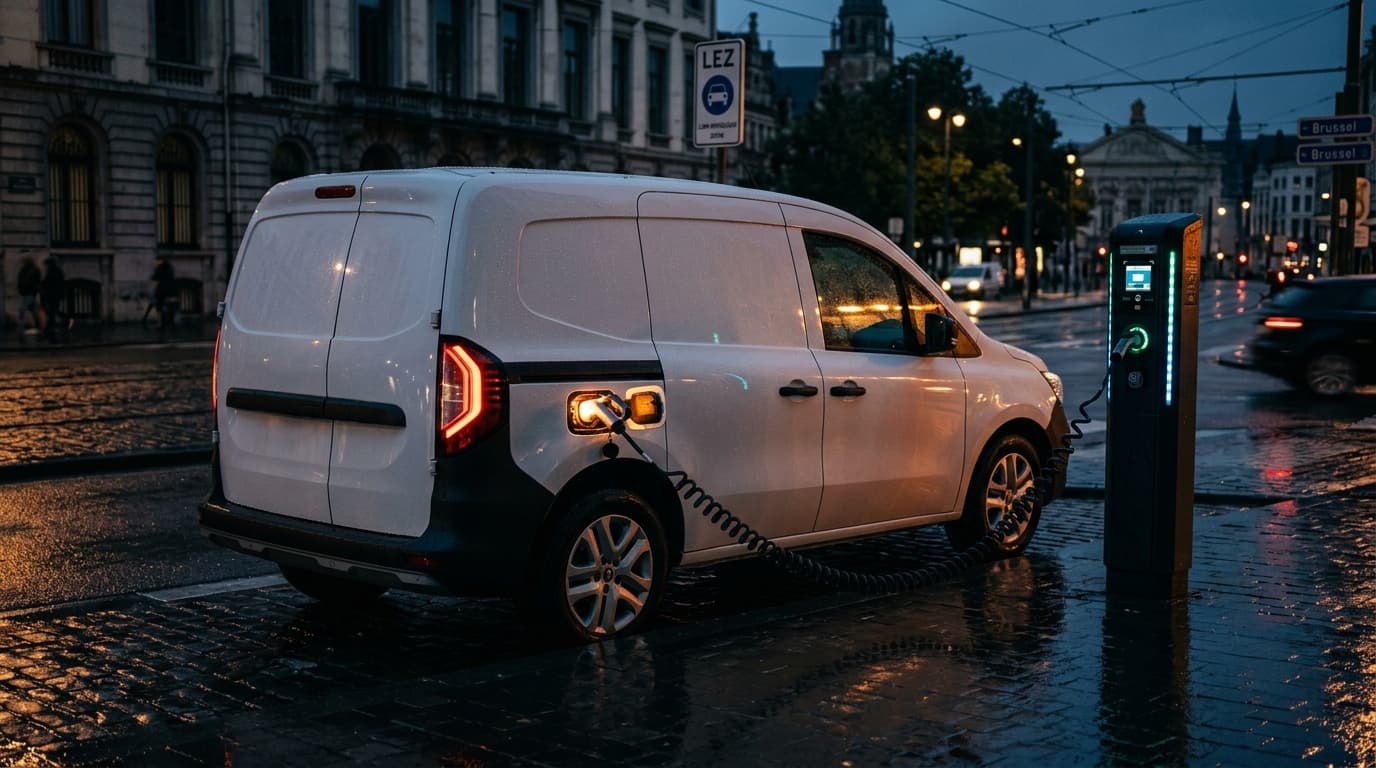
The best electric van is the one that completes your rounds without range anxiety and clears low-emission zones without a fine. In Belgium the range runs from the small city van to the large delivery van. We sorted it by use, real range and cost, with Belgian numbers to back it up.
Which electric van should you choose for your use?
The choice comes down to two numbers and one habit: payload (kg), load volume (m³), and your daily mileage. Electric does not change the rule, it just adds the charging question.
An urban tradesperson — electrician, plumber — doing 80 to 120 km a day and returning to the depot at night does fine with a compact city van: Renault Kangoo E-Tech, Citroën ë-Berlingo, Peugeot e-Partner. An SME running dense city rounds aims for a mid-size electric van (Ford E-Transit Custom, Opel Vivaro-e). For volume — parcels, furniture — you need a large van (Ford E-Transit, Renault Master E-Tech), accepting a range that drops when you load up.
On a real job site, electric pays off first where diesel struggles: constant stop-start, town, access to regulated centres. On long, loaded motorway runs, the case is weaker.
Which are the best electric vans in Belgium?
There is no single winning model, but a good model per segment. Here are the references available at Belgian dealers, sorted by size, with WLTP range brackets — to be weighed against real-world use.
| Segment | Electric models | WLTP range | Load volume | Payload |
|---|---|---|---|---|
| City van (ludospace) | Kangoo E-Tech, ë-Berlingo, e-Partner, Combo-e | ~285–330 km | 3.3–4.4 m³ | 600–800 kg |
| Compact all-rounder | VW ID. Buzz Cargo | ~400 km | ~3.9 m³ | ~650 kg |
| Mid-size van | E-Transit Custom, ë-Jumpy, Vivaro-e, eVito | ~280–350 km | 5.3–6.8 m³ | 900–1,100 kg |
| Large van | E-Transit, Master E-Tech, eSprinter, E-Ducato | ~300–460 km | 10–15 m³ | 1,000–1,600 kg |
In the compact segment, the Renault Kangoo E-Tech and Citroën ë-Berlingo are neck and neck: similar volumes, around 285 to 330 km WLTP, and a decent payload for tools. The Volkswagen ID. Buzz Cargo plays a different card, with a more generous range but a contained payload and a higher purchase price. In the mid-size class, the Ford E-Transit Custom and the Stellantis quartet (ë-Jumpy, e-Expert, Vivaro-e, Proace) cover most of a city delivery fleet's needs.
The number that matters: the battery cuts payload by 100 to 250 kg compared with the equivalent diesel. For a heavy-loading trade, check the homologated payload, not the volume.
What real range to expect from an electric van?
Count on 70 to 80% of the WLTP range in professional use, and 60 to 70% in winter. A van rated at 330 km therefore holds 230 to 260 km in decent conditions, and drops toward 200 km in hard cold with the heating on.
Three factors weigh in Belgium: the cold, which trims the battery; the load, which pushes up consumption; and the motorway, where electric uses more than in town. It is the opposite of diesel, and that is what makes electric relevant for urban rounds rather than long Liège–Ostend runs loaded to the brim.
For a realistic view, look at your worst day, not your average one. If you do 150 km one day in ten and 90 km the rest of the time, it is the 150 km day, in January, that decides. What we would avoid: picking the smallest battery "because the average fits". The average never breaks down; the worst day does.
Does an electric van clear low-emission zones?
Yes, everywhere, with no restriction or expiry date. Electric vehicles are exempt from Belgian low-emission zones — their most concrete asset in urban centres.
In Brussels the tightening is real: since 1 January 2026, Euro 5 diesel is banned from the LEZ, and fines for the affected light commercial vehicles start on 1 July 2026, at €350 per year. An ageing diesel van becomes a budget risk; an electric van removes the question. On the Flemish side, Antwerp and Ghent postponed their tightening: Euro 5 diesel is still tolerated there in 2026. The rule moves fast, but the direction is clear — each step strengthens electric in town.
On the Belgian market, it is often this factor, more than fuel, that triggers the switch to electric among Brussels tradespeople.
How much does an electric van cost, and what incentives in Belgium?
Expect roughly €35,000 to €45,000 ex-VAT for a well-equipped new mid-size electric van, clearly more than an equivalent diesel. The gap closes in use — charging, lower maintenance — but the upfront investment stays heavier.
On incentives, the Belgian landscape has dried up. The general Flemish premium for buying an electric vehicle has not been available since the end of 2024. Brussels keeps a targeted support for electric vans for companies through Brussels Economy and Employment. Wallonia offers no purchase premium, but, as in Brussels, an electric vehicle's road tax is capped at around €100 per year. On top of that, in Flanders, a one-off €61.50 charge applies on registering an electric vehicle since 1 January 2026.
The real lever stays fiscal and identical to diesel: a van used for business recovers 100% of the VAT and remains 100% deductible for income tax. Unlike company cars, light commercial vehicles escape the 2026 reform — whether electric, diesel or hybrid. Electric does not buy an extra tax advantage; it buys city access and a lower cost per kilometre.
Electric or diesel: which is cost-effective for a pro?
For short urban rounds with depot charging, electric wins on running cost within two to four years. For long, loaded motorway distances, diesel often remains the safer call today.
The honest reasoning goes through total cost of ownership (TCO), not the sticker price: purchase, energy, maintenance, taxation, insurance and residual value. Electric starts with a handicap at purchase, catches up on energy and maintenance, then keeps an unknown at the exit. At resale, the used market for electric vans is still thin in Belgium: depreciation is hard to predict, whereas a recent Euro 6 diesel resells easily. A fleet that keeps its vehicles six years absorbs this bet better than a self-employed person reselling at three years.
Our verdict
There is no universal "best electric van": there is the best one for your mileage, your load and your city. In a regulated urban zone, electric becomes hard to ignore — especially in Brussels since 2026. For dense rounds, aim for a compact (Kangoo E-Tech, ë-Berlingo) or a mid-size (E-Transit Custom, Vivaro-e); for volume, a large van (E-Transit, Master E-Tech), accepting the range that follows.
Before deciding, compare on what matters: our van comparator and the general guide to vans in Belgium. Not sure of your segment? A short quiz points you in the right direction.
Sources: FEBIAC (2025 registrations); City of Brussels and Test-Achats (low-emission zones 2026); FLEET and Cardoen (Flemish premium); Brussels Economy and Employment (electric van premium); SPW Finances (electric-vehicle taxation); AutoScout24 and Moniteur Automobile (models and ranges).
Utilitaires électriques comparator
Compare all utilitaires électriques side by side.
Compare now →
Frequently asked questions

Damien, 44 ans, a géré pendant douze ans la flotte d'utilitaires d'une PME de second œuvre dans la région de Namur : achats, entretien, revente, et les galères de carrosserie qui vont avec. Il a vu passer des dizaines de Trafic, Transporter et Master, et il sait ce qui casse, ce qui se revend bien et ce qui coûte cher à l'usage. Il a lancé ce site pour comparer les utilitaires sur ce qui compte vraiment en Belgique : charge utile réelle, volume utile, TVA récupérable et coût au kilomètre — pas la brochure du concessionnaire.