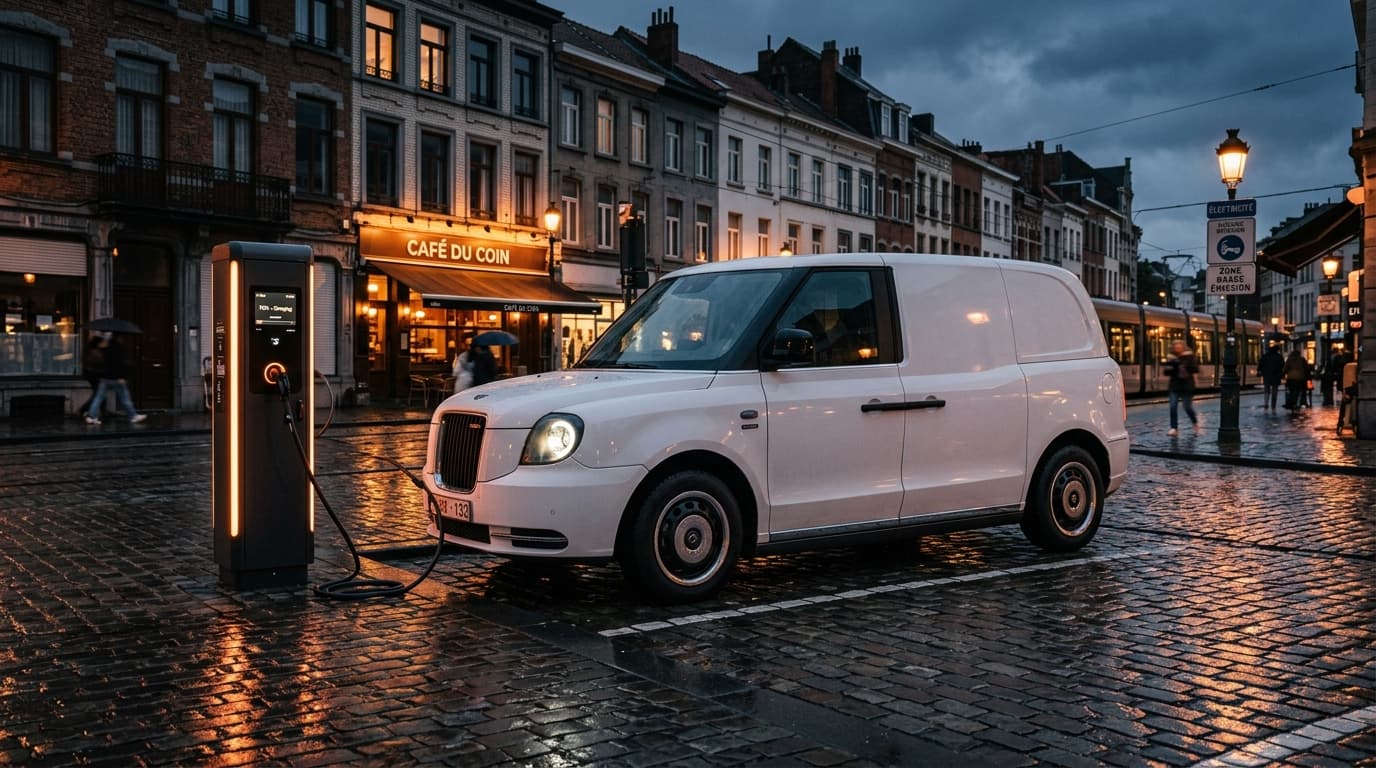
The best mid-size electric van in Belgium depends on your rounds and your budget, not the badge. For dense urban delivery, the Ford e-Transit Custom and its cousin the VW e-Transporter lead on range and payload; the Stellantis trio undercuts on price. Here is how they sort out.
Mid-size electric van: which one for an urban fleet, in short?
Look first at your daily mileage and the load you carry. For a delivery fleet running dense city rounds with overnight depot charging, the Ford e-Transit Custom is the safest bet today: 71 kWh battery since 2026, up to ~380 km WLTP, near-diesel payload and fast charging. Its twin, the VW e-Transporter, targets the same buyer, with a higher claimed payload.
If budget rules, the Stellantis trio (Opel Vivaro Electric, Peugeot e-Expert, Citroën ë-Jumpy) remains the best value for money, with a 75 kWh battery for around 350 km WLTP. The Renault Trafic E-Tech is at the end of its run before a genuine new generation in 2027, and the Mercedes eVito plays the premium card on its own.
The mid-size van is the heart of the Belgian market: 5 to 6.8 m³ of load volume, around a tonne of payload. In electric form it aims at the urban round, not the long, fully loaded motorway leg.
What real range to expect from a mid-size electric van?
Count on 70 to 80% of the WLTP range in professional use, and 60 to 70% in winter. A van rated at 350 km WLTP therefore holds 240 to 280 km in summer, and drops toward 210 km in hard cold, heating and load included.
Three factors weigh in Belgium: the cold, which trims the battery; the load, which pushes up consumption; and the motorway, where electric uses more than in town. It is the exact opposite of diesel, which is why these vans shine on stop-start urban rounds rather than a loaded Liège–Ostend run.
What we would avoid: picking the smallest battery because the average day fits. The average never breaks down. It is your worst day — 160 km on a January Monday, loaded — that decides the battery you need. Look at that day, not the average.
Ford e-Transit Custom or VW e-Transporter: what's the difference?
Under the metal, almost none. The new Transporter and its electric version are built by Ford Pro on the Transit Custom base, under the Ford-Volkswagen alliance. Platform, battery and motor are shared; what changes is the bodywork, the trim and the price.
The Ford e-Transit Custom pulled ahead in 2026: its usable battery grows from 64 to 71 kWh, range climbs to about 380 km WLTP, and fast charging gains ten minutes — 10 to 80% in 29 minutes instead of 39, on a 125 kW DC charger. For a fleet that sometimes charges mid-day between two rounds, that quarter-hour counts as much as extra range. The Ford adds a 2,000 kg towing capacity, rare on an electric van.
The VW e-Transporter plays the payload card — up to ~1,270 kg claimed, above the Ford — and a load volume that reaches 9 m³ in the long version, with a heat pump as standard. In practice, the choice comes down to price and to your after-sales network: the Ford is cheaper to get into and its Ford Pro ecosystem (telematics, charge planning) is built for fleets. On the Belgian market, if you already have a trusted Ford or VW workshop near the depot, keep it: on two near-identical vans, the service network makes the difference over five years.
Is the Stellantis Vivaro Electric / e-Expert worth it?
Yes, as soon as price matters more than the last kilometre of range. The five Stellantis cousins — Opel Vivaro Electric, Peugeot e-Expert, Citroën ë-Jumpy, Fiat E-Scudo and Toyota Proace Electric — share the same base and get in clearly cheaper than the Ford-VW duo.
With the big 75 kWh battery, they claim up to ~350 km WLTP and a payload up to about 1,000 to 1,250 kg depending on version and length (M, 5.3 m³, or L, 6.6 m³ with the Smart Cargo hatch). DC charging tops out at 100 kW, a notch below the Ford, but enough for a round top-up. A 50 kWh version exists for ~230 km: keep it for genuinely short rounds.
The number that matters: at comparable spec, the 75 kWh Stellantis often sits several thousand euros below the Ford e-Transit Custom in a pro deal. For a fleet doing 100 to 130 km a day in town, the range gap never shows on the ground, but the price gap does. The Toyota Proace Electric adds the Toyota Relax warranty (up to 10 years in-network), an argument for those who keep vehicles long.
Should you wait for the new 2027 Renault Trafic E-Tech?
If you can, yes — the current Trafic E-Tech is dated. Its 52 kWh battery gives only about 300 km WLTP, or 210 to 240 km real, and its fast charging tops out at 50 kW, half the Ford. For short urban rounds it does the job; for everything else, it shows its age.
The real shift comes with the new generation, unveiled at the Solutrans show in November 2025: 800 V architecture, two batteries (60 kWh LFP for ~350 km, 81 kWh for ~450 km WLTP) and much faster charging. Production announced for late 2026, first deliveries early 2027.
Bottom line: if your renewal can wait six to twelve months, the new Trafic will become a serious candidate again against the Ford and the Stellantis. If you must order now, look elsewhere — no point paying new-price for an electric van at the end of its technical cycle. In the meantime, compare the drivetrains in our electric or diesel for a fleet comparison.
Mercedes eVito: who is the premium electric for?
For the fleet that wants comfort, range and image, and accepts paying for it. The Mercedes eVito panel van now moves to a usable 90 kWh battery, pushing range to nearly 475 km in the WLTP urban cycle (around 360 km combined) — by far the best reach in the segment.
In return, it is the most expensive van in this comparison, with an entry price well above the others. Its payload stays average (about 990 to 1,015 kg in long and extra-long versions) and its load volume runs from 6.0 to 6.6 m³. The eVito targets a specific customer: premium courier, parcel-taxi, service company that drives a lot in town and for whom range and the badge justify the premium.
At resale, a Mercedes generally holds its value better than a mainstream brand, which recovers part of the higher purchase price over a long fleet cycle. For a self-employed driver reselling at three years, the maths is tighter.
Comparison table of mid-size electric vans in Belgium
Here is how the main mid-size electric vans available at Belgian dealers stack up in summer 2026. Prices are ex-VAT ballparks, excluding current pro offers and options.
| Model | Usable battery | WLTP range | Max payload | DC charging | Entry price (BE, ex-VAT) |
|---|---|---|---|---|---|
| Ford e-Transit Custom | 71 kWh | up to ~380 km | ~1,100 kg | 125 kW (10–80% in 29 min) | from ~€44,000 |
| VW e-Transporter | 64 kWh | ~330 km | up to ~1,270 kg | 135 kW | from ~€48,000 |
| Opel Vivaro / Peugeot e-Expert / ë-Jumpy | 75 kWh | ~350 km | ~1,000–1,250 kg | 100 kW | from ~€40,000 |
| Renault Trafic E-Tech (current gen) | 52 kWh | ~300 km | ~1,100 kg | 50 kW | from ~€38,000 |
| Mercedes eVito | 90 kWh | ~360 km (combined) | ~1,015 kg | ~110 kW | from ~€58,000 |
These figures move fast: homologated ranges, battery capacities and prices change from one model year to the next. Check the exact spec of the version you want before signing, especially the payload of the chosen drivetrain.
How much does a mid-size electric van cost, and what VAT to recover?
Expect roughly €40,000 to €50,000 ex-VAT for a well-equipped new mid-size electric van, clearly more than an equivalent diesel. The gap closes in use — depot charging, lower maintenance — but the upfront investment stays heavier, and it is often what blocks the deal.
On tax, the rule is identical to diesel and works in your favour: a van used 100% for business recovers 100% of the VAT and stays 100% deductible for income tax. For mixed use, the Belgian tax authority applies a flat rate of 85% or 35% depending on private use. Above all, unlike company cars, light commercial vehicles escape the 2026 tax reform — electric as well as combustion.
Can a mid-size electric van clear the Brussels LEZ?
Yes, everywhere and with no expiry date. Electric vehicles are exempt from Belgian low-emission zones — the most concrete argument for a fleet delivering in the city centre.
And the stakes are immediate in Brussels. Since 1 January 2026, Euro 5 diesel has been banned from the LEZ, and fines for the affected light commercial vehicles start on 1 July 2026, at €350 per year. Antwerp and Ghent postponed their tightening, but the direction is the same everywhere. An ageing diesel van becomes a budget risk; an electric van removes the question.
It is often this factor, more than fuel cost, that triggers the switch to electric in Brussels fleets. In 2025, Belgium registered 70,797 light commercial vehicles (+7.6% year on year, FEBIAC), but electric still accounts for less than 5% of the fleet: the room to switch is huge, and the LEZs are speeding it up.
Our verdict
There is no best mid-size electric van in the absolute, but a good choice per fleet profile. The Ford e-Transit Custom is the safest bet in 2026: range, fast charging and a fleet ecosystem. Its twin the VW e-Transporter follows closely, with more payload but a higher price. The Stellantis trio remains the most rational call when price rules. The Mercedes eVito targets the premium, and the Renault Trafic is worth waiting for its 2027 new generation.
Before deciding, compare on what matters: the guide to electric vans in Belgium maps every segment, the electric category of the comparator puts the models side by side, and the mid-size van comparison includes the diesel versions. Not sure of your segment? A short quiz points you in the right direction.
Sources: FEBIAC (light-commercial-vehicle registrations 2025, +7.6%); Brussels Environment and Test-Achats (Brussels LEZ 2026); Ford Belgium and Transportmedia (e-Transit Custom 71 kWh, 29-min charge, December 2025); Automobile-Propre and Volkswagen (e-Transporter, range and payload); Peugeot, Opel and Citroën Belgium (Stellantis e-Expert / Vivaro Electric 75 kWh); L'Argus (new Renault Trafic E-Tech, Solutrans 2025); Mercedes-Benz Vans (eVito 90 kWh); Belgian Federal Public Service Finance (VAT and deductibility of light commercial vehicles). Figures gathered in summer 2026, subject to change by model year.
Utilitaires électriques comparator
Compare all utilitaires électriques side by side.
Compare now →
Frequently asked questions

Damien, 44 ans, a géré pendant douze ans la flotte d'utilitaires d'une PME de second œuvre dans la région de Namur : achats, entretien, revente, et les galères de carrosserie qui vont avec. Il a vu passer des dizaines de Trafic, Transporter et Master, et il sait ce qui casse, ce qui se revend bien et ce qui coûte cher à l'usage. Il a lancé ce site pour comparer les utilitaires sur ce qui compte vraiment en Belgique : charge utile réelle, volume utile, TVA récupérable et coût au kilomètre — pas la brochure du concessionnaire.