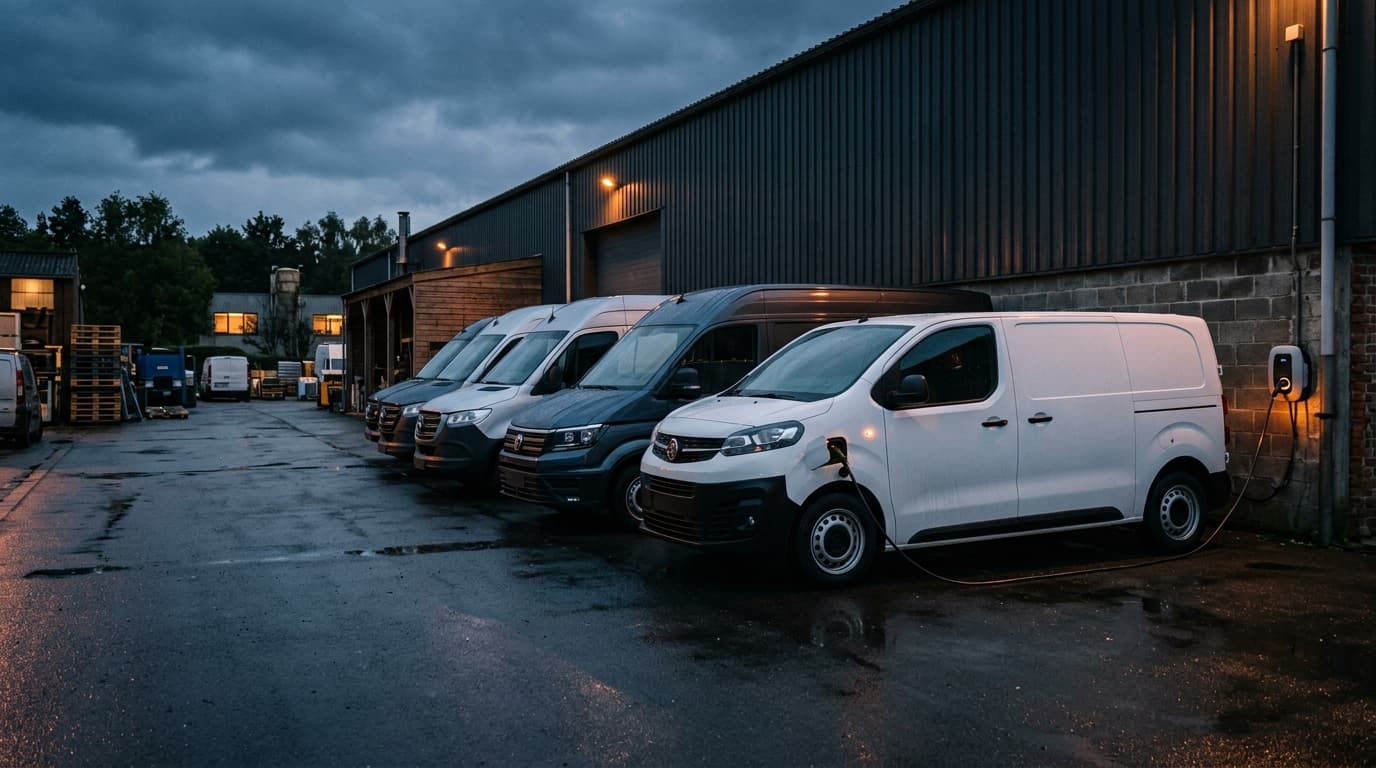
For a fleet that mostly drives in town and charges at the depot, the electric van already wins on running cost. For high-mileage motorway use, diesel often stays more rational. The arbitrage comes down to three numbers — annual mileage, low-emission-zone access, charging — not taxation, unlike company cars.
Electric or diesel for a fleet, in short?
If your vehicles cover more than 25,000 to 30,000 km a year and return to the depot every evening, switch to electric: energy and maintenance repay the purchase premium over four years. If your crews string together long motorway rounds with no reliable charging en route, keep diesel for those duties.
The debate is no longer ideological, it is accounting. A fleet manager does not pick a drivetrain, they pick a cost per kilometre over the contract. And that cost depends first on your driving profile, not on the badge or the brochure.
The number that matters: the annual mileage per vehicle. Below 20,000 km, the electric premium repays poorly; above 30,000 km with depot charging, diesel has no economic argument left. Between the two, you work it out duty by duty.
At what mileage does electric pay off?
The tipping point sits around 25,000 to 30,000 km a year, depot charging included. That is the threshold where the energy and maintenance savings end up covering the purchase premium over a four-year cycle.
The reasoning rests on two items. Energy first: on depot or home charging, an electric van costs €4 to €7 per 100 km, against €9 to €12 for an equivalent diesel. Maintenance next: no clutch, no belt, no oil change, brakes that wear less thanks to regeneration. Count €120 to €800 a year on an electric van, against €500 to €1,500 on a combustion one. Across a fleet, those gaps multiply by the number of vehicles and the years.
Arval's 2026 TCO study quantifies the shift: the average total cost of ownership of an electric van falls to around €29,084, while an equivalent diesel climbs to €31,888. The gap looks slim, but it has reversed in a few years — and it widens with mileage.
What we would avoid: applying that threshold without mapping the real trips. An electric van that spends its days hunting for a fast charger loses all its cost advantage and drags down availability. The maths only hold if charging is controlled, ideally at the depot overnight.
How much more does an electric van cost than a diesel?
At purchase, count €8,000 to €15,000 ex-VAT more for the electric version of the same van, depending on the segment and battery size. That is the number-one brake at entry, the one that makes many SMEs step back at signing.
That gap narrows two ways. Through use first: over four years and a good mileage, energy and maintenance recover a large part of the premium. Through incentives next, where they exist — regional grants, favourable leasing terms, negotiated fleet charging rates. On the Belgian market, manufacturers push aggressive pro offers on their electric versions to kick-start the switch.
On models, the line-up now covers the whole market. On the medium van, the Ford e-Transit Custom and the Renault Trafic E-Tech take on the Stellantis group (Peugeot e-Expert, Citroën ë-Jumpy, Opel Vivaro-e, Toyota Proace Electric), with the Mercedes eVito on the premium slot. On the large van, the Renault Master E-Tech, the Ford E-Transit and the Mercedes eSprinter take over. Ranges sit around 200 to 350 km WLTP, meaning 70 to 80% in real loaded use, and clearly less in deep cold.
On the Belgian market, 70,797 light commercial vehicles were registered in 2025, up 7.6% (FEBIAC). The electric share is climbing fast on this segment, driven by urban fleets and the pressure of low-emission zones.
Does the 2026 tax reform penalise the diesel van?
No, and it is the most widespread misunderstanding. The Belgian tax reform tightening the rules since 1 January 2026 targets combustion company cars, whose diesel ordered after that date is no longer deductible. It does not touch category N1 light commercial vehicles.
A van homologated as a utility vehicle stays 100% income-tax deductible for professional use, whether diesel or electric, even bought after 2026. Its VAT stays 100% recoverable for exclusively professional use, with the usual 85% or 35% flat rate for mixed use. Fuel or charging, maintenance, insurance and leasing follow the same deduction logic.
The direct consequence for a fleet manager: on a van fleet, the tax argument does not settle the electric-versus-diesel debate, unlike what happens on a company-car fleet. Both drivetrains start level on tax. The decision is made elsewhere — on energy, maintenance, and above all access to cities.
Does electric cost payload?
Yes, it is the real technical price of the battery. At equal size, an electric van usually loses 300 to 400 kg of payload against its diesel equivalent: the pack is heavy and eats into the margin between kerb weight and maximum authorised weight.
For a trade carrying tiles, metal or dense materials, that loss can be a deal-breaker. For a courier or an installer carrying volume rather than weight, it goes almost unnoticed. It is one of the first things to check before ordering: weigh your typical load, not just its volume.
Regulation has provided a fix. A B licence now allows driving an electric van up to 4.25 tonnes gross weight, against 3.5 tonnes for combustion, precisely to offset the battery weight without requiring a heavy-goods licence. In practice, that recovers a good part of the "lost" payload on the vans concerned.
On a real job site, a large electric van rated at 1 tonne of payload often matches a diesel thanks to that 4.25 t uplift. Just check your drivers fit the framework (licence seniority, any short training depending on the case).
| Item — fleet over 4 years / ~80,000 km | Diesel van | Electric van |
|---|---|---|
| Purchase price ex-VAT | reference | + €8,000 to €15,000 |
| Energy / 100 km | €9–12 | €4–7 (depot charging) |
| Maintenance / year | €500–1,500 | €120–800 |
| Deductibility (pro use) | 100% (N1 utility) | 100% |
| Recoverable VAT (pro use) | 100% | 100% |
| Payload | reference | −300 to −400 kg (4.25 t GVW, B licence) |
| Brussels LEZ access | Euro 5 banned, Euro 6 targeted by 2028 | full |
| Resale at 4 years | mature, liquid market | young, less predictable market |
Should you electrify the whole fleet at once?
Rarely. The switch that works is gradual: electrify the urban and suburban vehicles that return to the depot every evening first, and keep diesel on high-mileage or uncertain-charging duties. A mixed fleet absorbs the risk while the infrastructure catches up.
Two reasons for that caution. Charging first: electrifying ten vans without sizing the depot chargers creates a bottleneck at dawn when everyone leaves at once. Resale next: the used electric van market is still young in Belgium, so the four-year residual value is less predictable than on a diesel, whose ex-fleet examples sell easily.
City access, on the other hand, pushes the other way and speeds up the timetable. Since 1 January 2026, Euro 5 diesel is banned from the Brussels LEZ (cars and category N1 light commercial vehicles), with a tolerance period until 1 July 2026 and €350 fines, renewable every three months. The announced trajectory targets Euro 6 diesel around 2028, then all diesel around 2030. Antwerp and Ghent postponed some tightening, but the direction is not in doubt.
At resale, a Euro 5 diesel locked out of the city depreciates faster than an electric that clears every zone. For a fleet working in Brussels, betting on diesel over four or five years means buying a vehicle whose usable area will shrink each year. To compare electric models against each other, see our guide to the best electric van in Belgium; to place each segment, the guide to vans in Belgium compares city vans, medium vans and large vans. Not sure of the right call for your trade? The van comparator and a short quiz point you in the right direction in minutes.
Our verdict
The electric-or-diesel call on a van fleet is not settled at the dealer's counter, it is settled on a spreadsheet. Put down the real mileage of each duty, the energy cost given your charging mode, the low-emission-zone timetable across your working areas, and the payload you actually need. Taxation does not break the tie: the van stays deductible either way. At the end of the maths, most Belgian fleets that drive in town are better off electrifying their depot vehicles now and keeping a few diesels for long distances. All-diesel is becoming a bet on the past; all-electric at once, a bet on infrastructure. The right balance is between the two.
Sources: FEBIAC (light commercial vehicle registrations 2025, +7.6%); Brussels Environment and lez.brussels (LEZ 2026, Euro 5 diesel, category N1, fines and timetable); Arval Mobility Observatory (2026 TCO study, electric vs diesel vans); SPF Finances (deductibility and VAT of N1 light commercial vehicles); MyWay and NIBC (electric vs diesel energy and maintenance costs in Belgium); Ford, Renault, Stellantis and Mercedes-Benz Belgium (electric van ranges and autonomy, June 2026).
Utilitaires électriques comparator
Compare all utilitaires électriques side by side.
Compare now →
Frequently asked questions

Damien, 44 ans, a géré pendant douze ans la flotte d'utilitaires d'une PME de second œuvre dans la région de Namur : achats, entretien, revente, et les galères de carrosserie qui vont avec. Il a vu passer des dizaines de Trafic, Transporter et Master, et il sait ce qui casse, ce qui se revend bien et ce qui coûte cher à l'usage. Il a lancé ce site pour comparer les utilitaires sur ce qui compte vraiment en Belgique : charge utile réelle, volume utile, TVA récupérable et coût au kilomètre — pas la brochure du concessionnaire.