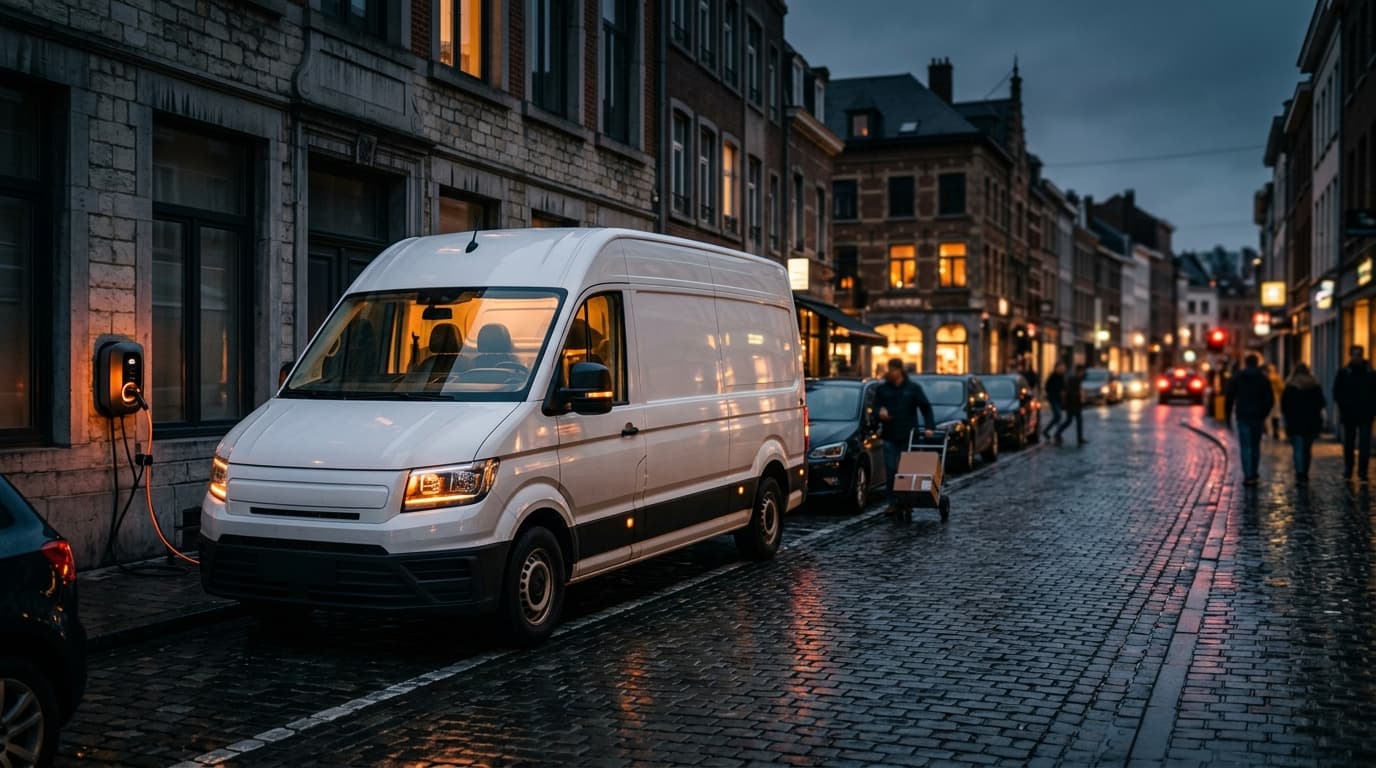
The best large electric van for delivery is the one that completes your day's round without a detour to a charger and clears regulated centres without a fine. In Belgium four families share the segment: Ford, Mercedes, Renault and the Stellantis quartet. We sorted them by volume, payload and real range, with Belgian numbers to back it up.
Which large electric van for delivery, in short?
The choice comes down to three numbers: load volume (m³), payload (kg) and your kilometres per round. For last-mile urban work, aim for range and manoeuvrability; for heavy parcels or furniture, payload comes first, even at the cost of kilometres.
A driver running dense city rounds — 120 to 180 km a day, back to the depot at night — does fine with any of today's large electric vans. A carrier loading heavy (materials, appliances) must first look at the homologated payload, because the battery eats 200 to 400 kg versus diesel. A wholesaler chaining long loaded runs stays, for now, on the edge.
On a real round, electric pays off first where diesel struggles: constant stop-start, town, access to low-emission zones. That is exactly the last-mile delivery profile.
Which are the best large electric vans in Belgium?
There is no single winner, but a good van depending on what you load and where you drive. Here are the references available at Belgian dealers, with WLTP brackets to weigh against real-world use.
| Model | Battery | WLTP range | Load volume | Max payload |
|---|---|---|---|---|
| Ford E-Transit | 68 kWh (89 kWh option) | ~300–320 km | up to 15.1 m³ | up to ~1,750 kg |
| Mercedes eSprinter | 56 to 113 kWh | up to 440 km | 9 to 14 m³ | ~900–1,200 kg |
| Renault Master E-Tech | 40 or 87 kWh | 200 to 460 km | up to ~14 m³ | up to 1,625 kg |
| Stellantis (E-Ducato, e-Boxer, ë-Jumper, Movano Electric) | up to 110 kWh | up to ~424 km | 10 to 17 m³ | up to ~1,400 kg |
| Maxus eDeliver 9 | 72 or 88 kWh | up to ~296 km | up to 12.5 m³ | ~1,200 kg |
The Renault Master E-Tech plays range and payload: 460 km WLTP claimed with the 87 kWh battery, up to 1,625 kg of load on a B licence, and a measured 21 kWh/100 km. The Mercedes eSprinter aims for premium and robustness, with its big 113 kWh battery and up to 14 m³. The Ford E-Transit remains the payload reference — up to ~1,750 kg — at the cost of a shorter range. The Stellantis quartet (Fiat E-Ducato, Peugeot e-Boxer, Citroën ë-Jumper, Opel Movano Electric) shares one base and covers the widest volume range, up to 17 m³. The Maxus eDeliver 9 plays the entry ticket, with a more modest range.
The number that matters: between the most enduring van (Master E-Tech, 460 km) and the shortest (E-Transit or eDeliver, ~300 km), the gap doubles over the same day. For a fixed round, range you never use is money spent for nothing.
What real range to expect on a round?
Count on 70 to 80% of the WLTP range in summer, and 60 to 70% in winter, load included. A van rated at 440 km therefore holds 300 to 350 km in decent conditions, and drops toward 260 km in hard cold with heating and a full body.
Three factors weigh in Belgium: the cold, which trims the battery; the load, which pushes up consumption; and the motorway, where electric uses more than in town. For delivery, that is good news: the urban round, made of starts and stops, is exactly where electric is most efficient, while diesel clogs up.
To size it, look at your worst day, not your average. If you do 200 km one day in ten and 130 km the rest of the time, it is the 200 km day, in January, that decides. What we would avoid: picking the smallest battery "because the average fits". The average never runs flat at the third stop; the worst day does.
What payload is left once the battery is aboard?
Less than on diesel: count on 200 to 400 kg less payload, the weight of the battery packs. On a heavy-loading trade, that is the first number to check, before volume and before range.
The Ford E-Transit fares best, with payload up to about 1,750 kg on some versions — enough to stay at diesel level. The Renault Master E-Tech follows with up to 1,625 kg on a B licence, a real argument to avoid the C licence. The Stellantis large vans sit around 1,400 kg, the eSprinter between 900 and 1,200 kg depending on body and battery. The bigger the battery, the more it eats payload: the eSprinter's 113 kWh version buys range, not tonnage.
On the Belgian market, a driver loading pallets must watch two limits: the homologated payload and the 3.5 t GVW that bounds the B licence. Going over the payload means driving overloaded, with insurance that may turn against you in a claim. Check the payload of the exact version, not the brochure's top figure.
Does a large electric van clear low-emission zones?
Yes, everywhere, with no restriction or expiry date. Electric vehicles are exempt from Belgian low-emission zones — their most concrete asset for anyone delivering in the city centre.
In Brussels the tightening is real: since 1 January 2026, Euro 5 diesel is banned from the LEZ, and fines for the affected light commercial vehicles start on 1 July 2026, at €350 per year. An ageing diesel delivery van becomes a budget risk; an electric van removes the question. On the Flemish side, Antwerp and Ghent postponed their tightening: Euro 5 diesel is still tolerated there in 2026. The rule moves fast, but the direction is clear — each step strengthens electric in town.
For a delivery fleet working across several cities, it is often this factor, more than fuel, that triggers the switch to electric. A van stopped at the edge of a city centre is a round to redo.
How much does a large electric van cost, and what incentives in Belgium?
Expect roughly €50,000 to €70,000 ex-VAT for a well-equipped new large electric van, clearly more than an equivalent diesel. The gap closes in use — depot charging, lower maintenance — but the upfront investment stays heavy for an SME.
On incentives, the Belgian landscape has dried up. The general Flemish purchase premium has not been available since the end of 2024. Brussels keeps a targeted support for electric vans for companies through Brussels Economy and Employment. Wallonia offers no purchase premium, but an electric vehicle's road tax is capped at around €100 per year, as in Brussels. In Flanders, a one-off €61.50 charge applies on registering an electric vehicle since 1 January 2026.
The real lever stays fiscal and identical to diesel: a van used for business recovers 100% of the VAT and remains 100% deductible for income tax. Unlike company cars, light commercial vehicles escape the 2026 reform — whether electric, diesel or hybrid. Electric does not buy an extra tax advantage; it buys city access and a lower cost per kilometre.
Depot or public charging: how to hold the round?
The model that works is overnight depot charging; the fast charger is only a backup. A large van comes in loaded in the morning, drives all day, and recharges quietly on an AC charger overnight, at the lowest rate.
DC fast charging exists and helps: the Renault Master E-Tech recovers 252 km in 30 minutes on a 130 kW charger, the eSprinter goes from 10 to 80% in about 42 minutes. But repeated, it is expensive and wears the battery. For a fleet, the real project is not the van, it is the depot's electrical installation: available power, number of charge points, load management to avoid the consumption peak.
What we would avoid: ordering the vans before costing the infrastructure. A fleet of five large vans charging at once is serious power to draw, sometimes a connection upgrade. The calculation is van and depot, never one without the other.
Our verdict
There is no universal "best large electric van": there is the best one for your mileage, your load and your cities. For range and payload, the Renault Master E-Tech leads; for pure payload, the Ford E-Transit; for volume, the Stellantis large vans; for premium, the Mercedes eSprinter. The Maxus eDeliver 9 keeps the price argument.
The switch to electric is justified first by the dense urban round and guaranteed access to low-emission zones, not by a tax miracle. Before deciding, compare on what matters: our electric van comparator and the guide to vans in Belgium to place the diesels. Not sure of your segment? A short guide resets all the segments.
Sources: FEBIAC (2025 light commercial vehicle registrations, +7.6%); Renault (Master E-Tech: 460 km WLTP, 87 kWh, 1,625 kg, 130 kW charging); Mercedes-Benz (eSprinter: batteries and volumes); Ford Belgium (E-Transit: payload and volumes); Stellantis / Fiat Professional (110 kWh large electric vans); Brussels Environment and Test-Achats (low-emission zones 2026); FPS Finance (VAT and deductibility of light commercial vehicles).
Utilitaires électriques comparator
Compare all utilitaires électriques side by side.
Compare now →
Frequently asked questions

Damien, 44 ans, a géré pendant douze ans la flotte d'utilitaires d'une PME de second œuvre dans la région de Namur : achats, entretien, revente, et les galères de carrosserie qui vont avec. Il a vu passer des dizaines de Trafic, Transporter et Master, et il sait ce qui casse, ce qui se revend bien et ce qui coûte cher à l'usage. Il a lancé ce site pour comparer les utilitaires sur ce qui compte vraiment en Belgique : charge utile réelle, volume utile, TVA récupérable et coût au kilomètre — pas la brochure du concessionnaire.