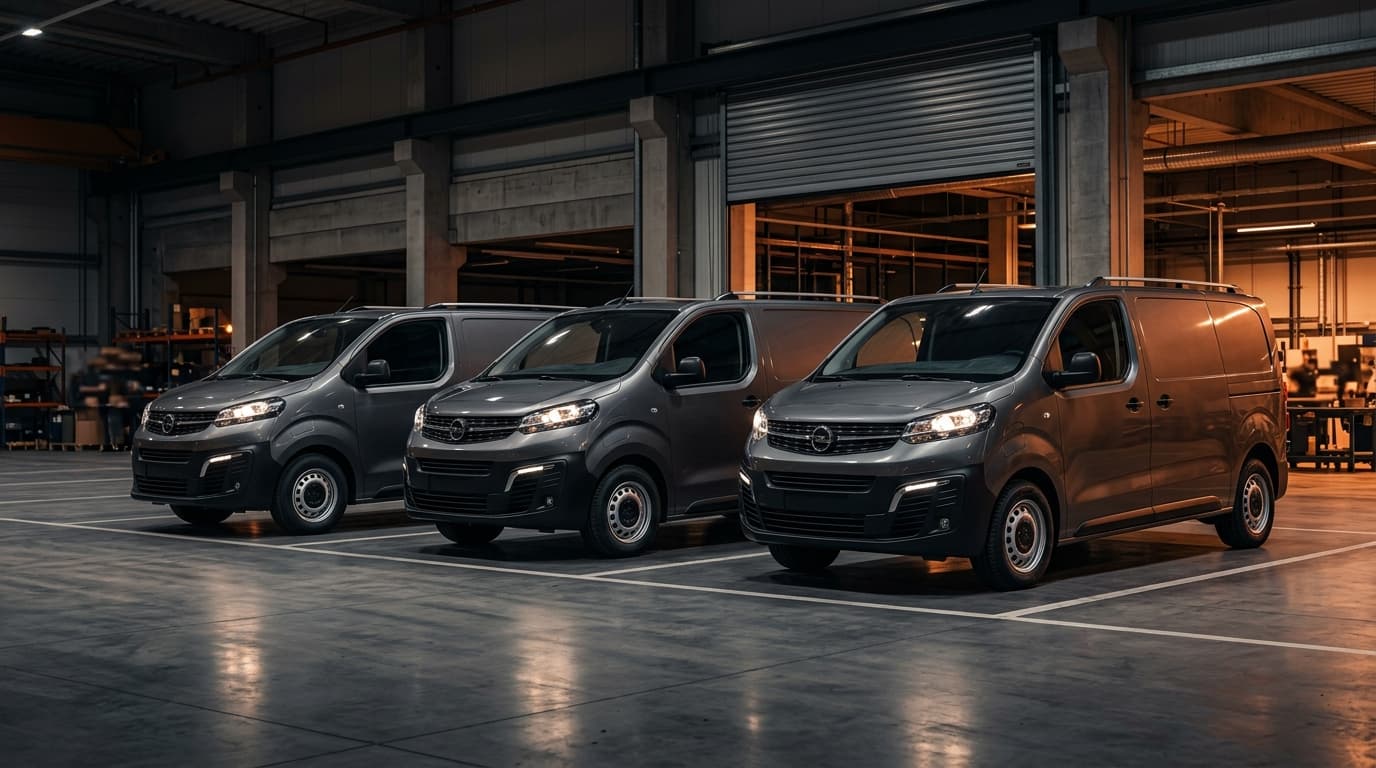
The best van is the one that carries what you transport without costing you a fortune to run. In Belgium the range is wide: from the small city van to the large delivery van, by way of pick-ups. We sorted it out by use, with the numbers to back it up.
Which van should you choose for your trade?
The right choice comes down to two numbers: payload (in kg) and load volume (in m³). Everything else — trim, infotainment, badge — comes after.
An electrician or plumber working in the city gets by with a city van such as the Renault Kangoo or Citroën Berlingo: 3 to 4.4 m³, easy to park, frugal. A carpenter or kitchen fitter loading panels needs a mid-size van (Renault Trafic, Ford Transit Custom) for the load length. A delivery company doing rounds aims for a large van (Renault Master, Fiat Ducato) for sheer volume.
On a real job site, it is better to have a van one notch above your average need than one that is permanently maxed out: overloading wears the running gear and hurts the resale value.
Which vans sell the most in Belgium?
The Belgian light commercial vehicle market is doing well: 70,797 registrations in 2025, up 7.6% year on year according to FEBIAC. Over the year, Ford leads, ahead of Renault and Mercedes; some months Renault takes the top spot. The Stellantis group (Peugeot, Citroën, Opel) lost more than 7% of market share, partly due to the switch to an agency model.
On powertrains, diesel remains king: 88% of registered vans run on it, and electric still accounts for less than 5%. In other words, the used market for the coming years will be mostly Euro 6 diesel.
| Mid-size van | Load volume | Payload | Main strength |
|---|---|---|---|
| Renault Trafic | 5.8–8.9 m³ | ~1,200 kg | Best volume-to-price ratio |
| Ford Transit Custom | 5.8–9.0 m³ | ~1,300 kg | Versatility, popular double cab |
| VW Transporter | 5.8–6.7 m³ | ~1,200 kg | Reliability and residual value |
| Mercedes Vito | 6.0–6.9 m³ | ~1,100 kg | Comfort and finish |
City van, mid-size van or large van: which one?
The city van starts around 3 m³ and fits everywhere in town. The mid-size van is the heart of the market: 5.8 to 9 m³, over a tonne of payload, and a load length that swallows long materials. The large van climbs beyond 10 m³ for big volumes.
What we would avoid: buying a large van “just in case” if you mostly drive in town. It uses more fuel, parks badly and costs more to insure. The right volume is the one for your busy days, not your once-a-year moves.
How much VAT can you recover on a van?
This is the decisive tax argument in Belgium. A vehicle homologated as a utility vehicle and used 100% for business lets you recover 100% of the VAT. For mixed use, the administration applies a flat rate: 85% if use is mainly professional, 35% if it is mainly private.
Better still: unlike company cars, light commercial vehicles are exempt from the 2026 tax reform. They remain 100% deductible for income tax for professional use, whether petrol, diesel, hybrid or electric. Running costs (fuel, maintenance, insurance, leasing) follow the same logic.
Is an electric van worth it today?
It depends on your mileage. For short urban rounds and access to low-emission zones (Brussels, Antwerp, soon Ghent), a ë-Berlingo, a Ford E-Transit or a Volkswagen ID. Buzz Cargo pays off quickly: depot charging, lower maintenance, avoided tolls.
For long, loaded motorway runs, diesel keeps the edge: real range, scarce fast charging in the van line-up, and a still-high purchase price. At resale, the electric van remains a gamble — the used market is thin.
Should you buy new or used?
A recent used model is often the smartest move. The Belgian market is full of Euro 6 diesels from 2019–2023 coming out of professional fleets, well maintained and depreciated. A recent used mid-size van runs around €18,000 to €26,000, against €28,000 to €38,000 ex-VAT for a well-equipped new one.
New makes sense for the warranty, the fit-out (racking, tail lift) and spread depreciation. To compare segments in detail, see our van comparator and the electric category. Not sure of your segment? A short quiz points you in the right direction.
Our verdict
There is no universal “best van”: there is the best one for your load, your volume and your mileage. For all-round use, the Renault Trafic and Ford Transit Custom remain the safe bets on the Belgian market. For long-term reliability, the Transporter. And before you sign, always check the recoverable VAT: that is where the real price is decided.
Sources: FEBIAC (2025 registrations), Transportmedia, link2fleet, Accountable and Athlon (taxation of light commercial vehicles, 2026).
Fourgons moyens comparator
Compare all fourgons moyens side by side.
Compare now →
Frequently asked questions

Damien, 44 ans, a géré pendant douze ans la flotte d'utilitaires d'une PME de second œuvre dans la région de Namur : achats, entretien, revente, et les galères de carrosserie qui vont avec. Il a vu passer des dizaines de Trafic, Transporter et Master, et il sait ce qui casse, ce qui se revend bien et ce qui coûte cher à l'usage. Il a lancé ce site pour comparer les utilitaires sur ce qui compte vraiment en Belgique : charge utile réelle, volume utile, TVA récupérable et coût au kilomètre — pas la brochure du concessionnaire.