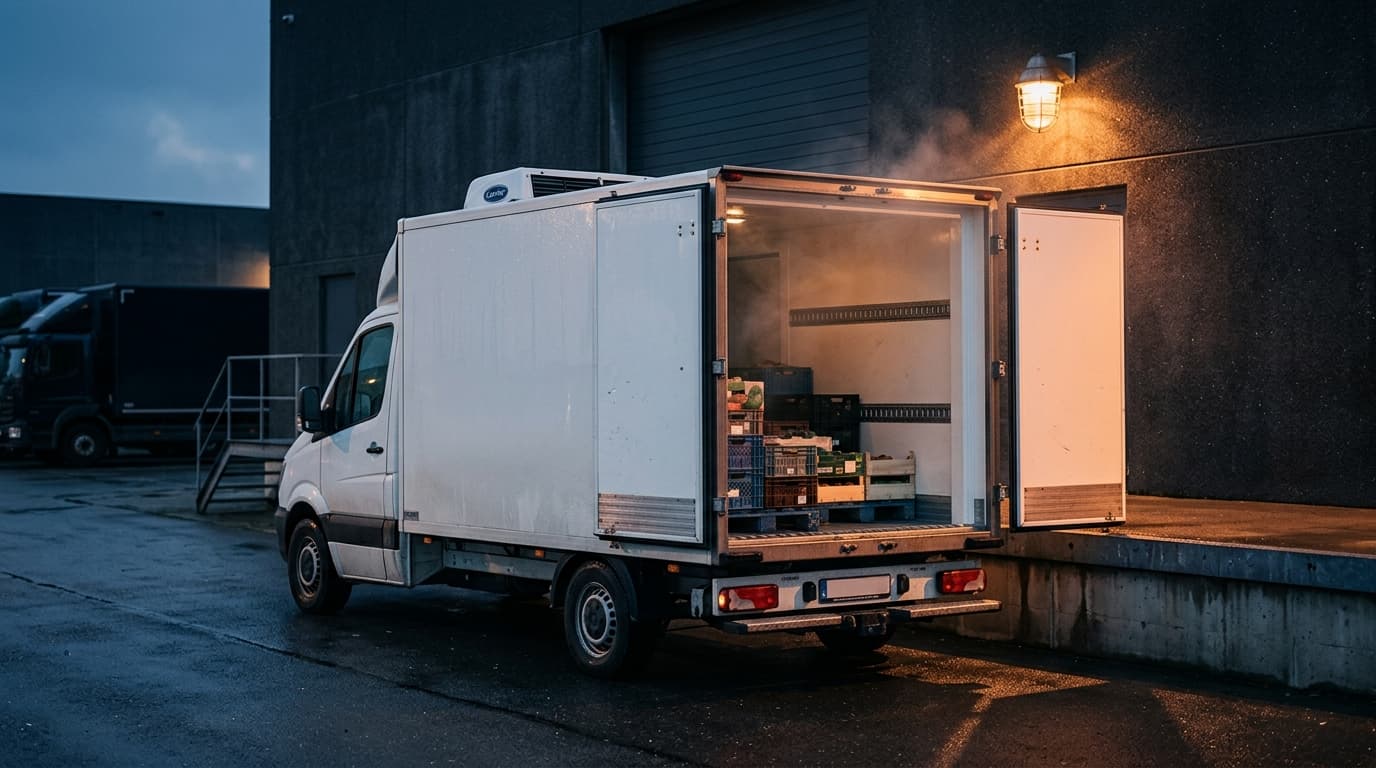
For a Belgian caterer delivering across the province, a medium van with an integrated refrigerated cell does the job: 5 to 6 m³, positive cooling, road-and-mains unit. The ATP certificate is only mandatory for international transport. In Belgium, what awaits you is FASFC registration and a readable thermometer on board.
Which refrigerated van for a caterer, in short?
Take a medium van — Ford Transit Custom, Renault Trafic, Citroën Jumpy, Peugeot Expert, Opel Vivaro or Toyota Proace — with an integrated refrigerated cell running positive cooling. That format covers the vast majority of catering, butcher and cheesemonger rounds in Belgium.
If you deliver frozen goods, you need negative cooling, so an FRC class body, and you accept thicker insulation that eats into the volume. If you are a wholesaler running twenty clients a day, the large van — Fiat Ducato, Renault Master, Mercedes Sprinter, Ford Transit — or a chassis-cab with a mounted body becomes the right tool.
In practice, on a delivery round, what decides is not the badge on the van: it is the type of cooling, the body class and the number of door openings per day. A perfectly insulated van that opens thirty times between 7am and 1pm loses its temperature far faster than an average one that opens six times.
What exactly is a refrigerated van?
A refrigerated van is a van whose load space is insulated and fitted with an active refrigeration unit. Not to be confused with an insulated (isothermal) van, which is insulated but has no unit: an insulated body slows warming, it does not cool anything.
The distinction matters, because the sales vocabulary is vague. A dealer will talk about an "insulated body" for the shell, and a "fridge unit" for the machine. The two together make a refrigerated van. Without a unit, you have a giant cool box — useful for a thirty-minute run with eutectic plates, not enough for a six-hour round in July.
A refrigerated van never exists as a factory model. It leaves the plant as a bare panel van, then goes through two conversions at a bodybuilder: fitting the insulation, then the interior. In Belgium, specialists such as Refricar (Liège, active since 1988, official Carrier Transicold distributor) or Modifroid (Courcelles) do this work on all brands. Two formats exist: the integrated cell, fitted inside the existing van — minimal bulk, no change to the vehicle's footprint — and the mounted body on a chassis-cab, which offers far more volume but turns the vehicle into a small truck.
The unit itself usually runs in road-and-mains mode: it draws power from the engine while driving, and plugs into a 230 V socket when the vehicle is parked at the depot. That overnight connection is what lets you load an already-cold van in the morning, instead of pulling the temperature down with the goods inside.
Do you need an ATP certificate to deliver in Belgium?
No, not if you stay inside the country. The ATP certificate is mandatory for international transport of perishable foodstuffs — that is the explicit position of the Vias institute, the laboratory that issues these certificates in Belgium. A caterer delivering between Namur and Brussels does not need ATP.
This is the point almost nobody states clearly, and it costs money both ways. On one side, self-employed operators pay for an ATP-certified conversion they will never use. On the other, hauliers cross the Dutch or French border with chilled goods and no certificate, assuming their FASFC registration is enough. It is not.
ATP — the Agreement on the International Carriage of Perishable Foodstuffs — covers, in short, products based on milk, meat (including game and offal) or fish (including shellfish and crustaceans), whether fresh or frozen. If you load that and cross a border, the certificate is required.
The number that matters: an ATP certificate issued abroad is valid for only 3 months on a Belgian-registered vehicle. Any vehicle registered here must hold a Belgian ATP certificate. If you buy a used refrigerated van in the Netherlands or France to run it on Belgian plates, that detail catches up with you within the first quarter.
On procedure: the initial application and renewals go to the Vias institute and the FPS Mobility and Transport. Inspection takes place at Vias in Brussels (Chaussée de Haecht 1405, 1130 Brussels), at one of seven stations across Belgium — renewals only — or at your own premises if you present several vehicles on the same day. At resale, a body with an up-to-date certificate is worth noticeably more than one whose ATP history has been lost.
What do the FRC, FRA and FNA classes mean?
ATP classes describe two things at once: how well the body is insulated, and the temperature range the unit can hold. The final letter gives the range, the leading letters give the insulation type.
| Class | Insulation | Temperature range | Typical use |
|---|---|---|---|
| FRA | Heavy | +12 °C to 0 °C | Caterer, butcher, cheesemonger, fruit and veg |
| FRB | Heavy | +12 °C to −10 °C | Mixed chilled and ice cream |
| FRC | Heavy | +12 °C to −20 °C | Frozen goods, frozen fish, ice cream |
| FNA | Normal | +12 °C to 0 °C | Chilled, short runs, tight budget |
| IR / IN | Heavy / normal | — (no unit) | Pure insulated body, eutectic plates |
For a caterer delivering chilled meals and salads, FRA is enough and costs less than FRC. For an ice-cream maker or a fishmonger loading frozen goods, FRC is the minimum. FNA exists and remains legal, but its normal insulation struggles once it is 30 °C outside and the door opens often.
What we would avoid: ordering an FRC "just in case" when you will never carry frozen goods. FRC's heavy insulation is thicker, so it cuts usable interior volume and adds weight — you pay more to carry less.
Marking the body is mandatory and informative: the class assigned, plus the month and year the certificate expires, in letters at least 10 cm tall and figures at least 5 cm, dark blue on white. On a used van, that marking is your first read: it tells you the class and the expiry date before you even open the doors.
What does the FASFC require from a caterer or butcher who delivers?
The FASFC (AFSCA) requires registration of the activity and respect for the cold chain. Transport of foodstuffs under controlled temperature or atmosphere corresponds to activity ACT 353 in the Agency's nomenclature — that is the code you must be registered under, including if you are a platform delivering restaurant meals to consumers.
In practice, three obligations recur. The vehicle and the refrigeration equipment must be in good condition and cleaned regularly. Temperature must be checkable during transport by means of a clearly readable, sensibly positioned thermometer — not one buried behind a stack of crates. And for frozen foodstuffs, you need a temperature recording device, not just a display.
One case deserves butchers' attention: for minced meat and meat preparations, chilled or frozen, an automatic air-temperature recording device becomes mandatory as soon as transport lasts more than 1 hour. One hour is Namur to Brussels off-peak. Which is to say: if you deliver mince, the recorder is not optional.
On legal temperatures, frozen goods travel at −18 °C or below. For meat, EU regulation 853/2004 sets +7 °C for carcasses and wholesale cuts, +4 °C for cut meat and poultry, +3 °C for offal. Fresh dairy travels around +3 to +6 °C. These thresholds apply whether or not you hold an ATP certificate: ATP is a question of borders, the FASFC is a question of product.
Which van segment for which round?
Usable volume after insulation, not catalogue volume, is what counts. Insulation steals 10 to 20% of a panel van's volume, and more with negative cooling. Here are the orders of magnitude per segment, to be confirmed with your bodybuilder.
| Segment | Common refrigerated models (BE) | Indicative usable volume after insulation | Indicative payload | Typical round |
|---|---|---|---|---|
| City van | Citroën Berlingo, Renault Kangoo, Peugeot Partner | ~2.5–3.5 m³ | ~450–650 kg | Urban delivery, small volumes |
| Medium van | Ford Transit Custom, Renault Trafic, Citroën Jumpy, Peugeot Expert, Opel Vivaro, Toyota Proace | ~4–5.5 m³ | ~700–1,000 kg | Caterer, butcher, provincial round |
| Large van | Fiat Ducato, Renault Master, Mercedes Sprinter, Ford Transit | ~8–13 m³ | ~900–1,400 kg | Wholesaler, dense multi-client round |
| Chassis-cab + body | Ducato, Master, Sprinter chassis | ~15–20 m³ | ~1,000–1,500 kg | Distribution, frozen goods, tail lift |
The medium van is the balance point for a caterer: it fits a restaurant car park, it parks in a town centre, and it holds a day of deliveries without returning to the depot. The Stellantis quartet — Jumpy, Expert, Vivaro, Proace — shares the same technical base and the same interior dimensions, which makes the bodybuilder's life easier; the Transit Custom and the Trafic have their own dimensions but dense networks in Belgium.
The large van changes trade: it earns its place when you deliver wholesale, with roll cages or pallets. There, the Ducato versus Master versus Sprinter debate turns on load-sill height, width between wheel arches and the service network near your depot — see our Master or Ducato comparison and the Transit versus Sprinter head-to-head to settle the base vehicle before talking cooling.
How much payload does a refrigerated body cost?
Count on 150 to 300 kg between insulation, the unit and the interior fit-out. On a medium van rated at around 1,000 kg of payload, up to a fifth of your capacity disappears before the first crate goes aboard.
This is the calculation many self-employed operators skip, because they compare brochures for bare vans. A Transit Custom advertised at 1,000 kg of payload only offers 750 to 850 once converted, and you still have to subtract the driver, the tools and the empty crates. If you carry meat or drinks, you hit the gross weight limit long before you fill the volume.
The number that matters: the residual payload written on the type-approval certificate issued after conversion, not the one in the original van's brochure. Ask the bodybuilder for that document before signing the order, not on delivery day.
What we would avoid: sizing on volume and discovering the overload at the first roadside check. An overloaded van means a fine, an immobilisation and an insurer who argues after an accident. If your figures are tight, move up a segment or switch to a well-optimised 3.5 t chassis-cab — you stay within a category B licence.
Can you reclaim VAT on a refrigerated van?
Yes, on the same terms as any Belgian light commercial vehicle. A refrigerated van type-approved as N1 and used exclusively for business purposes reclaims 100% of the 21% VAT and remains 100% deductible for income tax. For mixed use, the tax authorities apply their flat rate of 85% or 35% depending on the private share.
The refrigeration conversion does not change the regime: it follows the vehicle it equips. And on that point, the light commercial vehicle keeps a clear advantage — light commercial vehicles are exempt from the 2026 company-car tax reform. A refrigerated van, diesel, hybrid or electric, stays 100% deductible.
A refrigerated van has no credible private use anyway, which makes the "exclusively business" claim easy to defend in an inspection. It is one of the rare cases where "exclusively professional" is not up for debate: nobody heads off for the weekend with a cell running at −18 °C.
On the Belgian market, the used refrigerated van supply exists but stays narrow and very uneven. A used refrigerated van is judged on three points, in this order: the state of the body (insulation soaked with moisture cannot be repaired, it must be replaced), the hours on the refrigeration unit, and the ATP history if you have international work in mind. The base vehicle's mileage comes last — see our criteria in the reliable used van guide.
Should you switch to an electric refrigerated van in Brussels?
If your round is urban and you return to the depot each evening, electric deserves the calculation — especially in Brussels. Since 1 January 2026, Euro 5 diesel has been banned from the Brussels LEZ, with fines for the light commercial vehicles concerned from 1 July 2026. An electric van goes everywhere, without restriction.
The electric refrigerated van has one advantage diesel does not: the unit runs without a combustion engine, so no noise and no fumes while parked outside a restaurant at 6am. Several municipalities are tightening up on noise during early-morning deliveries, and that argument counts more than people think when it comes to keeping a city-centre client.
The downside is arithmetic: the refrigeration unit draws on the same battery as the drivetrain. In winter, with frequent door openings, the real range of an electric refrigerated van drops well below the 70 to 80% of WLTP already seen on a dry van. Add a payload cut by the battery and by the body, and the maths gets tight on dense rounds. For an 80 to 120 km city round with overnight charging, it works; for Liège to Ostend fully loaded, it does not. The detail on models and ranges is in our guide to electric vans in Belgium.
Our verdict
Refrigeration is the segment where the base vehicle matters least. Between a properly converted Transit Custom, Trafic and Jumpy, the real gap comes from the bodybuilder, the body class and the unit — not the badge. Choose your cooling first (positive or negative), then your usable volume after insulation, then the van that carries it all.
On regulation, remember the dividing line: ATP is about the border; the FASFC is about the product. Domestic delivery of chilled meals means no ATP, but ACT 353 registration, a readable thermometer and temperatures held. Crossing a border with chilled or frozen goods means a mandatory Belgian ATP certificate, on the body, valid 6 years then renewable every 3. And if you buy used, the body's serial number is worth more than the odometer.
To place the medium van in the wider market, see our medium van comparison for Belgium and the general guide to light commercial vehicles. Not sure which segment fits your round? Start from the home page and work down from your daily volume and payload.
Sources: Vias institute — ATP Lab (ATP classes, 6-year then 3-year validity, certificate tied to the insulated body, foreign certificate valid 3 months, 10 cm / 5 cm marking, accessed July 2026); FPS Mobility and Transport (carriage of perishable foodstuffs, ATP applications and duplicates); FASFC (AFSCA) — technical activity sheet TRA ACT 353, version 7 of 6 December 2021 (registration, readable thermometer, recorder for frozen goods, minced meat beyond 1 h of transport); FASFC (food safety for home-delivered meals); regulation (EC) No 853/2004 (transport temperatures for meat, offal and poultry); FEBIAC (light commercial vehicle registrations, 37,455 units in the first half of 2026, −4.9%); Brussels Environment (LEZ, Euro 5 diesel ban since 1 January 2026); Refricar (Liège) and Modifroid (Courcelles) for conversion practice in Belgium.
Fourgons moyens comparator
Compare all fourgons moyens side by side.
Compare now →
Frequently asked questions

Damien, 44 ans, a géré pendant douze ans la flotte d'utilitaires d'une PME de second œuvre dans la région de Namur : achats, entretien, revente, et les galères de carrosserie qui vont avec. Il a vu passer des dizaines de Trafic, Transporter et Master, et il sait ce qui casse, ce qui se revend bien et ce qui coûte cher à l'usage. Il a lancé ce site pour comparer les utilitaires sur ce qui compte vraiment en Belgique : charge utile réelle, volume utile, TVA récupérable et coût au kilomètre — pas la brochure du concessionnaire.