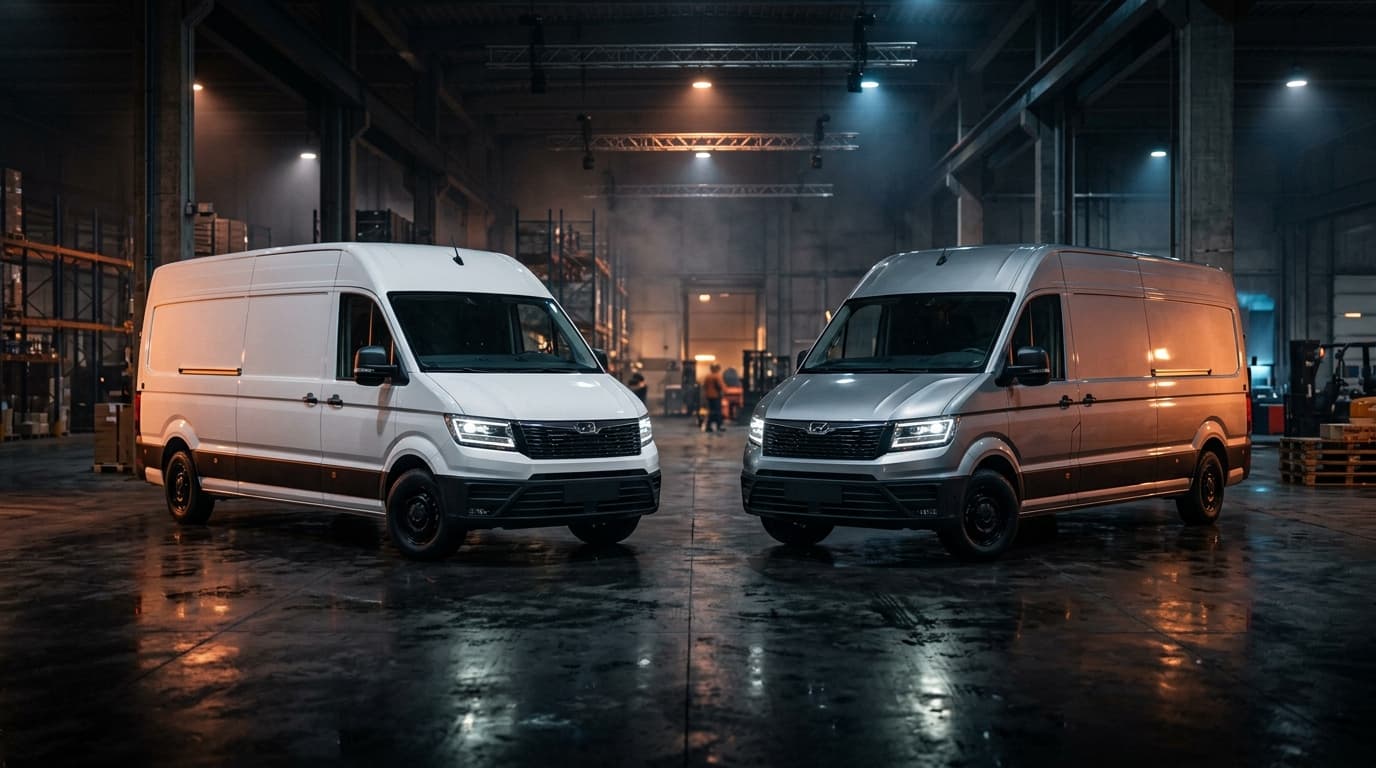
In Belgium, as soon as you talk high-end large vans, two names come up: the Ford Transit, the best-selling van in the segment's history, and the Mercedes Sprinter, the premium benchmark. The Transit wins on price and servicing, the Sprinter on volume, road comfort and image. We sorted them out point by point, with Belgian numbers, for fleets that clock up miles.
Transit or Sprinter: which to choose, in short?
For most fleets, the Ford Transit is the choice that fits the budget: it starts markedly cheaper, is serviced everywhere and replaces quickly. The Mercedes Sprinter earns its keep when your drivers spend their days on the motorway — driving position, quietness, road holding — or when you want maximum volume and a premium image.
Both vans cover the same ground: national delivery, mobile technical service, removals, big job sites. The logic differs. The Transit bets on price-to-practicality and a dense network; the Sprinter on driving refinement and a body range few can match.
On a real round, the choice comes down to three numbers: what you load (volume in m³), what you carry (payload in kg) and the GVW, which decides the licence. The Mercedes badge pleases the driver; it does not carry one more pallet.
What separates the Ford Transit from the Mercedes Sprinter?
The Transit plays accessible versatility, the Sprinter the move upmarket. On paper, both offer multiple wheelbases, high roofs and chassis-cab versions. In detail, the Sprinter goes further on options — front-wheel, rear-wheel or 4×4 drive, a refined automatic, driver aids derived from the car range.
Under the bonnet, the Transit gets the 2.0 EcoBlue diesel from 105 to 170 hp, front- or rear-wheel drive depending on the target payload. The Sprinter counters with its in-house 2.0 diesel, also in several power levels, with a reputation for smoothness above the segment average. On driving feel, the Sprinter keeps the edge on long runs: driving position, insulation, directional stability. The Transit replies with simple ergonomics and a lower running cost.
A point many miss: these two have no rebadged twin. On the Belgian market, the Volkswagen Crafter — once derived from the Sprinter — now shares its base with the MAN TGE, no longer with Mercedes. That is a clear difference from the Renault Master (cousin of the Opel Movano) or the Fiat Ducato (twin of the Peugeot Boxer and Citroën Jumper). Choosing a Transit or a Sprinter means choosing a real mechanical identity, not a grille.
Which carries and swallows the most (volume and payload)?
On raw volume, the Mercedes Sprinter leads, with up to about 17 m³ on its longest, tallest versions. The Ford Transit tops out a notch earlier, around 15.1 m³ in L4H3. On payload, it all depends on GVW: at 3.5 t the two are close, but the Transit covers a very wide range, from ~918 kg to over 2,400 kg on raised-GVW versions.
The Sprinter comes in three lengths and several heights, with a load length exceeding 4.7 m on the extra-long versions. The Transit hits back with an L4H3 offering 4.25 m of usable length and 15.1 m³ of volume — enough to swallow parcels by the load or flat-pack furniture. For bulky light goods the edge stays with the Sprinter; for a load-volume compromise at a keen price, the Transit does the job.
| Criterion | Ford Transit | Mercedes Sprinter |
|---|---|---|
| Max load volume | ~15.1 m³ (L4H3) | ~17 m³ |
| Payload (3.5 t) | ~918–1,400 kg by version | ~757–1,531 kg |
| Payload (raised GVW) | up to ~2,457 kg | up to ~3,144 kg (≥ 5 t) |
| Max load length | ~4,256 mm (L4) | > 4,700 mm (extra-long) |
| Drivetrain | FWD or RWD, AWD | RWD, FWD or 4×4 |
| Diesel engine | 2.0 EcoBlue, 105–170 hp | 2.0 diesel, several outputs |
| Key strength | price, servicing, network | volume, road comfort, options |
What we would avoid: trusting catalogue volume alone. Once the van is fitted out — bulkhead, racking, ply floor, tail lift — real payload drops by 100 to 250 kg. Weigh your typical load first, check the payload of the exact version, then look at the volume. To place these two vans against the rest of the market, see our best large van in Belgium comparison.
How much do a Transit and a Sprinter cost in Belgium?
The Ford Transit is clearly the cheaper to buy. In diesel, it starts around €27,000 ex-VAT on a business deal and stays close to €32,000 ex-VAT at catalogue for a common configuration. A comparable Mercedes Sprinter readily sits €5,000 to €10,000 ex-VAT higher: that is the price of the premium positioning, the network and the finish.
These catalogue prices do not tell the whole story. End-of-quarter business deals often shave €2,000 to €4,000 ex-VAT, and the same van equipped identically can land several hundred euros apart from one dealer to another. Ford and Mercedes both run aggressive fleet discounts, but the starting point is not the same.
The number that counts: over four years, the purchase gap is partly clawed back on resale and servicing — the Sprinter holds its value better, the Transit costs less to repair. Get the van quoted as you will actually use it, not the entry version: that is where €3,000 is won or lost.
Transit or Sprinter for a fleet that drives a lot?
For a fleet that clocks up motorway kilometres — national technical service, breakdown recovery, intercity delivery — the Sprinter takes the lead on driver comfort and road holding. For an urban and suburban fleet that prioritises cost per kilometre and service availability, the Transit stays the safer call. In both cases, keep the GVW at 3.5 t to drive on a category-B licence.
The fleet manager does not read the spec sheet like the tradesperson. He works out total cost of ownership over four years: purchase, fuel, maintenance, downtime, residual value. On that ground the Transit plays low running cost and a network that gets a van back on the road fast. The Sprinter plays durability, a comfortable service interval and solid resale, at the cost of a higher parts bill when work is needed.
On a long-distance round, a driver who spends six hours at the wheel finishes the day less tired in a Sprinter — and a rested driver means fewer mistakes and less damage. On fragmented urban rounds, that refinement shows less, and the premium is harder to justify. Set your vehicles' real driving profile before you walk into the dealer: it steers the choice more than the dashboard.
E-Transit or eSprinter: which electric version in 2026?
If your rounds are mainly urban with a return to the depot, electric settles a question of access first. Since 1 January 2026, Euro 5 diesel is banned in the Brussels LEZ, with fines starting on 1 July 2026 (€350 a year for the vans concerned). The Ford E-Transit and the Mercedes eSprinter go anywhere, charge at the depot overnight and cost less to maintain.
The two play different cards. The E-Transit claims about 317 km WLTP with its 68 kWh battery, for an entry price around €41,000 to €48,000 ex-VAT depending on the offer — the more affordable electric of the two, served by a dense network. The eSprinter aims higher: up to ~437 km WLTP with its big 113 kWh battery, but from around €56,000 ex-VAT, which reserves it for fleets that genuinely need that range.
What we would avoid: switching to electric "on principle" without mapping your real routes. Count on 70 to 80% of the WLTP range once loaded, and less in winter. For an urban courier covering 120 to 200 km a day, the E-Transit is enough; for long, loaded runs, diesel is still often more rational, for lack of fast charging suited to large vans. To dig deeper, see our guide to the best electric van in Belgium.
How much VAT can you recover, and which resells best?
This is the heaviest tax argument, and it applies to both. A large van homologated as a utility vehicle and used 100% for business lets you recover 100% of the VAT. For mixed use, the Belgian administration applies a flat rate: 85% if use is mainly professional, 35% if mainly private.
Better still: unlike company cars, light commercial vehicles are exempt from the 2026 tax reform. Transit and Sprinter alike stay 100% deductible for income tax for professional use, whether diesel or electric. On a van at €40,000 ex-VAT, going from 85% to 100% recovery is about €1,260 kept in the cash flow: keep a clean logbook, it is what justifies your rate in a tax check.
At resale, the Sprinter has long been the large-van safe bet, pulled by a robust image and strong export demand. The Transit, everywhere and easy to service, replaces quickly on the Belgian ex-fleet market. On well-kept vehicles, resale value comes down mostly to mileage and bodywork condition, not the logo. To compare with the segment's other big duel, see our Renault Master vs Fiat Ducato head-to-head, and to place these vans in the whole market, the Belgian van guide or the comparator. Not sure of your segment? The quiz points you in the right direction in two minutes.
Our verdict
The Transit versus Sprinter duel has no single winner, and that is a good thing: competition pulls prices and business terms down. The Transit wins on purchase price, servicing cost and network; the Sprinter on maximum volume, road comfort and resale. Measure your driving profile first — fragmented urban or long haul — set your budget ex-VAT, check the recoverable VAT and the GVW, then let the current offer decide between two vans built to last.
Sources: FEBIAC (2025 light commercial vehicle registrations, +7.6%); Ford Belgium and Comptoir-utilitaire (Transit / E-Transit versions, dimensions and prices, 2026); Moniteur Automobile and AutoScout24 (Belgian Sprinter / eSprinter versions and prices); Automobile Propre (eSprinter range); Bruxelles Environnement and Test-Achats (2026 LEZ); FPS Mobility (B / C1 / C licence categories); FPS Finance (VAT and deductibility of light commercial vehicles).
Grands fourgons comparator
Compare all grands fourgons side by side.
Compare now →
Frequently asked questions

Damien, 44 ans, a géré pendant douze ans la flotte d'utilitaires d'une PME de second œuvre dans la région de Namur : achats, entretien, revente, et les galères de carrosserie qui vont avec. Il a vu passer des dizaines de Trafic, Transporter et Master, et il sait ce qui casse, ce qui se revend bien et ce qui coûte cher à l'usage. Il a lancé ce site pour comparer les utilitaires sur ce qui compte vraiment en Belgique : charge utile réelle, volume utile, TVA récupérable et coût au kilomètre — pas la brochure du concessionnaire.