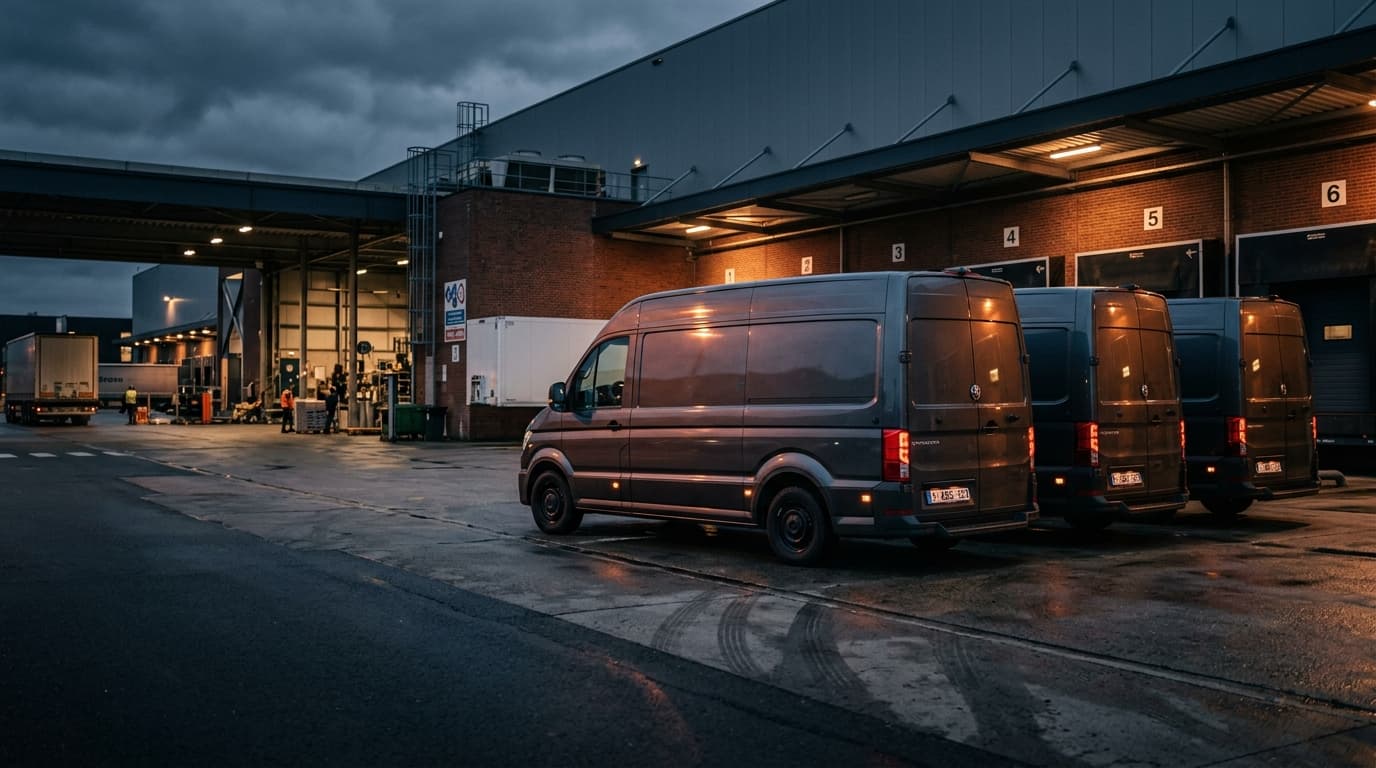
The best large van is the one that swallows your volume without going over 3.5 tonnes or draining your cash flow at the pump. In Belgium the contest comes down to the Renault Master, the Fiat Ducato and the Mercedes Sprinter, with the Ford Transit lurking. We sorted it out by use, with the numbers to back it up.
Which large van should you choose for your activity?
The right large van comes down to three numbers: load volume (in m³), payload (in kg) and GVW (the gross vehicle weight, which decides the licence). The badge comes after.
A delivery firm moving light volume (parcels, flat-pack furniture) looks at cubic metres first: a Ducato or a Sprinter at 17 m³ handles the round without reloading. A mover or a kitchen fitter carrying heavy loads looks at payload and load length: there, the new-generation Master and its 1,625 kg take the lead. A tradesperson hauling bulky but not especially heavy goods is fine with a well-sorted L3H2.
On a real job site, the classic trap is chasing the biggest volume without checking the payload left once the van is fitted out. An empty large van has never moved anyone.
Master, Ducato or Sprinter: which offers the most volume?
On raw volume, the Fiat Ducato and the Mercedes Sprinter lead the dance with around 17 m³ on their largest bodies. The Renault Master new generation tops out earlier, around 14.8 m³ as a panel van, but makes up for it with the best payload of the bunch.
The Ducato plays the versatility card: eight body sizes, a volume-to-price ratio that remains the segment benchmark, and contained maintenance costs. The Sprinter aims higher, with a GVW that climbs to 5.5 tonnes and a reputation for robustness over very high mileage — at the cost of pricier maintenance. The Master bets on a low load floor, a usable length up to 3.8 m in L3 and a claimed 1,625 kg of payload. The Ford Transit rounds out the table with up to 15.1 m³ and a drivetrain every garage knows.
The number that matters: beyond the catalogue volume, measure the load length at floor level. That is what decides whether your 3 m plasterboard or panels lie flat, not the theoretical volume above the wheel arches.
| Large van | Max load volume | GVW | Main strength |
|---|---|---|---|
| Fiat Ducato | ~17 m³ | 3.0–4.25 t | Volume-to-price ratio, cheap to maintain |
| Mercedes Sprinter | ~17 m³ | 3.0–5.5 t | Robustness, high GVW available |
| Renault Master | ~14.8 m³ | 2.8–3.5 t | Payload (up to 1,625 kg), low floor |
| Ford Transit | ~15.1 m³ | 3.0–3.5 t | Versatility, dense network |
Which large vans sell the most in Belgium?
The Belgian light commercial vehicle market is doing well: 70,797 registrations in 2025, up 7.6% year on year according to FEBIAC. In the large-van segment, the Master, Ducato and Sprinter trio captures most of the volume, chased by the Transit and the Stellantis family.
This is a point many people miss: several "models" are in fact the same van rebadged. The Peugeot Boxer, the Citroën Jumper and the Ducato share the same Sevel platform — same bodies, different grille. Since 2021, the Opel Movano is a cousin of the Renault Master. And the Volkswagen Crafter shares its base with the MAN TGE. In other words, choosing between a Boxer and a Ducato is mostly choosing a network and a commercial offer.
On energy, diesel remains overwhelmingly dominant: 88% of registered vans in 2025 run on diesel. The used market of the coming years will therefore be mostly Euro 6 diesel large vans.
Do you need a truck licence to drive a large van?
No, as long as the GVW stays at 3.5 tonnes: a category-B licence is enough. That is precisely why almost all large vans sold in Belgium are set at exactly 3.5 t.
The Belgian rule is simple: category B up to 3,500 kg GVW, category C1 from 3.5 to 7.5 t, category C beyond. A Sprinter or a Crafter can climb to 5 or 5.5 t to gain payload, but you then need a driver holding the C1, with a tachograph and medical fitness check. For a mover tempted by the big version, it is a real calculation: more payload, but an extra licence and constraints.
What we would avoid: overloading a 3.5 t van to dodge the C1 licence. Driving over the GVW means a fine, an insurer that may dig in after an accident, and running gear that suffers. Two trips beat one van breaking the law.
How much VAT can you recover on a large van?
This is the heaviest tax argument in Belgium. A large van homologated as a utility vehicle and used 100% for business lets you recover 100% of the VAT. For mixed use, the administration applies a flat rate: 85% if use is mainly professional, 35% if mainly private.
Better still: unlike company cars, light commercial vehicles are exempt from the 2026 tax reform. Master, Ducato, Sprinter or Transit remain 100% deductible for income tax for professional use, whether diesel or electric. Running costs — fuel or charging, maintenance, insurance, leasing — follow the same logic.
On the Belgian market, the stakes are huge at this price level. On a large van at €40,000 ex-VAT, going from 85% to 100% VAT recovery is about €1,260 kept in the cash flow. Enough to keep the logbook that justifies professional use in good order.
Is an electric large van worth it for delivery?
It depends on your mileage. For urban rounds with a return to the depot, electric pays off quickly: a Renault Master E-Tech (up to ~460 km WLTP, 1,625 kg payload), a Ford E-Transit, a Mercedes eSprinter or a Fiat E-Ducato charge overnight, cost less to maintain and go anywhere in low-emission zones.
And access is becoming a concrete issue. Since 1 January 2026, Euro 5 diesel is banned in the Brussels low-emission zone. A courier working in the capital has every reason to plan ahead: electric settles the matter once and for all, with no expiry date.
For long, loaded motorway runs, diesel keeps the edge: real range that shrinks with the load, fast charging still scarce in the large-van line-up, and a high purchase price (a Master E-Tech starts around €48,850 ex-VAT). At resale, the electric large van remains a gamble: the used market is still thin.
New or used: which large van for an SME?
A recent used model is often the smartest move. The Belgian market is full of Euro 6 diesel large vans from 2020-2023 out of fleets, well maintained and already depreciated. Expect €20,000 to €32,000 for a recent ex-fleet one, against €33,000 to €48,000 ex-VAT for a well-equipped new one.
New makes sense for the warranty, bespoke fit-out (racking, tail lift, floor) and depreciation spread over several years. For an SME that drives a lot and keeps its vehicles for a long time, the reliability of the Sprinter or the simple maintenance of the Ducato weigh as much as the purchase price.
To place these large vans in the rest of the market, see our van comparator and the large-van category. Not sure of your segment? A short quiz points you in the right direction.
Our verdict
There is no universal "best large van": there is the best one for your volume, your load and your mileage. The Ducato wins on volume-to-price, the Sprinter on endurance and high GVW, the Master on payload. Before you sign, check three things: that the GVW stays at 3.5 t if you drive on a category-B licence, that the real payload of the exact version covers your needs, and that the recoverable VAT is properly optimised. That is where the real price is decided.
Sources: FEBIAC (2025 commercial vehicle registrations); Utilicare and Renault Belgium (Master E-Tech versions and prices, 2025); Utilitaires.com and Caradisiac (Ducato, Sprinter, Transit volumes); Bruxelles Environnement (2026 low-emission zone); FPS Finance and Accountable (VAT and deductibility of light commercial vehicles); FPS Mobility (B / C1 / C licence categories).
Grands fourgons comparator
Compare all grands fourgons side by side.
Compare now →
Frequently asked questions

Damien, 44 ans, a géré pendant douze ans la flotte d'utilitaires d'une PME de second œuvre dans la région de Namur : achats, entretien, revente, et les galères de carrosserie qui vont avec. Il a vu passer des dizaines de Trafic, Transporter et Master, et il sait ce qui casse, ce qui se revend bien et ce qui coûte cher à l'usage. Il a lancé ce site pour comparer les utilitaires sur ce qui compte vraiment en Belgique : charge utile réelle, volume utile, TVA récupérable et coût au kilomètre — pas la brochure du concessionnaire.