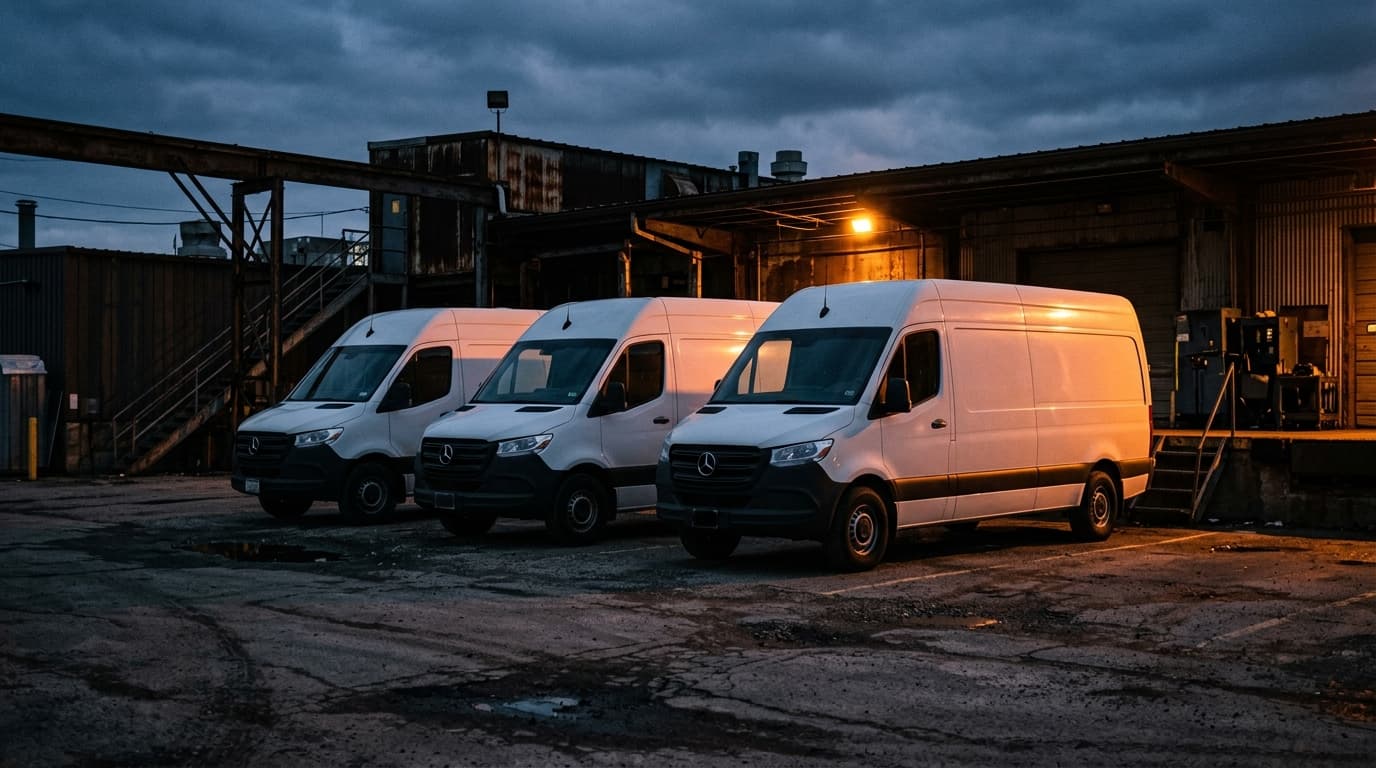
The most reliable large van today is the Mercedes Sprinter: 1.7 breakdowns per 1,000 vehicles in the 2025 ADAC record, against 6.5 to 8.6 for the Volkswagen Crafter and 27.9 to 39.1 for the Fiat Ducato. But for a fleet, the useful question is not "which breaks down least", it is "which costs me least when it is off the road".
Sprinter, Crafter or Ducato: which breaks down least?
The Mercedes Sprinter, no argument on the numbers. The 2025 ADAC breakdown record gives it 1.7 call-outs per 1,000 vehicles on the 2022 model year, the best score in the segment. The Volkswagen Crafter follows between 6.5 and 8.6. The Fiat Ducato sits between 27.9 and 39.1 depending on model year, with peaks above 45.
These records come from German roadside assistance call-outs, not a satisfaction survey. They measure something precise and useful for a fleet manager: the odds of a vehicle sitting on the hard shoulder with a driver and a load inside. That is exactly what wrecks a round.
The number that counts: the gap between the Sprinter and the Ducato is not 20%, it is a factor of 15 to 20. Across a fleet of ten large vans, that is the difference between one or two days off the road a year and one every six weeks.
What exactly do the breakdown statistics say?
They say the three vans are not in the same robustness bracket, but that none is disqualified. The Sprinter is an outlier in the industry. The Crafter has held a solid level since its 2017 redesign. The Ducato breaks down more often, on known parts that are cheap to fix.
A methodological point before deciding: a breakdown record measures how often incidents happen, not how serious or how expensive they are. A Sprinter that fails once every six years can cost you €2,400 in Mercedes parts; a Ducato that bothers you three times over the same period might cost €1,500 in total, but three half-days of work. Both numbers matter, and they point in opposite directions.
On a real round, the failure that hurts is not the most expensive one, it is the one that lands on a loaded Tuesday morning. A fleet manager thinks in available vehicle-days, not garage invoices.
| Large van | Breakdowns / 1,000 (ADAC 2025) | Technical base | Parts cost | Typical mileage in a maintained fleet |
|---|---|---|---|---|
| Mercedes Sprinter | 1.7 | Mercedes' own | High | up to ~400,000 km |
| Volkswagen Crafter | 6.5–8.6 | Shared with the MAN TGE | Medium to high | 300,000 km and beyond |
| Fiat Ducato | 27.9–39.1 (peaks > 45) | Sevel platform (Boxer, Jumper) | Low | 300,000 km and beyond |
Why does the Fiat Ducato fail more often?
Because three specific parts give up before the rest: the injection system, the EGR valve and the clutch. On the 2.3 MultiJet engines, more than 65% of documented failures past 60,000 km involve injection or the EGR. The clutch and its dual-mass flywheel give out between 70,000 and 120,000 km on urban examples.
That failure profile is not random, it matches how the Ducato is typically used. It is the van of couriers and body shops, the one doing short hops, stopping every ten minutes and never getting hot enough to regenerate its particulate filter properly. A Ducato on long motorway runs holds up far better than a city-centre one, and the breakdown records mix both populations.
The Ducato also keeps two heavy arguments for an SME: it is the cheapest of the three to buy, often €6,000 to €10,000 ex-VAT below a comparable Sprinter, and the cheapest to repair. Its parts are everywhere, it shares its Sevel platform with the Peugeot Boxer and the Citroën Jumper, and every independent garage knows it. It also accounts for more than 70% of converted vehicles sold in Europe, which guarantees parts supply for a long time.
Does the Volkswagen Crafter really go the distance?
Yes, and it is the clearest compromise of the three. At 6.5 to 8.6 breakdowns per 1,000 vehicles, the second-generation Crafter sits much closer to the Sprinter than to the Ducato, for a lower purchase price than the Mercedes.
One confusion persists among buyers: the Crafter is no longer a rebadged Sprinter. Until 2016 it genuinely was — same body, Mercedes engines. Since 2017 it has been built on a Volkswagen-developed platform shared with the MAN TGE, produced in the same plant in Wrzesnia, Poland. So a buyer choosing the Crafter "because it is a cheaper Sprinter" has the wrong reasoning: it is a different vehicle, good for different reasons.
On the Belgian market, the Crafter mainly suffers from a thinner commercial-vehicle network than Ford or Renault, which sometimes stretches workshop lead times. For a fleet concentrated on the Brussels-Antwerp-Liège axis that is a non-issue; for an operator working rural areas, service availability weighs as much as the breakdown rate.
What does downtime cost at 50,000 km a year?
Far more than the garage invoice. A large van generating €300 to €600 of revenue per working day costs €900 to €1,800 over three days in the workshop, before counting the part, the replacement vehicle and the customer you push back.
That is the calculation the spec sheet never makes. Take a haulage SME with six large vans covering 50,000 km a year, kept six years. With Ducatos, expect statistically a handful more unplanned stoppages per year than with Sprinters. At €1,200 of lost margin per episode, the annual gap quickly runs into several thousand euros — roughly the purchase-price difference, but every year.
The number that counts: the price gap between comparable Ducato and Sprinter, €6,000 to €10,000 ex-VAT, spreads over six years, i.e. about €1,000 to €1,700 a year per vehicle. That is the threshold to compare with your real downtime cost. Run the numbers with your own figures before you sign — our total cost simulator gives a starting point.
Should an SME fleet pay for reliability?
It depends on your kilometres. Below 25,000 km a year, the price gap does not get clawed back and the Ducato remains the rational call. Above 40,000 km a year, with vehicles kept five to six years, the Sprinter or the Crafter earn their keep — avoided downtime eventually pays the difference.
The reasoning also shifts with your structure. An SME holding a spare vehicle absorbs a breakdown without losing revenue: it can afford a less hardy van. A company where every van is tied to a driver and a fixed round has no slack — there, reliability is money in hand.
Third variable: resale. At resale, the Sprinter holds its value better than the Ducato, pulled by export demand on high mileages. Over six years, a residual value a few thousand euros higher erases part of the initial premium. To compare the three on volume and payload rather than failures, see our best large van in Belgium comparison and the Ford Transit vs Mercedes Sprinter head-to-head.
What the breakdown statistics do not tell you
Three blind spots deserve to be named before deciding, because they change the ranking for some fleets.
First, scope. The most complete breakdown records on the market are German and cover vehicles two to five years old, mostly diesel. They say nothing about recent electric versions — eSprinter, e-Ducato, e-Crafter — where fleet experience is still thin. They say nothing either about Belgian workshop availability, which varies sharply from one province to the next.
Second, maintenance. Service intervals on a large diesel van run around 24 months or 30,000 km depending on conditions, and many professionals deliberately drop to 20,000 km on hard-worked engines. A Ducato serviced every 20,000 km beats a Sprinter whose last two oil changes were postponed. Servicing quality weighs more than the badge, as every serious used buyer confirms — a subject covered in our guide to the reliable used van.
Third, regulation. Since 1 January 2026, Euro 5 diesel has been banned from the Brussels low-emission zone, with fines in force since 1 July 2026. A perfectly reliable van barred from your delivery area is worth nothing. Check the Euro standard before the breakdown statistic. And bear in mind the market is contracting: 37,455 light commercial vehicles registered in the first half of 2026, down 4.9% on the first half of 2025 according to FEBIAC — commercial terms follow, in the buyer's favour.
What we would avoid: buying the most reliable van in the ranking without looking at its parts cost. A fleet that keeps vehicles ten years and repairs them in-house wants cheap, available parts, not a theoretical breakdown rate.
Our verdict
The reliability of a large van is not read off a ranking, it is calculated with your kilometres. The Sprinter is objectively the hardiest of the trio and the best rated at resale, but it only pays off if you drive a lot and if every day off the road costs you revenue. The Crafter bridges the two worlds. The Ducato stays defensible for anyone buying tight, servicing seriously and holding some organisational slack.
Before signing, do three things: pull out your workshop days from last year, ask for the labour rate and the price of common parts at all three networks, and check the Euro standard against the low-emission zones you deliver into. That trio decides it, not the ranking. To place these three vans in the wider market, the van comparator puts them side by side.
Sources: ADAC, 2025 breakdown record (call-outs per 1,000 vehicles, 2016-2023 model years); FEBIAC, new vehicle registrations June 2026 (37,455 light commercial vehicles in the first half, -4.9%) and 2025 results (70,797 registrations, +7.6%); Mercedes-Benz Vans, press release on the Sprinter's 2025 ADAC results; Volkswagen Commercial Vehicles Belgium (Crafter range and MAN TGE technical base); workshop feedback and reliability guides on Fiat 2.3 MultiJet engines (injection, EGR, clutch); Bruxelles Environnement (low-emission zone, Euro 5 diesel ban from 1 January 2026 and fines since 1 July 2026); FPS Finance (VAT and deductibility of light commercial vehicles).
Grands fourgons comparator
Compare all grands fourgons side by side.
Compare now →
Frequently asked questions

Damien, 44 ans, a géré pendant douze ans la flotte d'utilitaires d'une PME de second œuvre dans la région de Namur : achats, entretien, revente, et les galères de carrosserie qui vont avec. Il a vu passer des dizaines de Trafic, Transporter et Master, et il sait ce qui casse, ce qui se revend bien et ce qui coûte cher à l'usage. Il a lancé ce site pour comparer les utilitaires sur ce qui compte vraiment en Belgique : charge utile réelle, volume utile, TVA récupérable et coût au kilomètre — pas la brochure du concessionnaire.