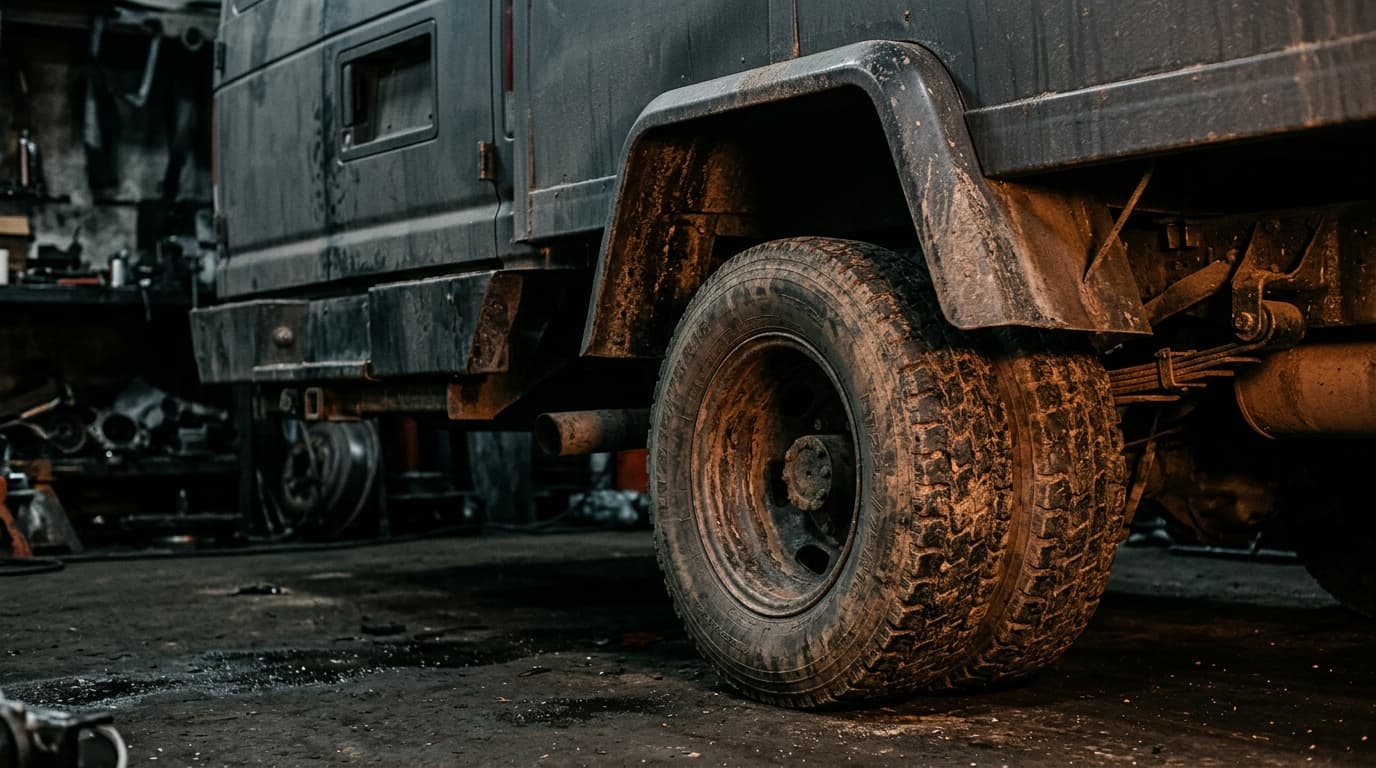
On a van that carries its load, you need a C tyre: it is a commercial vehicle tyre approved in a different class from a car tyre, and it carries more in the same size. An XL tyre is a reinforced passenger tyre, not a C tyre. At the Belgian roadworthiness test, what counts is not the label but the load capacity written on the certificate of conformity.
C tyre, XL tyre, standard tyre: three classes, three loads
The word "reinforced" covers two things that have nothing in common. Retailers stick it on an XL saloon tyre as readily as on a C van tyre, and that is where mistakes start, at the counter, in front of a salesperson who has the right size in stock and not the right tyre. The EU labelling regulation sorts tyres by class: C1 for cars, C2 for light commercial vehicles, C3 for trucks. An XL is still a C1. A tyre marked C is a C2.
To measure the gap, I took one size, 215/65 R16, common on medium vans and some large vans, and pulled three sheets from the EU EPREL database on 30 September 2026.
| Tyre (EPREL sheet) | Class | Load index | Load per tyre | Speed | 3PMSF snow symbol |
|---|---|---|---|---|---|
| Continental EcoContact 6, 215/65 R16 XL | C1 (passenger) | 102 | 850 kg | H (210 km/h) | No |
| Michelin Agilis CrossClimate, 215/65 R16 C | C2 (van) | 106/104 | 950 kg single | T (190 km/h) | Yes |
| Michelin Agilis CrossClimate, 215/65 R16 C | C2 (van) | 109/107 | 1,030 kg single | T (190 km/h) | Yes |
The figure that matters: 180 kg per tyre between the XL and the strongest C tyre. On one axle, that is 360 kg. That is the payload of a small van full of tools, lost on a single axle because someone picked the tyre that had the right size.
Two more readings. The C tyre is rated for a lower speed, T against H, because it is built to carry rather than to hold 210 km/h. And two C tyres of the same size, model and brand can show different indices: 106 or 109.
The sidewall is what counts, not the trade name.

What does the C on a van tyre mean?
It marks a commercial vehicle tyre, also sold as LT, for light truck. The C follows the size, for example 225/65 R16 C, and it always comes with two load indices separated by a slash.
TNPF, the French tyre trade federation, defines a C tyre as a tyre dedicated to commercial vehicles with a load index of 128 or less, i.e. 1,800 kg per tyre at most. Its carcass usually has two plies and its reference pressures are higher than a car tyre's. The first index applies to single wheels, the second to twin wheels.
Take the EPREL sheet of the Michelin Agilis 3 in 225/65 R16 C, a size Renault lists on the Master: 112/110. According to Michelin's index table, 112 means 1,120 kg and 110 means 1,060 kg.
Can an XL tyre replace a C tyre?
In principle, no. And even when the figures seem to allow it, the answer stays the same.
TNPF is clear on this: on a van, C tyres must not be replaced by passenger tyres, even in an identical size and even if load and speed indices are compatible, because the two families are not approved under the same regulation. The reverse holds too: you do not fit C tyres on a passenger car. The only document that settles it is the list of tyres the manufacturer approved for your vehicle.
The argument you hear in workshops, "the XL is reinforced, so it's fine", does not hold up. The XL gains capacity by running at higher pressure, about 0.4 bar more than a standard tyre according to Continental. It does not change carcass or class. In our table it tops out at 850 kg where the original C tyre carries 1,030.
There is one real exception, and it matters. Some vans, mostly small vans derived from cars, leave the factory on passenger tyres not marked C: TNPF says so itself. In that case, that tyre is the one on the COC, and it is the one you compare against.
Which load index for a 3.5 t large van?
The one your rear axle calls for, not your maximum authorised mass. A 3,500 kg van never splits its mass half and half, and it is the rear axle, the one carrying the load, that sizes the tyre. The maximum axle load is on the manufacturer's plate in the door frame and on the certificate of conformity.
The calculation is one division. Maximum axle load, divided by two on single wheels. Then find, in the index table, the first index that covers that weight.
| Maximum rear axle load (single wheels) | Load per tyre | Minimum index | Capacity of that index |
|---|---|---|---|
| 1,700 kg | 850 kg | 102 | 850 kg |
| 1,900 kg | 950 kg | 106 | 950 kg |
| 2,000 kg | 1,000 kg | 108 | 1,000 kg |
| 2,100 kg | 1,050 kg | 110 | 1,060 kg |
| 2,240 kg | 1,120 kg | 112 | 1,120 kg |
| 2,400 kg | 1,200 kg | 115 | 1,215 kg |
Read the first row. An XL tyre with index 102 is only enough if your rear axle is approved for 1,700 kg or less, which is rare on a 3.5 t van, and even then the tyre would still have to appear on the COC.
On site, the most common mistake is not the wrong index bought new. It is the spare, or the tyre fitted on a Saturday after a puncture, mounted alone on an axle with a lower index than its neighbour. I found that on two vans of the same fleet in a single year, both times after a puncture repaired outside the usual network, and both times the driver had no idea because nobody reads a sidewall coming back from a night call-out.
Twin rear wheels: the second figure decides
Rear-wheel-drive large vans, such as the Master on twin wheels, carry four tyres on the rear axle. You then read the second index.
A tyre marked 107/105 carries 975 kg single and 925 kg twin. Four tyres on twin wheels cover 3,700 kg of axle; two on single wheels, 1,950 kg. Twin wheels do not double the capacity, they raise it by about 90%, which is exactly why the second figure exists.
Are reinforced tyres compulsory on a van in Belgium?
The Belgian rule does not talk about "reinforced" tyres. It talks about capacity.
The technical rule is federal, set by the Royal Decree of 15 March 1968 on vehicle technical conditions, so it is identical in Wallonia, Brussels and Flanders. The roadworthiness test itself has been run by the Regions since the sixth state reform, but stations in all three Regions check the same points. According to controle-technique.be, the tyre's load capacity must be greater than or equal to the one on the certificate of conformity, and the speed index must match the manufacturer's. Not on the COC: re-test.
The points an inspector looks at on a van's tyres, according to that source and Test-Achats' legislation file:
- a load capacity at least equal to the COC's, on each axle;
- a compliant speed index, one letter lower being tolerated for a winter tyre;
- at least 1.6 mm of tread on three quarters of the tread width;
- two strictly identical tyres on the same axle, brand, size, indices, pattern and wear included;
- the same tyre structure on both axles.
A claim found on retail sites, "no obligation for reinforced tyres under 3.5 t", is therefore literally true and misleading in substance. If your COC shows a 215/65 R16 C 109/107, an XL 102 is under capacity, whatever it is called.
All-season, winter or summer on a van?
Winter tyres are not compulsory in Belgium, Test-Achats reminds us. They are in wintry conditions in Luxembourg and Germany, and that is what decides for a fleet delivering across the border.
Since 1 October 2024, Germany no longer accepts a plain M+S marking as a winter tyre: only the three-peak mountain snowflake symbol (3PMSF) counts. A C-rated all-season tyre marked 3PMSF, like both Agilis CrossClimate in the table, settles both questions at once, load and snow.
My choice as a fleet manager, for a large van running in Belgium and crossing into Germany once a week: a C-rated all-season 3PMSF tyre at the exact COC index. A van that never leaves Walloon Brabant can stay on summer tyres, provided you accept an icy morning at the depot now and then.
Pressure: 0.4 bar does not turn an XL into a C tyre
Pumping an XL harder does not give it a C tyre's capacity. A van's pressures are on the door pillar label, often in two columns, unladen and laden, and they apply to the original tyre. A different tyre means a different pressure curve.
Our verdict
On the vans I managed, tyres were the item most often bought on price, and it is the only one that affects payload, braking and the roadworthiness test at the same time. To read the masses on your certificate, see our guide to payload and the category B licence; for other re-test reasons, our article on the van roadworthiness test. If you are still torn between two large vans, Master or Transit and the van comparison tool set the versions side by side.
Sources: EU EPREL database, product information sheets for Continental EcoContact 6 215/65 R16 XL, Michelin Agilis CrossClimate 215/65 R16 C (106/104 and 109/107) and Michelin Agilis 3 225/65 R16 C (112/110); Michelin, load and speed index table; TNPF, C tyre specifics and interchangeability of van and passenger tyres; Continental, reinforced tyres; controle-technique.be, speed index and load capacity at the roadworthiness test (updated 20 July 2024); Test-Achats, Belgian tyre regulations (11 October 2024); Handwerksblatt, 3PMSF requirement in Germany from 1 October 2024; Royal Decree of 15 March 1968 on the technical conditions of vehicles. Checked on 30 September 2026. The only reference that applies to your vehicle is its certificate of conformity.
Grands fourgons comparator
Compare all grands fourgons side by side.
Compare now →
Frequently asked questions

Damien, 44 ans, a géré pendant douze ans la flotte d'utilitaires d'une PME de second œuvre dans la région de Namur : achats, entretien, revente, et les galères de carrosserie qui vont avec. Il a vu passer des dizaines de Trafic, Transporter et Master, et il sait ce qui casse, ce qui se revend bien et ce qui coûte cher à l'usage. Il a lancé ce site pour comparer les utilitaires sur ce qui compte vraiment en Belgique : charge utile réelle, volume utile, TVA récupérable et coût au kilomètre — pas la brochure du concessionnaire.