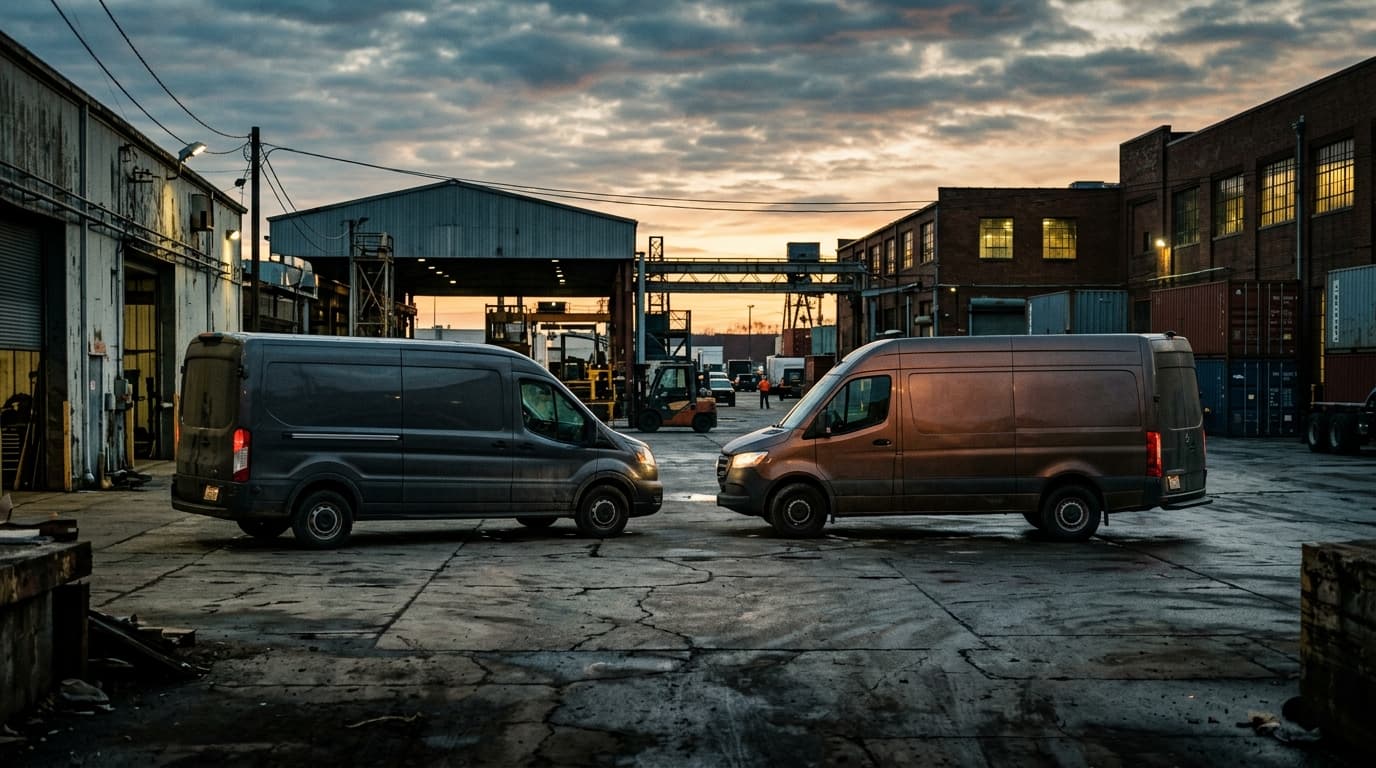
In Belgium, the large van often comes down to two sales heavyweights: the Renault Master, fully reworked in 2024, and the Ford Transit, a European best-seller for decades. The Master loads heavy and carries the best electric range; the Transit hits back with robustness and its choice of drivetrains. We split them apart use by use, figures in hand.
Master or Transit: which to choose, in short?
For side loading, driving in town and switching to electric, take the Renault Master: low floor, record 1,310 mm side opening and 460 km WLTP in E-Tech form. For heavy towing, driving on slippery ground or leaning on a dense network, the Ford Transit takes the lead, thanks to its rear- and all-wheel-drive versions and its Ford Pro services.
Both vans cover the same ground — delivery, the job site, moving house — but with two philosophies. The Master, more recent, looks after the driving position, payload at equal GVW and fuel use. The Transit, unbreakable and everywhere, banks on robustness, the variety of bodies and an after-sales footprint few brands match.
On a real job site, the choice comes down to three numbers: what you carry (volume in m³), what you load (payload in kg) and the GVW, which decides the licence. The badge comes after. A poorly sized large van costs money every day.
What sets the new Master apart from the Ford Transit?
Careful not to mix them up: the Ford Transit here is the "2-tonne" large van, not the Transit Custom, which is a medium van rivalling the Renault Trafic. The real rival of the Master is the Transit proper, the one playing in the yard of the Fiat Ducato and Mercedes Sprinter.
The 2024 Renault Master is the more modern of the two: a new platform, a rethought driving position, worked aerodynamics and a 2.0 Blue dCi ranging from 105 to 170 hp, quoted around 8.5 l/100 km in mixed use. The Ford Transit counters with its 2.0 EcoBlue, a reputation for endurance and, above all, a rare choice in the class: front-wheel drive, rear-wheel drive or all-wheel drive depending on the version.
One point many overlook: these vans have cousins. On the Belgian market, the Master has shared its base with the Opel Movano since 2021. The Transit stays an in-house Ford development, with no rebadged twin — a singularity against the shared Sevel platforms (Ducato, Boxer, Jumper). Choosing the Transit means choosing mechanicals and a network that belong to Ford alone.
Which loads and carries the most (volume and payload)?
A close match. The Renault Master panel van tops out around 14.8 m³, the Ford Transit climbs a notch higher, up to about 15.1 m³ on its L4H3 version. On payload at 3.5 t GVW, the two are close, with a slight edge to the Transit on its heaviest versions, able to approach 2.4 t against about 2 t for the diesel Master.
The Master makes up for it with concrete loading assets: a low floor, a load length up to 3.8 m in L3 and above all that record 1,310 mm side opening, which lets a pallet through the side without a fight. Its rear doors open to 270°, a real plus for loading against a dock. The Transit plays the raw-volume card and load length, up to about 4.25 m on the largest bodies.
| Criterion | Renault Master (2024) | Ford Transit |
|---|---|---|
| Max load volume | ~14.8 m³ | ~15.1 m³ |
| Max payload (3.5 t) | up to ~2 t (diesel) | up to ~2.4 t |
| Load length | up to ~3.8 m (L3) | up to ~4.25 m (L4) |
| Side opening | up to 1,310 mm | ~1,300 mm |
| Drivetrain | front-wheel drive | front / rear / all-wheel |
| Diesel engine | 2.0 Blue dCi, 105–170 hp | 2.0 EcoBlue |
| Key strength | low floor, side loading | length, drivetrains, robustness |
What we would avoid: trusting the catalogue volume alone. Once the van is fitted out — bulkhead, shelving, ply floor — the real payload drops by 100 to 250 kg. Measure the weight of your typical load first, then the volume, and check the payload of the exact version, not the entry line. To place these two against the competition, see our best large van in Belgium comparison.
How much do a Master and a Transit cost in Belgium?
As a guide, count around €33,355 ex-VAT for a Master L2H2 3.5 t Blue dCi 130, and a close bracket, around €35,000 ex-VAT, for an entry-level diesel Transit. Electric versions start clearly higher: the Master E-Tech near €44,850 ex-VAT, the E-Transit in the same order of magnitude. The Master holds the diesel entry-price edge; the Transit hits back on range depth and its services offer.
These list prices do not tell the whole story. End-of-quarter pro deals often shave €2,000 to €4,000 ex-VAT, and the same van fitted identically can end up several hundred euros apart from one maker to the next. Renault and Ford both run aggressive fleet-volume discounts, and Ford Pro pushes hard on packaged service contracts.
Master or Transit for an SME fleet or a tradesperson?
For a tradesperson who loads from the side and strings together stops in town, the Master and its 1,310 mm side opening save time at every drop. For an SME fleet that tows a trailer, drives loaded on a muddy site or wants a turnkey service contract, the Transit and its rear- or all-wheel drive take the lead.
The fleet manager does not read the same table as the tradesperson. They calculate cost per kilometre over four years: fuel, maintenance, downtime, residual value. On that ground, the Transit holds firm thanks to a dense after-sales network, common parts and the Ford Pro ecosystem (telematics, fleet management). The Master, more recent, plays modernity, controlled fuel use and a gentler diesel entry price.
On a real job site, a tradesperson favours side access and headroom; a fleet manager favours the service contract and the replacement lead time. Set your priority before walking into the dealership: it steers the choice more than the dashboard finish. To frame your need across segments, the guide to vans in Belgium compares city vans, medium vans and large vans.
Should you choose the electric version (E-Tech or E-Transit)?
If you mostly drive in town, yes — and the Master E-Tech has stretched the range gap. It claims up to 460 km WLTP with its 87 kWh battery, when the E-Transit sits around 300 km. The Master recovers 252 km in 30 minutes on a 130 kW rapid charger, keeps 1,625 kg of payload on a category B licence and tows up to 2.5 t. In real loaded use, count 70 to 80% of those figures, less in winter.
Electric first settles a question of access. Since 1 January 2026, Euro 5 diesel is banned from the Brussels LEZ, with fines starting on 1 July 2026. A large electric van clears every zone, charges at the depot overnight and costs less to maintain. For an urban courier covering 100 to 200 km a day, the E-Tech or the E-Transit do the job with no range stress.
The maths flip for whoever strings together long loaded motorway rounds: diesel often stays more rational on time and cost, for lack of a rapid-charging network suited to large vans. What we would avoid: switching to electric "on principle" without mapping your real trips. On that point, the Master's superior range widens its comfort zone. To dig deeper, see our guide to the best electric van in Belgium.
How much VAT can you recover, and which resells best?
This is the heaviest tax argument, and it applies to both. A large van homologated as a utility vehicle and used 100% for business lets you recover 100% of the VAT. For mixed use, the Belgian administration applies a flat rate: 85% if use is mainly professional, 35% if mainly private.
Better still: unlike company cars, light commercial vehicles escape the 2026 tax reform. Master and Transit alike stay 100% deductible for income tax for professional use, whether diesel or electric. On a €40,000 ex-VAT van, moving from 85% to 100% of recovery is nearly €1,260 that stays in the cash flow: keep a clean logbook, it is what justifies your rate in an audit.
At resale, the Transit remains one of the most liquid vans on the Belgian market, a big supplier of ex-fleet used stock: known mechanicals, parts everywhere, strong demand. The new Master is too recent to judge its value, but its 2.0 Blue dCi base is proven and the twin Opel Movano widens the parts pool. Not sure of your segment or engine? A short quiz points you in the right direction in two minutes, and the comparator puts the costs side by side.
Our verdict
The Master-versus-Transit duel has no single winner, and that is just as well: competition drags prices and pro terms down. The Master wins on modernity, side loading and electric range; the Transit on drivetrains, load length, robustness and resale. Measure your typical load first, set your budget in ex-VAT, check the recoverable VAT and the GVW — and let the current offer split two front-rank vans. To go further, compare also the Master against the Fiat Ducato and the Transit against the Sprinter.
Sources: FEBIAC (light commercial vehicle registrations 2025, +7.6%); Renault Belgium and Utilicare (Master / Master E-Tech versions, prices and range, 2025); Renault global media (Master E-Tech, 460 km WLTP, 87 kWh battery); Ford Belgium and Ford Pro (versions, drivetrains and E-Transit); L'argus (new Master 2024 review and range); Moniteur Automobile and AutoScout24 (Belgian versions and prices); Brussels Environment (LEZ 2026); SPF Mobility (category B / C1 / C licences); SPF Finances (VAT and deductibility of light commercial vehicles).
Grands fourgons comparator
Compare all grands fourgons side by side.
Compare now →
Frequently asked questions

Damien, 44 ans, a géré pendant douze ans la flotte d'utilitaires d'une PME de second œuvre dans la région de Namur : achats, entretien, revente, et les galères de carrosserie qui vont avec. Il a vu passer des dizaines de Trafic, Transporter et Master, et il sait ce qui casse, ce qui se revend bien et ce qui coûte cher à l'usage. Il a lancé ce site pour comparer les utilitaires sur ce qui compte vraiment en Belgique : charge utile réelle, volume utile, TVA récupérable et coût au kilomètre — pas la brochure du concessionnaire.