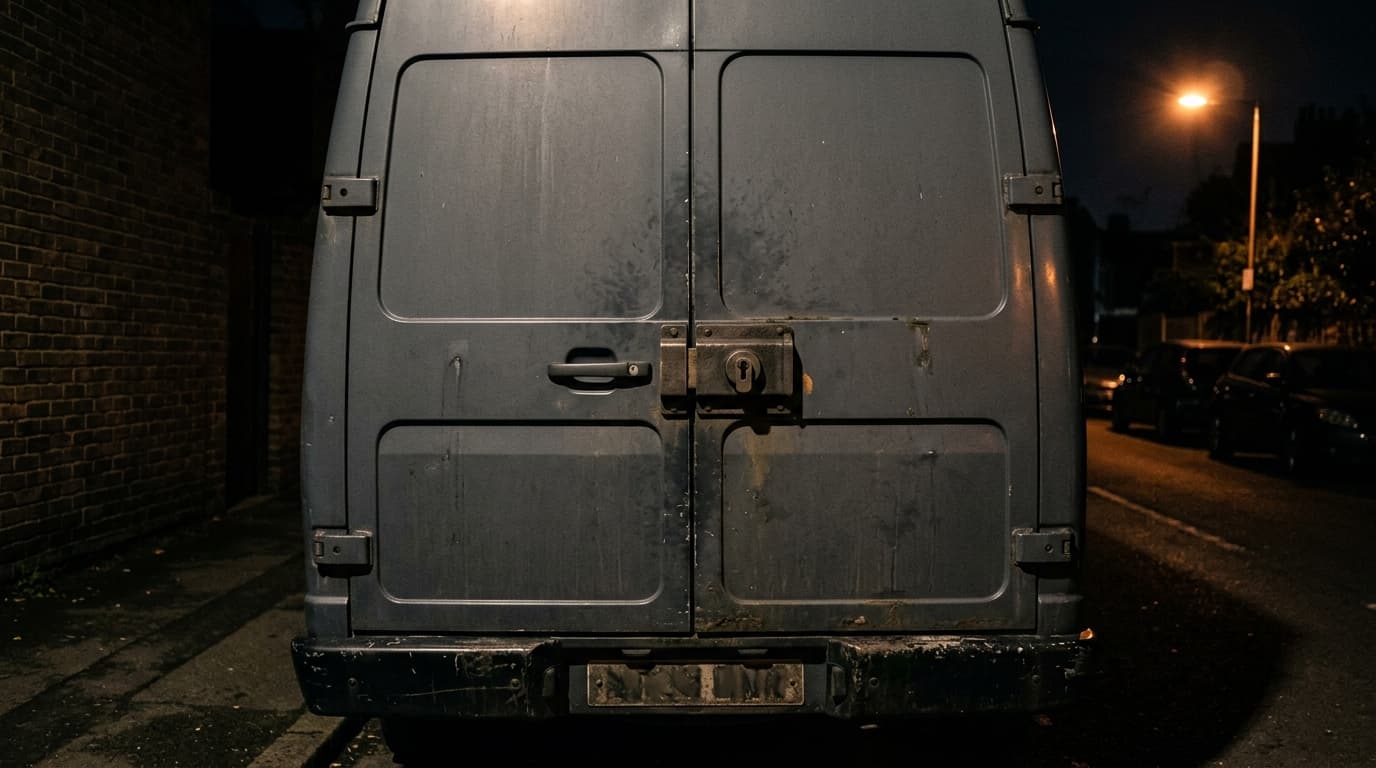
A surface-mounted or puck deadlock on the rear doors and the sliding door, before any alarm. That is the spend that slows a thief down; alarms and trackers only signal or recover. Neither helps if the tools spend the night in a public car park: your insurer will not pay.
Slam lock, puck or alarm: the verdict in one table
Three families share the job of protecting a load area. We compare them on the criteria that matter for a tradesperson's large van, a Master, a Ducato or a Sprinter carrying a few thousand euros of power tools.
| Criterion | Surface-mounted deadlock | Puck lock | Alarm or tracker |
|---|---|---|---|
| Examples | Mul-T-Lock Arma-D-Lock, Daken Saturn EVO | UFO Plus (France Cadenas) | Load-area alarm, INCERT-certified tracker |
| Slows the break-in | Yes | Yes | No |
| Resistance to force | Good, steel bolt | Better, spherical stainless shape | Not applicable |
| Stated weight | 1.8 kg (Arma-D-Lock), 1 kg (Saturn EVO) | 3 kg | Depends on system |
| Locking | Push the bolt, no key | Automatic when the door closes | Remote activation |
| Fitting | Drilling with a template | Drilling with a template | Installer recommended |
| Protects the whole vehicle | No | No | Yes, for the tracker |
| Who for | Fleets, key control | Van parked on the street, exposed area | Add-on, valuable vehicle |
My verdict, by profile. The sole trader who parks his Master outside his house on the street: the puck. The manager of ten vans who must know who holds which key: the Mul-T-Lock. Nobody: the alarm alone.
How do thieves get into a locked van?
Often through the original lock. Standard van locks are designed for bodywork, not for a safe, and AXA UK describes in a September 2018 article three methods insurers keep seeing: exposing and manipulating the central locking on some models, intercepting the key signal to open the van remotely, and peeling the door by bending the panel without touching the lock. The first takes a few minutes, while you are at the counter of the builders' merchant.
There is also theft without a break-in. The Condroz-Famenne police pointed out in October 2020 that some tool thefts from vans happen on vehicles left unlocked, even briefly.
And no break-in usually means no payout, as we will see below.
In Belgium, the federal police regularly report waves of thefts from site vans, mostly at night and at weekends when business stops, according to its prevention page on tool theft. Its advice starts with the basics: leave nothing valuable on board, park in a garage or near home in a lit spot, and if possible drive an unlettered van.
The surface-mounted deadlock: Mul-T-Lock against Daken
It is a housing bolted to the outside, across the join of the two rear doors or between the sliding door and the body, with a bolt that locks both parts together. The original lock may give way: the door stays held.
The Mul-T-Lock Arma-D-Lock has an aluminium body and a 12 mm alloy steel bolt, according to the manufacturer's brochure. Its real argument is the key: a Mul-T-Lock cylinder with an ownership card, which distributor France Cadenas describes as coded and unique. A fleet can order locks keyed alike across all its vehicles, or master keyed. The double version for rear and sliding doors weighs 1.8 kg and is 155 mm long, according to the product sheet.
Daken's Saturn EVO takes another route. Stainless steel body, 1 kg, fitting in about twenty minutes, four identical keys. And a disengage mode that lets the doors open normally during a day of deliveries, which drivers like, and which also means remembering to re-engage it in the evening. The sheet does not say which cylinder it uses.
On a fleet, I would have taken the Arma-D-Lock for one reason: when a driver leaves with his keys, you know how many copies exist.
Does a puck lock stand up better to a crowbar?
Yes, because of its shape. The puck is a half-sphere fixed to the door: the thief has no edge to slip a lever under and no flat surface to hit. The UFO Plus sold by France Cadenas is stainless steel, with anti-drill steel, and locks itself when the door closes, no key needed; its product sheet states 3 kg and three high-security keys, without naming the cylinder.
Two caveats. Weight first: three kilos on a rear door is noticeable when opening a medium van, less so on a large one. And automatic locking means always keeping the key on you: slamming the door with the key inside the load area happens once.
Is an alarm enough on a large van?
No. An alarm slows nobody down. It rings while the load area empties.
A large van adds one more problem: the solid bulkhead between cab and load area. Sensors at the front cannot see the back, and AXA UK notes that a peeled door can go unnoticed for that very reason. A useful van alarm monitors the load area itself, with contacts on every door.
A tracker helps recover the whole vehicle when it is stolen with its keys. In Belgium, the reference label is INCERT, in place since 2002 for vehicle theft protection. Tracking systems are graded TT1 to TT4, according to a May 2023 presentation by a certified installer:
- TT1: tracking with a control room connection;
- TT2: TT1 plus driver cards;
- TT3: TT1 plus an immobiliser;
- TT4: control room, immobiliser and driver cards.
Some policies require one for valuable vehicles. For a five-year-old van, it is rarely the best euro spent against tool theft.
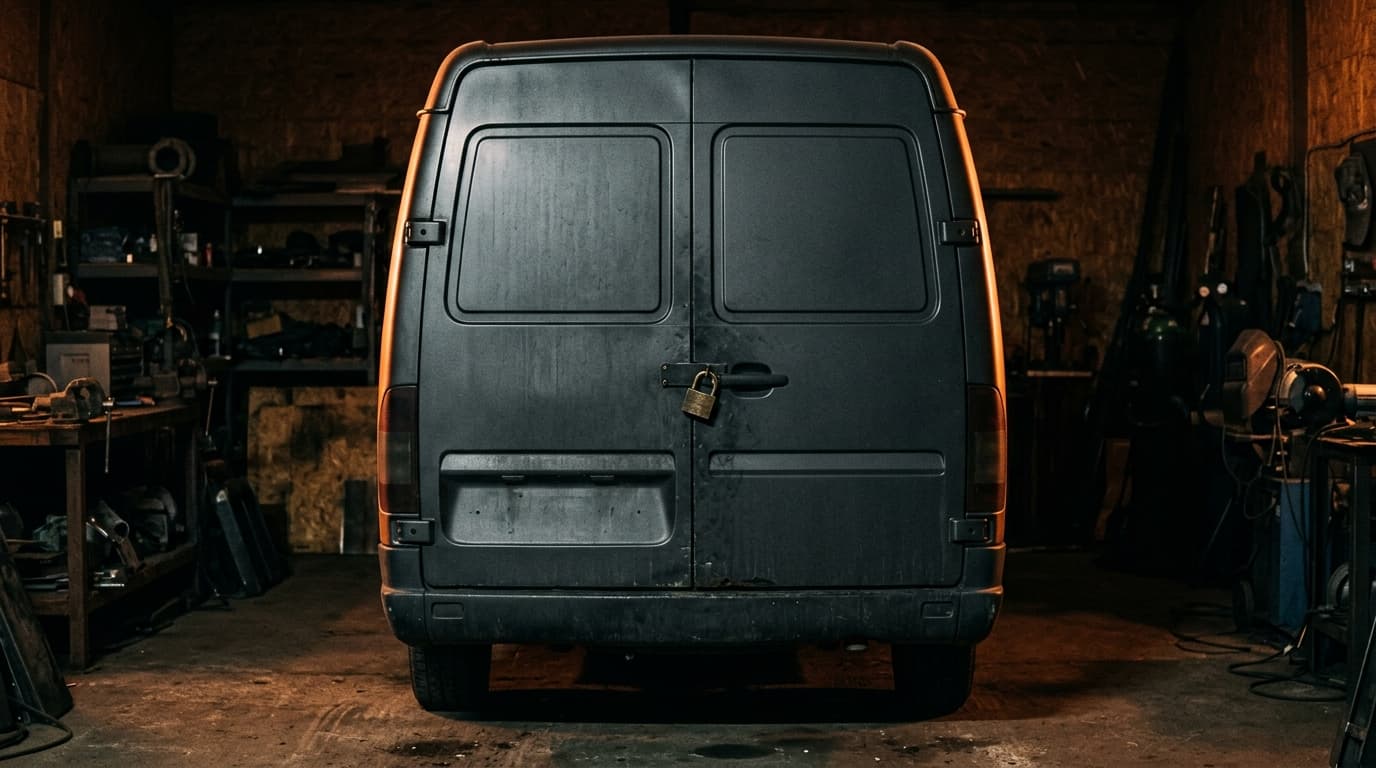
The insurer has already decided: 8 pm, a garage and a 10% excess
Before choosing a lock, read your policy. AXA Belgium's terms for its 'Goods and equipment in transit' cover (edition 10.2019), used here as an example because they are public, set four requirements for theft with forced entry: doors, windows and roof closed and the load area locked; between 8 pm and 7 am, an unoccupied vehicle parked in a locked private garage or similar, public car parks not accepted; equipment always out of sight, in a load area separated from the cab or behind blacked-out windows; and, if the special conditions say so, an anti-theft device that cuts ignition and fuel, with an audible alarm. The theft excess is 10% of the payout, minimum 200 euros and maximum 750 euros per vehicle and per claim.
The figure that matters: applied to a few typical thefts, that excess gives this.
| Tools stolen | Excess applied | Payout before depreciation |
|---|---|---|
| €1,500 | €200 (minimum) | €1,300 |
| €4,000 | €400 | €3,600 |
| €7,500 | €750 | €6,750 |
| €12,000 | €750 (maximum) | €11,250 |
| €4,000, van parked overnight in a public car park | Not covered | €0 |
The last line is the one people forget, and it costs everything. These rules fall under federal insurance law: they do not change between Brussels, Wallonia and Flanders, but each insurer writes its own.
Before you drill: four checks
- The leasing or rental contract: drilling the bodywork is something to agree with the lessor, in writing, before fitting; on return, it may be charged. Our guide to van leasing covers end-of-contract repair costs.
- Model compatibility: the Arma-D-Lock instructions list templates by vehicle, including the Renault Master, Fiat Ducato and their twins, Renault Trafic and Volkswagen Transporter T5; check a recent Sprinter with the dealer.
- Rust: the same instructions call for a 7 mm drill bit, then anti-rust paint on every hole. A bare hole rusts in one winter.
- Telling your insurer: report the lock you fitted and keep the invoice; it also proves a device existed on the day of the theft.
Do you always need to buy something?
No. If the tools go back to the workshop every evening and the van sleeps empty in a locked garage, the deadlock mainly protects the panel. A sticker saying the van is emptied every night and a load area visible through the rear window deter just as well.
For everyone else, the order is simple: a lock on all three doors, storage that cannot be seen, an alarm that watches the load area. The lockable units covered in our article on van shelving add a second layer. And if you are changing vehicle, our large van ranking compares payload and volume for models sold in Belgium.
Sources: federal police, 'Vol d'outillage professionnel dans les camionnettes : vigilance !'; Condroz-Famenne local police, notice of 12 October 2020; Stavelot-Malmedy local police, notice of 5 December 2019; AXA Belgium, special conditions 'Matériel et marchandises transportés', ref. 4185613, edition 10.2019; AXA UK, 'Three clever ways criminals are breaking into vans', 21 September 2018; Mul-T-Lock, ArmaDlock brochure; France Cadenas, sheets for the Arma-D-Lock Double, Daken Saturn EVO Double and UFO Plus Double; Traxgo, INCERT-certified TT systems, 15 May 2023. Pages accessed on 20 October 2026. No prices are quoted: we found no dated public price from a Belgian retailer. I have not tested any of these products; specifications come from manufacturer and distributor sheets.
Grands fourgons comparator
Compare all grands fourgons side by side.
Compare now →
Frequently asked questions

Damien, 44 ans, a géré pendant douze ans la flotte d'utilitaires d'une PME de second œuvre dans la région de Namur : achats, entretien, revente, et les galères de carrosserie qui vont avec. Il a vu passer des dizaines de Trafic, Transporter et Master, et il sait ce qui casse, ce qui se revend bien et ce qui coûte cher à l'usage. Il a lancé ce site pour comparer les utilitaires sur ce qui compte vraiment en Belgique : charge utile réelle, volume utile, TVA récupérable et coût au kilomètre — pas la brochure du concessionnaire.