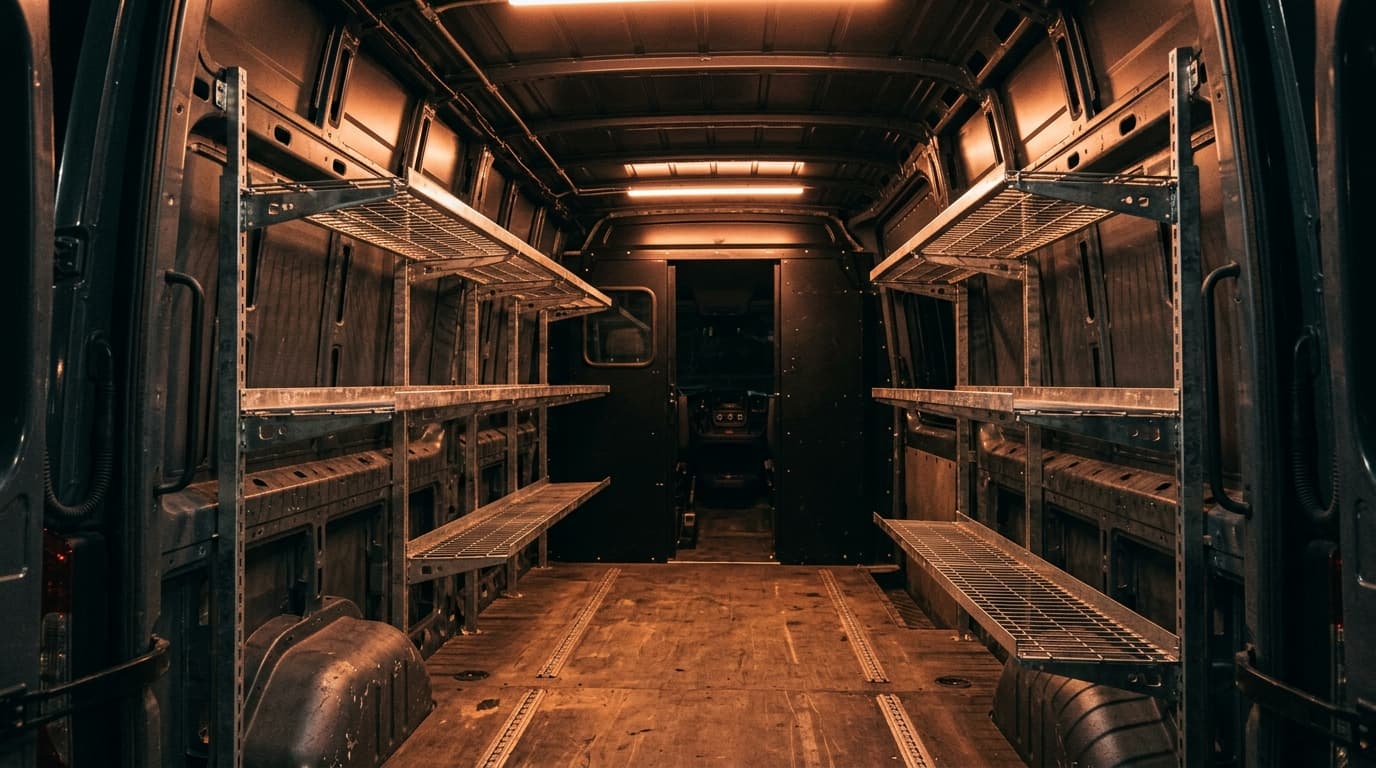
On a working van, modular aluminium wins in most cases. It weighs about half what a plywood fit-out weighs at equal design, it comes apart, and it goes back on the next vehicle. Plywood keeps one solid piece of ground: the used van you plan to keep two or three years.
Wood, aluminium or steel: which one costs the most payload?
Wood, by a wide margin. This is the point every converter's catalogue steps around, because it turns against the cheapest product.
Modul-System states it plainly on its wood versus metal comparison page: at identical design, metal racking weighs half what wood racking weighs. On a medium van whose real payload sits around 1,000 kg once delivered, that gap never comes back. It gets paid every morning, on every run, for seven years.
No Belgian converter publishes those weights. We checked the public price list of Syncro System, in Fernelmont: lengths, heights, depths, prices, and not one kilogram. The question to put to the salesperson fits in eight words: how much does this set weigh, this vehicle?
| Made-to-measure plywood | Modular aluminium | Modular steel | |
|---|---|---|---|
| Weight | heaviest, roughly double the metal | lightest | in between |
| Entry price | lowest | highest | mid |
| Behaviour in a crash | splits and throws splinters | deforms | deforms, stiffer |
| Reconfiguration | cut, drill, screw back | hooks and rails, ten minutes | hooks and rails |
| Transfer to the next van | none | comes apart and refits | comes apart and refits |
| Damp and road salt | swells and delaminates | unaffected | depends on the surface treatment |
| Load per shelf | depends on thickness and supports | published by the maker | published by the maker |
The number that counts: a medium van quoted at 1,200 kg payload in the brochure actually works at around 950 kg once fitted out, as our guide to payload on a category-B licence sets out. The kilos the fit-out takes do not come back.
Five decisions to settle before the material
The material argument comes last. Before it, five choices drive everything else, and getting one of them wrong is paid back six months later with a hole saw.
- Depth. With most makers, 31 cm or 36 cm. Those five centimetres decide whether a standard bin stands upright or has to lie flat, and they eat into the usable width between wheel arches.
- Height. Shelving that reaches 152 cm in an L2H2 leaves room above for tubes; the same unit in an L1H1 stops you loading a dishwasher.
- Linear metres. One side is enough for an electrician. A plumber carrying fittings wants two, and then loses side access to the floor.
- Fixing points. On the manufacturer's factory rails where they exist, otherwise on spread mounting plates. The count matters more than the torque.
- Permitted load per shelf. It belongs on the maker's data sheet. A data sheet without it is worth nothing.
How much does van shelving cost in Belgium?
From €370 to €1,380 excluding VAT per bay, depending on length. The figures below come from the public order form of Syncro System, in the version dated 1 May 2026, recorded on 30 August 2026 in the 31 cm depth.
| Preassembled shelf unit (L × H × D) | Price excluding VAT | Typical use |
|---|---|---|
| 101 × 100 × 31 cm | €370 | extra bay in a city van |
| 152 × 100 × 31 cm | €465 | one side of a city van |
| 202 × 109 × 31 cm | €770 | one side of a short medium van |
| 252 × 152 × 31 cm | €1,265 | one side of a long medium van, full height |
| 304 × 152 × 31 cm | €1,380 | one side of a large van |
The fixing kit is billed at €25 excluding VAT per piece. Moving to the 36 cm depth adds €35 to €200 depending on length.
Run the full sum on a Renault Trafic or a Ford Transit Custom in short-wheelbase form, fitted on both sides. Two 202 cm units at €770, four fixing kits at €25, and you get €1,640 excluding VAT, or €1,984.40 including VAT. The €344.40 of VAT comes back in full if the vehicle serves the business exclusively. Workshop fitting or delivery come on top, and they are negotiable.
Put that number next to the rest of the file before wincing. It is less than a set of all-season tyres on a medium van, and it is a depreciable asset.
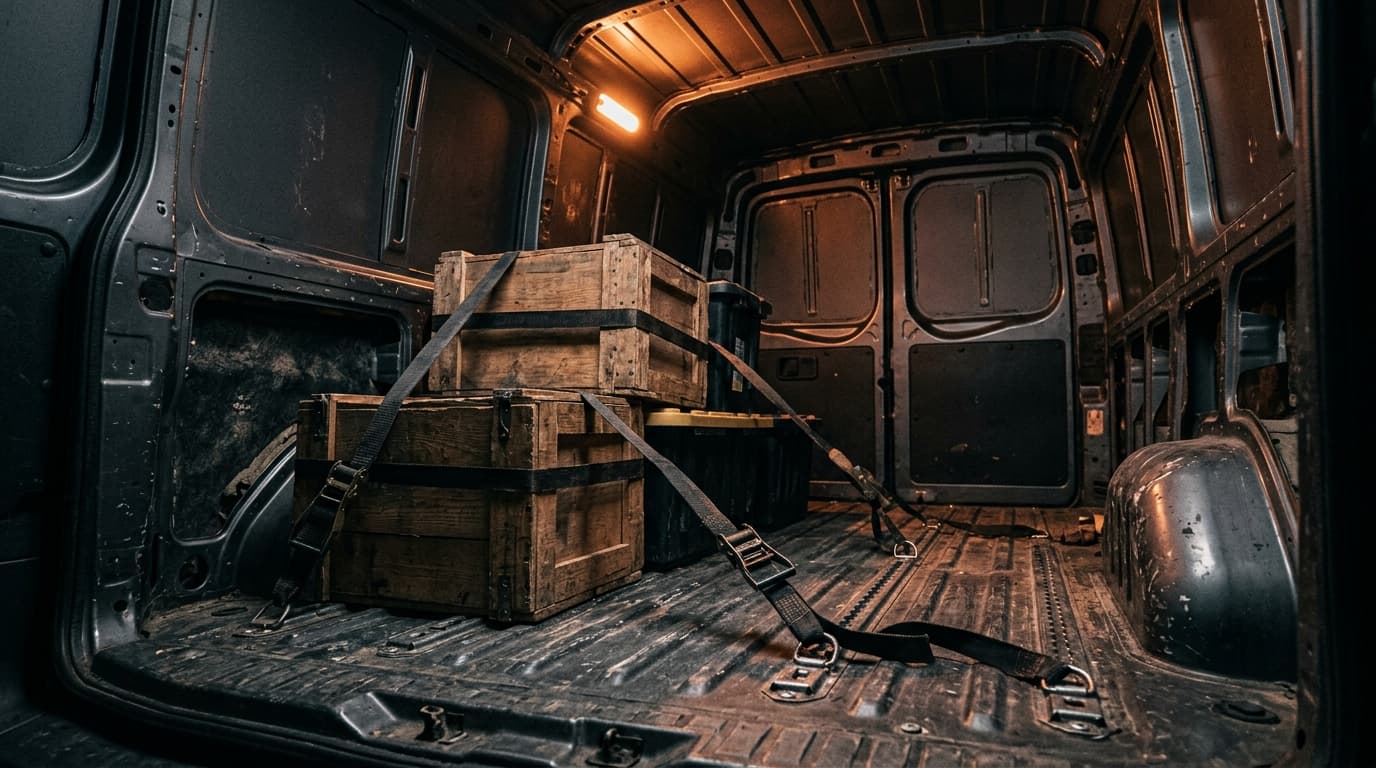
The weak link is the 0.6 mm body panel, not the shelf
The INRS ran van fit-outs on a deceleration sled under its NS 286 test protocol, and the result runs against intuition.
The conditions reproduce a 50 km/h frontal impact, with a 20 g deceleration held for 30 milliseconds, aligned on UN regulation No. 126. Two criteria validate the test: no ballast ejected, and no intrusion of more than 300 mm into the cab survival zone. The failures observed happen neither on the shelves nor on the uprights. They happen on the body panel, 0.6 mm thick, at the exact point where the bracket is bolted. With conventional brackets, the force transmitted to that panel exceeds 11,000 N. With energy-absorbing brackets it drops to 5,500 N, and the INRS proposes a minimum body resistance threshold of 8,000 N.
Put another way, the best racking on the market badly fixed to a ten-year-old van with corroded anchor points is worth less than average racking properly spread over mounting plates.
Nobody asks about the fixings. Everybody asks about the price per metre.
Does shelving cost you the Belgian van tax status?
No, and it is the most widespread worry among self-employed people fitting out their first van.
The FPS Finance qualifies a van on construction criteria, not on equipment. You need a ratio of at least 50 % between the length of the load compartment and the wheelbase, and a separation between the passenger space and the load space. Racking bolted to the side walls changes neither the wheelbase, nor the floor length, nor the bulkhead. The vehicle stays what the registration certificate says it is, and van taxation does not move by one euro.
The move that flips the file sits elsewhere, and it is common: refitting a bench seat or restoring seat anchor points behind the bulkhead. There, the vehicle leaves the van regime, deductible VAT is recalculated and road tax changes scale.
Two cases where you should buy nothing
A van that goes out ten days a year to move furniture needs no shelving. Stackable bins and two straps do the job, for €80.
Second case, rarer but expensive: a vehicle nearing the end of its lease. Twelve months from handback, new racking leaves with the van, and no converter buys it back second-hand.
Our verdict
When I ran the fleet, we made the wood mistake on six vans at once. It was 40 % cheaper to order, the local workshop fitted it in a day, and the accountant was happy. Three years later the panels had swollen around the wheel arches, two shelves had split, and the lot went in the skip at resale time because nothing could be refitted to the replacement vehicles. The arithmetic was wrong from the start: we had compared purchase prices where we should have compared a cost over the holding period.
Aluminium costs more once. Wood costs less every time.
If you are still choosing the vehicle, our comparison of the best medium van in Belgium ranks on real payload, and the comparator filters on load volume and interior dimensions, which decide the shelf length you can actually fit.
Sources: Modul-System, "Wood vs Metal Van Racking" page (weight ratio between wood and metal racking); Syncro System, quick order form "Kit de base Étagère Ultra", version dated 1 May 2026, recorded on 30 August 2026, prices excluding VAT, Fernelmont workshop; INRS, NS 286 test protocol for impact retention of in-vehicle furniture and the associated technical note (50 km/h and 20 g test conditions, 300 mm survival zone, forces transmitted to the body); UN regulation No. 126 on partitioning systems; standard ISO 27956:2009 on load securing in delivery vans; FPS Finance, tax qualification criteria for vans (50 % ratio between load length and wheelbase, separation of spaces). Pages consulted on 30 August 2026. Fit-out prices move: ask for a dated quotation and for the weight in kilograms of the set proposed for your vehicle.
Fourgons moyens comparator
Compare all fourgons moyens side by side.
Compare now →
Frequently asked questions

Damien, 44 ans, a géré pendant douze ans la flotte d'utilitaires d'une PME de second œuvre dans la région de Namur : achats, entretien, revente, et les galères de carrosserie qui vont avec. Il a vu passer des dizaines de Trafic, Transporter et Master, et il sait ce qui casse, ce qui se revend bien et ce qui coûte cher à l'usage. Il a lancé ce site pour comparer les utilitaires sur ce qui compte vraiment en Belgique : charge utile réelle, volume utile, TVA récupérable et coût au kilomètre — pas la brochure du concessionnaire.