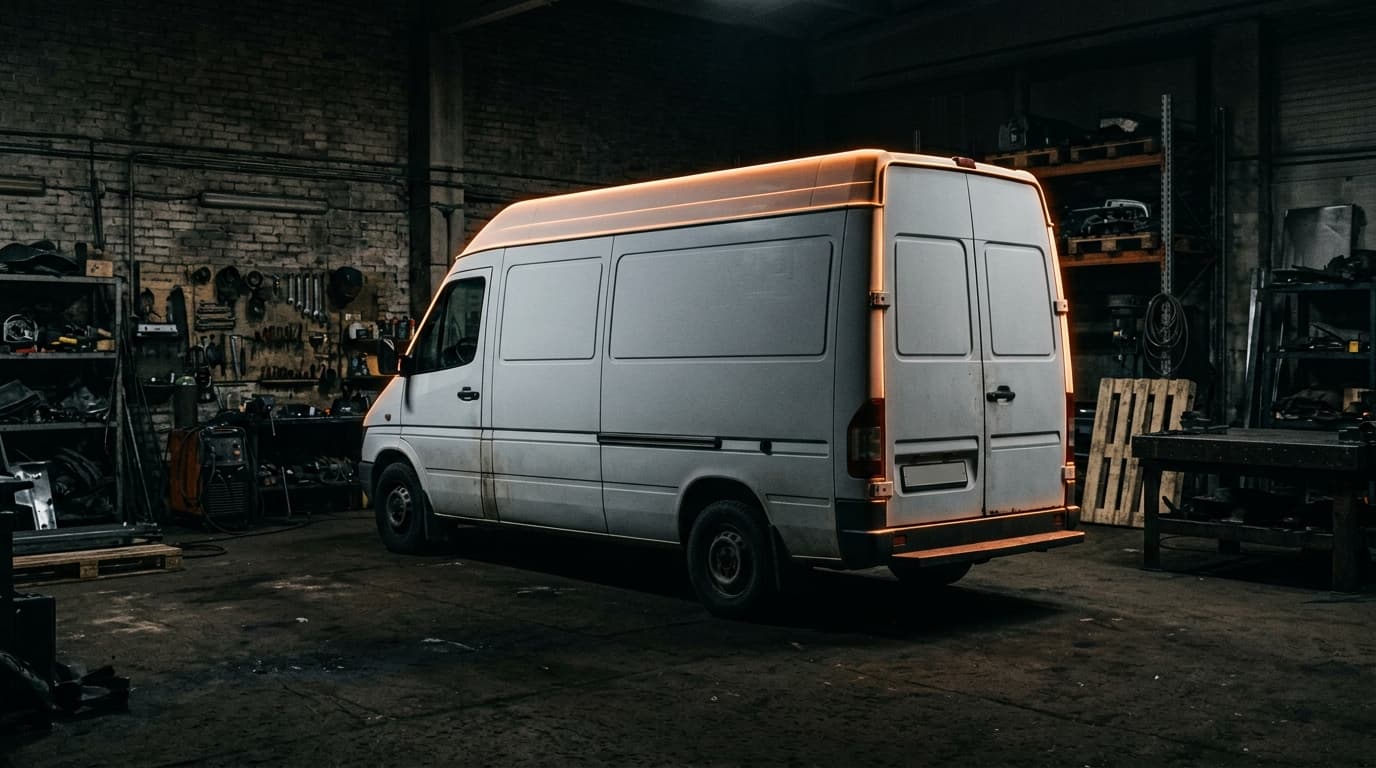
A van costs less than it looks, but not for the reason most people assume. A Renault Trafic Advance L1H1 listed at €29,310 excl. VAT comes to €35,465 incl. VAT for a private buyer. A self-employed professional using it for work reclaims the €6,155 of VAT, deducts 100% of running costs and pays €85 in annual tax. That is where the real gap sits.
What is the real price of a van for a self-employed buyer?
The ex-VAT price, provided the vehicle qualifies as a van for tax purposes and is used exclusively for work. Belgian VAT at 21% is not a cost for a VAT-registered business, it is an advance: it goes into the periodic return and comes back. Dealer pricing for professionals is almost always quoted excluding VAT, which throws off buyers coming from the passenger car market.
Take a concrete case: an electrician replacing his van. He is looking at a Renault Trafic Advance L1H1 at €29,310 excl. VAT on the Belgian price list. Including VAT that is €35,465, of which €6,155 is VAT. Buying as a private individual with no declared activity, he spends €35,465. Buying under his business, he advances €35,465 and reclaims €6,155 on the next return. The vehicle cost him €29,310.
The number that matters: €6,155 on a single vehicle is roughly three years of fuel on a 20,000 km round. And that is before deductibility even enters the picture.
Can you reclaim 100% of the VAT on a van?
Yes, but only if use is exclusively professional. A type-approved van escapes the 50% ceiling applied to passenger cars: the deduction follows actual business use, and it can reach 100%.
This is the most misunderstood part of the Belgian regime. On a company car, even used 90% for work, deductible VAT is capped at 50% by article 45 § 2 of the VAT Code. On a van, that ceiling does not exist. Someone driving 100% for business deducts 100%. Someone using the van at weekends to move his daughter's flat deducts the business share and nothing more.
Then it has to be justified. Three methods are accepted: a detailed logbook (the most demanding, the most solid), the semi-general flat rate that computes private use from the home-to-work distance plus a 6,000 km allowance, or the general 35% flat rate. The logbook is the only one that lets you go beyond what the formula gives you — and the only one the tax authority does not argue with.
What we would avoid: claiming 100% business use on a van parked outside your house every night with no mileage record at all. VAT audits on vehicles are routine, not exceptional.
Why does 2026 change things for vans?
Because fossil-fuel company cars lost their deductibility, and vans did not. Since 1 January 2026, business expenses on a fossil-fuel company car bought this year are no longer deductible for corporate tax. Light commercial vehicles up to 3.5 tonnes keep their own regime, at 100%.
The effect is mechanical. An SME owner hesitating between a diesel estate and a medium van no longer really hesitates: on the estate, the cost is fully out of pocket in tax terms; on the van, the state picks up part of it. A transitional regime softens the step for fossil-fuel cars ordered before 1 January 2026 — maximum 50% deduction in 2026, 25% in 2027, zero from 2028 — but the direction is set.
This reform should be read for what it is: a policy to green the company fleet, not a gift to van buyers. Vans were simply left outside the scope, because nobody expects a tiler to load 400 kg of material into an electric hatchback. Nothing says that perimeter will hold for ten years, and electric company cars remain 100% deductible in 2026, which closes part of the gap for urban users. Our comparison of an electric or diesel van for a fleet costs that match over four years.

How much is road tax on a van?
Between €46.70 and €148.76 per year in Wallonia and Brussels. Annual tax on a van of maximum 3.5 tonnes is calculated on gross vehicle weight, not on the engine's fiscal horsepower. That change of basis is what creates the whole gap with a passenger car.
The scale is simple and public. Six brackets, no CO₂ coefficient, no age correction, no eco-malus. A medium van rated at 3,000 kg GVW pays €127.51. An L3H2 large van at 3,500 kg pays €148.76. A city van such as the Peugeot Partner or Citroën Berlingo Van, usually between 1,900 and 2,400 kg GVW, lands in the €85.01 or €106.26 bracket.
| Gross vehicle weight (GVW) | Annual tax 2026 | Typical vehicle |
|---|---|---|
| 0 to 1,000 kg | €46.70 | Micro-van, car-derived |
| 1,001 to 1,500 kg | €63.76 | Lightweight city van |
| 1,501 to 2,000 kg | €85.01 | Short Berlingo Van type |
| 2,001 to 2,500 kg | €106.26 | Peugeot Partner, Renault Kangoo Van |
| 2,501 to 3,000 kg | €127.51 | Renault Trafic, Ford Transit Custom |
| 3,001 to 3,500 kg | €148.76 | Ford Transit L3H2, Fiat Ducato |
The official scale is published in the road tax rates for commercial vehicles issued by Wallonia, and the general rules are consolidated in the Code of taxes assimilated to income taxes. Flanders applies its own logic and its own amounts — check your region before budgeting.
Do you pay registration tax on a van?
No, neither in Wallonia nor in Brussels for a light commercial vehicle of maximum 3.5 tonnes. No eco-malus either. It is the most spectacular saving in the regime, and the one nobody calculates before buying.
The gap deserves to be stated in euros. Since 1 July 2025, Wallonia calculates registration tax on a passenger car by combining power in kW, age, CO₂ emissions, GVW and fuel type, with a result capped between €50 and €9,000. A large new diesel SUV lands high in that range. The same buyer choosing a double-cab pick-up type-approved as a van pays nothing.
In practice, on a work site, this exemption explains much of the double-cab pick-up's success among Belgian self-employed buyers. Five seats, a load bed, the look of a leisure vehicle and the tax treatment of a work tool. It is also what put the category under scrutiny — we cover the traps in our guide to the single or double-cab pick-up.
How do you check your vehicle really qualifies as a van?
By checking four points before you sign, not after. An N1 marking on the registration certificate guarantees nothing: the DIV registration authority can register a vehicle as commercial while the SPF Finances later reclassifies it as a car, with retroactive effect on VAT and deductibility.
Here is the check I run systematically before a purchase, in this order.
- The load area to wheelbase ratio. Load area length must reach at least 50% of the wheelbase. This is the criterion that fails the most vehicles, especially double-cab pick-ups and converted SUVs. Measure it; do not take the salesperson's word.
- The partition. On a single-cab van, the load area must be separated from the passengers by a fixed partition at least 20 cm high, or by the backrest of the single row of seats. A removable partition does not count.
- The number of seat rows. Two rows maximum. An N1 vehicle marked as a van with two rows stays commercial even if it seats five; add a third row and you leave the regime.
- BCE/KBO registration. Since 2022, Wallonia requires the vehicle to be registered to an individual or legal entity listed in the Crossroads Bank for Enterprises to qualify for the favourable regime. A private buyer registering a van in their own name does not qualify.
The SPF Finances distinguishes four families — single-cab pick-up, double-cab pick-up, single-cab van, double-cab van — and each has its own set of conditions. The applicable texts are available on Fisconetplus, the SPF Finances tax knowledge base. If your vehicle is borderline, have your accountant validate it before ordering, not at the first return.

What is the full annual cost of a van in Belgium?
Count depreciation, fuel, insurance, servicing and tax — then subtract what the tax system gives back. On a medium van at €29,310 excl. VAT depreciated over five years, annual cost of ownership before tax relief runs around €9,000 to €11,000 for 25,000 km, of which road tax is barely over 1%.
The breakdown is worth doing. Straight-line depreciation over five years: €5,862 a year. Diesel at 25,000 km with a real-world 8 l/100 km: about €3,400 excl. VAT at Belgian summer 2026 prices. Business insurance: €900 to €1,400. Servicing and tyres: €700 to €1,100. Road tax: €127.51. Gross total: in the region of €11,000 to €12,000.
On that total, a self-employed buyer reclaims VAT on fuel, servicing and parts, and deducts 100% of the rest from taxable income. At a 45% marginal rate, the tax saving on an €11,000 cost base exceeds €4,000. The cost actually borne drops below €7,000 a year. That is the figure to compare against a fossil-fuel company car, not the list price.
At resale, a van adds a constraint the brochure never mentions: the sale is subject to VAT if you deducted it on purchase. You will charge 21% to the buyer — irrelevant if they are VAT-registered, a real obstacle if they are not. That mechanically narrows your second-hand market to professionals, a topic we cover in our guide to the reliable used van.
Our verdict
A van in Belgium costs its ex-VAT price, plus a few hundred euros of annual tax. A Trafic at €29,310 excl. VAT, €127.51 of road tax, no registration tax, no eco-malus, and 100% of running costs deductible in 2026 while the equivalent fossil-fuel car has dropped to zero. The gap between the two regimes has never been as wide as it is today.
Three things to do before signing an order form. Check type approval on the four points above, with a tape measure if needed. Read the GVW under point F.1 of the registration certificate and place it in the right tax bracket. Decide on your VAT justification method — logbook or flat rate — before the first kilometre, because a logbook cannot be reconstructed six months later. If you are still hesitating on segment, our best medium van in Belgium comparison puts prices and payloads side by side, and the rest of the guides sit in the blog.
Sources: SPF Finances — Fisconetplus (tax definition of a van, load area to wheelbase ratio, 20 cm partition, four categories of commercial vehicles); Code of taxes assimilated to income taxes, SPW Wallonia; 2026 road tax scale for commercial vehicles ≤ 3.5 t, SPW Wallonia and Brussels-Capital Region (€46.70 to €148.76); reform of company car deductibility on 1 January 2026 and the 50% / 25% / 0% transitional regime; Walloon registration tax since 1 July 2025 (capped between €50 and €9,000); Renault Belgium, Trafic Van Advance L1H1 list price (€29,310 excl. VAT); VAT Code, article 45 § 2 (50% ceiling for passenger cars); Walloon BCE/KBO registration rule for commercial vehicles, in force since 2022. Usage figures established for 25,000 km/year at Belgian summer 2026 prices — check your own numbers with your accountant.
Fourgons moyens comparator
Compare all fourgons moyens side by side.
Compare now →
Frequently asked questions

Damien, 44 ans, a géré pendant douze ans la flotte d'utilitaires d'une PME de second œuvre dans la région de Namur : achats, entretien, revente, et les galères de carrosserie qui vont avec. Il a vu passer des dizaines de Trafic, Transporter et Master, et il sait ce qui casse, ce qui se revend bien et ce qui coûte cher à l'usage. Il a lancé ce site pour comparer les utilitaires sur ce qui compte vraiment en Belgique : charge utile réelle, volume utile, TVA récupérable et coût au kilomètre — pas la brochure du concessionnaire.