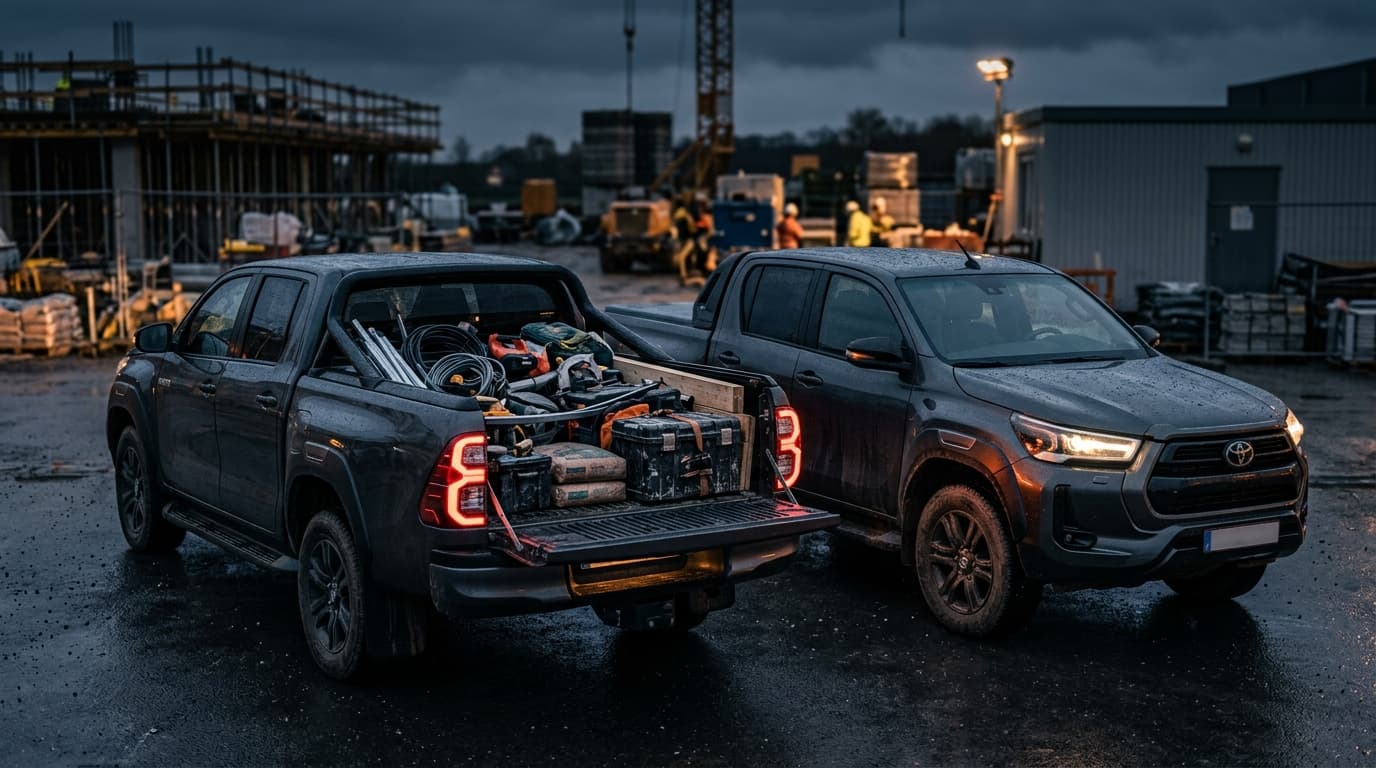
In Belgium, the double cab carries five people but shortens the bed; the single cab keeps a long bed, more useful on a job site. What really decides is light commercial vehicle homologation (N1) and recoverable VAT — and both depend on the configuration and, above all, on the name on the registration certificate.
Single or double cab pickup: which one in short?
Take the double cab if the pickup also has to carry a crew or a family, and you accept a bed of around 1.50 m. Keep the single cab if you load long items flat every day: its bed often exceeds 2.20 m. In both cases, towing stays identical at 3,500 kg braked.
The choice is not about taste but real use and taxation. A fitter who drives alone and carries profiles has every reason to take the single cab. A small-crew boss who brings two workers to the site needs the double cab, even if a trailer handles the long loads.
On a real job site, the double cab mostly means not leaving a colleague behind at the depot. But every added row of seats eats into the bed, and can weaken van homologation if the maker shortened the load floor. That is the real Belgian trap — far more than comfort.
What is the difference between single, extra and double cab?
Three configurations exist, from most site-focused to most family-oriented. The single cab offers two to three seats and the longest bed. The extra cab (also called king or space cab) adds two folding jump seats behind and an intermediate bed. The double cab provides five proper seats and the shortest bed.
Each configuration matches a trade. The single cab targets the sole trader, the landscaper, the roofer loading long materials. The extra cab helps with an occasional passenger or sheltered storage without sacrificing the whole bed. The double cab suits crews and mixed work-personal use, at the cost of a reduced load floor.
The number that matters: the bed gap between the two extremes reaches around 70 cm. On a Ford Ranger, you go from roughly 2.30 m in single cab to 1.55 m in double cab. That gap decides what you load flat without a trailer: a 2.50 m plasterboard sheet fits in no double-cab bed with the tailgate up.
Is a double-cab pickup still a light commercial vehicle in Belgium?
Yes, in most cases. The Belgian tax authority treats the pickup as a van regardless of cab configuration, as long as it meets the technical criteria and is registered to a company or a self-employed person. On that condition, it stays 100% deductible and its 21% VAT is recoverable.
Two technical criteria count for the double cab. First, the bed must be at least 50% of the wheelbase (the mobility authority only requires 30%, hence differing assessments). Second, the load area must be separated from the cabin by a rigid, permanent and indivisible partition across the full width and height, with a fixed horizontal floor free of anchor points for extra seats. A factory pickup almost always ticks these boxes; a home-made conversion that alters the partition can break them.
Above all, unlike company cars, light commercial vehicles escape the 2026 tax reform. A pickup homologated as a van stays 100% income-tax deductible, whether diesel, hybrid or electric. That is the argument tipping many sole traders from a company SUV to a pickup: at a similar budget, the deductibility is not clipped.
How much bed do you lose with a double cab?
Count on around 0.70 m less bed than a single cab. You move roughly from 2.20-2.30 m to 1.50-1.55 m of usable length. Floor volume drops accordingly, and payload dips slightly, since the double cab is heavier unladen.
In practice, the double cab stays perfect for short pallets, bags, tools and loose material. It struggles with long loads: structural timber, tubes, scaffolding, sheets. For those, the single cab or a trailer becomes essential again. Payload, however, holds up in both cases: the Belgian market's four contenders top a tonne even in double-cab form.
| Model | Double-cab bed | Double-cab seats | Double-cab payload | Single-cab option |
|---|---|---|---|---|
| Ford Ranger | ~1.55 m | 5 | ~1,000 kg | Yes (bed ~2.30 m) |
| Toyota Hilux | ~1.53 m | 5 | ~1,025 kg | Yes (bed ~2.32 m) |
| Isuzu D-Max | ~1.57 m | 5 | ~1,105 kg | Yes (bed ~2.33 m) |
| VW Amarok | ~1.54 m | 5 | ~1,130 kg | No (double cab only) |
What we would avoid: choosing the double cab "just in case" without measuring your typical load. If you mostly carry long items, you will pay for five seats to drive two-up with a bed that is too short. Conversely, taking the single cab when you regularly carry two workers means sending the crew in another vehicle.
Can you register a pickup in your own name as a private buyer?
Yes, but the tax bill changes entirely. Since 1 January 2022 in Wallonia and 1 January 2023 in Flanders, a pickup — single or double cab — ordered and registered in a private individual's name, on their national register number, is taxed at passenger-car rates. The van advantage on registration tax and road tax disappears.
The difference is not trivial. A big 3-litre diesel, taxed at car rates based on fiscal horsepower and CO2, can cost several hundred euros a year more than the flat van rate. Over a pickup's ownership period, the gap runs into thousands of euros. The professional exception covers pickups registered to a legal entity, or to a self-employed person holding a business number — even for a secondary activity.
On the Belgian market, this rule cooled the private buyers who used to purchase a double cab as a family leisure vehicle. Today, a pickup only makes fiscal sense when carried by a professional activity. Without a business number, you may as well look at a proper SUV, often more comfortable for the same running budget.
Single or double cab for both work and personal use?
For deliberately mixed use, the double cab is the only coherent choice: it carries the family at the weekend and the crew during the week. But private use is paid for on VAT. The tax authority then applies a flat deduction rate of 85% (mainly professional) or 35% (mainly private), instead of the 100% reserved for exclusively professional use.
This point traps the self-employed who buy the pickup "half work, half personal." On paper, the double cab ticks every box. In reality, as soon as private trips weigh in, recoverable VAT shrinks and deductibility drops to the flat rate. The maths often still wins against a car, but less spectacularly than the "100% recoverable" pitched at the counter.
What we would avoid: declaring 100% professional use on a visibly family vehicle. In an audit, the administration looks at actual use — children on board, caravan tow bar, weekend mileage. Better to declare honest mixed use at the 85% flat rate than risk a reassessment on an untenable 100%.
Ranger, Hilux, Amarok or D-Max: which configurations are available?
The Belgian offer narrows to four models, and not all of them offer every cab. The Ford Ranger, the best seller, comes in single, extra and double cab — the most flexible for picking your configuration. The Toyota Hilux and the Isuzu D-Max also cover single and double cab, with a robustness reputation that speaks to high-mileage users.
The second-generation Volkswagen Amarok (2023), born from the alliance with Ford, is sold only as a double cab on the Belgian market: it embraces a premium positioning, closer to an SUV than a bare work tool. For a long-bed single cab, you therefore turn to the Ranger, the Hilux or the D-Max.
At resale, the single cab remains a niche market, mainly sought by construction and farming trades. The double cab resells more easily to the general public, which supports its residual value. The Hilux and the D-Max hold their value particularly well in rugged trim, whereas the premium Amarok depreciates more on high-end finishes.
Our verdict
The single-or-double-cab choice comes down to two concrete questions: what do you load, and who has to get on board? Single cab for long flat loads solo, double cab for a crew or mixed use, extra cab for the compromise. Towing capacity settles nothing: 3,500 kg everywhere.
The real Belgian trade-off is fiscal. As long as the pickup is carried by a business number and meets the van's technical criteria, it stays 100% deductible and recovers its VAT, 2026 reform included. Registered in a private individual's name, it becomes a car in the tax authority's eyes, and loses all its appeal. Before ordering, check the certificate of conformity, measure your typical load and run the VAT calculation according to your share of private use.
To compare the models against each other, see our Ranger, Hilux and Amarok comparison for tradespeople. Still hesitating between an open bed and enclosed volume? The pickup or van guide decides by use, and the guide to vans in Belgium places each segment. Not sure of your configuration? A short quiz points you in the right direction.
Sources: Belgian Federal Public Service Finance (technical criteria for the fiscal van, bed-to-wheelbase ratio, double-cab partition); Moniteur Automobile (taxation of light commercial vehicles for private use in Belgium); Accountable and Athlon Belgium (deductibility and VAT of N1 light commercial vehicles, 2026); link2fleet (LCV and pickup taxation, 2026); FEBIAC (2025 light commercial vehicle registrations, +7.6%); What Car? and manufacturers (bed dimensions and payloads for Ranger, Hilux, D-Max, Amarok, 2026).
Pick-up comparator
Compare all pick-up side by side.
Compare now →
Frequently asked questions

Damien, 44 ans, a géré pendant douze ans la flotte d'utilitaires d'une PME de second œuvre dans la région de Namur : achats, entretien, revente, et les galères de carrosserie qui vont avec. Il a vu passer des dizaines de Trafic, Transporter et Master, et il sait ce qui casse, ce qui se revend bien et ce qui coûte cher à l'usage. Il a lancé ce site pour comparer les utilitaires sur ce qui compte vraiment en Belgique : charge utile réelle, volume utile, TVA récupérable et coût au kilomètre — pas la brochure du concessionnaire.