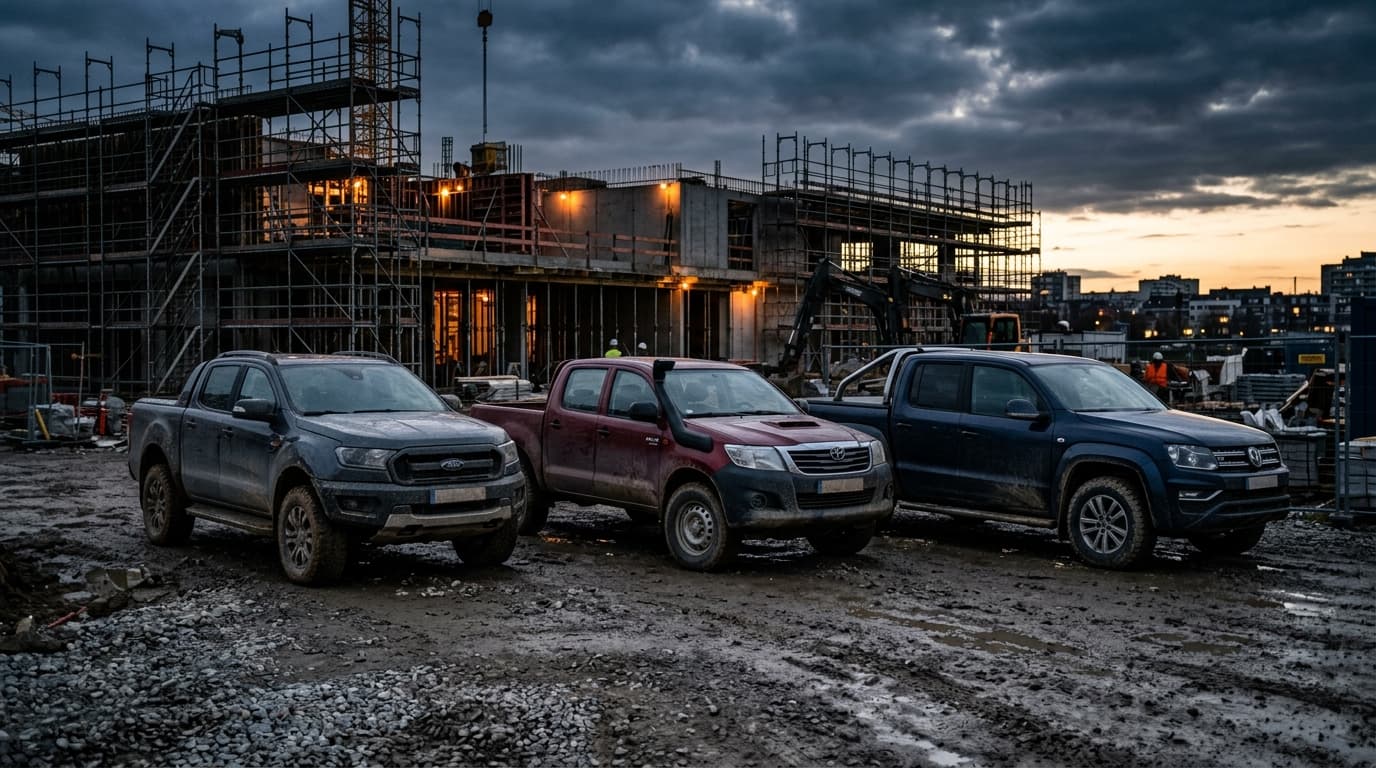
In Belgium, the pickup remains the tool of demanding job sites: open load bed, 3,500 kg of towing capacity, and favourable tax treatment that sidesteps the 2026 reform. Ford Ranger, Toyota Hilux or VW Amarok — the choice comes down to three criteria: what you tow, the tax treatment of your use, and the ex-VAT budget.
Ranger, Hilux or Amarok: which one in short?
If budget rules, take the Ranger diesel: it enters the range cheaper and covers 90% of a Belgian tradesperson's needs. If you work on difficult terrain or clock high mileage on rough tracks, the Hilux is hard to beat. If you want SUV-level comfort in a load bed, the Amarok answers — at a noticeably higher price.
On a real job site, the pickup earns its place when a city van or medium van no longer cuts it: bulky flat loads, towing a site trailer, getting through muddy ground. If you mainly carry boxes and tools, a medium van like the Trafic or the Vivaro is often more practical — and cheaper to buy.
All three models share the same towing capacity (3,500 kg braked) and a broadly similar footprint. What separates them: entry price, long-term robustness, and interior fit and finish.
What exactly is a pickup in Belgium?
A pickup is a utility vehicle with an open load bed and a separate cab. In double-cab form, it carries four to five people with a load bed at the rear. In single or extra-cab form, the bed is longer — more useful on site, but less practical for daily driving.
In Belgium, a pickup can be homologated as a light commercial vehicle (N1, up to 3.5 t GVW) or as a passenger car, depending on its configuration. Homologation determines the tax treatment. A double-cab pickup must meet precise technical criteria — in particular a bed-to-cab ratio — to retain N1 status. Check the certificate of conformity before signing: without N1, there is no full VAT recovery.
The number that matters: interior bed length. A Ranger double cab offers around 1.55 m of usable bed; a Hilux double cab around 1.53 m; an Amarok around 1.55 m. These lengths limit what you slide in flat. For pipes or planks over 2 m, an open trailer is still necessary.
Which pickup carries the most in Belgium?
On payload, the Ford Ranger and Mitsubishi L200 are among the most generous: up to around 1,000 kg depending on the version. The Hilux runs between 950 and 1,035 kg and the Amarok around 1,000 kg depending on trim. In practice, the few dozen kilograms of difference matter little: what really counts for a construction tradesperson is towing capacity — identical at 3,500 kg braked for all four models.
3,500 kg is a loaded site trailer with a sub-2.5 t mini digger, a full skip trailer, or a flatbed with roofing materials. It is also the maximum permitted on a B licence. On this criterion, none of the three pulls ahead — they are all homologated at this ceiling.
| Model | Approx. payload | Max towing (braked) | Engine | Entry price (ex-VAT, BE) |
|---|---|---|---|---|
| Ford Ranger diesel | ~870–1,000 kg | 3,500 kg | 2.0 EcoBlue TDCi | from ~€34,000 |
| Ford Ranger PHEV | ~870 kg | 3,500 kg | 2.3 Plug-in Hybrid | from ~€43,500 |
| Toyota Hilux MHEV 48V | ~950–1,035 kg | 3,500 kg | 2.8 D-4D 48V | from ~€51,090 |
| VW Amarok V6 TDI | ~1,000 kg | 3,500 kg | 3.0 V6 TDI 255 hp | from ~€50,200 |
| Mitsubishi L200 | ~1,000 kg | 3,500 kg | 2.2 DI-D | from ~€32,000 |
What we would avoid: choosing the single cab purely for the longer bed if you carry employees or need rear passengers. The extra cab is a useful compromise — slightly longer bed, two reduced rear seats — but rear comfort drops fast on longer journeys.
How much does a new pickup cost in Belgium?
Prices vary widely by trim and engine. The Mitsubishi L200 remains the most accessible, from around €32,000 ex-VAT. The Ford Ranger diesel entry model starts at around €34,000–35,000 ex-VAT on professional offers; the PHEV Wildtrak version sits around €43,500–46,400 ex-VAT depending on current Belgian promotions in June 2026. The Toyota Hilux MHEV 48V starts at around €51,090 ex-VAT and the fully electric Hilux BEV at around €57,438 ex-VAT. The VW Amarok lists at around €50,200 ex-VAT depending on trim.
On the Belgian market, end-of-quarter pro deals often shave €2,000–5,000 ex-VAT off these list prices. Fleet discounts increase with fleet size: from six vehicles, Ford offers additional terms. Always negotiate on the all-in ex-VAT price, not on the monthly leasing payment.
Ford Ranger or Amarok: which is the more modern?
The Ranger (T6.2 generation, 2022) and the Amarok (second generation, 2023) actually share a common technical base — the result of the Ford-Volkswagen alliance. Under the skin, the platform and several mechanical components are similar; above it, the interiors and presentation are quite different.
The Amarok pushes cabin comfort significantly further: 12-inch screens, heated seats standard on higher trims, interior quality that rivals a premium SUV. The Ranger plays accessibility and a broad range — more trims, more configurations, lower prices. For a tradesperson who brings clients along or wants a presentable vehicle, the Amarok convinces. For those after the no-frills work tool, the Ranger wins at normalised specification.
On a real job site, the gap between the two shows less in the bed — identical in capacity — than at the wheel and in how you arrive. A sole trader alone does not exploit it; an independent who receives clients does.
Is the Toyota Hilux really the most reliable?
On this point, the Hilux's reputation is not marketing mythology. Mining companies, NGOs in crisis zones and farmers on hard ground did not choose the Hilux for its infotainment: they chose it because it runs where others stop. In Belgium the context is different — your tracks are not the Sahel — but the logic holds at high mileage on rough construction sites and Nordic weather.
The current-generation Ranger has made significant progress in mechanical reliability. Its more complex electronics — driver aids, PHEV systems — raise more questions at 200,000 km than the simpler, proven mechanics of the Hilux. At 100,000 km on Belgian roads, both hold up. At 250,000 km in intensive fleet use on difficult terrain, the Hilux pulls ahead.
At resale, the Hilux holds a higher residual value on the Belgian used market: its robustness image is bankable. A well-maintained ex-fleet Ranger resells well too, but with a valuation gap in the Hilux's favour at high mileage and in off-road specification.
Can you recover VAT on a pickup in Belgium?
This is the question that changes the whole equation. If your pickup is N1-homologated and used 100% for business, you recover 100% of the VAT and deduct 100% of running costs. For mixed use, the Belgian tax authority applies a flat rate: 85% (mainly professional) or 35% (mainly private).
Better still: unlike company cars, light commercial vehicles — N1 pickups included — escape the 2026 tax reform. Ranger, Hilux or Amarok homologated N1 remain 100% deductible for income tax, diesel or electric. This favourable regime is a strong argument against a company SUV, which now faces the new progressive deductibility rules.
Should you pick diesel or electric in 2026?
For the vast majority of Belgian tradespeople, diesel remains the most rational powertrain in 2026. The electric option exists — the Toyota Hilux BEV has been available since mid-2026, at around €57,438 ex-VAT — but range drops sharply under towing load, and fast-charging density on construction sites or in rural areas is still insufficient for unconstrained daily use.
The Ranger PHEV is an interesting compromise for urban tradespeople covering 50 km or less per day and charging at the depot: it runs on electric in town, sidesteps LEZ concerns, and switches to diesel when towing. But it costs around €8,000–10,000 ex-VAT more than an equivalent diesel Ranger — a gap that needs time to pay back.
What we would avoid: switching to electric on a pickup without mapping your real routes and charging access. A pickup that spends as much time looking for a charger as loading materials costs more in practice than a well-sized diesel.
On the LEZ front, the situation is reassuring for now: since January 2026, it is Euro 5 diesel that is banned in Brussels. A Euro 6 Ranger, Hilux or Amarok (current production standard) clears the Brussels LEZ without restriction. Antwerp and Ghent have postponed their tightening. The trajectory is set, but not urgent for a Euro 6 vehicle bought new today.
Our verdict
The pickup earns its place for tradespeople who tow, load flat or work on difficult ground — where a medium van cannot go. In Belgium, N1 tax treatment makes it financially compelling when your use is genuinely professional. Choose the Ranger for accessibility and network density; the Hilux for long-term robustness; the Amarok if interior comfort is a selection criterion. And above all: check the homologation, negotiate the all-in ex-VAT price and calculate your VAT recovery — that is where the real price is decided.
To place pickups in the wider market, see our guide to vans in Belgium. If you are hesitating between a pickup and a medium van, the Trafic, Transit Custom and Vivaro comparison gives you the tools to decide. Not sure of your segment? A short quiz points you in the right direction.
Sources: FEBIAC (2025 light commercial vehicle registrations, +7.6%); Ford Belgium (Ranger and Ranger PHEV ex-VAT pro prices, June 2026); Toyota Belgium (Hilux MHEV and BEV prices, June 2026); Volkswagen Commercial Vehicles Belgium (Amarok list price, June 2026); Accountable and Athlon Belgium (VAT and N1 pickup deductibility, 2026); link2fleet (LCV and pickup taxation, 2026); Brussels Environment (Euro 5 diesel LEZ, 2026).
Pick-up comparator
Compare all pick-up side by side.
Compare now →
Frequently asked questions

Damien, 44 ans, a géré pendant douze ans la flotte d'utilitaires d'une PME de second œuvre dans la région de Namur : achats, entretien, revente, et les galères de carrosserie qui vont avec. Il a vu passer des dizaines de Trafic, Transporter et Master, et il sait ce qui casse, ce qui se revend bien et ce qui coûte cher à l'usage. Il a lancé ce site pour comparer les utilitaires sur ce qui compte vraiment en Belgique : charge utile réelle, volume utile, TVA récupérable et coût au kilomètre — pas la brochure du concessionnaire.