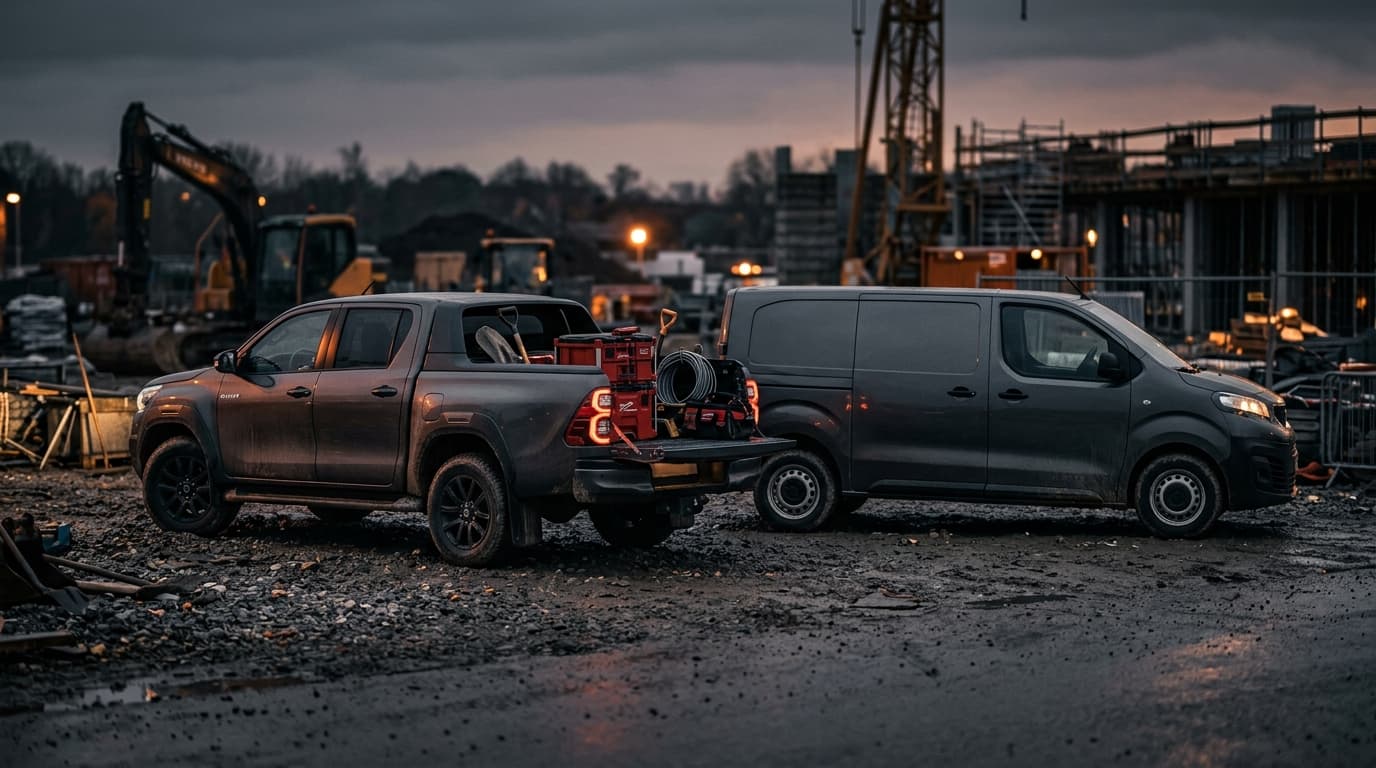
Between a pickup and a van, the choice is not about looks but about what you carry. The van puts more volume under cover, for less money. The pickup handles dirty, oversized loads and tows heavier. Here is how to decide by trade, with Belgian figures to back it up.
Pickup or van: which one in short?
For most tradespeople, it is the van. It offers more enclosed cubic metres, costs half as much as a double-cab pickup, and parks more easily in town. The pickup becomes relevant when you load dirty items, oversized gear, or tow heavy off the road.
The van remains the reference vehicle for building and delivery trades: electrician, plumber, heating engineer, courier. Goods travel dry, out of sight, and volume climbs fast. The pickup speaks mostly to landscapers, groundworkers, roofers and farmers — the ones who throw in rubble, sand or a six-metre ladder without worrying about the bodywork.
On a real job site, the real question is not "which is best" but "what do I load most often". A roofer hauling pallets of tiles and towing a lift does not think like a fitter storing power tools. Start from your typical load, the rest follows.
What differences in loading between pickup and van?
The van wins on volume and protection, the pickup on access and mess. A medium van opens 5 to 8 m³ enclosed, a large van climbs to 17 m³; a double-cab pickup's bed tops out around one usable cubic metre, but in the open air.
In practice, the van carries your gear dry and locked. You load standing in some large vans, you fit a bulkhead, you shelve. The pickup takes what sticks out: a trailer of branches, bags of cement that will make a mess, a tiller hauled in over the tailgate. The bed hoses down; a van floor does not.
The number that matters: payload. Medium van and pickup both hover around a tonne (900 to 1,300 kg depending on version), but the double-cab pickup sacrifices part of that payload to the weight of its structure and five-seat cab. If you load heavy every day, check the homologated payload on the registration, not the brochure.
| Criterion | Double-cab pickup | Medium van | Large van |
|---|---|---|---|
| Load volume | ~1 m³ (open bed) | 5–8 m³ (enclosed) | 10–17 m³ (enclosed) |
| Payload | ~900–1,100 kg | 1,000–1,300 kg | 1,000–1,600 kg |
| Towing (braked) | up to 3,500 kg | 2,000–2,500 kg | 2,500–3,000 kg |
| Load protection | Low (open air) | High (enclosed, locked) | High (enclosed, locked) |
| Rough terrain | Excellent (4x4, ground clearance) | Limited | Limited |
| Indicative new price | €45,000–60,000 | from ~€24,000 ex-VAT | from ~€30,000 ex-VAT |
Which vehicle to tow and get off the site?
The pickup, no argument. A recent Ford Ranger, Toyota Hilux or Volkswagen Amarok in double cab tows up to 3,500 kg braked, against 2,000 to 2,500 kg for a medium van. Add all-wheel drive and ground clearance, and you climb out of a muddy field where the van stays stuck.
That is the argument for outdoor trades. A landscaper towing a trailer of wood chip, a groundworker moving a mini-digger, a farmer hitching a trailer: the pickup does the work the van cannot. Four-wheel drive and approach angles change everything the moment you leave the tarmac, on a waterlogged meadow or a forest track.
The van is not out of the game, though. In rear-wheel drive or well-loaded front drive, a large van tows 2.5 to 3 tonnes and carries more gear under cover. What we would avoid: buying a pickup "just in case" to tow twice a year. If heavy towing and off-road are not your daily reality, you pay dearly for a capacity you do not use.
Pickup or van: which costs more?
The pickup, by a wide margin. A new medium van starts around €24,000 to €27,000 ex-VAT, while a recent double-cab pickup sits between €45,000 and €60,000 depending on trim. At purchase, the gap runs from one to two for comparable payload.
Use widens the difference further. A diesel double-cab pickup is heavy and unaerodynamic: count 8 to 10 l/100 km in real conditions, often above an equivalent medium van. Over 30,000 km a year, a few litres per 100 km end up showing on the fuel bill.
On the Belgian market, the used segment rebalances the match a little. Ex-fleet vans are everywhere and resell at slashed prices; pickups, rarer and prized for leisure, depreciate more slowly but sell higher. At resale, a well-kept Hilux holds a strong value — as much a buying argument as a trap if you pay full price new without using its capabilities.
What taxation for a pickup in Belgium?
Good news: in Belgium, the pickup remains a commercial vehicle for tax. The SPF Finances distinguishes four families of light commercial vehicles, and pickups — single cab, extended cab and double cab — are all in them. So you do not fall into the penalising company-car regime.
In short, for professional use, the VAT (21%) is 100% recoverable on the purchase and the running costs, and the charges (fuel, maintenance, insurance, financing) stay deductible for income tax. Same treatment as a van, where a regular saloon sees its VAT capped at 50% and its deductibility indexed to CO2 emissions.
Two caveats to know. First, under the latest rules, the commercial vehicle must be registered to a professional — self-employed, secondary self-employed or a company listed in the Crossroads Bank for Enterprises — to unlock these benefits. Second, a conversion that turns the vehicle into passenger transport (added benches or glazing) can trigger reclassification. What we would avoid: committing on the tax promise alone without checking your exact case with your accountant or the SPF Finances — the usage details make the difference.
Pickup or van against low-emission zones?
Neither has an edge: what counts is the fuel and the Euro standard, not the body style. An old diesel pickup is blocked in a low-emission zone just like an old van, and a recent Euro 6d model gets through anywhere.
The stake is concrete in Brussels. Since 1 January 2026, Euro 5 diesel is banned from the LEZ, and fines for the affected commercial vehicles start on 1 July 2026, at €350 a year. Antwerp and Ghent postponed their tightening, but the trajectory is the same everywhere: old diesels leave the cities, pickups included.
If you drive mostly in a regulated urban zone, the question comes up before you buy. A recent combustion pickup has its place there, but an electric model — still rare and costly in this body style — or an electric van settles the matter in one move. For mostly rural or peri-urban use, the constraint is far lighter, and the diesel pickup keeps all its sense.
Our verdict
There is no universal winner between pickup and van: there is the vehicle that fits your load and your terrain. The van stays the default choice for most tradespeople — more volume under cover, cheaper to buy and to run, simpler in town. The pickup takes the lead when you load dirty, oversized items, tow heavy, or leave the tarmac.
Start from your most frequent load and your worst day, not from a towing capacity you will use twice a year. And on Belgian tax, both play in the same league: commercial vehicle, recoverable VAT, deductible costs — the advantage is won on use, not on the body style.
To place these vehicles in the wider market, see our van comparator and the general guide to vans in Belgium. If the pickup tempts you, our Ranger, Hilux or Amarok comparison details the three references. Not sure of your choice? A short quiz points you in the right direction.
Sources: FEBIAC (2025 light commercial vehicle registrations); SPF Finances (commercial-vehicle categories and deductibility); Moniteur Automobile and AutoScout24 (Belgian prices and versions); Ford Belgium and Toyota Belgium (towing capacity and payload, 2026); Brussels Environment and Test-Achats (low-emission zones 2026); Accountable and Athlon (VAT and taxation of light commercial vehicles).
Pick-up comparator
Compare all pick-up side by side.
Compare now →
Frequently asked questions

Damien, 44 ans, a géré pendant douze ans la flotte d'utilitaires d'une PME de second œuvre dans la région de Namur : achats, entretien, revente, et les galères de carrosserie qui vont avec. Il a vu passer des dizaines de Trafic, Transporter et Master, et il sait ce qui casse, ce qui se revend bien et ce qui coûte cher à l'usage. Il a lancé ce site pour comparer les utilitaires sur ce qui compte vraiment en Belgique : charge utile réelle, volume utile, TVA récupérable et coût au kilomètre — pas la brochure du concessionnaire.