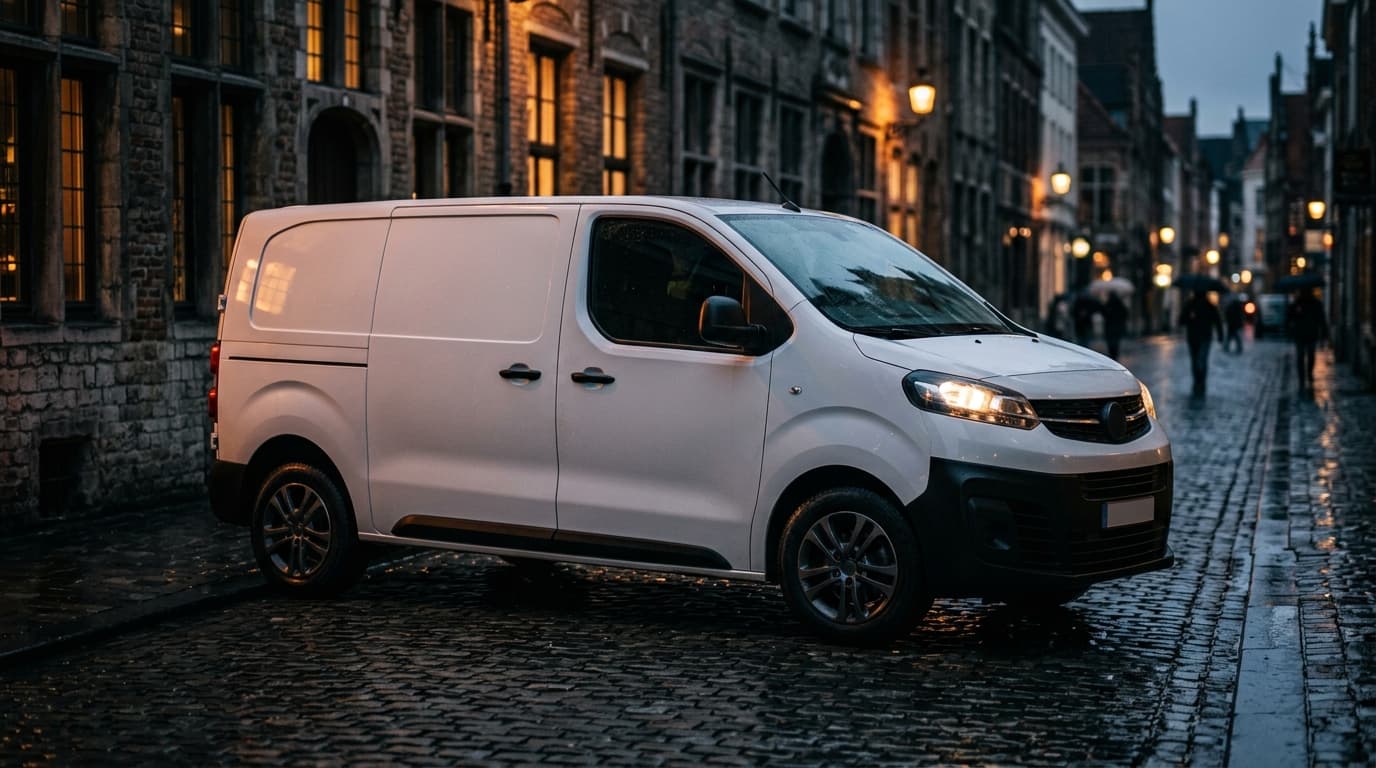
Opel Vivaro, Peugeot Expert, Citroën Jumpy, Fiat Scudo and Toyota Proace are the same mid-size van under five badges: same factory, same mechanicals, same payload. What separates them in Belgium comes down to warranty, price, network and resale, not the sheet metal. Let's sort it out.
Vivaro, Expert, Jumpy and Proace: is it really the same van?
Yes. These five vans are one and the same vehicle, built on the EMP2 platform at the Hordain plant in northern France. Peugeot Expert, Citroën Jumpy, Opel Vivaro, Fiat Scudo and Toyota Proace share the chassis, the engines, the body and the load dimensions. This is badge engineering: a different grille design, a reworked dashboard, and five commercial names for a single product.
In practice, a Vivaro and an Expert of the same length have the same load volume, the same payload and the same fuel consumption. The wear parts, service intervals and BlueHDi engines are identical. The Toyota Proace is itself a rebadged Expert, assembled on the same line — Toyota does not build its own mid-size van in Europe, it buys Stellantis's.
On a real job site, that means one simple thing: don't compare these five on their specs, they are the same. Compare them on what actually changes — everything around the vehicle.
What technical differences between these five twins?
None on the mechanicals, a few on the trim and finish. The five come in three body lengths and one height, with the same engine range and the same electric version.
| Feature | Common to all five |
|---|---|
| Platform / factory | EMP2, assembled at Hordain (France) |
| Lengths | Compact 4.60 m · Standard 4.98 m · Long 5.33 m |
| Load volume | 4.6 to 6.1 m³ depending on length |
| Payload | up to ≈ 1,400 kg |
| Diesel | BlueHDi 1.5 (100 / 120 hp) and 2.0 (145 / 180 hp), manual or EAT8 |
| Electric | 50 or 75 kWh battery, ≈ 230 to 350 km WLTP |
The real differences are elsewhere: the front-end design (the Vivaro and Proace have their own identity, the three "Latin" Stellantis vans look more alike), the trim levels each brand offers, and the dashboard ergonomics. Nothing that changes the working day.
The number that matters: the electric version cuts payload by 100 to 200 kg compared with the equivalent diesel, because of the battery. If you load heavy, check the homologated payload of the exact trim, not the catalogue maximum.
Which has the best warranty in Belgium?
The Toyota Proace, and the gap is not small. It's the one argument that truly sets one badge apart from another for a professional who keeps a van a long time.
In Belgium, Toyota offers the Toyota Relax warranty: once the factory warranty expires, it extends free of charge by one year at every service done in the approved network, up to 10 years or 185,000 km. It's automatic, free, and it applies to commercial vehicles too. In front of it, the Stellantis badges stick to the 2-year factory warranty. Opel adds a possible extension up to 6 years or 160,000 km tied to network servicing; Peugeot, Citroën and Fiat rely on more conventional paid extension packages.
For a tradesperson doing 25,000 km a year and keeping the van eight to ten years, the difference is real: an injector or an EAT8 gearbox failing at 160,000 km is a four-figure bill landing on the Stellantis badge, while it stays covered on the Proace. At resale, this transferable warranty also supports the value of the used Toyota.
How much does a Vivaro, an Expert or a Jumpy cost in Belgium?
Count on from about €22,000 to €24,000 ex-VAT for a diesel entry version, and from €26,000 ex-VAT for electric. The five badges sit within a whisker of each other at comparable equipment.
The Fiat Scudo regularly plays the cheapest entry, closely followed by the Opel Vivaro (around €22,190 ex-VAT for a 120 hp manual diesel in 2026) and the Peugeot Expert. The Toyota Proace sits a notch higher, but its long warranty justifies the gap if you keep the vehicle. Careful, though: the list price says little. On this segment, it's the network and fleet discounts that make the real difference — the same Expert can come out €3,000 to €5,000 cheaper at a dealer with volume to move.
On Belgian taxation, everything is identical from one badge to the next: for exclusively professional use, a light commercial vehicle recovers 100% of the VAT and stays 100% deductible, without being caught by the 2026 company-car reform.
Diesel or electric on these vans: which to choose?
It depends on your mileage and your city. The electric version (Vivaro-e, e-Expert, ë-Jumpy, E-Scudo, Proace Electric) targets urban rounds; the BlueHDi diesel stays the safe bet for high-mileage drivers.
With a 75 kWh battery, these vans claim about 330 to 350 km WLTP, that is 230 to 260 km real in professional use, less in winter and loaded. For a plumber or electrician doing 80 to 120 km a day and charging at the depot overnight, that's enough. The killer argument in Belgium remains low-emission-zone access: in Brussels, Euro 5 diesel has been banned from the LEZ since 1 January 2026, with fines starting in July 2026. An electric van clears it with no restriction.
For loaded motorway mileage — a daily Liège–Antwerp run — diesel keeps the edge on range and cost. What we would avoid: taking the electric "to be safe" without checking your worst round of the day. The average always fits; it's the 200 km day in January that decides.
Which to choose for your trade?
The right choice depends less on the badge than on your usage profile. Three cases cover most Belgian tradespeople and fleets.
The self-employed tradesperson who keeps a van eight to ten years and drives a lot has the most to gain with the Toyota Proace: the Relax warranty covers the period when the Stellantis twins are already out of warranty, and the perceived reliability supports resale. The SME fleet manager reasons differently: they look at the discount obtained, the density of the service network to limit downtime, and the residual value — here, Peugeot Expert, Citroën Jumpy and Opel Vivaro hold up well thanks to a dense dealer network in Belgium. For a tight budget or a secondary vehicle, the Fiat Scudo often offers the best entry ticket, provided you accept a slightly thinner network.
Which are the best Stellantis twins in Belgium?
Compared on what matters to a Belgian pro — warranty, network, price, resale — here's how the five badges of one mid-size van stack up.
| Badge | Strength | Reservation |
|---|---|---|
| Toyota Proace | Warranty up to 10 years / 185,000 km, resale | Slightly higher entry price |
| Opel Vivaro | Good price / network balance, 6-year extension possible | Plain front end |
| Peugeot Expert | Very dense network, refined trim | 2-year factory warranty only |
| Citroën Jumpy | Comfort, aggressive fleet pricing | 2-year factory warranty only |
| Fiat Scudo | Often the cheapest to buy | Thinner network |
Our verdict
These five are the same mid-size van, an excellent choice in the segment. The badge changes neither the volume, nor the payload, nor the consumption. It changes the warranty (clear Toyota Proace advantage), the network (advantage to the three historic Stellantis brands), and sometimes the entry price (Fiat Scudo). Choose by how long you'll keep it and your priority: long coverage, or discount and service proximity.
To go further, compare on what matters: our van comparator and the general guide to vans in Belgium. Not sure of your segment? A short quiz points you in the right direction.
Sources: Flotauto and L'Argus (EMP2 platform, badge engineering); Toyota Belgium (Toyota Relax warranty 10 years / 185,000 km); Opel Belgium and AutoScout24 (Vivaro 2026 pricing); City of Brussels and Test-Achats (LEZ 2026); Belgian FPS Finance (VAT and deductibility of light commercial vehicles); Moniteur Automobile (engines and electric versions).
Fourgons moyens comparator
Compare all fourgons moyens side by side.
Compare now →
Frequently asked questions

Damien, 44 ans, a géré pendant douze ans la flotte d'utilitaires d'une PME de second œuvre dans la région de Namur : achats, entretien, revente, et les galères de carrosserie qui vont avec. Il a vu passer des dizaines de Trafic, Transporter et Master, et il sait ce qui casse, ce qui se revend bien et ce qui coûte cher à l'usage. Il a lancé ce site pour comparer les utilitaires sur ce qui compte vraiment en Belgique : charge utile réelle, volume utile, TVA récupérable et coût au kilomètre — pas la brochure du concessionnaire.