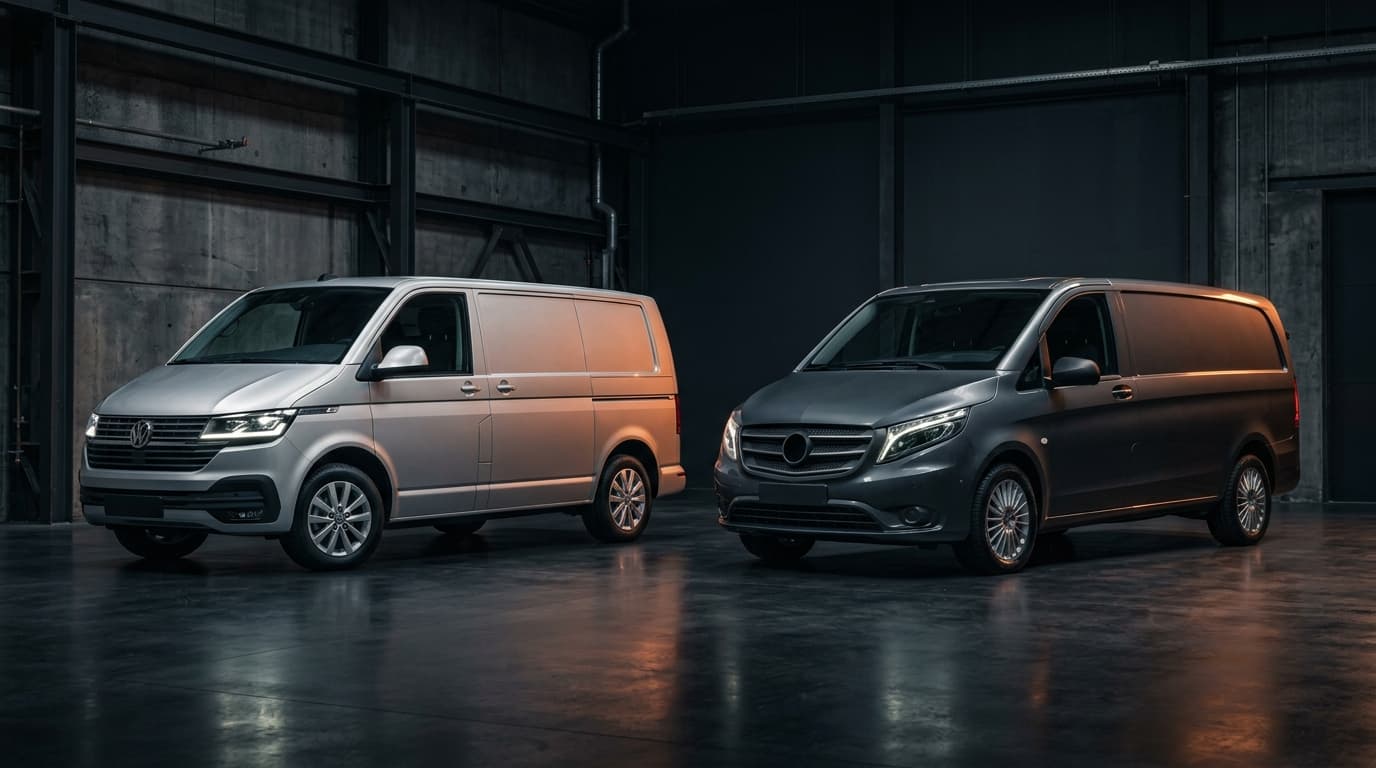
Between the Mercedes Vito and the Volkswagen Transporter, the Transporter loads more and starts cheaper; the Vito banks on finish, ride comfort and a long-range electric version. The right choice comes down to three numbers: your payload, your volume and your ex-VAT budget. We compared what matters in Belgium.
Vito or Transporter: which to choose, in short?
To load heavy and bulky for the best price, take the Volkswagen Transporter: it climbs to 9 m³ and 1.33 t for an entry price around €33,491 ex-VAT. For comfort, perceived quality and the longest electric range, the Mercedes Vito takes the lead, at the cost of a higher entry ticket and a volume capped at 6.6 m³.
These two vans play the top of the medium segment, but with opposite logics. The Transporter T7 was born in 2024 from the Ford-Volkswagen alliance: technically a rebadged Ford Transit Custom, modern and generous on volume. The Vito stays on its own Mercedes base, more focused on comfort and standing than on litres of load.
On a real job site, the Transporter is mainly there to carry — it swallows a pallet crosswise and heavy loads. The Vito is also there to drive: a polished driving position, sound insulation, car-like road manners. The first is a tool, the second a tool that looks after the driver. Everything follows from that.
What is a premium medium van?
A premium medium van is a commercial vehicle 5 to 5.4 m long offering 5 to 9 m³ of load volume, but positioned on finish, comfort and brand image rather than on price per litre alone. The Vito and Transporter are its two representatives on the Belgian market, facing the more mainstream Renault Trafic and Ford Transit Custom.
In practice, "premium" does not mean more volume — often the opposite. The Vito trades part of its load for life on board, and the Transporter charges for its modernity and VW badge above an otherwise twin Transit Custom. You pay for the feel at the wheel, the active safety, the resale value and the showcase effect in front of a client.
The number that matters: the entry-price gap with a mainstream van. A Renault Trafic starts around €29,310 ex-VAT when the Transporter starts at €33,491 ex-VAT and the Vito higher still. That €4,000-plus gap is justified if you drive a lot or if the vehicle carries your image; not if you just need to load.
Which loads the most (volume and payload)?
The Transporter, no debate. It climbs to around 9 m³ of load volume and 1.33 tonnes of payload, where the Vito tops out at 6.6 m³ and around 1,125 kg. The reason is simple: the Transporter comes in two lengths with a wide body designed for a pallet crosswise, while the Vito is only offered with a low roof, which caps its volume.
The Vito keeps one trump: three body lengths (L1, L2, L3, from 4.90 to 5.37 m), one more than the Transporter. Its load length reaches nearly 3.06 m in L3, enough to slide long loads through without stretching the footprint too far. But on cube volume and raw payload, it stays behind.
| Criterion | Mercedes Vito | VW Transporter (T7) |
|---|---|---|
| Lengths | 3 (L1 / L2 / L3) | 2 (L1 / L2) |
| Load volume | up to 6.6 m³ | 5.8 to 9 m³ |
| Max payload | ~1,125 kg | ~1,330 kg |
| Load length | up to ~3.06 m (L3) | ~2.60 m (L1) to ~3 m (L2) |
| Platform | own Mercedes base | twin of the Ford Transit Custom |
What we would avoid: picking the Vito thinking "load big". If your trade is volume — furniture, boxes, bulky items — the Transporter, or even a large van, will fit better. The Vito shines when the load stays moderate and the mileage, instead, climbs. To place these two against the rest of the segment, see our best medium van in Belgium comparison.
How much do the Vito and Transporter cost in Belgium?
The Transporter starts clearly cheaper. Count from around €33,491 ex-VAT for a Transporter panel van 2.0 TDI 150, and €34,280 ex-VAT as a double cab. The Mercedes Vito sits above, true to its rank: its diesel entry price exceeds the Transporter's, and the gap widens once the Mercedes trims are ticked.
These list prices do not tell the whole story. On the Belgian market, end-of-quarter pro deals often shave €2,000 to €4,000 ex-VAT, and the discount effect is stronger at Volkswagen, which pushes hard on volume. Mercedes defends its prices but polishes the leasing offers for fleets, where most of its van sales happen.
Vito or Transporter: which for an SME fleet?
For a fleet thinking cost per kilometre and image, the maths depend on the trade. The Transporter suits SMEs that load and drive a lot, with a more favourable purchase price and volume per litre. The Vito is for service firms, pro shuttles or taxis where comfort and standing in front of the client count as much as the load.
The fleet manager does not read the spec sheet like the tradesperson. They calculate over four years: purchase or lease, fuel or charging, maintenance, downtime, residual value. The Vito holds its value well at resale thanks to the Mercedes badge; the Transporter benefits from sustained demand and a dense network in Belgium. On after-sales, both brands have a solid footprint, with a slight density edge for Volkswagen.
On a real job site, one point often decides: the Vito offers, depending on the version, rear-wheel drive and all-wheel drive — useful for towing or driving loaded on slippery ground. The Transporter relies on front-wheel drive with 4MOTION optional on the most powerful versions. If you tow a heavy trailer daily, that detail weighs more than the seat colour. To frame your need across segments, the guide to vans in Belgium compares city vans, medium vans and large vans.
Should you choose the electric version (eVito or e-Transporter)?
If you mostly drive in town, yes — and the eVito has taken the lead on range. The new eVito claims up to around 432 km WLTP with its 90 kWh battery, by far the more enduring of the two. The e-Transporter sits around 300 km WLTP and starts near €46,213 ex-VAT. In real loaded use, remove 20 to 30%, more in winter.
The stakes are not just image. Since 1 January 2026, Euro 5 diesel is banned from the Brussels LEZ, with fines starting on 1 July 2026 (€350 a year for the affected vehicles). Antwerp and Ghent postponed their tightening, but the trajectory is set. An electric van clears every zone, with no expiry date.
The maths flip for whoever strings together long motorway rounds: diesel often stays more rational on time and cost, unless you have well-placed fast charging. What we would avoid: taking the e-Transporter for big interurban mileage counting on 300 km — you will spend too long at the charger. There, the long-range eVito or a diesel hold up better. To dig deeper, see our guide to the best electric van in Belgium.
How much VAT can you recover on these vans?
This is the tax argument that weighs more than the badge, and it applies to both. A van homologated as a utility vehicle and used 100% for business lets you recover 100% of the VAT. For mixed use, the Belgian administration applies a flat rate: 85% if use is mainly professional, 35% if mainly private.
Better still: unlike company cars, light commercial vehicles escape the 2026 tax reform. Vito and Transporter alike stay 100% deductible for income tax for professional use, whether diesel or electric. Running costs — fuel or charging, maintenance, insurance, leasing — follow the same deduction logic.
On a €35,000 ex-VAT van, moving from 85% to 100% of VAT recovery is more than €1,100 that stays in the cash flow. That is often more than the trim gap between two versions: before choosing the model, settle your real private-use share. The comparator helps you put the costs side by side.
Which resells and holds up best?
A close match, with two different profiles. The Vito leans on the premium Mercedes image and proven mechanicals to defend its value; the Transporter benefits from strong demand and a dense network, signs of resale liquidity. On the Belgian used market, well stocked with ex-fleet vans, both find a buyer easily.
At resale, what really makes the difference is the service history and body condition, not the logo. A serviced, clean Vito sells better than a battered Transporter, and vice versa. The Transporter T7 being recent, its used market is still young; the Vito, around longer in its current form, has a better-established value.
What we would avoid: picking the weakest engine "to save money". An undersized block hauling a permanently full van wears faster, drinks as much and resells worse than a well-born mid-range version. Not sure of your segment or engine? A short quiz points you in the right direction in two minutes.
Our verdict
The Vito and the Transporter aim at the same premium medium-van niche, but answer different questions. If you load big and watch the budget, the Transporter wins on volume, payload and entry price. If you drive a lot, carry your image in front of clients, or want the longest electric range, the Vito justifies its premium. Measure your real payload first, set your budget in ex-VAT, check the recoverable VAT — and let the current offer split two vans of standing.
Sources: FEBIAC (light commercial vehicle registrations 2025, +7.6%); Volkswagen Commercial Vehicles and link2fleet (Transporter T7 — ex-VAT prices, payload, volume, June 2026); Mercedes-Benz Belgium (Vito and eVito — dimensions, payload, range); Moniteur Automobile and AutoScout24 (Belgian versions and prices); L'argus (Transporter T7 and eVito reviews); Brussels Environment and Test-Achats (LEZ 2026); SPF Finances (VAT and deductibility of light commercial vehicles).
Fourgons moyens comparator
Compare all fourgons moyens side by side.
Compare now →
Frequently asked questions

Damien, 44 ans, a géré pendant douze ans la flotte d'utilitaires d'une PME de second œuvre dans la région de Namur : achats, entretien, revente, et les galères de carrosserie qui vont avec. Il a vu passer des dizaines de Trafic, Transporter et Master, et il sait ce qui casse, ce qui se revend bien et ce qui coûte cher à l'usage. Il a lancé ce site pour comparer les utilitaires sur ce qui compte vraiment en Belgique : charge utile réelle, volume utile, TVA récupérable et coût au kilomètre — pas la brochure du concessionnaire.