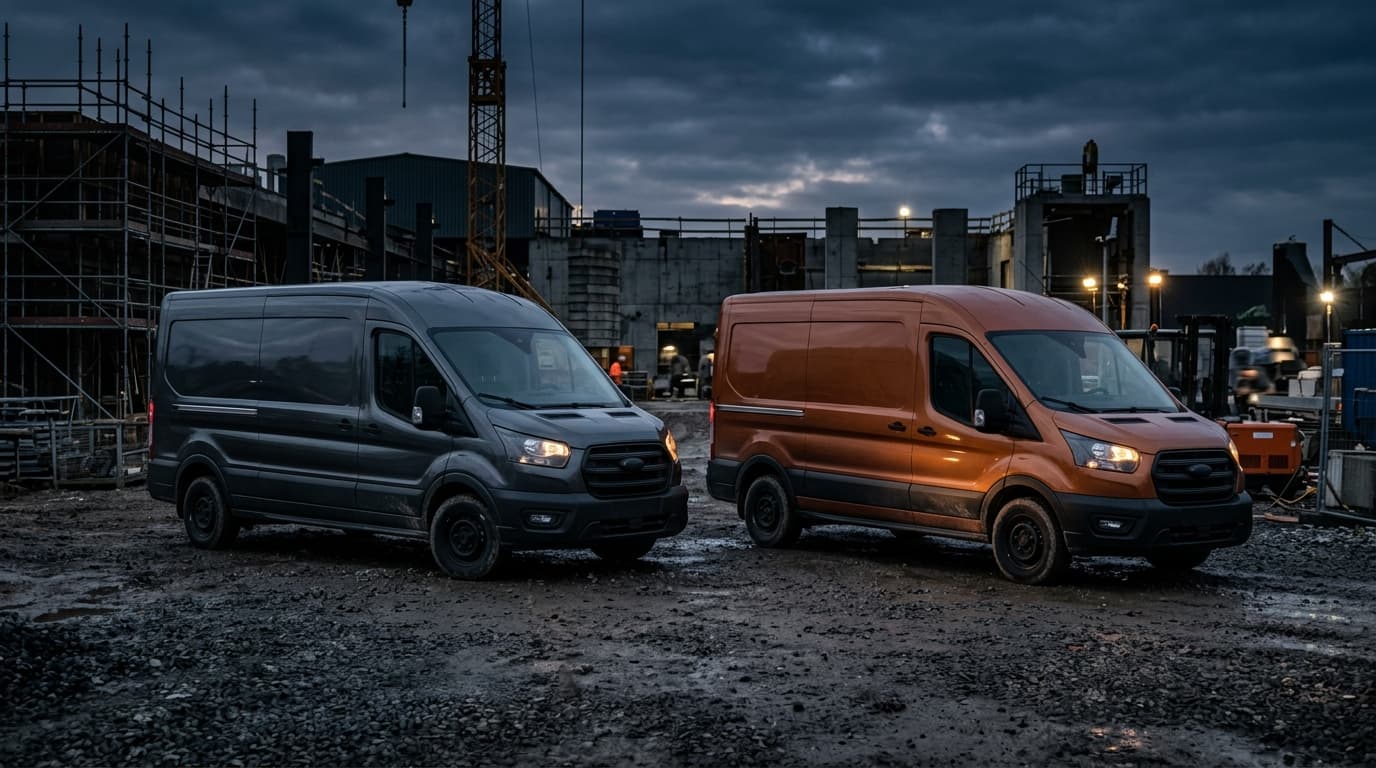
Between the Renault Trafic and the Ford Transit Custom, the Trafic starts cheaper and defends running cost; the Transit Custom loads a bit more, polishes the tech and is the only one to offer a plug-in hybrid. The right choice comes down to three numbers: your ex-VAT budget, your payload and your trips. We compared what matters in Belgium.
Trafic or Transit Custom: which to choose, in short?
To spend the least at purchase and run on diesel or affordable electric, take the Renault Trafic: it starts around €29,310 ex-VAT and its electric version starts at €39,835 ex-VAT. For maximum load, on-board tech and a plug-in hybrid engine unique to the segment, the Ford Transit Custom takes the lead, at the cost of a slightly higher entry ticket.
These two medium vans target the same tradesperson, but with two logics. The Trafic stays true to a pragmatic Renault base, built for cost per kilometre and a dense network. The Transit Custom, redesigned in 2024, now shares its platform with the Volkswagen Transporter T7 and pushes further on modernity: 13-inch SYNC 4 screen, SUV-like driving position, full electrified range.
On a real job site, the Trafic is mainly there to load and drive without counting the euros. The Transit Custom brings comfort and engine choices the Trafic lacks — the plug-in hybrid first of all. The first optimises the bill, the second widens the options. Everything follows from that.
What sets a Trafic apart from a Transit Custom?
A Trafic and a Transit Custom are two medium vans 5 to 5.45 m long offering 5.8 to 9 m³ of load, but one banks on value-for-use and the other on tech and electrification. On the Belgian market, they are two of the most common vans at the traffic lights, alongside the Peugeot Expert, Citroën Jumpy and VW Transporter.
The real dividing line runs through the engine. The Trafic sticks to the Blue dCi diesel (110 and 150 hp) and a full-electric version, the Van E-Tech. The Transit Custom plays the whole range: EcoBlue 2.0 diesel from 110 to 170 hp with an 8-speed automatic, mild hybrid, plug-in hybrid, and full electric. It is the only one in the segment to offer a PHEV, which matters for anyone who has to enter a low-emission zone without going full electric.
The number that matters: the entry-level gap. A Trafic starts at €29,310 ex-VAT when the Transit Custom sits a notch above. That gap is justified if you want the hybrid or the tech; not if you just need a diesel that loads and resells.
Which loads the most (volume and payload)?
The Transit Custom, but only just. It climbs to 9.0 m³ and up to 1,350 kg of payload, where the Trafic tops out at 8.9 m³ and 1,251 kg. On paper the gap is marginal. Both come in two lengths and two heights, with a body able to swallow a pallet crosswise.
In practice, it is not that tenth of a cubic metre that decides, but your version. A Trafic Blue dCi 150 in a high trim with bulkhead, third seat and options drops fast below a tonne of real payload. Same on the Ford side. Towing, on the other hand, leans clearly toward the Transit Custom: up to 2,800 kg braked depending on version, a real argument for anyone towing a trailer of gear.
| Criterion | Renault Trafic | Ford Transit Custom |
|---|---|---|
| Lengths / heights | 2 / 2 | 2 / 2 |
| Load volume | 5.8 to 8.9 m³ | 5.8 to 9.0 m³ |
| Max payload | ~1,251 kg | ~1,350 kg |
| Braked towing | up to ~2,000 kg | up to ~2,800 kg |
| Platform | Renault base | twin of the VW Transporter T7 |
What we would avoid: choosing on catalogue payload alone. Have the exact version you plan to order weighed, options included, before concluding. To place these two against the rest of the segment, see our best medium van in Belgium comparison.
How much do the Trafic and Transit Custom cost in Belgium?
The Trafic starts cheaper. Count from around €29,310 ex-VAT for a Trafic Advance L1H1 Blue dCi 110, and up to €37,050 ex-VAT for a Pro+ Edition L2H1 dCi 150. The Transit Custom starts a notch above: we have seen Transit Custom Trend PHEV listed around €30,700 ex-VAT on promotion, and the electric E-Transit Custom climbs to €53,045 ex-VAT in Trend 136 hp, up to €59,170 ex-VAT in Trail 218 hp.
These list prices do not tell the whole story. On the Belgian market, end-of-quarter pro deals often shave €2,000 to €4,000 ex-VAT, and both networks push finance-lease over bare purchase. The Trafic keeps the edge on entry-level electric: at €39,835 ex-VAT, the Van E-Tech is nearly €13,000 ex-VAT cheaper than an E-Transit Custom.
Diesel, hybrid or electric: which engine to choose?
It depends on your trips, and this is where the Transit Custom has the most arguments. It covers everything: EcoBlue 2.0 diesel for big motorway mileage, plug-in hybrid for urban use with workshop charging, and full electric. The Trafic forces a choice between a proven Blue dCi diesel and the E-Tech electric, with no middle step.
The Transit Custom plug-in hybrid is the exclusive that can tip the balance. It pairs a 2.5 petrol and an electric motor for 227 hp combined, with an 11.8 kWh battery giving around 55 km all-electric. Enough to run urban rounds at zero emission — so clearing LEZs — then switch to combustion for the long trips, with no charging anxiety. On full electric, the E-Transit Custom claims up to 373 km WLTP with its 71 kWh net battery and charges from 10 to 80% in 29 minutes at 125 kW.
The stakes are not just technical. Since 1 January 2026, Euro 5 diesel is banned from the Brussels LEZ, with fines starting on 1 July 2026 (€350 a year for the affected vehicles). Antwerp and Ghent postponed their tightening, but the trajectory is clear. What we would avoid: paying €53,000 ex-VAT for the E-Transit Custom for a 90% short-distance urban use — the Trafic Van E-Tech or the Transit Custom PHEV will do the same job for less. To dig deeper, see our guide to the best electric van in Belgium.
Trafic or Transit Custom for a tradesperson?
For an independent tradesperson, the maths start from the typical trip and the budget. An electrician or plumber driving mostly in town, with one or two job sites a day, gains by looking at the Transit Custom PHEV or the Trafic E-Tech: guaranteed LEZ access, low charging cost at the workshop. A carpenter stringing together regional motorway deliveries stays better served by a diesel — and there, the Trafic Blue dCi defends its price.
The point that often decides is the mobile workshop. The Transit Custom offers more factory fit-outs and modern connectivity (SYNC 4, 13-inch screen, sockets), handy for anyone living in their van eight hours a day. The Trafic banks on simplicity and a dense repairer network across Belgium, a guarantee of short downtime when a vehicle breaks down on a Monday morning.
On a real job site, a permanently full van towing a trailer of gear will prefer the Transit Custom and its 2,800 kg braked towing. A tradesperson who does not tow and watches every euro will find the Trafic more rational. To frame your need across segments, the guide to vans in Belgium compares city vans, medium vans and large vans; and the comparator puts the specs side by side.
How much VAT can you recover on these vans?
This is the tax argument that weighs more than the badge, and it applies to both. A van homologated as a utility vehicle and used 100% for business lets you recover 100% of the VAT, and stays 100% deductible for income tax. For mixed use, the Belgian administration applies a flat rate: 85% if use is mainly professional, 35% if mainly private.
Better still: unlike company cars, light commercial vehicles escape the 2026 tax reform. Trafic and Transit Custom alike stay fully deductible for professional use, whether diesel, hybrid or electric. Running costs — fuel or charging, maintenance, insurance, leasing — follow the same deduction logic.
On a €32,000 ex-VAT van, moving from 85% to 100% of VAT recovery is more than €1,000 that stays in the cash flow. That is often more than the trim gap between two versions: before choosing the model, settle your real private-use share. In 2025, 70,797 light commercial vehicles were registered in Belgium (+7.6% vs 2024, FEBIAC) — a market where both vans weigh heavily.
Which resells and holds up best in Belgium?
A close match, with two profiles. The Trafic leans on broad demand, known mechanicals and a dense Renault network to defend its value. The Transit Custom plays modernity and the technical kinship with the VW Transporter, a sign of perceived robustness. On the Belgian used market, well stocked with ex-fleet vans, both find a buyer easily.
At resale, what really makes the difference is the service history and body condition, not the logo. A serviced, clean Trafic sells better than a battered Transit Custom, and vice versa. The current Transit Custom being recent, its used market is still young; the Trafic, around for a long time, has a better-established value and parts that are easy to find.
What we would avoid: picking the weakest engine "to save money". An undersized block hauling a permanently full van wears faster, drinks as much and resells worse than a well-born mid-range version. Not sure of your segment or engine? A short quiz points you in the right direction in two minutes.
Our verdict
The Trafic and the Transit Custom aim at the same tradesperson, but answer different questions. If you watch the budget and drive on diesel or entry-level electric, the Trafic wins on price and running cost. If you want maximum load, heavy towing, the tech or a plug-in hybrid to clear LEZs without betting everything on electric, the Transit Custom justifies its premium. Measure your real payload first, set your budget in ex-VAT, check the recoverable VAT — and let the current offer split two vans built for work.
Sources: FEBIAC (light commercial vehicle registrations 2025, +7.6%); Renault Belgium (Trafic Van and Trafic Van E-Tech — ex-VAT prices, payload, volume, 2026); Ford Belgium (Transit Custom and E-Transit Custom — price list, engines, range, towing, 2026); Moniteur Automobile and AutoScout24 (Belgian versions and prices); L'argus and Utilitaire Service (Trafic / Transit Custom comparisons); Brussels Environment and Test-Achats (LEZ 2026); SPF Finances (VAT and deductibility of light commercial vehicles).
Fourgons moyens comparator
Compare all fourgons moyens side by side.
Compare now →
Frequently asked questions

Damien, 44 ans, a géré pendant douze ans la flotte d'utilitaires d'une PME de second œuvre dans la région de Namur : achats, entretien, revente, et les galères de carrosserie qui vont avec. Il a vu passer des dizaines de Trafic, Transporter et Master, et il sait ce qui casse, ce qui se revend bien et ce qui coûte cher à l'usage. Il a lancé ce site pour comparer les utilitaires sur ce qui compte vraiment en Belgique : charge utile réelle, volume utile, TVA récupérable et coût au kilomètre — pas la brochure du concessionnaire.