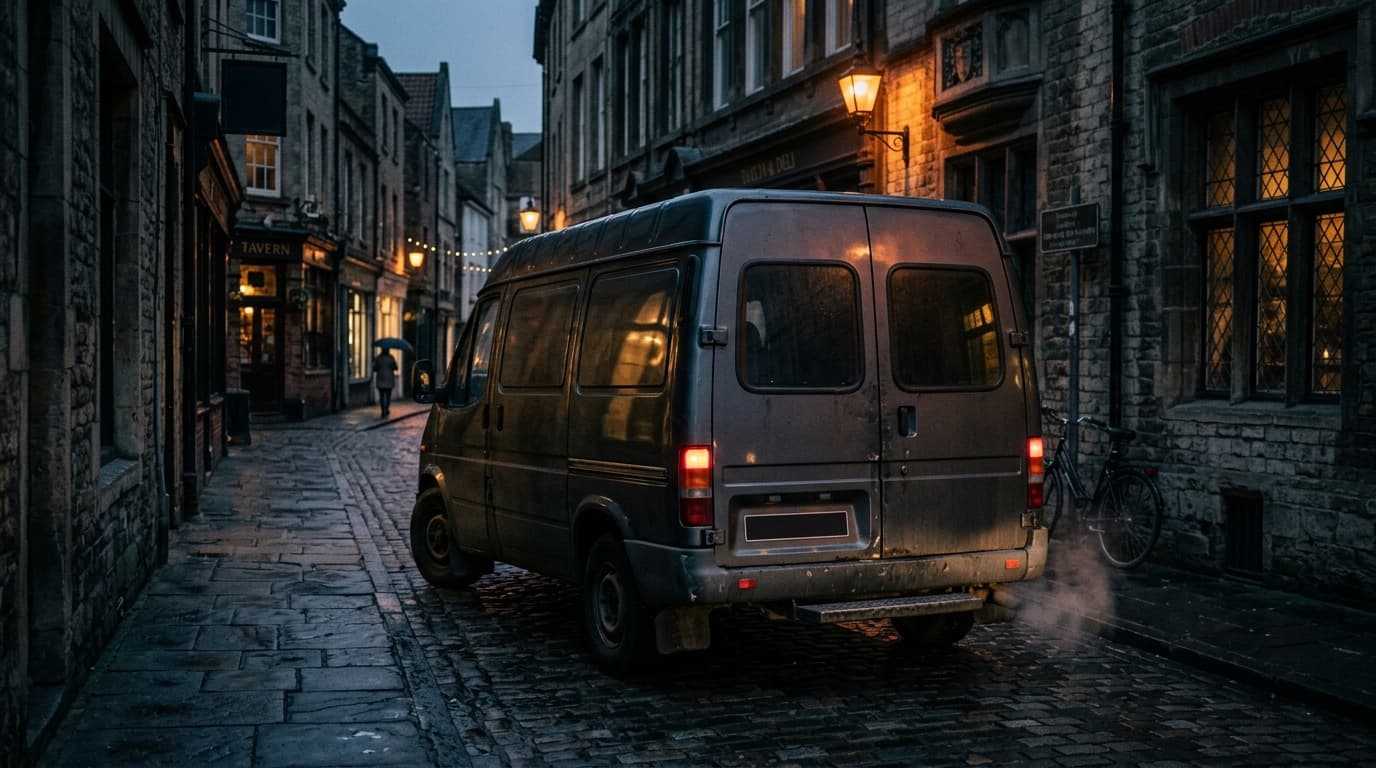
A clogged particulate filter on a van that only does city work is almost never a faulty part. It is a filter that never got hot enough to burn off its soot. First drive under sustained load as the handbook says; if the light stays on, book a workshop before you buy a bottle of anything.
A city van almost never reaches 550 °C
The diesel particulate filter (DPF, or FAP in French) traps diesel soot in a ceramic block, then burns it. Everything comes down to temperature. ADAC, in its guide updated on 9 September 2025, gives the benchmarks: soot ignites at 550 °C, the engine pushes the exhaust to about 600 °C when it triggers a regeneration itself, and additive systems come down to around 400 °C.
| Benchmark | Value | Source |
|---|---|---|
| Soot ignition temperature | 550 °C | ADAC, 9 September 2025 |
| Target during active regeneration | about 600 °C | ADAC |
| Threshold with fuel-borne additive | from about 400 °C | ADAC |
| Cleaning a removed filter | 400 to 500 euros (Germany) | ADAC |
| Filter replacement | 1,000 to 3,000 euros (Germany) | ADAC |
| New filter in Belgium | 1,000 to 2,500 euros, even 3,000 | RTBF, 4 December 2022 |
| Roadworthiness test limit | 1,000,000 particles per cm³ | all three Regions |
A Trafic or a Transit Custom holds those temperatures without effort on the E411 motorway with a tonne in the back. The same van making twelve stops around Liège between 7 am and 4 pm, engine off at every customer, gets nowhere near, and every regeneration it attempts is cut short by the ignition being switched off at the next job.
The figure that matters: 550.
Hence my thesis, which bottle sellers dislike: on a city van, the filter clogs because of the round. Changing the part without changing the round means paying twice.
Clogged particulate filter: what are the symptoms?
The dashboard speaks first, and you should not wait for the rest. The classic signs, in the order they usually appear:
- the filter warning light or a "particulate filter" message on the instrument cluster;
- a fan still running with the engine off and a slightly higher idle, signs of a regeneration you have just interrupted;
- fuel consumption climbing for no reason;
- loss of power, then limp mode with the engine warning light;
- an oil level that rises instead of falling, because post-injection diesel ends up in the sump.
The last one is the sneakiest. Nobody worries about a dipstick reading too high.
DPF regeneration: what does the van do on its own?
There are two modes. On the open road, under sustained load, soot burns off continuously without the driver noticing: that is passive regeneration. When the engine computer judges the filter too loaded, it injects extra fuel to raise the temperature, and that is active regeneration. ADAC notes that long spells of short trips prevent this second step, for lack of temperature, and that the filter can then block or be damaged.
When the light comes on, the procedure is the same on a Ducato, a Sprinter or a Trafic:
- Open the vehicle handbook at the particulate filter page. The manufacturer describes the regeneration drive it expects, and that is the reference.
- Get on the road the same day, without switching off, under sustained load: a main road or motorway rather than a jammed ring road. Before a roadworthiness test, the consumer body Test-Achats advises at least an hour at around 70 km/h.
- If the light goes out, note the date and mileage. Two warnings in the same month point to an incompatible round, not bad luck.
- If the light stays on or the engine goes into limp mode, stop experimenting and book in. The workshop reads the soot load and can start a forced regeneration with the diagnostic tool.
- Ask for the ash level at every service. That is what announces the end of the filter's life.
On site, step 2 is the one that gets skipped. The van is loaded, the customer is waiting, and "we'll do it Friday". By Friday it is in limp mode.
No-removal DPF cleaners: the serious objection
There is an objection to my thesis, and it holds some water: these products are not all hot air. Take an official product sheet. Liqui Moly's Pro-Line Diesel Particulate Filter Cleaner, sold in a one-litre can, is presented by the manufacturer as a liquid for cleaning a clogged filter without removing it. Yet the same sheet describes workshop work: you take out a pressure or temperature sensor, spray the whole litre at 6 to 8 bar with a dedicated gun and probe, filter cooled below 40 °C, rinse with a second product, then a workshop starts the regeneration according to the vehicle maker's instructions. Nothing you pour into the tank between two customers. Liqui Moly itself writes that the loosened soot must then be burnt off by a normal regeneration, so by temperature, so by road miles.
ADAC, for its part, recommends no particular method or product, and sets the limit: chemical cleaners, like fuel additives, can shift soot left after an incomplete regeneration, never ash. And ash, a residue of engine oil, is what fills a filter for good. On some older models, the club mentions scheduled replacement between 120,000 and 180,000 km.
So, the nuance. Cleaning can save a soot-loaded filter on a van whose use is then corrected. It does not save a filter full of ash, nor a van that goes back to three-kilometre trips. I have not tested any of these products; I read their sheets, and none promises more.
Fouled EGR valve: same cause, different part
The EGR (exhaust gas recirculation) valve sends part of the exhaust back to the intake to bring down nitrogen oxides. At low load, so in town, it works hard, and soot mixed with oil vapour builds up until it sticks. Symptoms of a fouled EGR valve: uneven idle, hesitation under acceleration, black smoke, engine warning light. The cure is cleaning or replacement in a workshop, and prevention is the same as for the filter.
AdBlue warning light: why does it have nothing to do with soot?
Because AdBlue deals with nitrogen oxides, not particles. It is a urea solution injected into the exhaust, downstream, and an hour on the motorway will never put that light out. It wants a refill, or it is flagging a fault in the injection system.
Three useful figures from TotalEnergies' storage guidance: the product crystallises below -11 °C, keeps between 0 and 30 °C and lasts up to a year and a half in those conditions. Above 40 °C it starts to degrade. The ten-litre can left all summer behind the bulkhead of a van parked in full sun is therefore a bad idea.
In principle, a van whose AdBlue tank is empty refuses to restart, after a countdown shown in kilometres. The threshold varies from one manufacturer to another: read the handbook, and do not run on the reserve at the end of the week.
One million particles per cm³: the rule in the three Regions
Since 1 July 2022, the Belgian roadworthiness test has measured diesels with a particle counter, cars and N1 light commercial vehicles alike. The thresholds are shared, according to Brussels Mobility. What happens next is not.
| Wallonia | Brussels | Flanders | |
|---|---|---|---|
| Diesels tested | Euro 5b and later (first registered from 1 January 2013) | Euro 5a and later | Euro 5a and later |
| Under 250,000 particles/cm³ | green certificate, no remark | in order until the next test | in order |
| 250,000 to 1,000,000 | note on the certificate | non-penalising remark | code 4: to be monitored, no re-test |
| Over 1,000,000 | fault to repair or filter to replace, "without compulsory re-presentation" | green certificate with a fault, new test at most three months later; fifteen-day red certificate at the third failure | green certificate limited to three months (code 3); red "banned from traffic" certificate at the third failure |
| Source | Autosécurité, page amended 29 May 2025 | be.brussels, viewed 10 October 2026 | vlaanderen.be, viewed 10 October 2026 |
These deadlines have changed several times since 2022: fourteen days, then three months, then twelve, then three again in Flanders on 1 December 2023. The Brussels page still mentions a temporary derogation announced until 31 December 2025. Check with your test station what applies on the day you go.
The test has a measurable effect. VRT counted more than 60,000 red cards at the roadworthiness test in 2025, a record, based on figures obtained by Flemish MP Sofie Mertens, who puts a large share of them down to the particulate filter test. In Wallonia, RTBF reported in December 2022 that 5.5% of diesels tested were failing.
Then there is the temptation. Having the filter removed, or the EGR and AdBlue disabled by remapping, is a fraud this test was designed to catch: a missing filter goes over the million just like a cracked one. You pay for the job, then for the new filter.
Do you still need a diesel for city work?
Not if the round never leaves the built-up area. A van covering forty kilometres a day in twenty trips is a particulate filter's worst customer and a battery's best; our comparison of electric or diesel vans for a fleet sets out the numbers, and the low-emission zone rules for diesel vans finish the argument in Brussels.
If diesel is still needed, for towing or for distant sites, organise the week around it: one proper road trip every week, given to the van that needs it rather than the newest one. On a fleet, that is one line in the schedule. It costs less than a filter.
To prepare for the test station, see our guide to the van roadworthiness test; to compare models, the medium van ranking.
Sources: ADAC, "Diesel-Partikelfilter: Funktion, Reinigung, Tausch" (9 September 2025); Liqui Moly, product sheet for Pro-Line Diesel Particulate Filter Cleaner (ref. 5169); TotalEnergies, "Comment stocker l'AdBlue ?"; Brussels Mobility, press release of 15 June 2022; be.brussels, vehicle inspection stations; vlaanderen.be, "Roetfilter en deeltjestellertest"; Autosécurité, "Nouveau contrôle filtre à particules" (amended 29 May 2025); Fleet.be, 29 November 2023; Test-Achats, 21 November 2022; RTBF, 4 December 2022; VRT NWS, 7 March 2026. Checked on 10 October 2026. None of the products mentioned was tried by us. Your vehicle handbook takes precedence over any general advice.
Fourgons moyens comparator
Compare all fourgons moyens side by side.
Compare now →
Frequently asked questions

Damien, 44 ans, a géré pendant douze ans la flotte d'utilitaires d'une PME de second œuvre dans la région de Namur : achats, entretien, revente, et les galères de carrosserie qui vont avec. Il a vu passer des dizaines de Trafic, Transporter et Master, et il sait ce qui casse, ce qui se revend bien et ce qui coûte cher à l'usage. Il a lancé ce site pour comparer les utilitaires sur ce qui compte vraiment en Belgique : charge utile réelle, volume utile, TVA récupérable et coût au kilomètre — pas la brochure du concessionnaire.