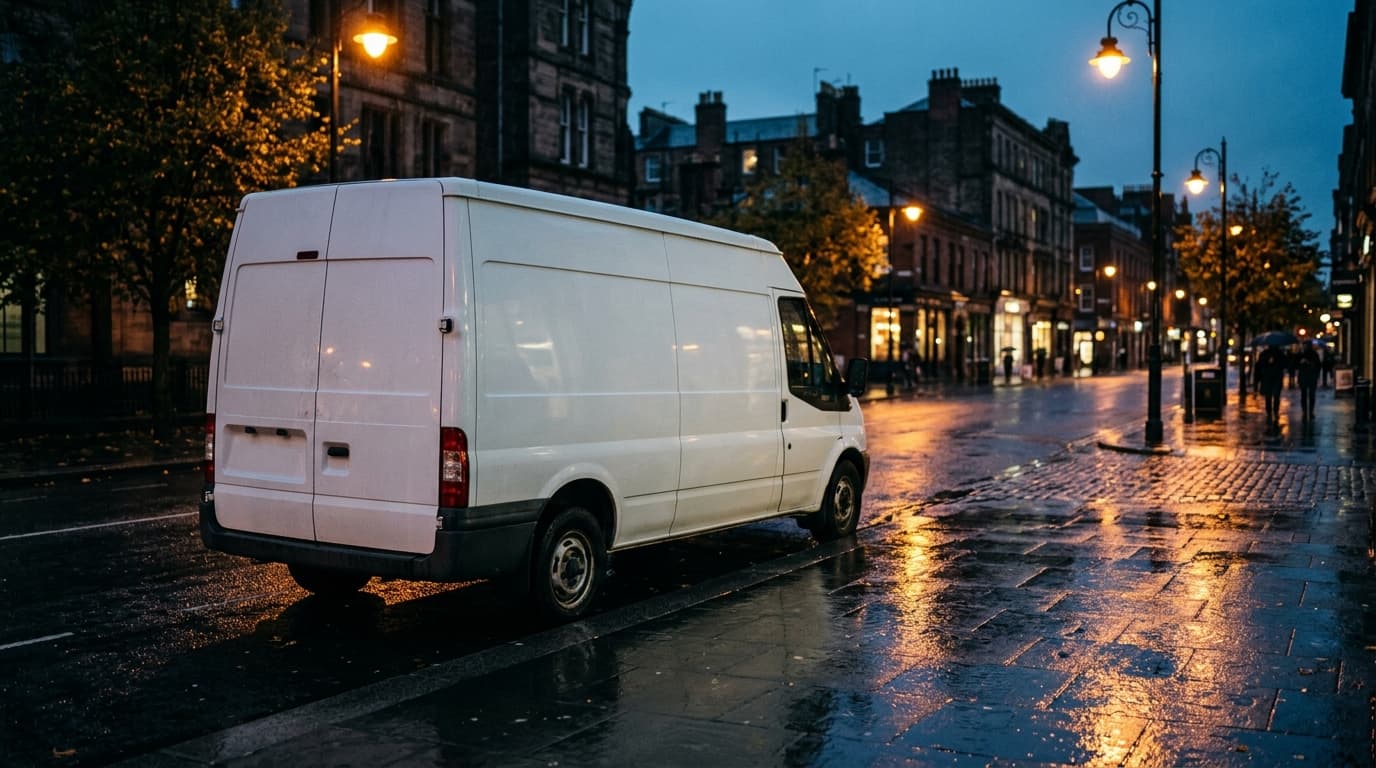
A 2014 diesel Trafic can no longer enter Brussels, and has not been able to since 1 January 2026. The same vehicle, the same plate, the same driver still deliver freely in Antwerp and in Ghent. Belgium's rule on vans is not the rule on cars, and it is not the same in the three cities that operate a low emission zone.
A Euro 5 Trafic is banned in Brussels and free in Ghent
This is the kind of sentence you do not dare write without checking three times. It is accurate all the same.
On 11 September 2025 the Constitutional Court handed down a ruling that ended the Brussels postponement of the Euro 5 diesel ban. Brussels Environment drew the consequence: since 1 January 2026, Euro 5 diesel and Euro 2 petrol vehicles no longer meet the access criteria of the Brussels-Capital Region, and the administration states explicitly that the measure covers cars and vans.
Three months earlier the Flemish government did precisely the opposite. It decided not to tighten the Antwerp and Ghent low emission zones in 2026, to keep letting Euro 5 diesel and Euro 2 petrol in, and to postpone to 2027 the air quality review that will decide what comes next. The City of Ghent says so in plain terms on its official access conditions page.
For a tradesperson from Namur delivering in Brussels on Tuesday and in Ghent on Thursday, one single van is outside the law every other day. I cannot remember a comparable split between two Belgian cities fifty kilometres apart.
Which Euro standards get through in the three cities in 2026?
The table below cross-checks the conditions published by the three administrations, recorded on 3 September 2026. It applies to an N1 van, meaning everything from a city van to a large panel van up to 3.5 tonnes.
| Van engine | Brussels | Antwerp | Ghent |
|---|---|---|---|
| Euro 6 diesel | free | free | free |
| Euro 5 diesel | banned, pass or exemption | free | free |
| Euro 4 diesel | banned, pass or exemption | paid access | paid access |
| Euro 3 diesel and below | banned, pass or exemption | day pass | day pass |
| Euro 3 petrol and above | free | free | free |
| Euro 2 petrol | banned, pass or exemption | free | free |
| Euro 1 petrol and below | banned, pass or exemption | day pass | day pass |
| Electric and hydrogen | free, automatic exemption | free | free, outside the LEZ |
Two lines sum the year up. Euro 5 diesel and Euro 2 petrol flip in Brussels and nowhere else.
LPG, CNG and LNG follow the petrol calendar in all three cities, provided the original engine was a petrol engine. A diesel hybrid is still judged on its diesel line: the electric motor buys nothing back.
Flanders turned around in September 2025
The story is worth telling in order, because it explains why so many pages you read today carry wrong dates.
| Date | Decision | Effect on vans |
|---|---|---|
| 19 December 2023 | Antwerp LEZ regulations adapted after a change to the Flemish decree | The tightening slips from 2025 to 2026, day passes go from 8 to 12 a year |
| During 2025 | The Flemish calendar announces Euro 6 diesel minimum on 1 January 2026 | Every publication of the period leads on Euro 5 vehicles being excluded |
| September 2025 | Flemish government agreement: no tightening in 2026 | Euro 5 diesel and Euro 2 petrol stay admitted in Antwerp and Ghent |
| 11 September 2025 | Constitutional Court ruling on the Brussels postponement | Brussels applies the Euro 5 exclusion on 1 January 2026 |
| 1 January 2026 | Entry into force in Brussels | Checks resume, warning letter before any fine |
| 2027 | Flemish air quality review | Will decide on any tightening in Flanders |
| 2028 | Flemish step already written into the regulations | Euro 6d diesel and Euro 4 petrol minimum |
Two governments, the same month, two opposite directions. Anyone landing on an article written in 2024 will read that Euro 5 vehicles have been banned from Antwerp since January: true when it was written, no longer true now.
A van is not unlawful in the abstract. It is unlawful at an address, on a date.
The 2028 step is the only one already written on the Flemish side, and it bites far wider than the 2026 one: Euro 6d as a floor excludes Euro 6b and 6c, so every van first registered between September 2015 and September 2019. A whole slice of the professional used market flips at once.
Class I, II or III: the figure on your registration certificate
Brussels does not treat all vans alike, and no consumer-facing page mentions this.
The Brussels calendar sorts N1 vehicles into two families. Class I travels with M1 passenger cars. Classes II and III travel with M2 minibuses. The border has nothing to do with load volume, payload or body size: it rests on the reference mass, which the administration defines as the vehicle's mass in running order plus 25 kg.
- Class I: reference mass of 1,305 kg or less
- Class II: reference mass above 1,305 kg and below 1,760 kg
- Class III: reference mass above 1,760 kg
- Mass in running order appears in box G of the registration certificate; failing that, the European certificate of conformity gives it
- An example published by the administration: 1,500 kg in running order, plus 25 kg, gives 1,525 kg, so class II
In practice, on a building site, almost anything that looks like a panel van lands in class II or III. Genuine class I vehicles are the lightest city vans, the car-derived ones and the stripped-out versions. Two versions of the same model can sit on either side of the threshold, which is enough to change calendar.
In 2026 the distinction changes nothing: both families lose Euro 5 diesel on the same day. It will decide everything from the following steps onwards, and now is when you read the figure, not the day a camera catches you. The official Brussels LEZ calendar publishes both grids side by side, year by year through to 2036.
24 day passes, €840, and then what?
The Brussels day pass costs €35 for a van. It covers the calendar day bought, until 6 a.m. the next morning, and it is capped at 24 purchases per plate per calendar year.
The arithmetic is blunt. Twenty-four days of access is one Tuesday in two. A self-employed tradesperson delivering three days a week in the capital needs roughly a hundred and fifty days: the pass covers 16 % of them, for €840 spent, and there is no way to buy the twenty-fifth.
How much is a fine, and how often?
€350 for a non-compliant van without a pass or an exemption. €150 for an unregistered foreign vehicle, even one that meets the standards. €25 for a registration filled in with incorrect information.
The rhythm counts as much as the amount. Brussels Fiscality caps this at one fine every three months per vehicle, so four a year at most. For the vehicles concerned since 1 January 2026 a transitional regime applies: a first offence triggers a warning letter, the fine can only land three months later, and since 1 July 2026 a fine issued covers a twelve-month period during which no other will be sent.
The administration owns the arithmetic and explains it itself: the €350 matches the price of an annual pass the Brussels government wants to introduce. The fine, in other words, stands in for a subscription until a real subscription exists. This is not an operating strategy to recommend, if only because the transitional regime has no reason to last and because an enforcement file does not plead well with an insurer, but it says something about how mature the scheme is.
Should you sell your Euro 5 diesel now?
No, not mechanically, and certainly not in a panic.
Three questions decide, in this order. How many days a year do you actually enter a zone? Which one? And when were you planning to replace the vehicle anyway?
A van that never crosses the Ring costs nothing more today than it did yesterday. A van delivering in Antwerp or Ghent has until the 2027 Flemish review, and probably until 2028 given the step already on the books. A van delivering in Brussels more than twenty-four days a year, on the other hand, no longer has a continuous lawful option, and that is the only situation forcing a decision this year.
At resale, the gap will open fast. A Brussels buyer will not look at a Euro 5 diesel any more, a Flemish buyer will for another year or two, and a rural Walloon buyer for a long time yet. The same vehicle is therefore not worth the same money depending on where you put it up for sale, which was not true three years ago and which nobody on a used lot will tell you. Our guide to the reliable used van in Belgium covers the other pre-purchase checks, and the calculation of the real cost of a van with Belgian VAT and taxation will tell you whether an early replacement pays for itself.
How to check your van in ten minutes
Take the registration certificate and read four boxes. Box J gives the category, N1 for a van. Box P3 gives the fuel. Box V9 gives the Euro standard, with the Euro 6b, 6c, 6d-TEMP, 6d and 6e sub-categories that will matter for the 2028 step. Box G gives the mass in running order, to which you add 25 kg to find your class.
If box V9 is empty, which happens on pre-2010 vehicles, the date of first registration lets you recover the standard through the correspondence tables each administration publishes. The European certificate of conformity and the Car-Pass also mention it. And if the standard shown looks wrong to you, it can be challenged with the DIV, evidence in hand.
All three cities offer a free number plate checker, and it is the only answer that binds the administration.
If the check leads you to change vehicle, our comparator filters on payload, load volume and fuel consumption, the piece on the city van for last mile delivery sorts the compacts that work in town, and the ranking of the best electric vans in Belgium lists the ones carrying the automatic exemption in all three zones.
Sources: Brussels Environment and Brussels Fiscality, "Calendar" and "Checks and fines" pages on lez.brussels, and the "Day pass" page, consulted on 3 September 2026; Constitutional Court ruling of 11 September 2025; City of Ghent, "Toelatingsvoorwaarden voor de lage-emissiezone", 2026 conditions and the Flemish government decision not to tighten the zone in 2026; City of Antwerp, press release «Aanpassingen reglementen lage-emissiezone» of 19 December 2023, postponement of the tightening and day passes raised from 8 to 12; Flemish government "Low-emission zones" portal. The Antwerp and Ghent paid access tariffs for Euro 4 diesel sit in municipal retribution regulations that could not be opened at the time of writing: check them on slimnaarantwerpen.be and stad.gent before budgeting. The rules change from year to year and sometimes mid-year: the number plate checker of the city concerned remains the only source that binds the administration.
Fourgonnettes & ludospaces comparator
Compare all fourgonnettes & ludospaces side by side.
Compare now →
Frequently asked questions

Damien, 44 ans, a géré pendant douze ans la flotte d'utilitaires d'une PME de second œuvre dans la région de Namur : achats, entretien, revente, et les galères de carrosserie qui vont avec. Il a vu passer des dizaines de Trafic, Transporter et Master, et il sait ce qui casse, ce qui se revend bien et ce qui coûte cher à l'usage. Il a lancé ce site pour comparer les utilitaires sur ce qui compte vraiment en Belgique : charge utile réelle, volume utile, TVA récupérable et coût au kilomètre — pas la brochure du concessionnaire.