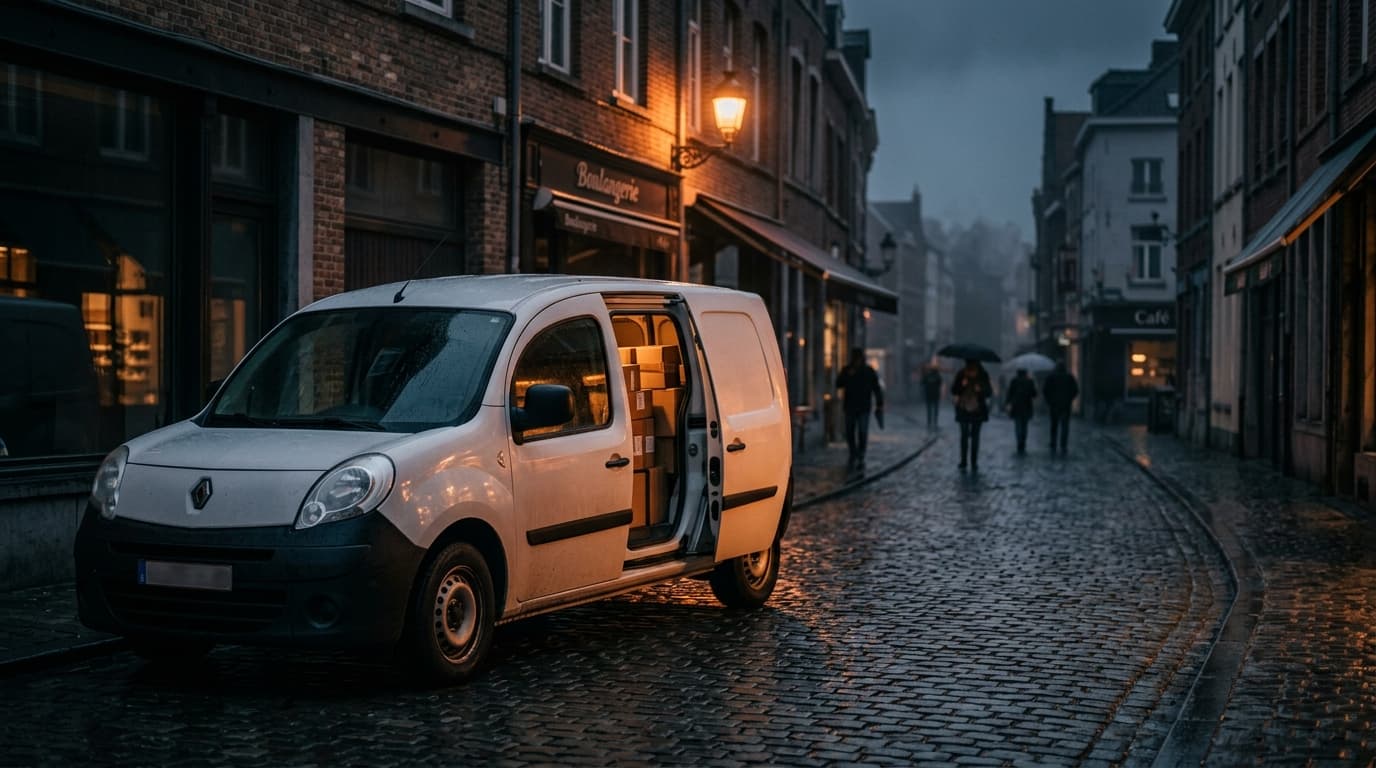
For last-mile delivery in Belgium, a 3 to 5 m³ city van covers most urban rounds. Renault Kangoo Van, Citroën Berlingo Van, VW Caddy Cargo or Ford Transit Connect: the choice comes down to usable volume, ease of parking and powertrain — diesel or electric against the low-emission zones.
Which city van should you choose for delivery?
For an urban courier, the Renault Kangoo Van and Citroën Berlingo Van are the two safe bets: hatchback footprint, sliding side door, 3 to 5 m³ of volume and a dense service network across Belgium. The VW Caddy Cargo and Ford Transit Connect are a notch more compact, worth it if you often park tight.
On a real round, what matters is not the maximum volume on the brochure, but how fast you load and unload. A wide sliding side door, a low load sill and a height under 1.90 m — which clears underground car parks — count for more than an extra half cubic metre.
The number that matters: stops per round. At thirty or forty delivery points a day in the city centre, manoeuvrability and turning circle beat everything else. That is where the city van crushes the medium van.
City van or medium van for delivery?
In town, the city van almost always wins. It is shorter, threads through traffic better, parks more easily and costs less to buy and run. The medium van is only justified when your rounds carry full pallets or regularly exceed 5 to 6 m³.
A Kangoo- or Berlingo-sized van swallows half a pallet and 3 to 5 m³ of parcels — enough for a standard courier round. As soon as you load a full Euro pallet (80 × 120 cm) upright, or several per round, you need to move up to the medium van, taller and longer.
On the Belgian market, many delivery sole traders run a city van day to day and keep a medium or large van for volume peaks. It is not one or the other: it is often a city van first, a bigger vehicle as backup.
What volume and payload for last-mile work?
Between 3 and 5 m³ of volume and 600 to 1,000 kg of payload, you cover almost every urban-round need. Beyond that, you pay for a footprint you will not use in town.
The long (L2) version of a city van mainly adds floor length, useful for long parcels or for bracing the load. But it stretches the vehicle by 35 to 40 cm — a real handicap in narrow streets and for parking. For most couriers, the short (L1) version is the right compromise.
What we would avoid: thinking in cubic metres alone. A bulky, light parcel fills the volume before the payload; dense parcels (bottles, parts, food) fill the payload before the volume. Look at both figures against your type of goods.
| Model (short version) | Usable volume | Approx. payload | Length | Height |
|---|---|---|---|---|
| Renault Kangoo Van | ~3.3 to 4.9 m³ (L1/L2) | ~600–800 kg | ~4.49 m | < 1.86 m |
| Citroën Berlingo Van | ~3.3 to 4.4 m³ | up to ~1,000 kg | ~4.40 m | < 1.88 m |
| Peugeot Partner | ~3.3 to 3.9 m³ | up to ~1,000 kg | ~4.40 m | < 1.88 m |
| VW Caddy Cargo | ~3.1 to 3.7 m³ | ~600–780 kg | ~4.50 m | < 1.80 m |
| Ford Transit Connect | ~2.9 to 3.6 m³ | ~600–850 kg | ~4.50 m | < 1.84 m |
Kangoo, Berlingo, Caddy or Transit Connect: which for a courier?
None dominates on every criterion, but the profiles differ. The Kangoo plays driving ease and network; the Berlingo, payload and comfort; the Caddy, perceived quality; the Transit Connect, compactness.
The Renault Kangoo Van is the most common city van in Belgian fleets: dense network, cheap parts, easy driving. The Citroën Berlingo Van (and its twin the Peugeot Partner, from the same Stellantis base) offers the most generous payload of the group — up to around 1,000 kg — and close to 4.4 m³. The VW Caddy Cargo has the best finish and road manners, but costs more to buy and service. The Ford Transit Connect is the most compact, an asset in dense cities.
At resale, the Berlingo and Kangoo place most easily on the Belgian used commercial market, pulling down their cost of ownership over three to four years. A well-kept ex-fleet Caddy resells well too, but the higher purchase price is not always recovered.
Should you switch to an electric van for city delivery?
For last-mile work, electric is becoming the default. A Kangoo E-Tech or ë-Berlingo offers 3 to 4 m³, around 600 kg payload and 250 to 300 km of real range — well beyond an urban round, which rarely exceeds 100 to 150 km a day.
The advantage is not just regulatory. In town, at low speed with frequent stops, the electric motor uses little energy and recovers on deceleration. The cost per kilometre drops sharply if you charge at the depot overnight on the night tariff. And you are covered on the LEZ, current or coming.
What we would avoid: switching to electric without securing depot charging. Without an on-site charger, a courier who depends on public points loses time and money — the opposite of the expected gain. If your rounds string together long runs between distant depots, Euro 6 diesel stays simpler. To dig deeper, see our comparison of electric city vans in Belgium.
How much does a delivery van cost in Belgium?
Budget from around €18,000–22,000 ex-VAT for a diesel work van, and €28,000–34,000 ex-VAT for an electric version depending on trim and battery. Prices vary a lot with pro terms and order size.
These figures are ex-VAT, recoverable for professional use. That is the key point: an N1 light commercial vehicle stays income-tax deductible and is not affected by the tightening of company-car taxation. Across a delivery fleet, that difference in treatment weighs heavily on total cost.
On the Belgian market, end-of-quarter discounts often shave €1,500–3,000 ex-VAT off list prices, and more from several vehicles. Always negotiate on the all-in ex-VAT price, never on the leasing monthly alone, which hides the residual value and the real cost.
Will the LEZ ban my diesel van?
It depends on its Euro standard. Since 1 January 2026, Euro 5 diesel (and Euro 2 petrol) is banned in the Brussels-Capital Region, with a €350 fine for driving without a daily pass. A Euro 6 diesel still gets through, but the trajectory points to tightening.
For a courier, this is a front-line factor: your work tool spends most of its time exactly where restrictions are strongest, in the city centre. A Euro 6 diesel van bought new today stays compliant in Brussels for now, but the structural LEZ reform expected for 2027 will reshuffle the deck.
The number that matters: €350. That is the Brussels fine for driving a non-compliant vehicle, renewable. Antwerp and Ghent run their own LEZ too, with their own thresholds. On a vehicle that drives in town every day, electric closes the question for good — one more argument in its favour for last-mile delivery.
Our verdict
The city van is the right tool for last-mile delivery: enough volume for a round, a footprint that fits everywhere, and favourable commercial-vehicle taxation. The Kangoo and Berlingo lead on the overall compromise and resale; the Caddy and Transit Connect aim for compactness and finish. Against tightening LEZ rules, electric is becoming the default for daily urban use — provided you charge at the depot.
To place the city van in the wider market, see our guide to vans in Belgium. If you are hesitating with a medium van, the city van or medium van comparison decides by your volumes. For tradesperson use rather than delivery, see which city van for a tradesperson. Not sure of your segment? A short quiz points you in the right direction.
Sources: FEBIAC (2025 light commercial vehicle registrations, +7.6%); Brussels Environment and City of Brussels (LEZ, Euro 5 diesel ban from 1 January 2026, €350 fine); RTBF (Brussels LEZ 2026); Caradisiac and Utilitaire Magazine (compact city-van volumes and dimensions, 2026); Renault and Citroën Belgium (Kangoo Van and Berlingo Van ranges, E-Tech / ë-Berlingo range figures, 2026); link2fleet (light commercial vehicle taxation and VAT, 2026).
Fourgonnettes & ludospaces comparator
Compare all fourgonnettes & ludospaces side by side.
Compare now →
Frequently asked questions

Damien, 44 ans, a géré pendant douze ans la flotte d'utilitaires d'une PME de second œuvre dans la région de Namur : achats, entretien, revente, et les galères de carrosserie qui vont avec. Il a vu passer des dizaines de Trafic, Transporter et Master, et il sait ce qui casse, ce qui se revend bien et ce qui coûte cher à l'usage. Il a lancé ce site pour comparer les utilitaires sur ce qui compte vraiment en Belgique : charge utile réelle, volume utile, TVA récupérable et coût au kilomètre — pas la brochure du concessionnaire.