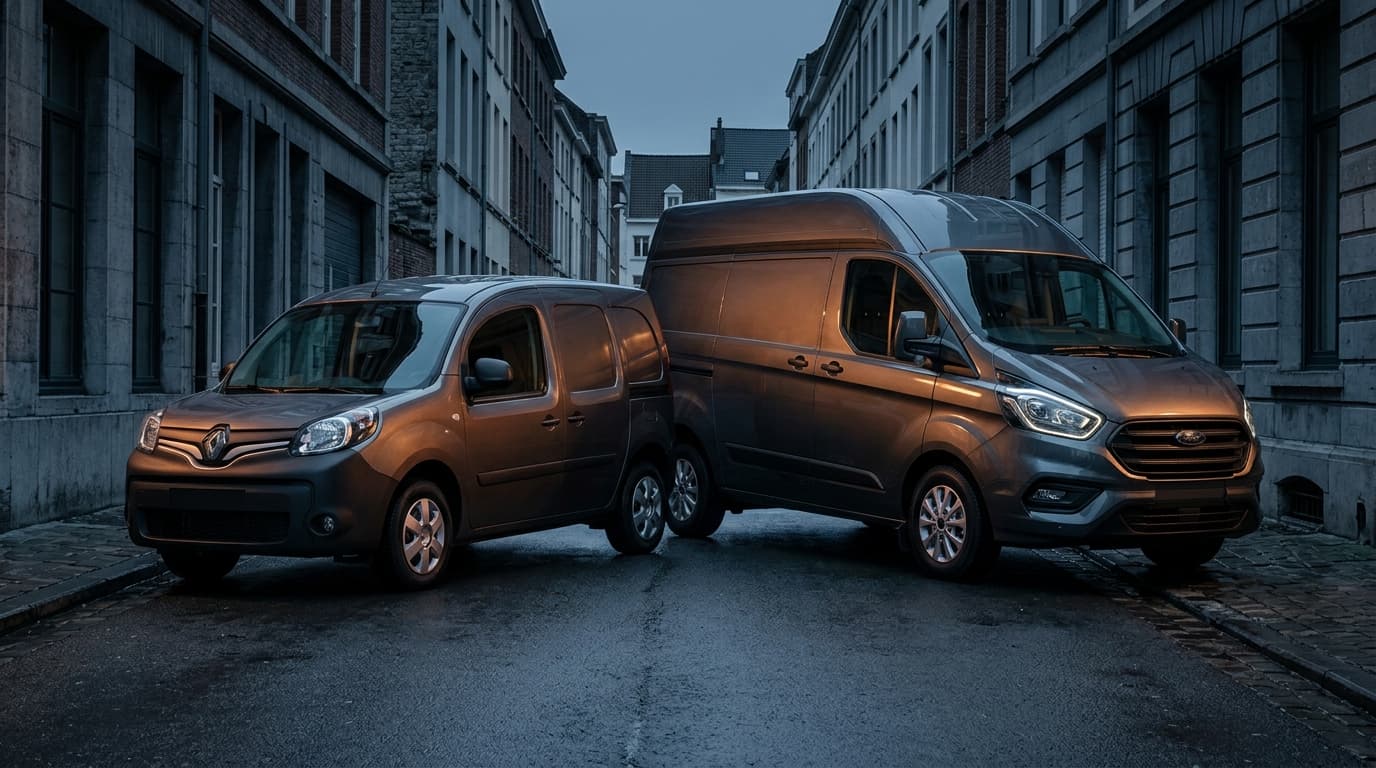
Between a city van and a medium van, the line comes down to two numbers: the volume you load every day and the length of your items. Below 4 m³ and with nothing over 2 metres, the city van wins — cheaper, more nimble. Above that, the medium van takes over.
City van or medium van: which one in short?
Take the city van if you drive mostly in town with tools and supplies: Renault Kangoo, Citroën Berlingo, Peugeot Partner, Volkswagen Caddy Cargo. Take the medium van — Renault Trafic, Ford Transit Custom, Opel Vivaro, Volkswagen Transporter — as soon as volume or load length becomes the real subject of your days.
The city van is 4.4 to 4.9 m long for 3.3 to 4.9 m³ of load. The medium van runs 4.9 to 5.5 m for 5.8 to 8.9 m³. Between the two: half a metre of size, double the volume, and around €10,000 ex-VAT more at purchase. Everything else — trim, screen, looks — comes after.
On a real job site, the question is not "which is best" but "which fits what I actually load". A tradesperson who packs a city van well carries more than a colleague who dumps everything loose into a half-empty Trafic.
What differences in volume and payload?
The medium van offers roughly double the volume of a city van, and it starts where the city van hits its ceiling. A city van climbs to 4.9 m³ at best; a medium van starts at 5.8 m³ and reaches 8.9 m³ in the long version.
On payload, the gap exists but is more nuanced than it looks. A good city van carries up to 1,000 kg homologated; a medium van runs around 1,000 to 1,300 kg. The medium van wins mainly on volume and load length, less on raw weight. In other words, if you carry heavy but compact — tiles, mortar bags — a solid city van often copes. If you carry bulky but light — boxes, insulation, furniture — the medium van changes everything.
The number that matters: the load length at floor level. A city van swallows about 1.8 to 2.2 m (up to ~3 m with a hatch under the seat), a medium van L2 clears 3 metres. That figure, not the theoretical volume, decides whether your boards fit flat.
| Criterion | City van | Medium van |
|---|---|---|
| Typical models (BE) | Kangoo, Berlingo, Partner, Caddy Cargo, Combo | Trafic, Transit Custom, Vivaro, Transporter, Expert |
| Overall length | 4.4–4.9 m | 4.9–5.5 m (L1/L2) |
| Load volume | 3.3–4.9 m³ | 5.8–8.9 m³ |
| Payload | 600–1,000 kg | 1,000–1,300 kg |
| Load length | ~1.8–2.2 m (~3 m with hatch) | > 3 m in L2 |
| Entry price (BE, ex-VAT) | from ~€17,300–20,000 | from ~€28,000–29,300 |
When should you move up to a medium van?
Move up to a medium van as soon as one of these three needs comes back every week: more than 4 m³ to load, items longer than 2 metres flat, or a EUR pallet to carry upright. As long as none of the three shows up regularly, the city van stays the rational call.
The trap is oversizing "just in case". A medium van bought for two bulky runs a month, but driven empty the rest of the time, costs dearly in fuel, parking and purchase for marginal service. Conversely, a city van that forces a second depot trip three times a week costs you billable hours.
What we would avoid: reasoning from your biggest job of the year. Look at your typical week. If the average volume fits in 4 m³ and the overflow happens once a quarter, a trailer or an occasional rental costs less than a medium van kept all year.
Is a city van enough for an urban tradesperson?
For an electrician, plumber or fitter working mostly in town, a well-fitted city van is enough in the vast majority of cases. The secret is not size, it is the internal layout: side shelves, screw bins, drawers. A racking fit-out packs into 4 m³ what a bare van wastes.
The city van also wins where the medium van struggles: short double-parking, tight slots, city-centre lanes, covered car parks under 1.90 m. On a day of ten close-set jobs, those saved manoeuvring minutes count more than two cubic metres in reserve.
The medium van becomes relevant for the urban tradesperson in two precise cases: the finishing trade that regularly carries plasterboard, panels or furniture, and the fitter who loads a stock of material to last several days without returning to the depot. On the Belgian market, many self-employed start with a city van and only move up to a medium van when they hire a second worker.
Which is cheaper to buy and to run?
The city van, on almost every line. At purchase, count from around €17,300 to €20,000 ex-VAT for a city van against €28,000 to €29,300 ex-VAT for an entry medium van: an €8,000 to €12,000 gap. In use, the city van burns less, wears smaller tyres, insures cheaper and services for less.
The medium van only claws back that gap through the work it enables. If it saves you a second daily trip, carries two orders in one, or wins you jobs the city van turns down, the purchase gap repays itself in productivity. The honest reasoning runs through total cost of ownership — ex-VAT purchase, fuel, servicing, insurance, tax, resale — not the headline price.
City van or medium van for driving in Brussels?
Both clear the Brussels low-emission zone if they are Euro 6 or electric. Since 1 January 2026, Euro 5 diesel is banned in Brussels, with fines for the affected light commercial vehicles starting on 1 July 2026, at €350 a year. On this point, the fuel and the standard matter more than the size of the vehicle.
Where the city van takes the edge is size. Under 1.90 m tall, it fits most covered car parks and height-limited loading bays; a medium van, often above 1.90 m or even 2 m with a roof rack, stays outside. In a dense urban centre — Brussels, Antwerp, Ghent — that difference is paid every day in parking time.
On the Flemish side, Antwerp and Ghent postponed the tightening of their zones: Euro 5 diesel is still tolerated there in 2026. The direction is clear — every tightening penalises older combustion — but a Euro 6 van bought new today, city van or medium van, passes everywhere for several years.
Which resells best in Belgium?
At resale, both hold up, but the city van benefits from a wider and more liquid used market. Berlingo, Partner, Kangoo and Caddy trade in volume: demand from tradespeople and private buyers stays strong, and the value holds up given a proper service record. A well-kept medium van resells well too, especially an ex-fleet example with a clean logbook, but the typical buyer is narrower.
What weighs most, in both segments, is not the badge: it is the body condition and the history. A city van dented at the corners gets dumped; a serviced, clean medium van sells in a week. At resale, a van with a coherent mileage, service invoices and sound bodywork always beats a "good deal" model with a blurry history.
What we would avoid: picking the smallest engine to save at purchase. An undersized block permanently hauling a full city van wears faster and resells worse than a well-born mid-range engine — true for the city van as for the medium van.
Our verdict
There is no universal winner between city van and medium van: there is the one that fits what you load, where you drive and how often you go back to the depot. The city van wins on price, urban size and everyday use; the medium van on volume, load length and big runs. Both recover 100% of the VAT for professional use and escape the 2026 reform — so the choice comes down to use, not tax.
To go further, compare on what matters: our van comparator and the general guide to vans in Belgium. If you are torn between two specific city vans, the Berlingo or Kangoo comparison settles it; for the segment above, see the best medium van in Belgium.
Sources: FEBIAC (2025 light commercial vehicle registrations, +7.6%); Moniteur Automobile (city van / urban commercial vehicle comparison, 2025); Renault Belgium and Ford Belgium (volumes, dimensions and ex-VAT prices for Trafic and Transit Custom, 2026); Citroën Belgium and Renault Belgium (pro ex-VAT city van prices, 2026); Brussels Environment and Test-Achats (low-emission zones 2026); SPF Finances and Accountable (VAT and deductibility of light commercial vehicles, 2026).
Fourgonnettes & ludospaces comparator
Compare all fourgonnettes & ludospaces side by side.
Compare now →
Frequently asked questions

Damien, 44 ans, a géré pendant douze ans la flotte d'utilitaires d'une PME de second œuvre dans la région de Namur : achats, entretien, revente, et les galères de carrosserie qui vont avec. Il a vu passer des dizaines de Trafic, Transporter et Master, et il sait ce qui casse, ce qui se revend bien et ce qui coûte cher à l'usage. Il a lancé ce site pour comparer les utilitaires sur ce qui compte vraiment en Belgique : charge utile réelle, volume utile, TVA récupérable et coût au kilomètre — pas la brochure du concessionnaire.