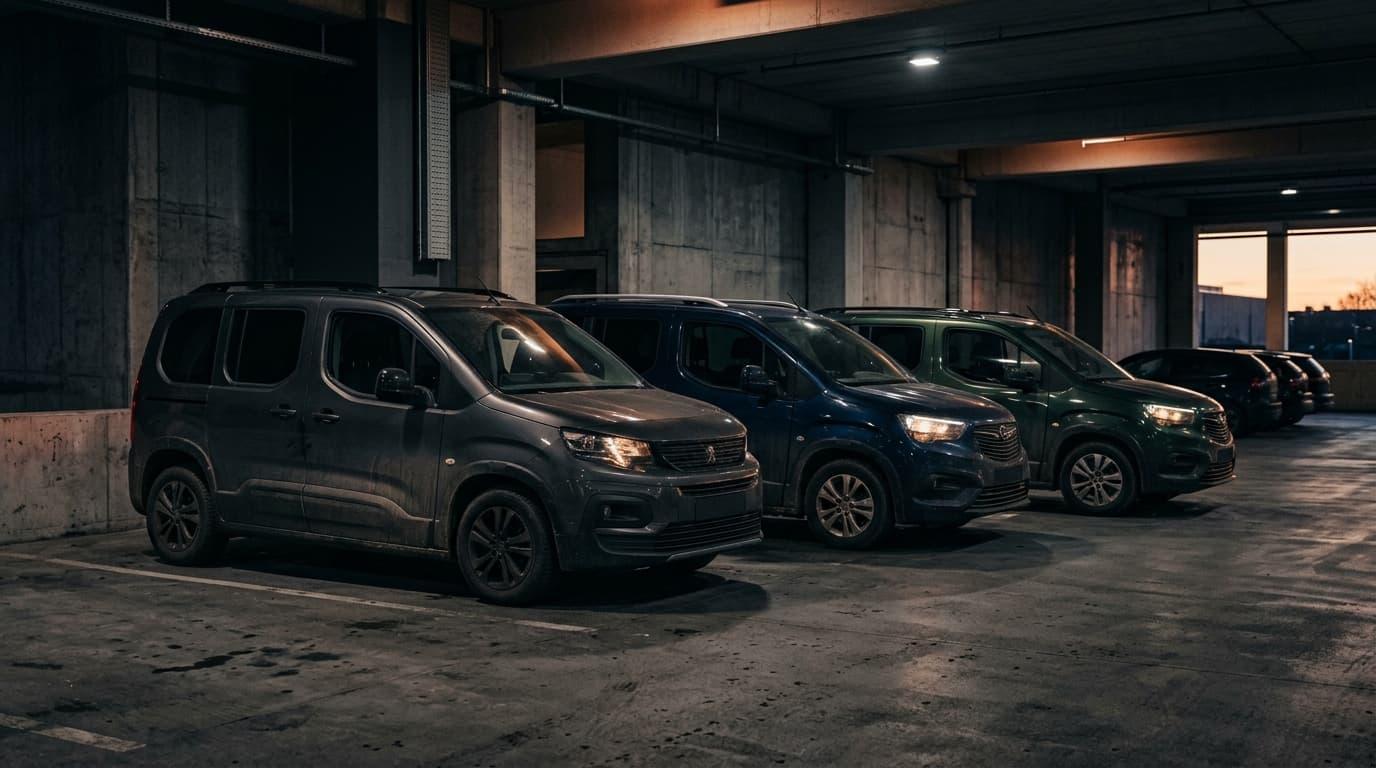
To move five kids, a big dog and the bikes without selling a kidney, the 7-seat leisure van remains the most rational option on the Belgian market. Dacia Jogger, Berlingo XL, Rifter Long, Grand Kangoo, Caddy Maxi: we compared them on what matters for a family — price and boot first, Belgian taxation included.
Which 7-seat leisure van should a family choose, in short?
On a tight budget, the Dacia Jogger crushes the field: seven seats from about €19,000 in petrol or LPG, and around €26,000 as a hybrid. For comfort and finish, the Citroën Berlingo XL and Peugeot Rifter Long remain the benchmarks. For the top of the range, the VW Caddy Maxi Life and Ford Grand Tourneo Connect move up a notch, price included.
All these models boil down to four platforms. Berlingo, Rifter, Proace City Verso and Opel Combo Life are the same vehicle under four badges. Caddy and Grand Tourneo Connect have shared their base since the VW-Ford alliance. The Grand Kangoo plays alone, so does the Jogger.
In practice, for a family, the choice rests on three numbers: purchase price, boot volume once the third row is in place, and cost per kilometre by powertrain. The badge comes after.
What is a leisure van, and why aim for 7 seats?
A leisure van (ludospace) is the passenger derivative of a utility city van: tall body, sliding doors, large volume, contained price. The seven-seat version adds a removable third row, making it the cheapest alternative to an MPV or a large family SUV.
In concrete terms, it is a vehicle built for space rather than style. Sliding doors make fitting child seats easy in a tight car park, the headroom saves you from bending double, and the modularity switches from seven seats to a removal-van volume in a few moves. It is the choice of large families, childminders and anyone hauling as much gear as people.
The number that matters: length. Under 4.50 m you get five real seats and two occasional jump seats; beyond 4.75 m (Berlingo XL, Rifter Long, Caddy Maxi) the third row becomes usable daily and the residual boot stops being a joke.
Which leisure vans actually come in 7 seats?
Not every leisure van climbs to seven seats: you need a long body. On the Stellantis side, the Citroën Berlingo XL, Peugeot Rifter Long and Toyota Proace City Verso L (4.75 m) offer a third row. On the VW-Ford side, the Caddy Maxi Life and Grand Tourneo Connect (4.85 m) do the same. The Renault Grand Kangoo (4.91 m) is the longest, and the Dacia Jogger (4.55 m) the most compact to offer seven seats.
The technical kinship simplifies the choice. The Stellantis quartet (Berlingo, Rifter, Proace City Verso, Combo Life) shares everything but the grille: the same 4.75 m in long form, the same PureTech petrol, BlueHDi diesel and fully electric versions. The Caddy Maxi and Grand Tourneo Connect are twins too, more focused on finish and road manners. The Grand Kangoo and Jogger play their own tune.
The Jogger is the odd one out: at 4.55 m it is shorter than the others, but it is a raised estate more than a true van body. It gains in road comfort what it loses in raw volume and loading height.
| Model | Length | Seats | Boot (7 / 5 seats) | Starting price (BE, incl. VAT) |
|---|---|---|---|---|
| Dacia Jogger | 4.55 m | 5 or 7 | ~160 L / ~607 L | from ~€19,000 |
| Citroën Berlingo XL | 4.75 m | 7 | ~322 L / ~1,050 L | from ~€27,000 |
| Peugeot Rifter Long | 4.75 m | 7 | ~322 L / ~1,050 L | from ~€26,900 |
| Toyota Proace City Verso L | 4.75 m | 7 | ~322 L / ~1,050 L | from ~€29,000 |
| Ford Grand Tourneo Connect | 4.85 m | 7 | ~322 L / ~1,050 L | from ~€33,000 |
| VW Caddy Maxi Life | 4.85 m | 7 | ~446 L / ~1,213 L | from ~€36,000 |
| Renault Grand Kangoo | 4.91 m | 7 | ~280 L / ~1,100 L | from ~€30,000 |
Which leisure van has the biggest boot?
With seven seats occupied, none works miracles: around 160 L on the Jogger, about 320 L on the Stellantis quartet, up to 446 L on the Caddy Maxi Life, the most generous. It is the eternal trade-off of the format: the third row is paid for in litres of boot.
The real strength of these vehicles shows once the third row is removed or folded. A Berlingo XL or Rifter Long then offers about 1,050 L behind the second row, and exceeds 2,100 L with the bench folded — enough to swallow a student move or a weekend for six with luggage. The Caddy Maxi goes further still, beyond 1,200 L in five-seat mode.
The Jogger reasons differently. Its third row comes out completely (the seats lift out of the vehicle), freeing a loading volume that is huge for the class, over 1,800 L once the seats are removed. The catch: you have to store those seats somewhere, where the Berlingo and Caddy simply fold or stow them.
What we would avoid: choosing on the five-seat catalogue volume alone. A family that often drives with seven aboard looks first at the residual boot with the third row up. On that exact criterion, the Caddy Maxi and Berlingo XL take the lead, the Jogger loses it.
Which 7-seat leisure van is the cheapest in Belgium?
The Dacia Jogger, and the gap is not small. It starts around €19,000 incl. VAT in TCe petrol or LPG bi-fuel, and around €26,000 as a hybrid 140 hp. By comparison, a Peugeot Rifter Long starts near €26,900 and a Citroën Berlingo XL in the same waters, while the VW Caddy Maxi Life passes €36,000.
On the Belgian market, this purchase-price gap is doubled by a running-cost gap. The Jogger on LPG posts one of the lowest costs per kilometre on the market, with cheaper fuel and often lighter road taxation. For a family counting every fill-up, that is the deciding argument, ahead of the superior finish of the Berlingo, Rifter and Caddy.
That said, the entry price does not tell the whole story. A properly equipped Jogger (seven seats, air conditioning, safety) climbs towards €22,000-€24,000, and an entry Berlingo XL stays pricier but better finished and better insulated. It is up to you to weigh the entry ticket against long-term comfort.
Petrol, diesel, hybrid, LPG or electric for the family?
For most families, petrol or hybrid cover the need without complication. Petrol (PureTech at Stellantis, TSI at VW) stays the simplest and cheapest to buy. The Jogger's hybrid, at 140 hp, cuts urban consumption with no charging constraint. The Jogger's LPG slashes the cost per kilometre for high-mileage drivers.
Electric has its place for urban and suburban use. The ë-Berlingo, e-Rifter, Proace City Verso Electric and Renault Grand Kangoo E-Tech carry a battery of about 50 kWh for some 280 km WLTP, i.e. 200 to 230 km real when loaded, and less in winter. For school-activities-shopping runs with home charging overnight, it is enough and unbeatable on running cost.
Diesel only still pays off for high motorway mileage. And it raises an access problem: since 1 January 2026, Euro 5 diesel is banned in the Brussels low-emission zone, with fines from 1 July 2026. What we would avoid: buying a used diesel leisure van without checking its Euro standard and the zone where the family drives daily. To dig deeper, see our guide to the best electric van in Belgium.
Can a private buyer recover VAT on a leisure van?
No, and it is the most common tax trap. A seven-seat passenger leisure van is homologated as a passenger car (category M1): a private buyer who buys one recovers no VAT, and pays the registration tax and road tax like any other car, based on fiscal horsepower, CO2 and region.
The confusion comes from its kinship with the utility version. The same body, sold as a two-seat panel van (category N1) to a business for professional use, does allow VAT recovery. But as soon as you add the rear bench and windows to carry the family, the vehicle becomes a car again in the eyes of the tax office. A private buyer therefore has no VAT advantage to expect from a "passenger" Berlingo or Jogger.
Where a family can play is on road taxation. An LPG or hybrid powertrain, or a low CO2 figure, lightens the registration tax and the annual tax, especially in Flanders where the calculation factors in the eco standard. The Jogger LPG and the electric versions are, on that front, the best placed. To place these models in the rest of the market, see our guide to vans in Belgium.
New or used: which leisure van for a family budget?
A recent used model is often the smartest move. The Belgian market is full of Berlingo, Rifter, Kangoo and Caddy from 2020-2023, out of fleets or families, well maintained and already depreciated. Expect €14,000 to €22,000 for a recent seven-seater depending on version and mileage, against €19,000 to €36,000 new depending on the model.
New still makes sense for the warranty, the exact configuration (seven seats, powertrain, safety equipment) and spreading the cost. For a family keeping its car eight to ten years, the known reliability of a current-generation Berlingo or the simple maintenance of a Jogger weigh as much as the purchase price.
At resale, these leisure vans hold up well thanks to steady family demand and a deep used market. What makes the value is the state of the cabin and the service history, not the badge: a tidy kids' interior resells better than a mistreated top-spec trim. Still torn between two city vans? Our Berlingo or Kangoo comparison details the short versions; and the comparator lines up the specs side by side.
Our verdict
The 7-seat leisure van remains the most sensible answer for a large family in Belgium: more space than an SUV for far less money, and real modularity. The Jogger wins the wallet battle, the Berlingo XL and Rifter Long the balance battle, the Caddy Maxi the refinement one. Measure first the boot you need with everyone aboard, match the powertrain to your real trips, and remember that as a private buyer, no VAT will come back to your pocket. That is where the right choice is made — not on the brochure.
Sources: Dacia Belgium (Jogger range and prices, hybrid and LPG, June 2026); Peugeot Belgium and Citroën Belgium (Rifter Long and Berlingo XL, prices and versions); Moniteur Automobile and AutoScout24 (dimensions, volumes and used values Belgium); Volkswagen and Ford Belgium (Caddy Maxi Life, Grand Tourneo Connect); Renault Belgium (Grand Kangoo); Bruxelles Environnement (LEZ 2026); FPS Finance and regional services (VAT, registration tax and road tax, M1 / N1 categories).
Fourgonnettes & ludospaces comparator
Compare all fourgonnettes & ludospaces side by side.
Compare now →
Frequently asked questions

Damien, 44 ans, a géré pendant douze ans la flotte d'utilitaires d'une PME de second œuvre dans la région de Namur : achats, entretien, revente, et les galères de carrosserie qui vont avec. Il a vu passer des dizaines de Trafic, Transporter et Master, et il sait ce qui casse, ce qui se revend bien et ce qui coûte cher à l'usage. Il a lancé ce site pour comparer les utilitaires sur ce qui compte vraiment en Belgique : charge utile réelle, volume utile, TVA récupérable et coût au kilomètre — pas la brochure du concessionnaire.