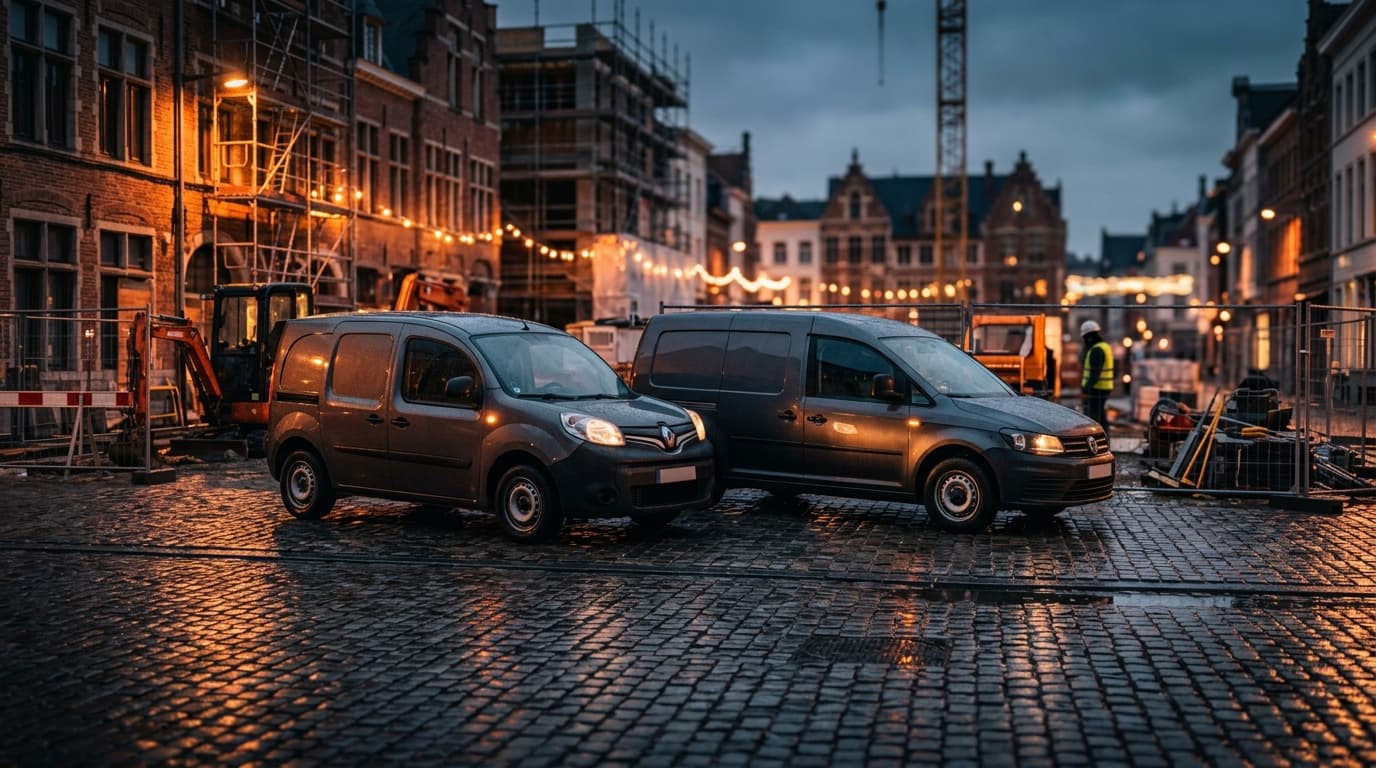
Between the Citroën Berlingo Van and the Renault Kangoo Van, the right choice comes down to three numbers: the ex-VAT price, the load volume and the payload. The Berlingo starts cheaper, the Kangoo loads a bit more. Everything else — trim, screen, looks — comes after. We compared what really matters in Belgium.
Berlingo or Kangoo: which one in short?
If budget rules, take the Berlingo: it enters the range lower, around €17,290 ex-VAT on a pro offer against roughly €20,000 ex-VAT for a diesel Kangoo Van. If you load a lot and load long, the Kangoo regains the edge thanks to its load-through hatch and a slightly higher payload.
Both city vans play in the same class: 4.4 to 4.9 m long, around 3.3 to 4.9 m³ of load volume, up to a tonne of payload. They are town tools, built for the tradesperson who threads through traffic and parks tight.
On a real job site, the difference shows less at the wheel than in the load bay: how you load, door width, length under the bulkhead. That is where the match is decided, not on the brochure.
What differences in volume and payload?
The Kangoo Van leads by a hair on volume. It comes in two lengths (L1 and L2), reaches 4.2 m³ in L2, and climbs close to 4.9 m³ with its load-through hatch under the passenger seat, which swallows pipes or three-metre skirting. Its payload reaches around 901 kg depending on the engine.
The Berlingo Van comes in two sizes, M (4.40 m) and XL (4.75 m), for 3.3 to 4.4 m³ of load volume. Its payload runs from 750 to 1,000 kg depending on version: at equal configuration, very close to the Kangoo. The Citroën trick is the opening rear window and the modular bench in the extended cab.
The number that matters: measure your bulkiest loads before signing. A 120×80 cm EUR pallet fits in both; a 3 m ladder means the Kangoo with hatch or the Berlingo XL.
| Criterion | Citroën Berlingo Van | Renault Kangoo Van |
|---|---|---|
| Length | 4.40 m (M) / 4.75 m (XL) | 4.49 m (L1) / 4.91 m (L2) |
| Load volume | 3.3–4.4 m³ | 3.3–4.2 m³ (~4.9 m³ hatch) |
| Payload | 750–1,000 kg | up to ~901 kg |
| Loading asset | Opening window, extended cab | Hatch under seat, no side pillar |
| Entry price (BE, ex-VAT) | from ~€17,290 (pro offer) | ~€20,000 (dCi 95) |
Which is cheaper to buy in Belgium?
The Berlingo. Its petrol entry price drops to about €17,290 ex-VAT on a professional offer, and stays around €21,900 ex-VAT on the list. The diesel Kangoo Van dCi 95 starts near €20,000 ex-VAT. At entry level, the gap can reach €2,000 to €3,000 ex-VAT in Citroën's favour.
That gap melts as soon as you tick the useful options: full bulkhead, third seat, air conditioning, driver aids. A Berlingo and a Kangoo equipped the same often end up a few hundred euros apart. So look at the price of the van as you will actually use it, not the headline figure.
On the Belgian market, both brands push aggressive pro deals, especially at quarter's end. Compare the current offer at two dealers: that is often where €1,500 is won, more than on the spec sheet.
Berlingo or Kangoo electric: which one for the city?
Neck and neck. The Kangoo Van E-Tech carries a 45 kWh battery for around 285 to 300 km WLTP; the ë-Berlingo a 50 kWh battery for around 275 to 280 km WLTP. In real, loaded use, count on 70 to 80% of those figures, and less in winter.
For an electrician or courier covering 80 to 120 km a day and charging at the depot overnight, both are plenty. The deciding argument is not range, it is access: an electric van clears every low-emission zone, with no restriction or expiry date.
And the stake is concrete. Since 1 January 2026, Euro 5 diesel is banned from the Brussels LEZ, with fines starting on 1 July 2026 (€350 a year for the affected vans). Antwerp and Ghent postponed their tightening, but the direction is clear. If you mostly drive in the capital, electric settles the question.
How much VAT can you recover on a city van?
This is the tax argument that weighs more than the badge. A city van homologated as a utility vehicle and used 100% for business lets you recover 100% of the VAT. For mixed use, the administration applies a flat rate: 85% if use is mainly professional, 35% if mainly private.
Better still: unlike company cars, light commercial vehicles escape the 2026 tax reform. Berlingo, Kangoo, Partner or Caddy stay 100% deductible for income tax for professional use, whether petrol, diesel or electric. Running costs — fuel or charging, maintenance, insurance, leasing — follow the same logic.
Which holds up and resells best?
Close again. The current-generation Berlingo (platform shared with Peugeot Partner and Opel Combo) posts solid real-world feedback and a dense Stellantis network. The third-generation Kangoo fixed the teething issues flagged at launch and benefits from the body shared with the Mercedes Citan, a finish guarantee.
At resale, both depreciate comparably on the Belgian used market, well stocked with ex-fleet vans. Body condition and service history weigh more than the logo: a tidy Berlingo resells better than a battered Kangoo, and vice versa.
What we would avoid: buying the weakest engine "to save money". An undersized block hauling a permanently full van wears faster and resells worse than a well-born mid-range version.
Berlingo, Kangoo or Partner: should you look elsewhere?
Yes, it pays to widen the field. The Peugeot Partner and Opel Combo are technical twins of the Berlingo: same volumes, same engines, different grille. The choice then comes down to the commercial offer and the nearest dealer. The Volkswagen Caddy aims one notch higher on finish and price, and appeals to those who drive a lot on the motorway.
To place these city vans in the wider market, see our van comparator and the general guide to vans in Belgium. Not sure of your segment? A short quiz points you in the right direction.
Our verdict
There is no universal winner between Berlingo and Kangoo: there is the one that fits your load, your volume and your budget. The Berlingo wins at entry level and on comfort; the Kangoo on maximum volume and loading ingenuity. On electric, it is a near dead heat. And before you sign, always check the recoverable VAT and deductibility: on a work tool, that is where the real price is decided.
Sources: FEBIAC (2025 commercial vehicle registrations); Moniteur Automobile and AutoScout24 (Belgian prices and versions); Citroën Belgium and Renault Belgium (pro ex-VAT prices, June 2026); Test-Achats and Brussels Environment (low-emission zones 2026); SPF Finances and Accountable (VAT and deductibility of light commercial vehicles).
Fourgonnettes & ludospaces comparator
Compare all fourgonnettes & ludospaces side by side.
Compare now →
Frequently asked questions

Damien, 44 ans, a géré pendant douze ans la flotte d'utilitaires d'une PME de second œuvre dans la région de Namur : achats, entretien, revente, et les galères de carrosserie qui vont avec. Il a vu passer des dizaines de Trafic, Transporter et Master, et il sait ce qui casse, ce qui se revend bien et ce qui coûte cher à l'usage. Il a lancé ce site pour comparer les utilitaires sur ce qui compte vraiment en Belgique : charge utile réelle, volume utile, TVA récupérable et coût au kilomètre — pas la brochure du concessionnaire.