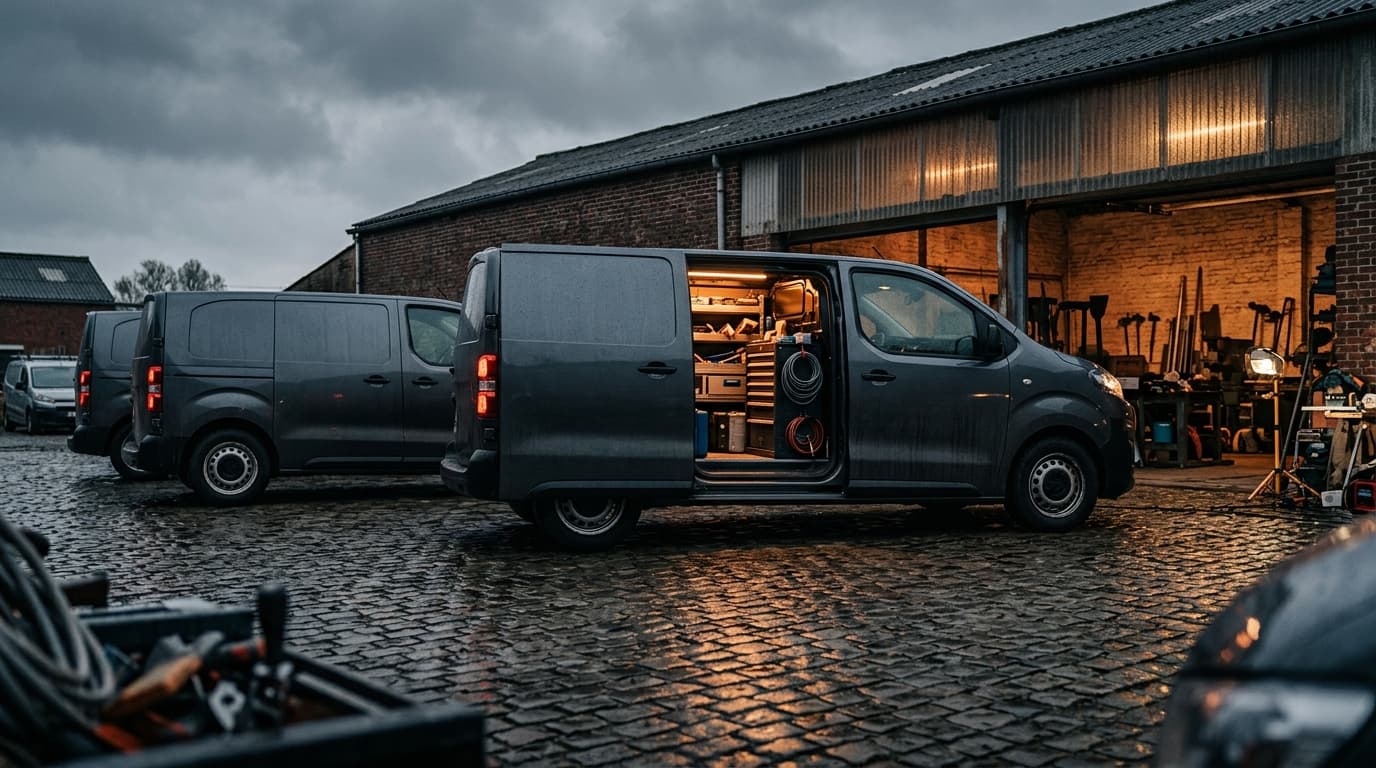
For a tradesperson in Belgium, the best city van depends first on your trade: an electrician wants storage and manoeuvrability, a plumber payload, a joiner load length. Kangoo, Berlingo, Partner, Combo, Caddy and Doblò share the market — here is which one really fits your job.
Which city van for a tradesperson, in short?
Look at your trade before the badge. If you load heavy (plumbing, tiling), the Stellantis trio — Berlingo, Partner, Opel Combo — climbs to around 1,000 kg payload and starts cheapest. If you carry long (joinery, skirting, pipes), the Renault Kangoo and its load-through hatch take the lead. If you drive a lot on the motorway, the Volkswagen Caddy looks after comfort.
All these city vans play in the same format: 4.4 to 4.9 m long, 3.3 to 4.4 m³ of load volume, up to a tonne of payload. They are town tools, built to thread through traffic and park tight.
On a real job site, the gap shows less at the wheel than in the load bay: side-door width, length under the bulkhead, sill height. That is where the match is decided, not on the brochure.
Which city van for an electrician?
An electrician wants storage and manoeuvrability, not raw volume. The priority is the interior fit-out — racks, drawers, bins — and easy side loading in the middle of the street.
An electrician carries a lot of small material: cable, trunking, boxes, power tools. Volume matters less than organisation. A short van (L1, ~4.40 to 4.49 m) is enough, and its manoeuvrability saves time on urban rounds. The Kangoo scores here with its Open Sesame side opening, which removes the central pillar on the passenger side and frees a wide access to slide in a full rack.
The number that matters: count the fit-out budget, often €1,500 to €3,500 ex-VAT, in the overall envelope. A bare Berlingo or Partner at €18,000 ex-VAT quickly reaches €21,000 once equipped. On the Belgian market, several fitters (Sortimo, Modul-System) offer homologated kits that can be transferred from one van to the next at resale.
Which city van for a plumber or heating engineer?
Take the one that carries most: payload rules. A plumber loads boilers, radiators, heavy bags of material — quickly 700 to 900 kg on board.
Here the Stellantis trio retakes the lead. The Citroën Berlingo Van, the Peugeot Partner and the Opel Combo climb to around 1,000 kg payload depending on engine and version, against ~901 kg for the Kangoo and rather 615 to 780 kg for the Caddy. The difference is not cosmetic: exceeding the homologated payload means driving overloaded, with insurance that can turn against you in a claim and accelerated wear on the running gear.
What we would avoid: choosing the weakest engine "to save money". An undersized block hauling a permanently full van heats up, wears faster and resells worse than a well-born mid-range version. For a heating engineer loading daily, a 100 to 130 hp diesel stays the rational choice.
Which city van for a joiner or fitter?
Aim for load length, not just volume. A joiner carries panels, skirting, profiles — long items that will not go in diagonally.
Two schools. The Renault Kangoo plays the load-through hatch under the passenger seat: it swallows pipes and skirting up to three metres without occupying the cab permanently. On the Stellantis side, the Extenso extended cab folds the passenger seat to create a flat floor over the bulkhead, and the XL / Maxi version pushes load length to ~3.05 m. The Fiat Doblò, now built on the same Stellantis base, offers the same solutions.
At resale, a van with a tidy floor and the original bulkhead resells better than a body drilled all over to fit a home-made roof rack. Plan a removable roof rack rather than holes: on a Belgian used market well stocked with ex-fleets, interior condition weighs heavily.
Electric city van: a good move for an urban tradesperson?
Yes, as soon as you mostly drive in town with a fixed base. For 80 to 120 km a day and overnight depot charging, electric settles the access question without range stress.
The Renault Kangoo Van E-Tech (45 kWh battery, ~285 to 300 km WLTP) and the Stellantis cousins ë-Berlingo, e-Partner and e-Combo (50 kWh, ~275 to 330 km WLTP by model year) last a day of rounds. Count on 200 to 250 km real when loaded, less in winter. The deciding argument is not range but access: an electric van clears every low-emission zone, with no restriction or expiry date.
And the stake is concrete. Since 1 January 2026, Euro 5 diesel is banned from the Brussels LEZ, with fines starting on 1 July 2026. Antwerp and Ghent postponed their tightening, but the trajectory is clear. A tradesperson working mostly in the capital is better switching now than buying a short-lived diesel. To weigh a whole fleet, see our electric or diesel for a fleet comparison.
How much VAT does a tradesperson recover on a city van?
This is the tax argument that weighs more than the logo. A city van homologated as a utility vehicle and used 100% for business lets you recover 100% of the VAT and deduct 100% for income tax. For mixed use, the administration applies a flat rate: 85% if use is mainly professional, 35% if mainly private.
Better still: unlike company cars, light commercial vehicles escape the 2026 tax reform. Kangoo, Berlingo, Partner, Combo, Caddy or Doblò stay 100% deductible for professional use, whether petrol, diesel or electric. Running costs — fuel or charging, maintenance, insurance, leasing — follow the same logic.
Comparison table: which city van for which trade?
Here is how the main city vans on the Belgian market line up, from the one that loads heavy to the one that drives far.
| Model | Max payload | Load volume | Trade strength | Entry price (BE, ex-VAT) |
|---|---|---|---|---|
| Citroën Berlingo / Peugeot Partner / Opel Combo | ~1,000 kg | 3.3–4.4 m³ | Heavy load, Extenso, low price | from ~€17,290 (pro offer) |
| Fiat Doblò | ~1,000 kg | 3.3–4.4 m³ | Stellantis twin, long warranty | ~€18,500 |
| Renault Kangoo Van | ~901 kg | 3.3–4.9 m³ (hatch) | Long items, Open Sesame | ~€20,000 (dCi 95) |
| Toyota Proace City | ~1,000 kg | 3.3–4.4 m³ | Reliability, warranty up to 10 years | ~€20,500 |
| Volkswagen Caddy Cargo | 615–780 kg | 3.1–3.7 m³ | Motorway comfort, finish | ~€22,500 |
Prices are Belgian ex-VAT ballparks from summer 2026; the current pro offer and options move the real bill by several thousand euros.
New or used for a first van?
For a tradesperson starting out, a recent used van is often the better calculation. An ex-fleet van 2 to 4 years old saves 30 to 40% on the new price, with depreciation already absorbed by the first owner.
The Belgian used-van market is well stocked with well-tracked ex-fleets. The risk is bodywork and history: these vehicles have worked. Check the service book, the state of the floor and wheel arches, and the presence of the original bulkhead. A recent roadworthiness test and a clear history beat a low but poorly documented mileage.
On the Belgian market, if budget allows, a new van on a pro offer stays relevant for high-mileage users: manufacturer warranty, chosen engine, clean fit-out from the start. To compare one notch up, the guide to vans in Belgium places city vans, medium and large vans, and our van comparator lines models up side by side. Torn between two favourites? The Berlingo or Kangoo comparison settles the most frequent duel.
Our verdict
There is no best city van in absolute terms — there is the one that fits your trade, your load and your rounds. The Stellantis trio wins on payload and price, the Kangoo on long items, the Caddy on comfort, the Proace City on long-term peace of mind. Choose the function before the logo, cost the fit-out and the recoverable VAT, and you will have a profitable tool rather than a pretty vehicle.
Sources: FEBIAC (2025 light commercial vehicle registrations, +7.6%); Moniteur Automobile and AutoScout24 (Belgian prices and versions); Citroën, Peugeot, Renault and Toyota Belgium (pro ex-VAT prices, summer 2026); Brussels Environment (low-emission zone 2026); SPF Finances and Accountable (VAT and deductibility of light commercial vehicles).
Fourgonnettes & ludospaces comparator
Compare all fourgonnettes & ludospaces side by side.
Compare now →
Frequently asked questions

Damien, 44 ans, a géré pendant douze ans la flotte d'utilitaires d'une PME de second œuvre dans la région de Namur : achats, entretien, revente, et les galères de carrosserie qui vont avec. Il a vu passer des dizaines de Trafic, Transporter et Master, et il sait ce qui casse, ce qui se revend bien et ce qui coûte cher à l'usage. Il a lancé ce site pour comparer les utilitaires sur ce qui compte vraiment en Belgique : charge utile réelle, volume utile, TVA récupérable et coût au kilomètre — pas la brochure du concessionnaire.