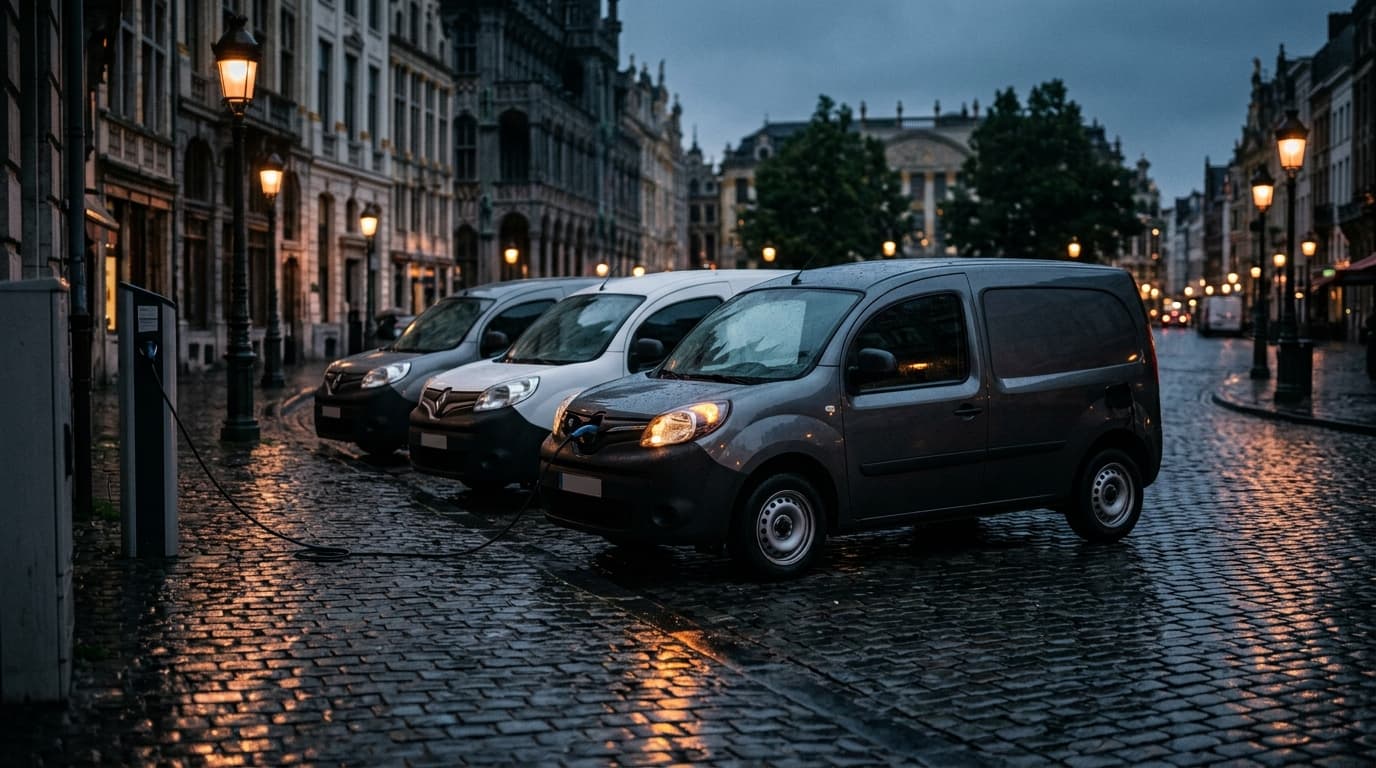
The best electric city van in Belgium depends on your rounds, not on the badge. For a tradesperson working in town and coming home every evening, the Stellantis trio (ë-Berlingo Van, e-Partner, Combo Electric) remains the safe choice, and the 2026 Ford E-Transit Courier is now a serious challenger. Here is how they separate, with Belgian figures.
Which electric city van should you choose, in short?
Start with your daily kilometres and what you load. For a plumber, an electrician or an installer covering 80 to 120 km a day and charging at the depot or at home, the Citroën ë-Berlingo Van, the Peugeot e-Partner and the Opel Combo Electric tick every box: 50 kWh, up to around 330 km WLTP, close to 800 kg of payload and 100 kW fast charging.
If price rules, the Ford E-Transit Courier is the model that moved up a class in 2026: its battery goes from 43 to 46 kWh, range climbs to 334 km WLTP, and it undercuts the Stellantis trio. The Renault Kangoo E-Tech Van keeps one solid argument with 213 km recovered in 30 minutes, but its charging caps at 80 kW.
The city van is the format of the self-employed: 4.4 to 4.9 m long, 3.3 to 4.4 m³ of load volume, around 600 to 800 kg of payload. In electric form, it targets urban and suburban rounds — not a fully loaded Brussels-Arlon run.
What exactly is an electric city van?
An electric city van is a light commercial vehicle in category N1, derived from a small car, powered by a 40 to 50 kWh battery and a 90 to 100 kW motor. Load volume: 3 to 4.4 m³. It is the smallest professional format that genuinely works day to day.
The segment splits into three families. First the Stellantis platform, which produces the ë-Berlingo Van, e-Partner, Combo Electric, Fiat E-Doblò and Toyota Proace City Electric — five badges, one vehicle. Then the Renault platform, behind the Kangoo E-Tech, the Mercedes eCitan and the Nissan Townstar EV. The Ford E-Transit Courier stands alone on its own base.
One detail that saves hours of searching: Volkswagen sells no electric Caddy. The Caddy exists in diesel and petrol, full stop. For an electric VW van you have to move up a size (e-Transporter, ID. Buzz Cargo), bigger and pricier. That is the kind of gap in a range no brochure mentions.
What real range should you expect in professional use?
Count on 70 to 80 % of the WLTP range in summer, and 60 to 70 % in winter. A van rated at 330 km therefore covers 230 to 260 km in summer and can fall towards 200 km on a January morning, heating on and vehicle loaded.
Three things eat the battery in Belgium: cold, which easily costs 20 %; the load on board, which drives consumption up; and motorway driving, where electric drinks more than in town. Good news for a tradesperson: a typical working day is the opposite — stops, restarts, short hops and plenty of regenerative braking.
The number that counts: a Belgian plumber or electrician covers around 80 to 120 km a day. Even at 200 km of real winter range, that leaves 40 % of margin. What we would avoid: sizing the battery on the average. The average never breaks down. It is your worst day — the Monday when you string together Namur, Wavre and Brussels with a full van — that decides the battery you need.
Is the Stellantis trio still worth it?
Yes, and it remains the segment benchmark. The Citroën ë-Berlingo Van, the Peugeot e-Partner and the Opel Combo Electric share the same 50 kWh battery, the same 100 kW (136 hp) motor, a range climbing to around 330 km WLTP in the short version, and 100 kW DC charging.
Where they pull ahead is payload: up to around 800 kg depending on version, the best in the segment. For a tiler carrying bags of mortar or an installer hauling heavy kit, that 100-plus kg gap over a Kangoo is not a detail — it is the difference between loading calmly and flirting with the legal limit. Load volume runs from 3.3 m³ (M) to 4.4 m³ (XL), with the Extenso bulkhead hatch letting a 3 m pipe through.
The Fiat E-Doblò and Toyota Proace City Electric are the very same vehicle under a different logo. In the Belgian market, Toyota adds its Relax warranty (up to 10 years within the network), which matters if you keep your van a long time. The Citroën is usually the cheapest of the three on a pro offer.
| Model | Battery | WLTP range | Max payload | Load volume | DC charging |
|---|---|---|---|---|---|
| Citroën ë-Berlingo Van | 50 kWh | up to ~330 km | ~800 kg | 3.3 to 4.4 m³ | 100 kW |
| Peugeot e-Partner | 50 kWh | up to ~330 km | ~800 kg | 3.3 to 4.4 m³ | 100 kW |
| Opel Combo Electric | 50 kWh | up to ~330 km | ~800 kg | 3.3 to 4.4 m³ | 100 kW |
| Toyota Proace City Electric | 50 kWh | up to ~330 km | ~800 kg | 3.3 to 4.4 m³ | 100 kW |
| Ford E-Transit Courier | 46 kWh | ~334 km | ~699 kg | ~2.9 m³ | 100 kW |
| Renault Kangoo E-Tech Van | 45 kWh | up to ~308 km | ~600 kg | 3.3 to 4.2 m³ | 80 kW |
| Mercedes eCitan | 45 kWh | ~285 km | ~600 kg | 2.9 to 3.7 m³ | 80 kW |
| Nissan Townstar EV | 45 kWh | ~285 km | ~600 kg | 3.3 to 4.3 m³ | 80 kW |
These are orders of magnitude recorded in summer 2026: homologated ranges, battery capacities and payloads shift from one model year and version to the next. Check the exact spec sheet of the version you are considering.
Does the 2026 Ford E-Transit Courier change things?
Partly, yes. Ford has taken its usable battery from 43 to 46 kWh for the 2026 model year, pushing range to 334 km WLTP (+10 % on the previous 304 km) — on paper, the best figure in the segment. DC charging at 100 kW does 10–80 % in under 30 minutes, and ten minutes of charge returns around 114 km.
The trade-off shows elsewhere. With 2.9 m³ of load volume and around 699 kg of payload, the Courier sits a notch below the Stellantis trio. It targets the solo tradesperson, the maintenance technician, the courier — not someone loading pallets. In exchange, it enters cheaper, and its Ford Pro ecosystem (telematics, charge planning, fleet management) is the best thought-out in the segment for anyone running several vehicles.
In practice, on a site, the question settles fast: measure what you actually load. If your biggest load fits in 2.9 m³ and under 700 kg, the Ford is the best calculation on the market in 2026. If not, move up to a Stellantis and stop hesitating.
Kangoo E-Tech, eCitan or Townstar: how good are the Renault cousins?
They are honest, but technically behind. The Renault Kangoo E-Tech Van, the Mercedes eCitan and the Nissan Townstar EV share the same base: a 45 kWh battery, a 90 kW (121 hp) motor, and fast charging that caps at 80 kW — a notch below the 100 kW of the rest of the pack.
The Kangoo is the best of the family: up to around 308 km WLTP in van form, and 213 km recovered in 30 minutes on a fast charger, which is perfectly decent as a mid-round top-up. Load volume reaches 4.2 m³ in the long version, with the Easy Inside Rack hatch. Payload, however, sits around 600 kg — 100 to 200 kg below a Stellantis.
The Mercedes eCitan is a Kangoo in a suit: same hardware, Mercedes trim and network, higher price. At resale, the star helps a little, but not enough to recoup the purchase gap over a three-year cycle for a self-employed owner. The Nissan Townstar EV plays the same tune with a more aggressive warranty and price. If you are still weighing up the combustion format, our guide to the city van for a tradesperson in Belgium covers the diesel and petrol versions.
How much does an electric city van cost, and what VAT can you recover?
Budget roughly €28,000 to €36,000 ex-VAT for a well-equipped new electric city van. That is €10,000 to €15,000 more than the diesel equivalent, which starts around €17,000 ex-VAT on a pro offer for a Berlingo Van. The up-front investment is the real brake, and nobody should play it down.
On tax, the rules work in your favour and match the diesel: in 100 % professional use, VAT is fully recoverable and the vehicle stays 100 % deductible. For mixed use, the Belgian tax authority applies a flat rate of 85 % or 35 % depending on private use. Crucially, unlike company cars, light commercial vehicles are exempt from the 2026 tax reform — electric and combustion alike.
The payback happens in running costs. An electric city van uses roughly 18 to 22 kWh/100 km. At €0.20/kWh on a home night tariff, that is €4 per 100 km, against €9 to €11 for a diesel at 7 L/100 km. Add lighter servicing (no oil changes, no clutch, brakes that last) and the gap closes over four to five years — provided you charge at home.
Can an electric city van enter Belgian LEZs?
Yes, everywhere, with no expiry date. Electric vehicles are exempt from Belgian low-emission zones. For a tradesperson working in city centres, that is the most concrete argument in this whole comparison — often stronger than the fuel bill.
The deadline is already here. Since 1 January 2026, Euro 5 diesel has been banned from the Brussels LEZ, and fines for affected light commercial vehicles start on 1 July 2026, at €350 per year. Antwerp and Ghent run their own, more staggered timetables, but the direction is identical. An ageing diesel van becomes a short-term budget risk; an electric one removes the question for good.
The market is moving slowly. Belgium registered 70,797 light commercial vehicles in 2025 (+7.6 % year on year, according to FEBIAC), yet electric still accounts for under 5 % of the fleet. In other words: the switch has not happened, and it is the LEZs, not ecology, driving it. To place the other segments, see our guide to electric vans in Belgium and our medium electric van comparison. The comparison tool puts the models side by side, and the quiz points you in the right direction in two minutes.
Should you buy a used electric city van?
Careful: the market is still thin and depreciation steep. The first ë-Berlingo and Kangoo E-Tech vans from 2022-2023 are reaching the Belgian used market around €18,000 to €24,000 ex-VAT, with first-generation batteries (often 45 to 50 kWh) and slower charging.
The real issue is battery condition. Demand a state-of-health (SOH) certificate before buying: below 85 %, real winter range gets tight for a full working day. Check too that the manufacturer's battery warranty (usually 8 years or 160,000 km) is still running — that is what carries the vehicle's value, not the odometer.
What we would avoid: buying a used electric van with no charge point at home. That combination wrecks the maths — purchase premium, limited range, expensive charging. In that specific case, a recent Euro 6 diesel often remains the rational choice, provided you check the zones you drive in. Our guide to the reliable used van in Belgium sets out the checks to run.
Our verdict
The electric city van is ready for the Belgian tradesperson, on one condition: charging at home or at the depot. At that price — €4 per 100 km, lighter servicing, LEZs erased — the purchase premium is recouped in four to five years. Without a charge point, the maths collapses and a Euro 6 diesel remains defensible.
Beyond that, the ranking is fairly clear: the Stellantis trio for those who load heavy, the Ford E-Transit Courier for those counting every euro, the Kangoo E-Tech for those attached to their Renault network. Size on your worst day, not your average one, weigh what you actually carry, and check the payload of the exact version before signing. That is where the right choice is made — not in the brochure.
Sources: FEBIAC (light commercial vehicle registrations 2025, 70,797 units, +7.6 %); Brussels Environment (Brussels LEZ, Euro 5 diesel ban from 1 January 2026, fines from 1 July 2026); Ford Belgium and Myutilitaire (E-Transit Courier 2026, 46 kWh and 334 km WLTP); Citroën, Peugeot and Opel Belgium (ë-Berlingo Van, e-Partner, Combo Electric 50 kWh); Renault Belgium and Automobile-Propre (Kangoo E-Tech, 45 kWh, 213 km in 30 min); L'Argus and La Revue Automobile (Kangoo E-Tech / ë-Berlingo comparisons); Mercedes-Benz Vans (eCitan); Belgian FPS Finance (VAT and deductibility of light commercial vehicles, 2026 company-car reform). Figures recorded in summer 2026 and subject to change by model year.
Utilitaires électriques comparator
Compare all utilitaires électriques side by side.
Compare now →
Frequently asked questions

Damien, 44 ans, a géré pendant douze ans la flotte d'utilitaires d'une PME de second œuvre dans la région de Namur : achats, entretien, revente, et les galères de carrosserie qui vont avec. Il a vu passer des dizaines de Trafic, Transporter et Master, et il sait ce qui casse, ce qui se revend bien et ce qui coûte cher à l'usage. Il a lancé ce site pour comparer les utilitaires sur ce qui compte vraiment en Belgique : charge utile réelle, volume utile, TVA récupérable et coût au kilomètre — pas la brochure du concessionnaire.