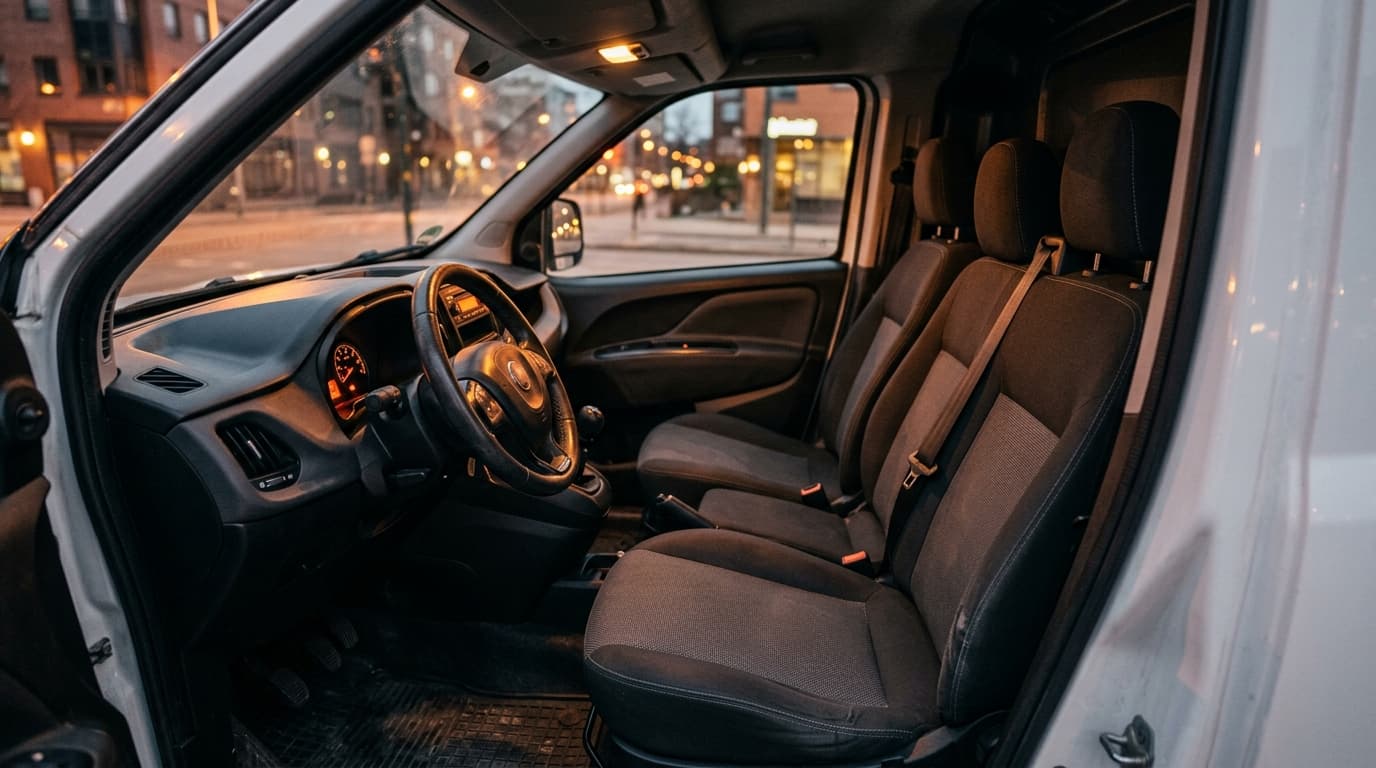
Yes. A van can carry three people side by side in Belgium, provided the third seat is type-approved, fitted with a belt and counted in field S.1 of the registration certificate. On a small van that seat is never standard: it is ordered as an option, and it is paid for in payload.
Can three people ride in the front of a van?
Yes, if the vehicle was approved that way. The Belgian rule fits on one line: the number of occupants may not exceed the number of seats fitted with a belt, and everyone wears theirs. The number of seats, driver included, is printed in field S.1 of the registration certificate. If it says 2, the third passenger has no legal seat, even if the space between the two seats looks sufficient.
On a medium van, a two-seat passenger bench is a common configuration and the question rarely comes up. On a small van it is the reverse: the standard cab has two seats, and the third place is chosen on the order form.
Which small vans have three front seats in Belgium?
Almost every platform sold here offers one, under different names and with different trade-offs. I checked the configurations in the manufacturers' official documentation in September 2026.
| Small van | Third front seat | Manufacturer name | Point noted |
|---|---|---|---|
| Citroën Berlingo Van | Yes, optional | Extenso cab | Centre backrest folds into a desk, outer seat folds away with a hatch for long items |
| Opel Combo Cargo | Yes, optional | Three-seat bench | Alternative to two individual seats, centre backrest folds into a desk |
| Fiat Doblò Cargo | Yes | Moduwork bench (Magic Cargo) | Bulkhead hatch for long loads |
| Toyota Proace City | Yes, optional | Moduwork bench | Lowerable bulkhead and folding passenger backrests |
| Renault Kangoo Van | Yes, optional | Fixed two-seat bench or mobile office | Not compatible with increased payload or the ISOFIX passenger seat |
| Volkswagen Caddy Cargo | Not found in the sources consulted | Flexible crew cab (Maxi) | Five seats over two rows rather than three abreast |
The Berlingo Van page on Citroën Belgium's business site describes the Extenso cab as a two-seat passenger bench with under-seat storage. The Peugeot Partner, built on the same platform as the Berlingo and the Combo, follows the same logic; check the exact option name on the Peugeot price list. For Fiat, Stellantis presents the Doblò Cargo Moduwork bench as three seats or a desk.
How much payload do two passengers cost?
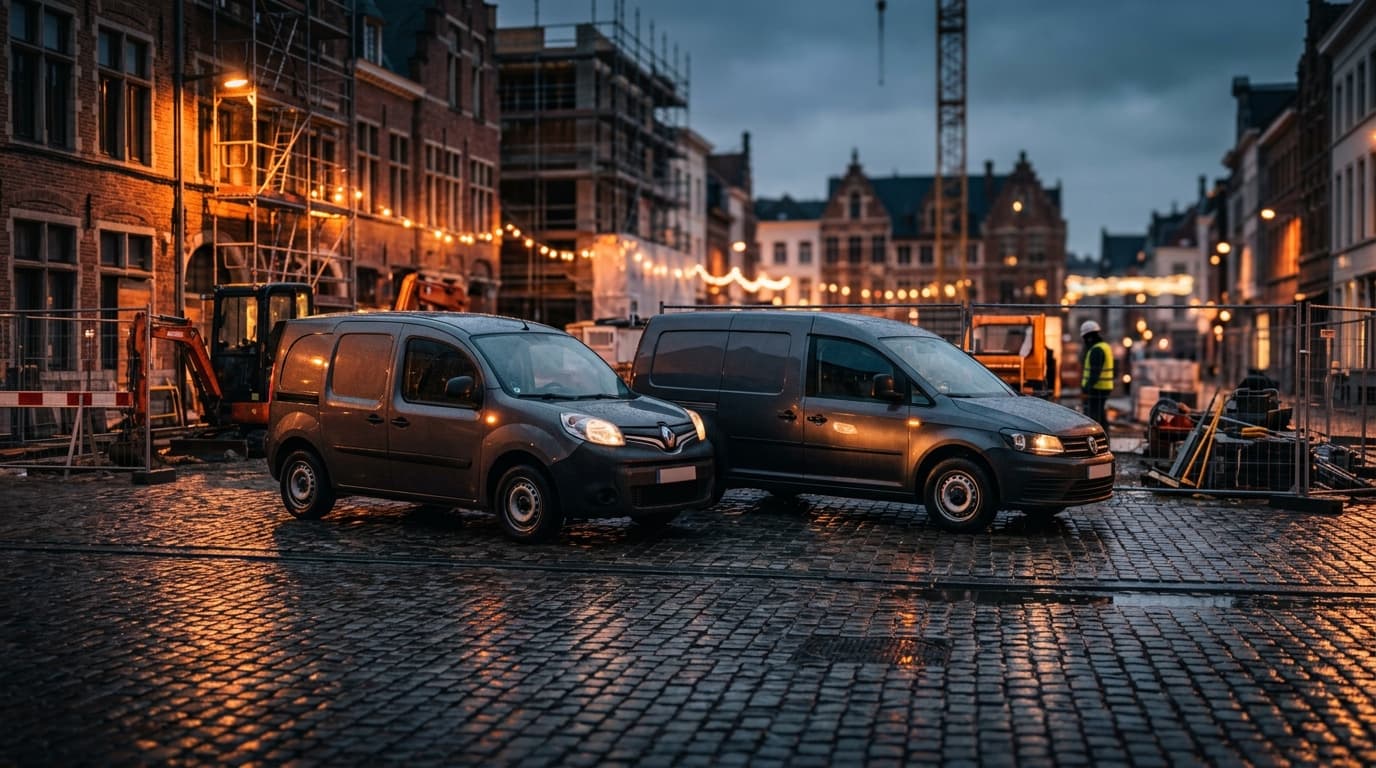
The number that matters: 150 kg. A van's kerb weight already includes a 75 kg driver, the type-approval convention restated in Renault's technical sheet. Passengers come out of the payload.
Take the most telling case, a Kangoo Van L1 with the 1.5 Blue dCi 95. Renault's January 2026 options and specifications list (Swiss edition, the only one detailing masses and incompatibilities version by version) gives it 547 kg of maximum payload without extra equipment. With two crew members aboard, 397 kg remain. The same list forbids combining the two-seat bench with the increased-payload option, which would have taken the vehicle to 767 kg. Between a two-seat Kangoo with increased payload and one passenger, and the same Kangoo with the bench and two passengers, the gap in possible cargo therefore reaches 370 kg, roughly a pallet of cement bags left behind at the depot.
On a Berlingo Van or a Combo Cargo rated up to 1,000 kg, the sum is less painful: 850 kg remain available. It still has to be done, using the payload on your registration certificate rather than the brochure. Our article on payload and the category B licence explains which fields to read.
Three abreast: 135 cm minimum width
The Belgian highway code gives the driver at least 55 cm of width and each passenger 40 cm, so 135 cm for three people side by side. The Kangoo Van lists 1,524 mm of front elbow width, a 17 cm margin on paper.
With two workers in winter jackets, the driver ends the day with an elbow against the door.
Can a child sit in the middle front seat?
In principle, yes, and it is the question self-employed parents ask most often when the kids come along on Wednesday afternoons. Belgian law allows a child in the front at any age, as long as the child is restrained as the law requires: under 1.35 m, a restraint suited to the child's height, above that, the belt is enough. The only explicit ban concerns a rear-facing seat installed in a position protected by a frontal airbag that has not been deactivated, as the Famenne-Ardenne local police points out. On a bench this gets more complicated, because the passenger airbag and its deactivation cover a position defined in the handbook, and the centre seat does not always have the geometry or the belt a child seat needs. The vehicle handbook states, seat by seat, which type of restraint is accepted, and that document is the one that counts.
One detail salespeople rarely mention: on the Kangoo Van, the two-seat bench rules out the passenger seat with ISOFIX anchorage. The child seat is then held by the belt, which means careful fitting on every trip.
Six situations, six answers
| Your situation | Three up front? | Why |
|---|---|---|
| Two-seat van (S.1 = 2) plus one extra colleague | No | No approved seat or belt for them |
| Van with a factory bench (S.1 = 3) | Yes | Seat listed on the certificate, belt at every position |
| Bench added after purchase, without manufacturer consent | No | Vehicle no longer matches its type approval |
| Child under 1.35 m in the middle seat | Yes, in a suitable seat | Provided the handbook allows a child seat in that position |
| Rear-facing baby seat in the passenger position | Only with the airbag deactivated | Forbidden in front of an active frontal airbag |
| Berlingo Extenso with the load stop removed | No | The centre seat belt is anchored to it |
The last line deserves a closer look. The Berlingo handbook states that the centre seat of the Extenso cab has a three-point belt whose upper guide is fixed to the load-stop frame behind the driver. Removing the bulkhead to gain a few centimetres of load space means removing a seat belt anchorage.
How do you check before setting off three abreast?
Five minutes, nothing to buy. This is the order I made crew leaders follow when I ran a fleet.
- Read field S.1 on the registration certificate. 3, you can leave with three. 2, the third person stays at the depot or takes another vehicle.
- Check every belt: it unwinds, it locks, and its buckle is reachable. On a bench that has been folded and raised again, the centre buckle often ends up trapped under the cushion.
- Add up the weight of the passengers and the load, then compare the total with the payload taken from the registration certificate, maximum mass minus kerb weight.
- If a child is coming, fit the restraint suited to the child's height and check the passenger airbag status before pulling away.
- Clear the centre desk: a backrest folded into an office is not a seat, and a binder left on it becomes a projectile at the first hard stop.
The mistakes that turn up most often on site:
- seating a third passenger on the centre backrest folded down as a desk;
- using the middle seat while its belt is still trapped under the cushion;
- removing the bulkhead or load stop without looking at where the belts are anchored;
- ordering the bench on a Kangoo and forgetting it closes the door on increased payload;
- fitting a rear-facing baby seat without switching off the airbag;
- working from the brochure payload rather than the one on the registration certificate.
Can a third seat be added after purchase?
Rarely in a simple way. Replacing the passenger seat with a two-seat bench moves the vehicle away from its type approval, exactly like adding a bench behind the bulkhead: you need the manufacturer's written consent, approved seats and belts, then a roadworthiness inspection. The rule is federal, identical in Wallonia, Brussels and Flanders; only the inspection stations differ from one Region to another. The full procedure is in our article on fitting rear seats in a van.
Tax status does not move. A front bench stays in the cab, the vehicle keeps a single row of seats, and the criteria for a camionnette in the Belgian tax sense are untouched. Seats added in the back raise a different problem altogether.
Our verdict
I have seen too many two-seat vans leave in the morning with an apprentice perched on the centre console, because "it's only five kilometres". Five kilometres without a belt, without an approved seat, and without clear cover if things go wrong. The factory bench is ticked on the order form; adding it later costs a file.
If your crew works in threes, pick the platform that absorbs the passengers' weight without sacrificing the load. Our small van comparison tool sets payloads side by side, and our guide to the right small van for a tradesperson helps you decide by trade.
Sources: Citroën Belgium, professional Berlingo Van page (Extenso cab, two-seat passenger bench), consulted on 27 September 2026; Citroën Berlingo handbook, Extenso cab chapter (three-point belt on the centre seat anchored to the load-stop frame); Renault, Kangoo Van price and specification list no. 18.0, January 2026, Swiss edition (fixed two-seat bench and mobile office bench, incompatibility with increased payload and the ISOFIX passenger seat, payloads and elbow width, 75 kg driver included in kerb weight); Opel, Combo Cargo documentation (two individual seats or three-seat bench); Stellantis Media, Doblò Cargo 2024 presentation (Moduwork bench); Toyota, Proace City documentation (Moduwork bench); Volkswagen Commercial Vehicles, Caddy Cargo and Flexible version; Famenne-Ardenne local police, reminder of the rules on carrying children; Belgian rules on passenger numbers, minimum widths and child restraints as taught for the category B theory test. Always check your own vehicle's exact configuration on its registration certificate and in its handbook.
Fourgonnettes & ludospaces comparator
Compare all fourgonnettes & ludospaces side by side.
Compare now →
Frequently asked questions

Damien, 44 ans, a géré pendant douze ans la flotte d'utilitaires d'une PME de second œuvre dans la région de Namur : achats, entretien, revente, et les galères de carrosserie qui vont avec. Il a vu passer des dizaines de Trafic, Transporter et Master, et il sait ce qui casse, ce qui se revend bien et ce qui coûte cher à l'usage. Il a lancé ce site pour comparer les utilitaires sur ce qui compte vraiment en Belgique : charge utile réelle, volume utile, TVA récupérable et coût au kilomètre — pas la brochure du concessionnaire.