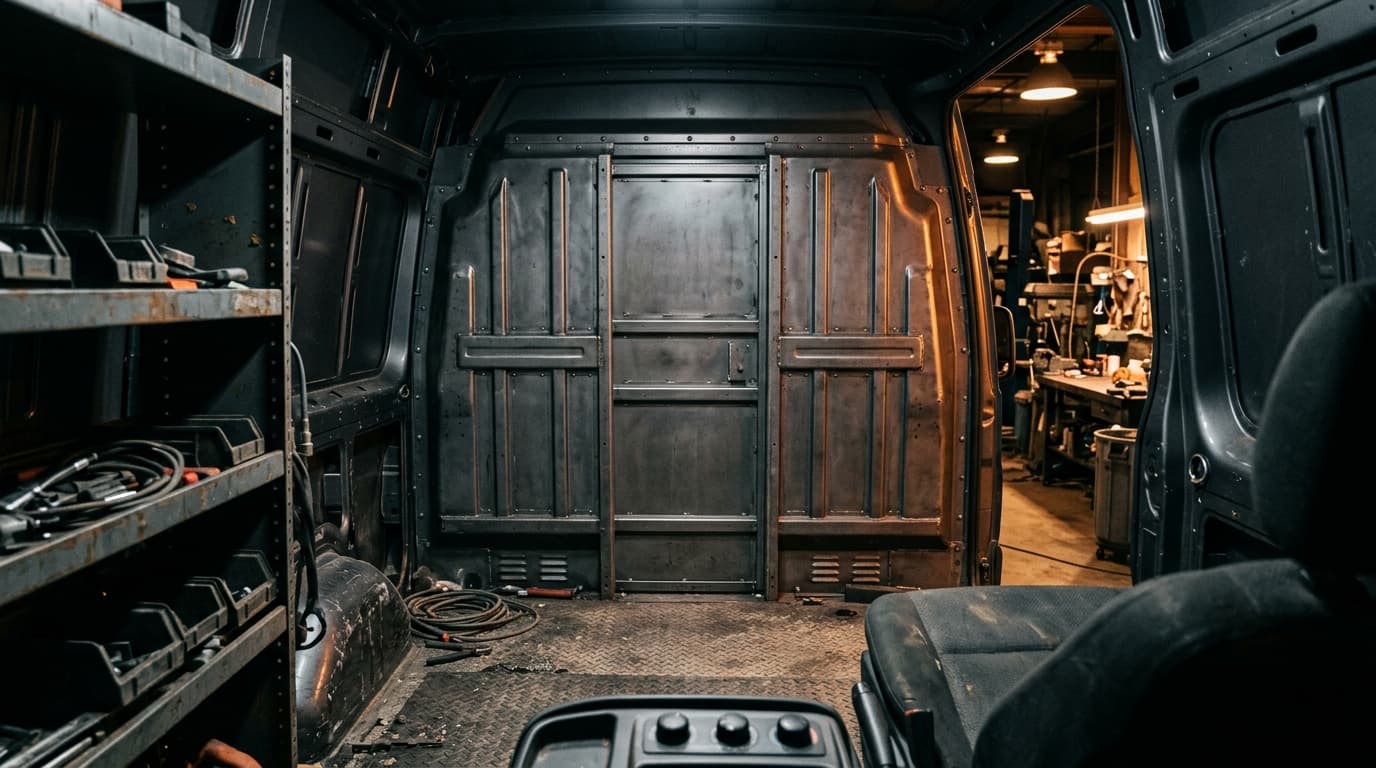
Yes, you can fit a rear bench seat in a panel van in Belgium. Not on your own, though: you need written consent from the manufacturer, type-approved seats and anchorages, and a visit to a roadworthiness test station. The circular that waives that consent covers cars only, never vans.
Can you fit a rear bench in a panel van?
Yes, the conversion is legal and happens every day. It simply is not free. Article 14, § 1, 3. of the Royal Decree of 15 March 1968 prohibits putting a vehicle on the road when it no longer matches its type-approval certificate in every respect, and a row of seats that does not appear on that certificate makes the van non-compliant from the first turn of the key.
The gateway is article 8, § 5 of the same decree: any conversion that takes the vehicle away from its type-approval certificate must be covered by a derogation, and when the work is not carried out by the manufacturer or its representative, the application is only considered with that party's consent. Consent is requested before the work, not after. An SME owner buying a used Master to carry three fitters usually discovers the correct order the hard way: bench ordered, floor drilled, then a call to the dealer.
The 2010 tuning circular covers cars only
Forums keep pointing to the ministerial circular of 12 March 2010, which lists fifty-five conversions exempt from manufacturer consent. It applies to category M1 vehicles only. For every other category, article 8, § 5 remains fully applicable. Your van has no claim on it.
What does the test station check after the conversion?
The station compares the vehicle against its type-approval certificate, then asks for three things: manufacturer consent, the approval certificates for the seats and the belts, and a validation report where the parts carry no e or E marking.
Even for cars, where the circular is comparatively permissive, replacing a single seat already requires a validation procedure, mounting on original fixing points and proven compatibility with the belts and their anchorages. Two prohibitions are absolute and apply everywhere: obstructing or removing an airbag, and replacing a three-point belt with a two-point belt. An incomplete file is not an outright rejection: the station issues an inspection certificate with limited validity, fifteen days or three months depending on the case, while the paperwork catches up.
How far back can the bulkhead go?
Further than you would think. Belgian tax rules require a ratio of at least 50 % between load compartment length and wheelbase for a double-cab van to keep its van status. On a large van, that floor sits well below the available load area.
I ran the numbers on the four best-selling L2 vans in Belgium, using wheelbases and load lengths published by the manufacturers and by conversion catalogues.
| L2 panel van | Wheelbase | Original load length | 50 % floor | Bulkhead setback still available |
|---|---|---|---|---|
| Mercedes-Benz Sprinter L2H2 front-wheel drive | 3,924 mm | 3,397 mm | 1,962 mm | 1,435 mm |
| Mercedes-Benz Sprinter L2H2 rear-wheel drive | 3,665 mm | 3,272 mm | 1,833 mm | 1,439 mm |
| Renault Master L2H2 (2010-2024 generation) | 3,682 mm | 3,083 mm | 1,841 mm | 1,242 mm |
| Fiat Ducato and Peugeot Boxer L2H2 | 3,450 mm | 3,120 mm | 1,725 mm | 1,395 mm |
One row of seats uses 40 to 50 cm of load length, a figure we see consistently on factory crew cab versions. That leaves you 74 to 94 cm of margin after the bench on the tightest of the four. The tax criterion is not what stops you on an L2. It gets tight on a short city van, where wheelbase and load area sit uncomfortably close together.
Do VAT and road tax change?
As long as the vehicle stays registered as a van in category N1, no. VAT at 21 % is still recovered according to the share of business use, and road tax is still calculated on maximum authorised mass in all three Regions.
The tipping point lies elsewhere. Add a fixed kitchen, a table and fixed storage on top of the bench and you are no longer building a crew cab: you are building a motorhome, with a regional reclassification file and a tax scale based on engine capacity. Wallonia spells out the mirror case, the car converted into a van, where it demands a load compartment of at least half the wheelbase, a 20 cm load stop behind the seats and a flat, rigid floor. Our guide on converting a van into a camper covers that switch in detail.
Which builds pass, and which ones stall?
Five situations cover almost every case.
| Your situation | Vehicle status | What to do |
|---|---|---|
| Factory-fitted bench, crew cab version | N1 van from new | Nothing, the conformity certificate already lists the seats |
| Approved bench fitted by a COP converter | N1 van status kept | The converter files the application and hands you the approval sheet |
| Bench bought separately and fitted by you | No longer matches the type-approval certificate | Written manufacturer consent, then a non-periodic roadworthiness test |
| Salvaged seats on improvised anchorages | Cannot be approved as it stands | Give up, or go through an approved technical service |
| Bench plus fixed kitchen, table and storage | Tips into the motorhome category | Regional reclassification file, this is no longer a bench |
What gets a file rejected?
- Manufacturer consent requested after the work, sometimes after the test station has already refused
- Anchorages drilled into a floor with no reinforcement designed for that spot
- A two-point lap belt where the rules require three points
- The bulkhead left in front of the bench, penning passengers in behind a solid panel
- A van presented without the seat approval certificates, leaving with fifteen days of validity
Is an approved converter necessary?
Nothing requires one. But an approved COP converter does the work and files the application with the regional service directly, which spares you the shuttling between dealer, test station and administration. The register of approved firms is public on homologatie.be, maintained by TRAXIO.

Our verdict
A panel van can be converted, and plenty of small-team bosses are right to want that rather than pay for a second vehicle. The calculation nobody makes is the one about time. Between the consent request, ordering a bench approved for the exact variant, the work itself and the test station visit, count several weeks, with a risk of refusal that only surfaces at the end.
Against that, a factory crew cab arrives approved, with its seats printed on the conformity certificate and its tax status intact. It costs more to buy. It costs nothing in paperwork. For the models available on the Belgian market, see our large van comparison.
Sources: Royal Decree of 15 March 1968 on the technical conditions applicable to motor vehicles, articles 8, § 5 and 14, § 1, 3.; ministerial circular of 12 March 2010 on certain converted vehicles (cat. M1), published in the Belgian Official Gazette on 26 March 2010, consolidated text last updated 28 August 2026 (Vias institute); SPW Mobility and Infrastructure, procedure "Transformer un véhicule en utilitaire", updated 23 July 2026; Belgian federal tax administration, van classification criteria; register of approved COP converters, homologatie.be (TRAXIO); dimensions and wheelbases taken from Mercedes-Benz, Renault, Fiat and Peugeot catalogues and converter data sheets, August 2026.
Grands fourgons comparator
Compare all grands fourgons side by side.
Compare now →
Frequently asked questions

Damien, 44 ans, a géré pendant douze ans la flotte d'utilitaires d'une PME de second œuvre dans la région de Namur : achats, entretien, revente, et les galères de carrosserie qui vont avec. Il a vu passer des dizaines de Trafic, Transporter et Master, et il sait ce qui casse, ce qui se revend bien et ce qui coûte cher à l'usage. Il a lancé ce site pour comparer les utilitaires sur ce qui compte vraiment en Belgique : charge utile réelle, volume utile, TVA récupérable et coût au kilomètre — pas la brochure du concessionnaire.