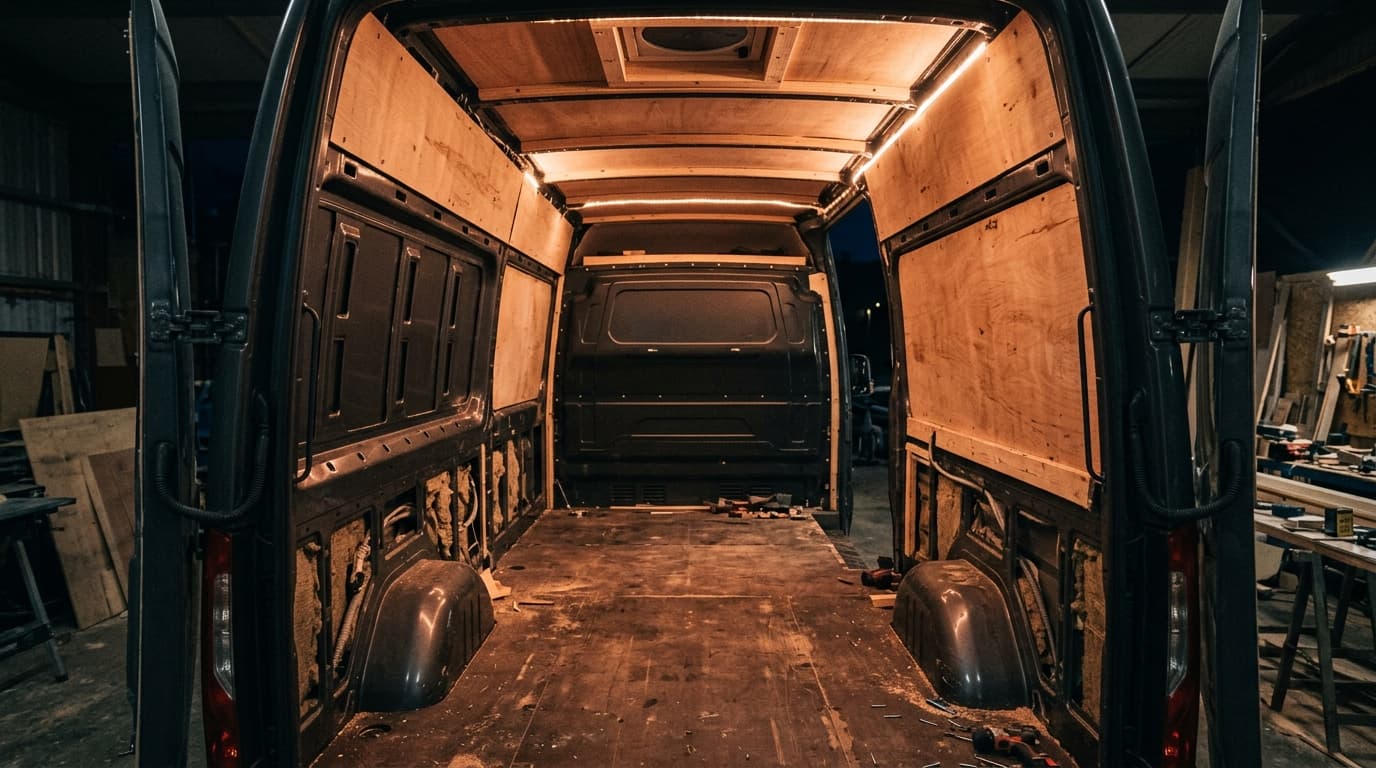
In Belgium, converting a van into a camper does not go through the word everyone searches for. "VASP" is French. Here it is called a motorhome — category M1, body code SA — and the file goes to your Region, before the work begins.
What Belgium calls a motorhome
The vocabulary is the first thing that leads people astray. On forums, in vanlife groups, on conversion websites, "VASP approval" appears on every page. That term belongs to French law and is absent from Belgian texts.
The Belgian definition comes from Regulation (EU) 2018/858 and the Royal Decree of 15 March 1968. A motorhome is a category M vehicle — passenger transport — with body code SA. On the Belgian registration certificate the type shows as VC/SA; in Dutch you read kampeerwagen.
A panel van, by contrast, is a category N1 vehicle: goods transport. The whole question lies in that move from N to M, because it is not an administrative stamp but a change of European category.
For the Region to accept that change, the vehicle must include at least four items, listed identically by SPW and by Brussels Mobility: seats and a table, sleeping accommodation — possibly obtained by converting the seats —, a cooking area with a heating point and a water point, and permanently fixed storage. The table itself may be removable.
The number that matters: the maximum dimensions are those of category M1 — 12,000 mm long, 2,550 mm wide, 4,000 mm high. No production large van comes close, but a badly designed roof rack on a Renault Master L3H3 is worth a second look.
Does a converted van really need approval?
Not always — and this is the point neither converters nor forums state clearly.
The official SPW Mobility note on converting a vehicle into a motorhome sets the rule in one sentence: any change of type or category of the vehicle requires approval. Read the other way round, it says the opposite too: as long as there is no change of type, there is no approval to apply for.
The same document spells out the practical case. If the base vehicle is an N1 and the fit-out stays limited and removable, it can remain N1, the fit-out then being treated as cargo. A demountable bed, a cool box, a storage unit set on the floor: the vehicle stays a light commercial vehicle. Once the kitchen is plumbed in, the furniture screwed to the structure and the beds fixed, you move into M1 SA, and approval becomes mandatory.
That boundary is not a matter of vocabulary. It decides everything else: cost, lead time, annual tax, even the price of the roadworthiness test. A demountable fit-out avoids the entire procedure; a fixed one triggers it, with the manufacturer's prior consent at the end of the chain.
Three Regions, three approval services
Vehicle approval is a regional competence. There is no single Belgian counter: depending on where the applicant lives, the file goes to Namur, to Brussels or to Flanders, each with its own platform and its own fee.
| Region | Competent service | Contact / platform | Individual approval fee |
|---|---|---|---|
| Wallonia | SPW Mobility and Infrastructure — Vehicle Regulation and Certification Directorate, Bd du Nord 8, 5000 Namur | homologation.vehicules@spw.wallonie.be · WTAS platform · 081/77.29.34 | refers to point I.c.4 of the fee table, amount not published online |
| Brussels | Brussels Mobility — Vehicle Expertise / Homologation, Place Saint-Lazare 2, 1035 Brussels | homologation@sprb.brussels · 0800 94 001 | €253 for categories M1 and N1 (2026 rates) |
| Flanders | Departement Mobiliteit en Openbare Werken (MOW) — Homologatie unit | homologatie.voertuigen@mow.vlaanderen.be · Fastlane platform | not published on the official page |
The Brussels fee is the only one of the three published in black and white: €253 for an M1 or N1 individual approval, €350 for M2/M3/N2/N3, set by the Royal Decree of 28 April 2011 and indexed annually. Roadworthiness centre fees are not included.
In Wallonia, the official page for the procedure refers to point I.c.4 of a fee table that is not freely accessible. The figure of €199 circulates on converters' websites; it appears on no public SPW source, and I will not repeat it as an official rate until it is published. The right move is still an email to the Namur directorate before setting a budget.
Manufacturer consent, the lock nobody mentions
It is the first condition, and the one that stops the most projects.
Before any cutting, you need the base vehicle manufacturer's conversion consent. Not the importer, not the dealer: the manufacturer. On a recent Fiat Ducato, Renault Master or Ford Transit, the brands' bodybuilder departments handle these requests as routine. On a twelve-year-old second-hand van, the answer arrives late, or never.
What a file actually looks like, step by step
The calendar trap is easy to describe: the technical file must be approved before the work, not after. Many projects run backwards — people fit out the van all winter, turn up in spring, and discover that no photo of the framing was ever taken.
| Step | With whom | What to produce |
|---|---|---|
| 1. Conversion consent | Base vehicle manufacturer | Project description, areas to be cut |
| 2. Approval in principle | Regional service (SPW, Brussels Mobility, MOW) | Technical file + layout plan |
| 3. Carrying out the work | Yourself or a COP converter | Photos before, during and after the fit-out |
| 4. Presenting the vehicle | Approved roadworthiness centre or recognised technical service | Approvals and fitting instructions for added components |
| 5. Individual approval | Regional service | Individual approval sheet acting as certificate of conformity |
| 6. Registration | DIV (the Belgian vehicle registration office) | New certificate, type M1 / code SA |
Going through a recognised COP converter short-circuits part of the route: the company carries out the work and files the application itself. The official register, run by TRAXIO, lets you filter COP companies by body type, including motorhomes (SA): it lists Compact Living (COP-VL-1385-001), Routegoesting (COP-RW-1350-002) and Friane (VL-1169-003), among others. The full, up-to-date list is public on the homologatie.be register.
What gets a file rejected
The technical requirements are not left to the inspector's judgement: they point to specific UNECE regulations, and this is where self-build projects lose the most time.
- Added seats: they fall under regulations R14, R16, R17 and R25 (anchorages, belts, seat strength, head restraints). A bench bolted into a plywood floor will not pass.
- Interior fit-out: compliance with regulation R21, which covers projections and interior edges.
- Added glazing: regulation R43, with a visible 43R marking on the pane. It is the quickest checkpoint to verify — and the one most often forgotten on windows bought online.
- Emergency exit: an opening of at least 400 × 600 mm on a wall other than the service door; if the exit works by breaking glass, an emergency hammer must be immediately to hand.
- Access to the cab: if rear seats are usable while driving, an opening of at least 250 × 300 mm towards the driving position is required.
- Gas bottles: sealed compartment vented to the outside, bottles secured, separating partition beyond one bottle. SPW details the ventilation sections, up to 2 % of the floor area for low-level ventilation only.
- Heating: compliant with regulation R122 if used while driving; a wood stove is only allowed when stationary.
- On-board electrics: CE marking on solar panels, inverters and fridges, and regulation R10 for anything operating while driving.
- Minimum payload: since 1 November 2014, a motorhome must satisfy PM ≥ 10 × (n + L), where n is the number of seats including the driver and L the overall length in metres. And the front axle load must stay above 30 % of the maximum authorised mass.
On a six-metre L3H2 approved for four, the formula therefore requires at least 100 kg of remaining payload, tanks full and the driver counted at 75 kg. That sounds like little. It gets tight once you add 120 kg of furniture, 100 litres of water, two lead batteries and a bike rack.
Does the conversion lower the tax bill?
In Wallonia, no: it raises it. In Flanders, it probably lowers it. In Brussels, the scale exists but is not published in a directly readable form. This is the calculation I found nowhere, and it is the one that decides whether the operation is worth it.
Walloon logic changed on 1 January 2022. Since then, a motorhome registered to a private individual is taxed on engine capacity, like a car — with a reduction introduced by the decree of 22 March 2023. A light commercial vehicle, meanwhile, is taxed on its maximum authorised mass. Two different calculation bases for the same vehicle, before and after conversion.
| Vehicle (Wallonia, scale 1 July 2026 → 30 June 2027) | Basis | Annual tax |
|---|---|---|
| Fiat Ducato 2.2 MultiJet as a van, MAM 3,500 kg | mass (3,001-3,500 kg) | €148.76 |
| The same, registered as a motorhome to a private individual | capacity (2,184 cc → 12 fiscal hp) | €275.88 |
| Renault Master 2.3 dCi as a van, MAM 3,500 kg | mass (3,001-3,500 kg) | €148.76 |
| The same, registered as a motorhome to a private individual | capacity (2,298 cc → 12 fiscal hp) | €275.88 |
| 1.6 city van, MAM 2,200 kg | mass (2,001-2,500 kg) | €106.26 |
| The same, registered as a motorhome | capacity (1,598 cc → 9 fiscal hp) | €148.68 |
€127.12 more per year on a 2.2-litre large van. Over ten years of ownership the gap exceeds €1,270 — the price of a full electrical fit-out. On top of that, a private individual pays a registration tax on the motorhome, while light commercial vehicles pay none. One useful nuance: if the registration predates 2022, or is in a company's name, Wallonia falls back on the commercial vehicle scale as long as the mass stays at or below 3,500 kg.
Flanders works differently. A kampeerwagen is taxed there on maximum mass, not on capacity: €132.00 between 1,500 and 3,500 kg, €145.20 up to 7,999 kg. And no registration tax is due at all — "U moet geen belasting op de inverkeerstelling betalen voor dit voertuig", writes the Flemish administration.
In Brussels, the competence passed to Brussels Fiscality on 1 January 2020 and the scale in force since 1 July 2026 does include a "Motorhome" line, distinct from "Van" and "Caravan". The amounts are not rendered on the public page: an email to the service before converting avoids twelve months of unpleasant surprise.
Two calculation bases for the same vehicle: mass before conversion, engine capacity after. In Wallonia it is the engine that decides, and engines do not shrink.
What the conversion changes at the roadworthiness test
Some good news for once, and it comes with a figure.
A light commercial vehicle under 3.5 t is tested every year from first registration. So is a motorhome — the frequency does not change. What changes is the price: according to the Autosécurité fee scale in force on 1 January 2026, the basic test on a camping vehicle under 3.5 t costs €59.60, against €77.00 for a light commercial vehicle of the same size.
So €17.40 a year recovered, against the €127 lost in Walloon road tax. The sums do not add up.
You also have to count the approval visit itself, which is not an ordinary test: €101.10 for a validation check without brake measurement, €134.70 with measurements, and €497.00 if the file has to go through a recognised technical service for a vehicle at or below 3.5 t. That last line is the one that surprises people, because it applies precisely to individual approvals of category M on recent vehicles.
On the inspection itself, a motorhome is examined on points a van never sees: belts at every seat rather than only at the driving position, passenger seats, access and exits, interior and exterior fit-out. The inspector looks at the furniture, not just the brakes.
Our verdict
I approached this file the way a fleet manager would: through cost of ownership, not through the sunset photo. The result is counter-intuitive. Conversion to motorhome status, presented everywhere as the crowning moment of a van project, is in Wallonia an operation that costs more every year than it returns.
It keeps two solid justifications. The first is legal: a permanently fixed fit-out requires the change of type, full stop. The second is practical and insurance-related — a vehicle registered as a motorhome is insured as one, with contents covered and rear seats declared. Travelling four-up in an N1 van approved for two is an offence, not a grey area.
What we would avoid: starting work before approval in principle, and buying a used van without having written to the manufacturer. Those two mistakes cost, respectively, a file to redo and a project to abandon.
If you are still choosing the base vehicle, our guide to picking a van to convert sorts the sizes by load volume and interior height, our feature on payload and the category B licence explains the figure that will decide your PM formula, and our feature on the roadworthiness test for vans covers what happens at the centre. For the professional tax side, read the real cost of a van, VAT included.
Sources: Regulation (EU) 2018/858; SPW Mobility and Infrastructure — note "Transformation d'un véhicule en autocaravane" (V01.1) and the procedure page "Transformer un véhicule en autocaravane" (updated 23 July 2026); Brussels Mobility — "Motorhome conversion", "Category M/N/O individual approval" and 2026 individual approval rates; Departement Mobiliteit en Openbare Werken (Flanders); SPW Finances — road tax scales for motorhomes and commercial vehicles valid from 1 July 2026 to 30 June 2027; Vlaamse Belastingdienst — verkeersbelasting kampeerwagens; Brussels Fiscality — rates in force since 1 July 2026; Autosécurité — fee scale FM0860 in force on 1 January 2026 and the motorhomes fact sheet; COP register homologatie.be (TRAXIO). Pages consulted on 22 August 2026. The tax amounts quoted apply to a vehicle registered to a private individual: check your own situation with your regional administration before starting work.
Grands fourgons comparator
Compare all grands fourgons side by side.
Compare now →
Frequently asked questions

Damien, 44 ans, a géré pendant douze ans la flotte d'utilitaires d'une PME de second œuvre dans la région de Namur : achats, entretien, revente, et les galères de carrosserie qui vont avec. Il a vu passer des dizaines de Trafic, Transporter et Master, et il sait ce qui casse, ce qui se revend bien et ce qui coûte cher à l'usage. Il a lancé ce site pour comparer les utilitaires sur ce qui compte vraiment en Belgique : charge utile réelle, volume utile, TVA récupérable et coût au kilomètre — pas la brochure du concessionnaire.