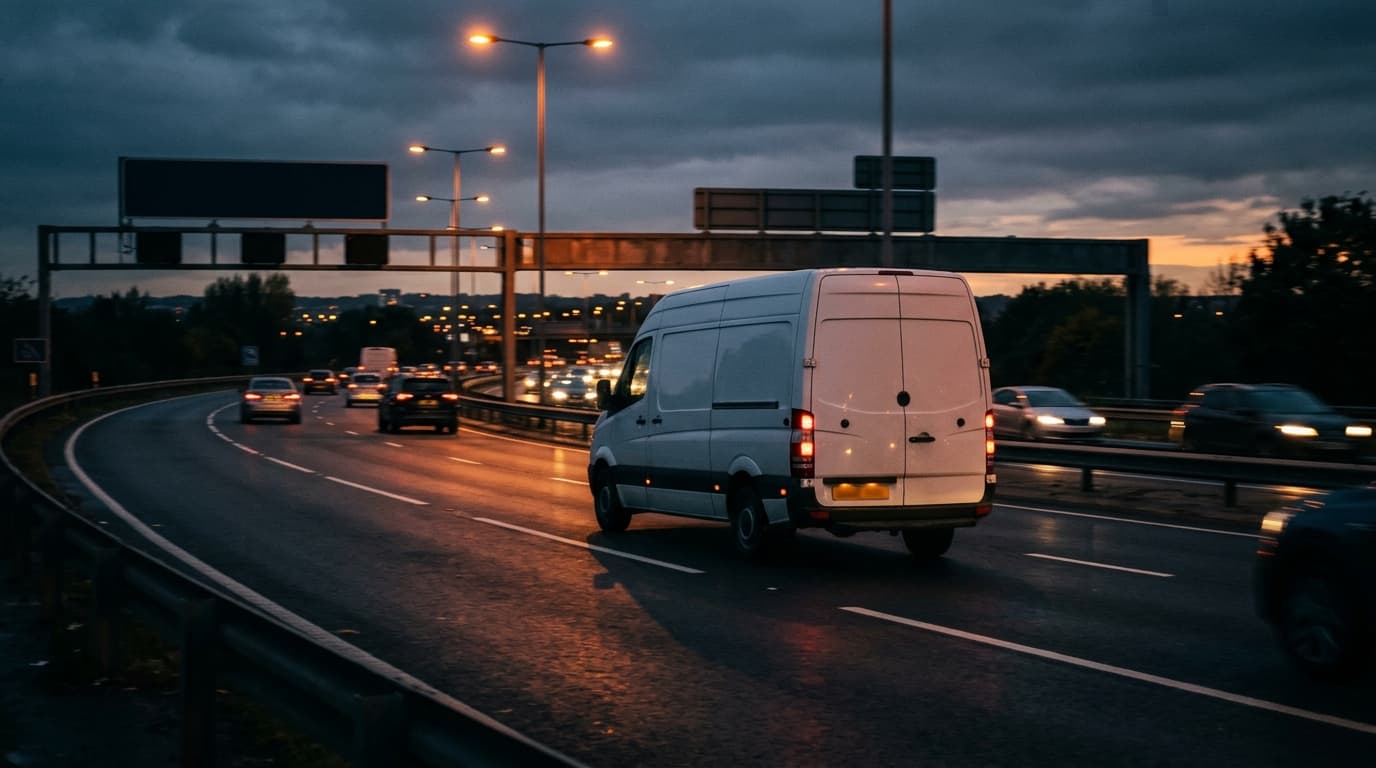
Yes, since 1 July 2026, a van whose maximum authorised mass exceeds 2.5 tonnes, trailer included, must carry a tachograph as soon as it moves goods for hire or reward across a border. No, if it never leaves Belgium. In between, the answer depends on own-account work and on the time spent at the wheel.
Who has had to fit a tachograph since 1 July 2026?
Three conditions, all required: a maximum authorised mass (masse maximale autorisée, MMA) above 2.5 t, an international goods transport or a cabotage operation, and transport for hire or reward. Digitach, the service that issues Belgian tachograph cards for the federal mobility department (SPF Mobilité et Transports), puts it this way: the tachograph is mandatory for international transport and cabotage as soon as the mass of the vehicle, trailers and semi-trailers included, exceeds 2.5 tonnes. Empty runs count.
The rule comes from Regulation (EU) 2020/1054, which amended Regulation 561/2006 on driving and rest times. European text, federal authority: it is the same in Brussels, Wallonia and Flanders. It tops up an older obligation, because since 21 May 2022 that same international transport for hire or reward above 2.5 t has already required a Community licence.
Every van in the large van ranking is in scope. A Renault Master, a Ford Transit, a Mercedes Sprinter, a Fiat Ducato or a Volkswagen Crafter homologated at 3.5 t clears the threshold by a tonne.
Which mass counts: F.1 or F.2?
F.1. On international transport, the SPF Mobilité FAQ uses the maximum technical mass, entered in box F.1 of the registration certificate, and not the national mass in box F.2.
With a trailer, the masses add up. A small van with a 2.3 t MMA towing a 750 kg trailer makes a 3.05 t combination: it falls within scope although it stayed outside on its own. The licence rules for that combination are in our guide to towing a trailer with a van.
Seven situations, seven answers
| Situation, vehicle of 2.5 to 3.5 t | Tachograph? | What to do |
|---|---|---|
| Delivery for a customer from Liège to Maastricht | Yes | G2V2 device, driver card, company card |
| Loading and unloading in Belgium | No | Nothing, national transport starts above 3.5 t |
| Belgium to Belgium trip crossing a neighbouring country ("horseshoe" transport) | No, in principle | Treated as national transport by the SPF FAQ |
| Tradesperson taking their own equipment to a site in Lille, driving incidental | No | Be able to prove driving is not the main activity |
| Employed delivery driver taking the employer's production abroad | Yes | Own account, but driving is the job |
| Non-commercial transport, a personal house move for example | No | Exempt up to 7.5 t, Article 3(h) of Regulation 561/2006 |
| National round in the morning, international run in the afternoon | Yes, from the international departure | Full record, attestation of activities for the rest |
Cabotage, meaning a domestic transport carried out in a country other than the one of registration, is handled like the first row.
When does driving become the main activity?
This is the question that settles the case of most Belgian self-employed people who cross the border, and the regulation answers it with no figure at all.
The own-account exemption rests on two cumulative conditions. The transport is not carried out for a third party but for the company or the driver, and driving is not the main activity of the person at the wheel. A heating engineer from Tournai fitting a boiler in Roubaix meets both. The delivery driver of a joinery who spends his days between Arlon and Luxembourg meets only the first.
Everyone else sits in between. The ITLB and the SPF Mobilité FAQ quote a marker taken from recital 10 of Directive (EU) 2022/2561: driving is not the main activity when it takes up less than 30 % of monthly working time. For a 38-hour full-time week, about 164.7 hours a month, the threshold lands at 49.4 hours of driving a month, a little over 11 hours a week. The FAQ itself warns that this marker is indicative and that its legal standing remains uncertain.
I would not build a team's schedule on 29 %. In fleet work, a roster that brushes a limit always ends up over it the week a colleague is off sick, and that is the week the van gets pulled over at Rekkem.
Which device, which cards, at what price?
The device is a second-generation smart tachograph, version 2, written G2V2. It records position by itself at the start and end of the day, at every border crossing and every three hours of accumulated driving, and inspectors can query it remotely. The VDO DTCO 4.1 and the Stoneridge SE5000 Smart 2 belong to this generation. Fitting is done in an approved workshop, and Digitach publishes the list.
There is no public price for fitting: ask for a quote. The cards do have an official price.
- Driver card: €65 including VAT, valid five years at most, one per driver.
- Company card: €150 including VAT, valid five years, several possible per VAT number.
- Lead time: posted five working days after payment, allow ten working days for a postal application.
- Conditions: normal residence in Belgium and a valid licence, category B at least.
These amounts were read on the Digitach website on 9 October 2026. The driver card price has not moved since 10 March 2011.
What are the obligations once the device is fitted?
The equipped vehicle enters the heavy goods regime for driving times: 9 hours a day, extended to 10 hours twice a week, 56 hours a week, 90 hours over two weeks, and a 45-minute break after 4 h 30 at the wheel. On request the driver shows the data for the current day and the previous 56 days. The company downloads the vehicle memory at least every two months and the cards every 21 working days, then keeps everything for at least two years.
Two truck constraints do not follow: no 90 km/h limiter, and no code 95 for a driver who holds only a B or BE licence. Above 3.5 t it is another world, that of the category C1 licence.

What is the fine for driving without a tachograph?
None of the official documents consulted for this article puts a figure on the penalty. So I am not repeating the amounts that circulate with no text behind them. Having no device remains an offence, recorded at the roadside or during a company inspection.
4.25 t electric van: the Belgian derogation runs until 2027
On national transport, the tachograph starts above 3.5 t, which catches large electric vans homologated at 4.25 t. The list of Belgian derogations published by Digitach, August 2026 version, mentions electric vehicles of 4,250 kg at most, within a 100 km radius, under a pilot project that ends on 26 November 2027. Check the exact conditions in the text before relying on it: the real payload of these vans is already a matter of a few dozen kilos.
Sources: Digitach service (ITLB non-profit), European framework of the tachograph system, page modified on 30 September 2026, and driver card, page updated on 10 September 2026; ITLB, «Le tachygraphe dans les camionnettes utilisées pour le transport international à partir du 1er juillet 2026», presentation dated 3 June 2026; FAQ on driving and rest times for light vehicles, version 0.7 dated 30 June 2026; list of exemptions and derogations, version 1.5 dated August 2026; SPF Mobilité et Transports, «Tachygraphe digital : nouvelle réglementation d'application au 1er juillet 2026»; Regulation (EU) 2020/1054 of 15 July 2020. Pages consulted on 9 October 2026. This article is for information and does not replace the SPF Mobilité's opinion on a specific case.
Grands fourgons comparator
Compare all grands fourgons side by side.
Compare now →
Frequently asked questions

Damien, 44 ans, a géré pendant douze ans la flotte d'utilitaires d'une PME de second œuvre dans la région de Namur : achats, entretien, revente, et les galères de carrosserie qui vont avec. Il a vu passer des dizaines de Trafic, Transporter et Master, et il sait ce qui casse, ce qui se revend bien et ce qui coûte cher à l'usage. Il a lancé ce site pour comparer les utilitaires sur ce qui compte vraiment en Belgique : charge utile réelle, volume utile, TVA récupérable et coût au kilomètre — pas la brochure du concessionnaire.