
The C1 licence covers vehicles whose maximum authorised mass exceeds 3,500 kg without exceeding 7,500 kg. You can take it from 18, after the category B licence, with a medical examination. But it is only the first of the obligations that kick in the day a commercial vehicle crosses 3.5 tonnes, and by far the cheapest.
The C1 licence covers 3,501 to 7,500 kilos
Category C1 covers vehicles other than those in categories D1 and D whose maximum authorised mass (MAM, the figure a French speaker calls the MMA) exceeds 3,500 kg without exceeding 7,500 kg, designed and built to carry a maximum of eight passengers in addition to the driver.
A trailer is included, provided its own maximum authorised mass does not exceed 750 kg. Above that, you need C1E, a separate extension with its own test.
The category B licence is a prerequisite. The minimum age is 18. And unlike B, C1 is not held for life: the group 2 medical examination is valid for five years at most, and the licence is renewed at that pace. A 55 year old driver who lets the medical lapse is driving without a valid licence, which a roadside check establishes in ten seconds.
What do the C1 tests cost?
Ninety-two euros. That is the total of the public fees for the C1 theory and practical tests, and it is the item nobody mentions because it is trivial next to the rest.
The fees are set federally and are identical in every test centre. GOCA publishes the scale in force since 1 January 2026, tax included.
| Test, 2026 fee (VAT incl.) | Amount |
|---|---|
| Theory test, categories C and D | €23.00 |
| Full practical test, categories C1, C, C1E, CE | €69.00 |
| Professional competence, multiple choice questions | €78.00 |
| Professional competence, case studies | €66.00 |
| Professional competence, oral test | €136.00 |
| Professional competence, manoeuvres | €55.00 |
| Professional competence, initial qualification | €81.00 |
| Professional competence, on-road test | €190.00 |
| Appeal against a decision, categories other than B | €12.50 |
The weight of the file sits elsewhere, in the lines missing from that table: the practical hours in an approved driving school on a rigid truck, the medical, and above all the code 95 if it applies to you. The six professional competence lines above stack up depending on the combination of tests chosen. Taken one by one, they already exceed six hundred euros in fees, training not included.
The number that counts: the licence alone costs less than a tank of diesel on a Daily. The rest of the file costs a week of site work.
Code 95 is not part of the C1 licence
The licence and professional competence are two separate things, and confusing them is the most expensive mistake in the file.
Code 95 is an endorsement printed on the licence. It is mandatory for most professional drivers in group C categories, it is valid for five years, and it is renewed through 35 hours of continuing training in an approved centre, with the group 2 medical in order at the time of the request. Holders of a category C or C1 licence issued before 10 September 2009 have acquired rights: no test for them, only the continuing training.
That leaves the question every small business owner asks: am I exempt? Belgium chose to grant exemptions where several of its neighbours grant none. The Public Service of Wallonia publishes the list of exempt driver categories, drawn from article 4, § 1 of the royal decree of 4 May 2007. The broadest exemption covers the carriage of material, equipment or machinery the driver needs in the exercise of his trade, provided driving is not his main activity.
The administration names the trades concerned, and the list reads like a directory of the Belgian building sector: roofers, gardeners, site workers, furniture and kitchen fitters, concrete pump operators, fairground workers, market traders, market gardeners. More usefully still, it also names the cases where the exemption falls away.
| At the wheel of a rigid over 3.5 t | Code 95 |
|---|---|
| Roofer taking his own material to his own site | Exemption possible |
| Gardener delivering topsoil and laying it himself | Exemption possible |
| Kitchen fitter who carries and then installs | Exemption possible |
| Recovery operator who repairs the vehicle on the road or at his garage | Exemption possible |
| Employee delivering colleagues' material without working on the site | Required |
| Recovery operator who merely tows or carries a vehicle | Required |
| Driver of a truck carrying waste collected by colleagues | Required |
| Private house move, with no commercial consideration | Exempt |
The Belgian exemption stops at the border
This is the point nobody tells tradespeople, and it is worth an article of its own.
The European directive is shared, its transposition is not. Belgium chose to grant exemptions; Germany, Luxembourg and France do not. A roofer from Namur, perfectly legal on a site in Marche-en-Famenne, becomes a driver without professional competence the moment he crosses the border for a job in Aachen, with the same truck and the same material. Belgian trainers have been repeating it for a decade, and Transportmedia was already relaying the warning in September 2016, quoting the same two expert names the sector still quotes today.
Six reasons to take code 95 even when the exemption looks like it applies:
- The list of exemptions does not engage the administration that publishes it, and only a judge decides
- The notion of the driver's main activity is quantified nowhere in the text
- The exemption crosses no border, and one return trip to Lille is enough to void it
- After a crash, an insurer may dispute cover if the driver held no code 95
- The European Union has asked Belgium to withdraw its exceptions, which makes the exemption a fragile right
- Renewal runs through 35 hours of training every five years, not through a fresh test
On a real job, the sums are quick. An owner who sends his rigid to Luxembourg once a quarter pays less for the code 95 of two drivers than for a single conversation with a Luxembourg inspector.
The kilometre becomes chargeable above 3.5 tonnes
Here is the item no driving school invoices and nobody budgets for.
The Belgian kilometre charge applies to every category N vehicle intended or used for the carriage of goods whose maximum authorised mass exceeds 3,500 kg. Empty or loaded. Commercial goods or private ones. A chassis cab bodied as a tipper at 4,500 kg falls in on its MAM alone, even when it only carries the company's own material. An on-board unit is required, and its light must show green at all times.
Rates depend on the mass, the emission standard and the Region crossed. Here is the band that concerns rigids from 3.5 to 12 tonnes, checked on 17 September 2026 against the rate grid published by Viapass, edition of 1 July 2026.
| Tolled network | Euro 6 diesel, CO₂ class 1 | Electric or hydrogen (ZEV) |
|---|---|---|
| Wallonia, excluding VAT | €0.061/km | €0.061/km |
| Flanders | €0.101/km | €0.009/km |
| Brussels, motorways | €0.099/km | €0.017/km |
| Brussels, urban roads | €0.132/km | €0.024/km |
Run the sums over 10,000 charged km in a year, which matches a regional rigid doing half its mileage on the tolled network. The Euro 6 diesel pays 610 euros in Wallonia, 1,010 in Flanders, 990 on Brussels motorways and 1,320 on the capital's urban roads. The same run in a vehicle of exactly 3,500 kg costs nothing.
Two Belgian quirks deserve a note, because they turn intuition upside down. The first is regional: in Wallonia the charge is a fee subject to VAT, and therefore recoverable by a VAT-registered business, whereas in Flanders and Brussels it is a tax outside the scope of VAT. The second is blunter still. Wallonia applies exactly the same rate to an electric vehicle as to a Euro 6 diesel, to the cent, while Flanders grants it a rate eleven times lower and Brussels one close to six times lower. A haulier electrifying his fleet therefore makes a remarkable move in the north and a strictly neutral one in the south, for the same truck and the same kilometre.
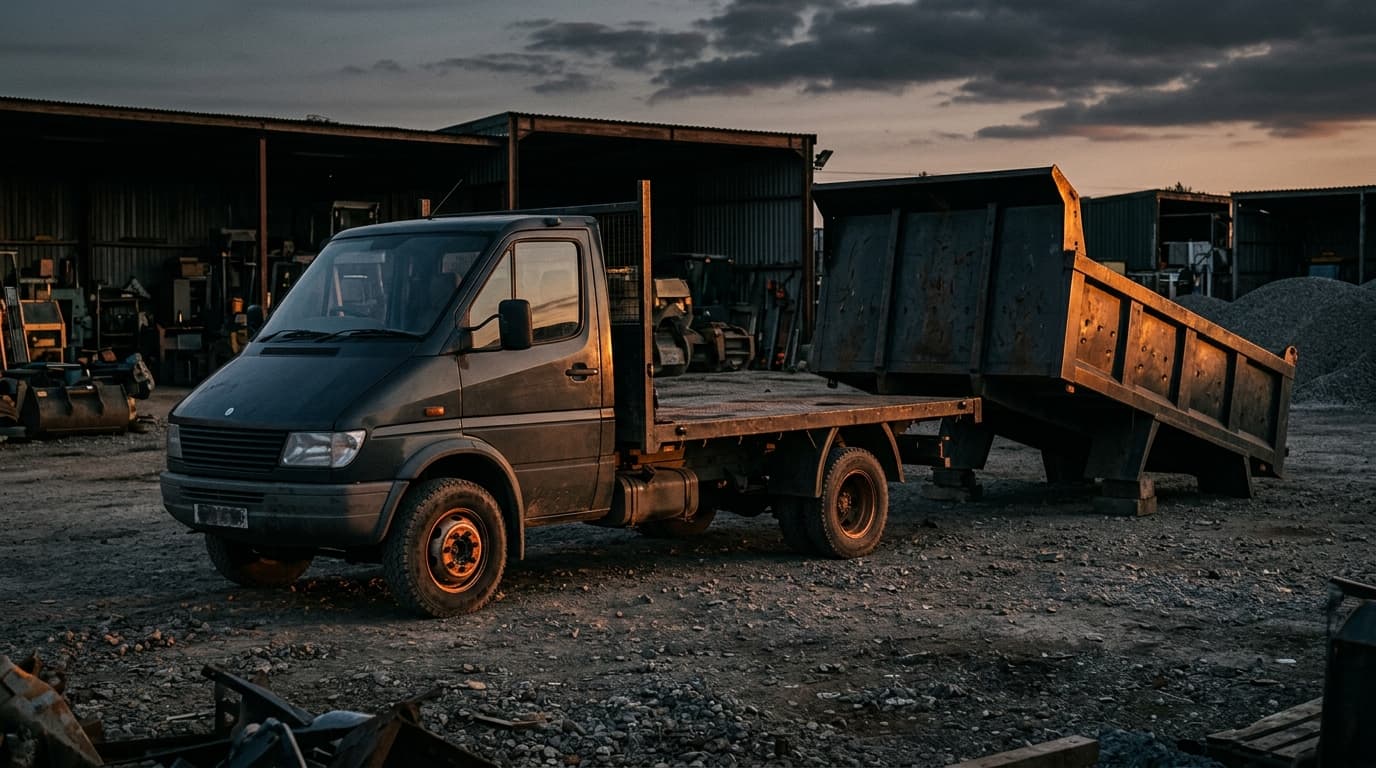
The Iveco Daily, the Renault Master in its 4 tonne version, the Fiat Ducato Maxi, the Mercedes-Benz Sprinter and the MAN TGE are all available above 3.5 tonnes on the Belgian market. Choosing that version means accepting a place in the table above.
Why does a 4.25 tonne electric van escape the C1?
Because the battery eats the payload, and the legislator eventually took note.
Since 1 September 2023 Belgium has run a pilot scheme allowing an electric or hydrogen van of up to 4,250 kg to be driven on a category B licence alone, even though the vehicle technically falls in category C1. The van must belong to a company and be used for the carriage of goods, which rules out private use and passenger transport. Vehicles entered in the scheme are also exempt from the tachograph.
The scheme was due to end in late August 2026. It has been extended to 26 November 2027, the day before the corresponding provision of directive (EU) 2025/2205 takes effect. From 27 November 2027, every member state will allow a holder of a category B licence issued at least two years earlier to drive an alternatively fuelled vehicle of up to 4.25 tonnes. The Belgian derogation, experimental today and subject to registration, will become an ordinary European right.
Beware the shortcut, though. The derogation covers the licence and the tachograph, not the rest. An electric van of 4,250 kg is still a category N vehicle whose MAM exceeds 3,500 kg: the kilometre charge applies, at the ZEV rate of the Region crossed. And on that point, the Walloon line of the table above stays the bad news of the file.
Take the C1, or stay pegged at 3.5 tonnes?
The question is not settled on the licence. It is settled on the number of runs.
Almost every large van sold in Belgium is deliberately pegged at exactly 3,500 kg, precisely to stay under the line. Moving up to C1 means gaining one to three tonnes of payload and losing, all at once: the freedom to hire a category B driver, the flexibility of the code 95, free kilometres, and access to roads closed by sign to heavy vehicles. The roadworthiness regime changes too, and our article on the van roadworthiness test sets out the intervals and the extra points the centre checks.
The trade-off almost always comes out the same way. If the payload shortfall is occasional, a second run costs less than switching to C1. If it is structural, because the trade carries dense material or because the body eats the payload, then C1 pays for itself. Our figures on chassis cab, flatbed and tipper bodies show that on an identical chassis, the choice of body alone can cost more than 800 kg. And the payload ceiling on a category B licence sets the starting point of the calculation.
Our verdict
On the fleets I have run, going above 3.5 tonnes was almost always decided for good technical reasons and budgeted for bad ones. People cost the licence, sometimes the training, rarely the code 95, and never the tolling unit. Then the first Viapass invoice lands at the end of the quarter and the spreadsheet turns out to be several hundred euros per vehicle short.
The advice fits in one line. Before signing for a chassis with an uprated MAM, add up the licence, the code 95 for every driver concerned, the roadworthiness testing and your Region's kilometre charge over your real mileage. Then compare that total with the cost of one extra run in a 3.5 tonner. The verdict comes out on its own, and it is not the same in Ghent as in Namur.
If the vehicle is not settled yet, the van comparator sorts on real payload and volume, and our ranking of the best large van in Belgium shows how far you can go without leaving the category B licence.
Sources: royal decree of 4 May 2007 on the driving licence, professional competence and continuing training of drivers in categories C1, C1+E, C, C+E, D1, D1+E, D, D+E; Public Service of Wallonia mobility and infrastructure, Professional competence (code 95) page and list of driver categories exempt from the CPC; GOCA, driving test fees in force since 1 January 2026; Viapass, kilometre charge rate grid and scope, edition of 1 July 2026, checked on 17 September 2026; FPS Mobility and Transport, pilot scheme for a category B licence on zero emission vans up to 4,250 kg; directive (EU) 2025/2205; Transportmedia, professional competence exemption valid only in Belgium, 11 September 2016.
Grands fourgons comparator
Compare all grands fourgons side by side.
Compare now →
Frequently asked questions

Damien, 44 ans, a géré pendant douze ans la flotte d'utilitaires d'une PME de second œuvre dans la région de Namur : achats, entretien, revente, et les galères de carrosserie qui vont avec. Il a vu passer des dizaines de Trafic, Transporter et Master, et il sait ce qui casse, ce qui se revend bien et ce qui coûte cher à l'usage. Il a lancé ce site pour comparer les utilitaires sur ce qui compte vraiment en Belgique : charge utile réelle, volume utile, TVA récupérable et coût au kilomètre — pas la brochure du concessionnaire.