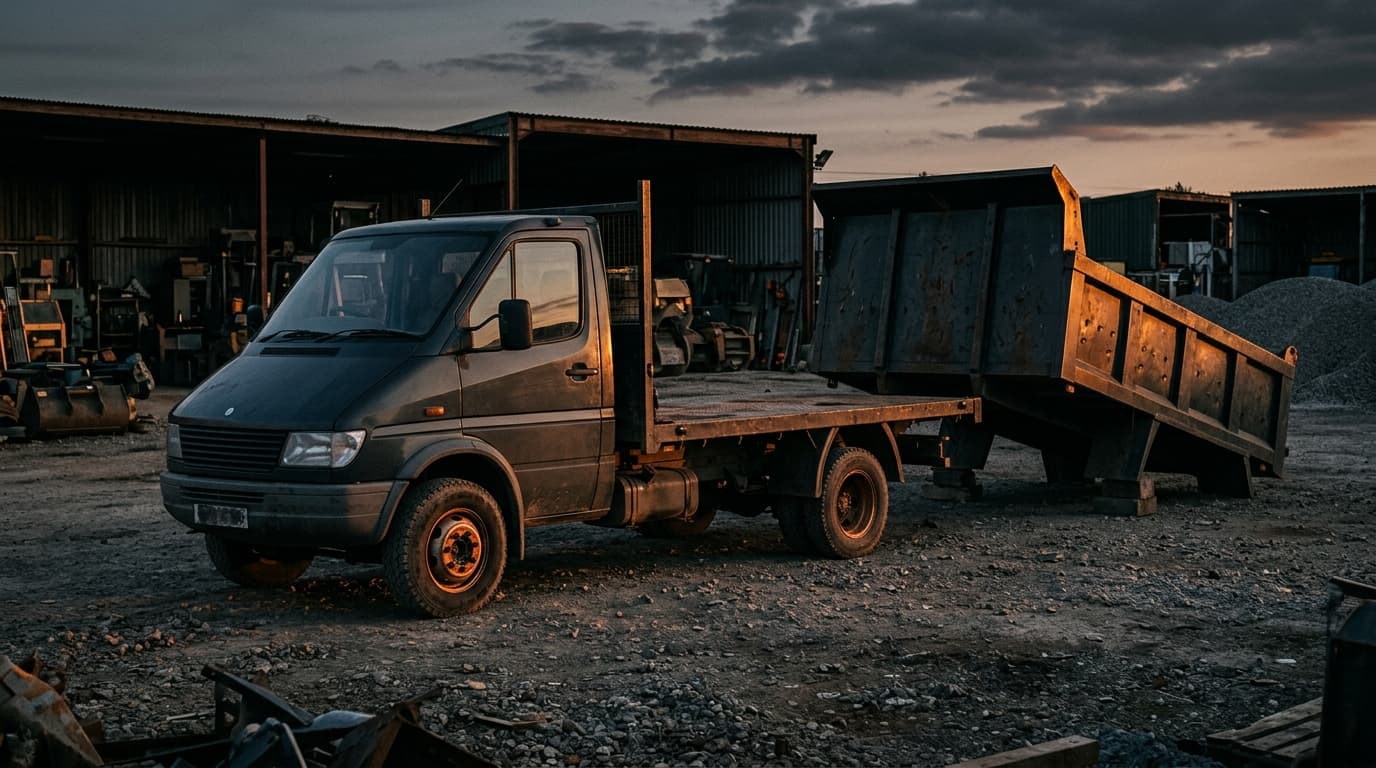
A chassis cab is a van delivered without a load body: the cab, the chassis rails, and nothing behind them. Flatbed, tipper and panel body are three bodies fitted on top. The choice is not only about looks: on the same 3.5 tonne Master, it moves payload by 821 kilos.
Chassis cab or floor cab: what is the difference?
A chassis cab stops at the rails. A floor cab adds a flat, square platform on top, ready for a body.
Sales vocabulary rarely follows body builder vocabulary. You will also hear bare chassis, cab and chassis, naked cab. Same thing.
Flatbed or tipper: which one tips?
The tipper tips. The flatbed never does.
A flatbed is a fixed platform surrounded by drop sides, built for long and wide loads: pallets, steel beams, plasterboard, scaffolding sections. You unload it by hand or by forklift. A tipper sits on a hydraulic ram that pivots the body, rearward only when it is a single-way body, on three sides when it is a three-way body, and it exists to dump loose material, soil, rubble, green waste.
On the Master range sold in Belgium, Renault quotes up to 43 degrees of tipping angle and twelve lashing points. The rest is a question of material: steel takes the rubble and the bucket strikes, aluminium saves weight.
How much does the body cost in payload?
Between the heaviest and the lightest body in the same catalogue, the gap reaches 821 kilos.
The figures below were taken on 10 September 2026 from the Belgian Renault Master tipper and flatbed page. Same base on every line: L2H1, single cab, diesel, 3.5 tonnes, two seats. Only the body changes.
| Body on a Master L2H1 single cab 3.5 t | Payload min / max |
|---|---|
| Steel tipper | 815 / 1,056 kg |
| Aluminium tipper | 1,294 / 1,493 kg |
| Steel flatbed | 1,371 / 1,626 kg |
| Aluminium flatbed | 1,443 / 1,636 kg |
The number that matters: moving from a steel tipper to an aluminium flatbed hands back up to 580 usable kilos, without touching the chassis. A steel tipper swallows close to half the capacity of the vehicle, because it carries a thick floor, reinforced drop sides, a ram and its hydraulic pack. That is the price of tipping, and it is paid in load before it is paid on the invoice. Nobody says so at order time. The catalogue shows a range that applies to the chassis, and the body turns up afterwards.
One cubic metre of damp sand weighs roughly 1,700 kilos. None of the four lines above will carry it.
Four extra seats cost up to 189 kilos
A crew cab is paid for in payload, and the amount is measurable.
Still on the Master, steel tipper L3H1: the single cab with locker is quoted at 844 to 1,166 kilos in two seats, the crew cab at 736 to 977 kilos in six seats. The gap runs from 108 to 189 kilos depending on trim. Four seats, their belts, the bulkhead that separates them from the body and the steel that goes with it.
On site it plays out simply: the crew rides in the truck, but it does not ride with all of its kit.
Panel van, flatbed or tipper: which body for which trade?
The trade drives the body, not the other way round.
| What you need | The body that fits | The catch |
|---|---|---|
| Tools under cover, delivery, field service | Panel van | Nothing overhangs, floor length is a hard ceiling |
| Pallets, boards, scaffolding sections | Flatbed with drop sides | Load exposed to rain and to theft |
| Soil, rubble, green waste | Tipper | The body takes up to 500 kg of payload |
| Refrigerated or high volume box | Floor cab | The body builder adds weight of his own, get it quoted before ordering |
| A crew of four or five on the same run | Crew cab | 108 to 189 kg less payload |
| A car or a machine to move | Car or plant transporter bed | The weight of the machine plus ramps and winch |
Five lines to have written into the order form:
- the maximum authorised mass of the completed vehicle, not that of the bare chassis
- the weight of the body, given by the body builder and not by the chassis salesman
- the remaining payload, calculated after fitting
- the usable length of the bed or tipper body, measured between the drop sides
- the vehicle category once bodied, N1 or N2
Why does the electric version lose close to 400 kilos?
The battery takes payload, exactly like a steel body does.
On the same aluminium flatbed L2H1, Renault quotes 1,443 to 1,636 kilos in 3.5 tonne diesel, and 1,064 to 1,240 kilos in E-Tech electric. That is 379 to 396 kilos of difference with a strictly identical body. On the steel flatbed the gap is still 318 to 343 kilos.
Hence the 4 tonne versions, which push the quoted payload back up to 1,812 kilos on the aluminium flatbed L2H1. The problem does not go away, it moves: the vehicle is no longer a van as far as the licence is concerned.
Above 3.5 tonnes a category B licence is not enough
3,500 kilos of maximum authorised mass is the border between categories N1 and N2. It is also the border of the category B licence.
Since 1 September 2023 Belgium has been testing an exception as a pilot scheme: driving on a category B licence, held for at least two years, an alternatively fuelled van of 4,250 kilos maximum, for the carriage of goods and without a trailer. Every vehicle must carry a participation certificate issued by the FPS Mobility and Transport, and the company reports every six months. The scheme was due to stop on 31 August 2026; it now runs to 26 November 2027, the date on which the provision of European directive 2025/2205 applicable to these vehicles enters into force across all member states.
The licence is not the only obstacle. In February 2026 Transportmedia counted twelve companies signed up for fifteen vehicles, while the spokesperson for IKEA Belgium mentioned at least thirty vehicles on the road for that retailer alone, the FPS list not always being up to date. A 4.25 tonne vehicle remains legally an N2: limited to 90 km/h by a speed limiter, like a truck, and turned back by every C21 sign banning vehicles over 3.5 tonnes, in city centres as much as in villages. Febetra, the Belgian road transport federation, has been asking for months for an explicit exemption in the traffic code.
Without that exemption the rule is everyone else's rule. From 3.5 to 7.5 tonnes you need a C1 licence.
Is a flatbed still a van in Belgian tax law?
Yes, provided the cab is fully separated and the load area reaches at least half the wheelbase.
The FPS Finance does not think in commercial silhouettes but in four families: single cab pickup, double cab pickup, single cab van, double cab van. A two seat chassis cab with a flatbed or a tipper body and an open load area falls into the first without difficulty. On a crew cab the partition has to be rigid across the full width and height of the interior, and the 50 % wheelbase test becomes the binding one: it is what rules out the shortest configurations.
Which base vehicles carry these bodies in Belgium?
Chassis cabs, flatbeds and tippers are sold in Belgium on the same platforms as large panel vans: Master, Ducato, Sprinter, Transit and Daily. For the load limit tied to your licence, see payload and the category B licence. If a crew cab is on the table, single or double cab on a pickup runs the same arithmetic on an open bed. The full tax picture, VAT and deduction included, is in our file on the real cost of a van in Belgium, and the large van ranking sorts the base vehicles by payload and volume.
Sources: Renault Belgium, Master tipper and flatbed range, payload and dimension tables consulted on 10 September 2026; FPS Mobility and Transport (SPF Mobilité et Transports), pilot scheme on the category B licence and zero emission vans up to 4,250 kg; Transportmedia, "Où en est-on avec le projet-pilote 4,25 tonnes ?", 19 February 2026; Moniteur Automobile, "Peut-on conduire une camionnette électrique jusqu'à 4,25 tonnes avec un permis B ?" on the N2 speed limiter; link2fleet, dossier on light commercial vehicles for the four families recognised by the FPS Finance (SPF Finances); Regulation (EU) No 1230/2012 for the definition of mass in running order. The payloads quoted are those published by the manufacturer for versions not bodied by a third party: always have the remaining payload of your exact configuration confirmed by the body builder.
Grands fourgons comparator
Compare all grands fourgons side by side.
Compare now →
Frequently asked questions

Damien, 44 ans, a géré pendant douze ans la flotte d'utilitaires d'une PME de second œuvre dans la région de Namur : achats, entretien, revente, et les galères de carrosserie qui vont avec. Il a vu passer des dizaines de Trafic, Transporter et Master, et il sait ce qui casse, ce qui se revend bien et ce qui coûte cher à l'usage. Il a lancé ce site pour comparer les utilitaires sur ce qui compte vraiment en Belgique : charge utile réelle, volume utile, TVA récupérable et coût au kilomètre — pas la brochure du concessionnaire.