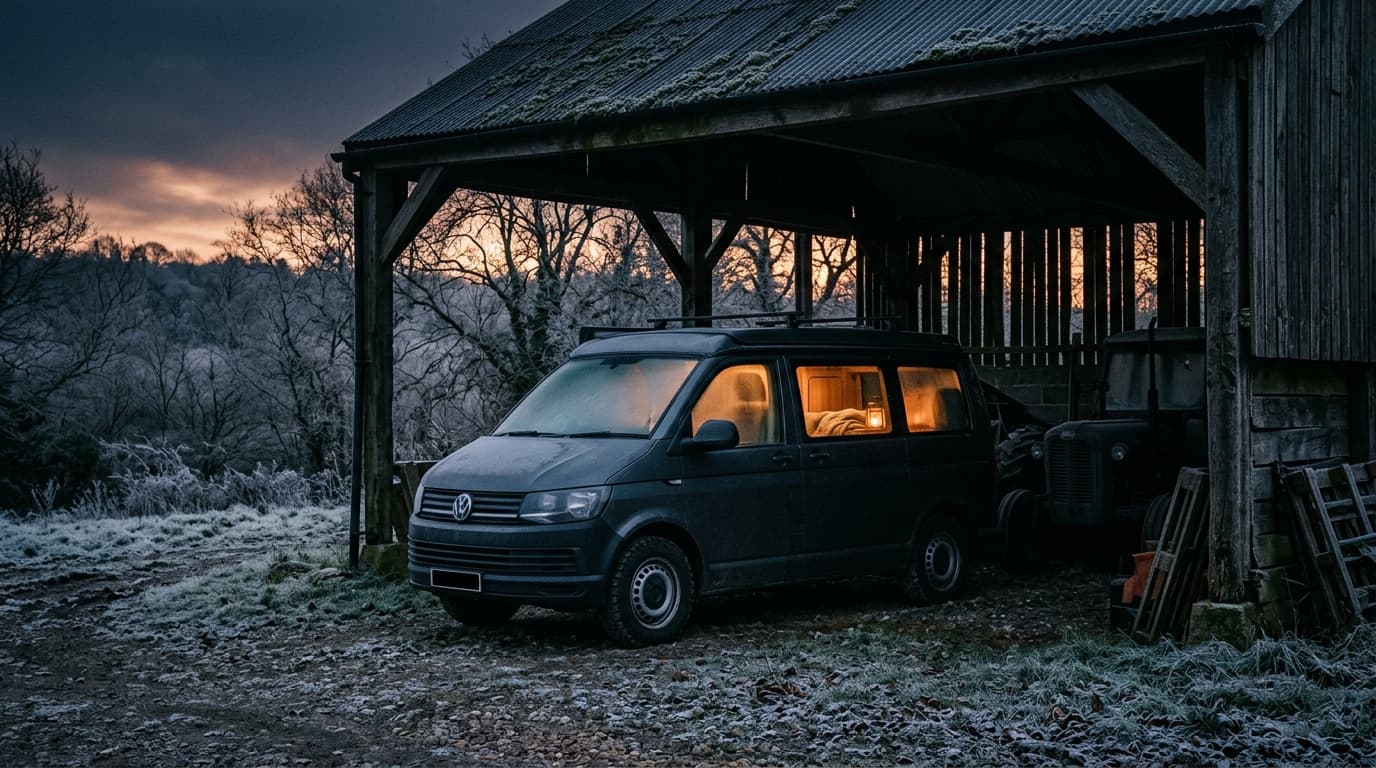
Winterising a campervan or motorhome takes half a day and seven jobs: drain the water, empty the cassette, clean, ventilate, deal with the leisure battery, fill the tank, take the load off the tyres. The only unforgiving one is the first. One night at minus three is enough to split a tap left full.
When should you winterise a campervan in Belgium?
Before the frost, meaning October or the first days of November.
The Belgian winter is mild, and that is the trap. You put it off, you tell yourself there will be one more weekend in November, and the van spends its first sub-zero night with ten litres in the water heater. The monthly climate reports of the Royal Meteorological Institute (Institut royal météorologique, IRM) put a number on the risk at Uccle, the country's reference station.
| Month | Frost days at Uccle, 1991-2020 normal | Latest report consulted |
|---|---|---|
| December | 9.3 days | 11 days in December 2022, minimum of -6.8 °C on the 18th |
| January | 10.8 days | 11 days in January 2026, minimum of -3.8 °C on the 5th |
| February | 9.3 days | 3 days in February 2022, minimum of -1.0 °C |
The number that matters: 29.4 frost days on average over the three winter months, close to one night in three. And Uccle is urban, at one hundred metres above sea level. A van stored in Bastogne or Elsenborn freezes earlier and more often.
How do you winterise a campervan, step by step?
- Drain the fresh water. Open the tank drain valve, then every tap in the middle position, between hot and cold, pump off. Leave them open all winter.
- Empty the water heater. Open its safety valve. On a California, a Nugget or a Pössl, the valves sit in different places from one model to the next: the vehicle handbook is the reference.
- Empty the grey water and the cassette at a service point, never into a street drain. Rinse the cassette and leave its blade slightly open so the seal does not stick.
- Empty and clean the interior. No crumbs, no tins, no damp textiles. Fridge defrosted, door wedged ajar.
- Let the air move. Cupboards and lockers open, cushions stood on edge, a moisture absorber on the floor if the van sleeps outside.
- Deal with the leisure battery: isolator switch open or maintenance charger plugged in, depending on whether you have a socket.
- Relieve the tyres and fill up. Diesel tank full, tyres at maximum pressure, vehicle chocked.
Half a day and less kit than you would think
| Job | Equipment | Time | To repeat during winter |
|---|---|---|---|
| Water system and water heater | None, the valves are factory fitted | 30 to 45 minutes, the time it takes to run out | No, if the taps stay open |
| Cassette and grey water | Gloves, service point | 20 minutes | No |
| Cleaning and ventilation | Vacuum cleaner, moisture absorber | 1 to 2 hours | Empty the absorber tray every month |
| Leisure battery | 5 A maintenance charger, or nothing with an isolator | 10 minutes | A monthly glance at the charger light |
| Tyres | Inflator, chocks | 15 minutes | Move the vehicle once a month |
Nothing to buy if the van has a battery isolator and sleeps under cover. That is the most common case.
Should you put antifreeze in the water system?
Not in the fresh water, and rarely anywhere else. A properly drained circuit has nothing to protect, because it holds nothing. Engine antifreeze, based on ethylene glycol, is toxic: it has no place in pipes that will make April's coffee. Antifreeze sold for sanitary use, based on propylene glycol, has a defensible role in traps and in the grey water tank when a reverse slope prevents a full drain, and it is used at the dose its manufacturer states. I never needed any on a van whose valves were accessible.
That leaves the case that worries owners of a Truma water heater every autumn: the tank that empties itself in the car park. The FrostControl valve opens automatically when the temperature at the valve falls below about 3 °C, and the Truma manual dated April 2016 specifies that it can only be closed by hand above about 7 °C. In between, it stays open whatever you do.
It is not a fault. It is the cheapest insurance on the vehicle.
Leisure battery: disconnect it or leave it on a charger?
Both work. The choice comes down to one thing: is there a 230 V socket within ten metres of the van?
Without a socket, isolate the battery. Victron states a self-discharge rate below 2 % a month at 20 °C for its AGM and gel batteries, and storage of up to a year without recharging in a cool place. From October to March, a battery that starts full and is truly disconnected therefore loses less than 10 %. Left connected, the story changes, because the control unit, the display panel and the gas detector draw current around the clock. Take a 50 mA standby load, an order of magnitude to check with a clamp meter on your own installation: 0.05 A over 720 hours makes 36 Ah a month, and a 95 Ah battery drops below half capacity in forty days. In fleet work, that is exactly how vans end up flat after the construction industry's summer shutdown.
With a socket, a maintenance charger keeps the battery full unattended. Two 5 A models are easy to find in Belgium, and their official data sheets do not say the same thing.
| Charger | Current | Batteries covered | Chemistry | Warranty |
|---|---|---|---|---|
| CTEK MXS 5.0 | 5 A, 12 V, 8-step charging | 1.2 to 110 Ah charging, up to 160 Ah in maintenance | Lead-acid: wet, AGM, EFB, gel | 5 years |
| NOCO Genius5 | 5 A, 6 V and 12 V | Up to 120 Ah | Lead-acid and lithium | 3 years |
Both are rated IP65. If your leisure battery is lithium, the CTEK sheet lists lead-acid only: that leaves the NOCO, or the charger specified by the battery maker.
Five mistakes that cost a water heater or a battery
- Closing the taps after draining: the leftover water has no room to expand.
- Forgetting the shower hose and head, which hold half a glass of water at the low point.
- Isolating the leisure battery while a compressor fridge or a tracker stays wired direct.
- Putting a cover on a van that is still damp, which traps condensation instead of letting it out.
- Leaving the vehicle four months on tyres at summer pressure, without moving it.
On tyres, Continental recommends inflating to maximum pressure and moving the vehicle slightly at least once a month, or lifting it to relieve the contact patch. The TNPF, the French tyre standards body, adds chocking the vehicle and shielding the rubber from light. Road pressure is restored cold in spring, following the door pillar plate and the pointers in our guide to van tyres.
Where to store the van: street, driveway or barn?
The barn wins on everything except price. The driveway does the job. The street is legal, with one distinction that separates the van from the caravan.
The federal police sum it up this way: on the public road, with no specific signage, a vehicle that is in order may park with no time limit. A motorhome is an ordinary motor vehicle and benefits from that rule, provided it stays roadworthy. A caravan, like any trailer, may not stay more than 24 consecutive hours. Neither may a vehicle that is unfit to drive. The same rule holds in Brussels, Wallonia and Flanders, and it is the municipality that tightens it when it chooses to: some police bylaws restrict motorhomes by zone, as our article on parking a campervan explains.
A van wintering on the street therefore stays registered, insured and up to date with its roadworthiness test (contrôle technique). The test deadline does not pause because the vehicle has stopped moving.
The March restart takes an hour
Close the valves and the taps, fill up, bleed the air tap by tap, then flush the circuit before drinking from it. Reconnect the leisure battery, bring the tyres back to road pressure, inspect the sidewalls. Run the heating and the fridge before the first trip, not at the motorway services.
If the winter made you want to change base vehicle instead of storing it, the guide to which van to convert into a camper compares the panel vans best suited to a conversion.
Sources: Royal Meteorological Institute of Belgium, monthly climate reports for January 2026, December 2022 and February 2022, observed frost days and 1991-2020 normals at Uccle; Federal Police, «Le stationnement de longue durée sur la voie publique»; Truma, FrostControl kit manual, reference 70070-80100, April 2016 edition; Victron Energy, gel and AGM battery data sheet; Continental, «Les bons pneus pour camping-car»; Travaux de normalisation des pneumatiques pour la France (TNPF), motorhome safety rules; official CTEK MXS 5.0 and NOCO Genius5 product sheets. Pages consulted on 4 October 2026. None of the products named was tested for this article: the specifications come from the manufacturers' sheets.
Fourgons moyens comparator
Compare all fourgons moyens side by side.
Compare now →
Frequently asked questions

Damien, 44 ans, a géré pendant douze ans la flotte d'utilitaires d'une PME de second œuvre dans la région de Namur : achats, entretien, revente, et les galères de carrosserie qui vont avec. Il a vu passer des dizaines de Trafic, Transporter et Master, et il sait ce qui casse, ce qui se revend bien et ce qui coûte cher à l'usage. Il a lancé ce site pour comparer les utilitaires sur ce qui compte vraiment en Belgique : charge utile réelle, volume utile, TVA récupérable et coût au kilomètre — pas la brochure du concessionnaire.