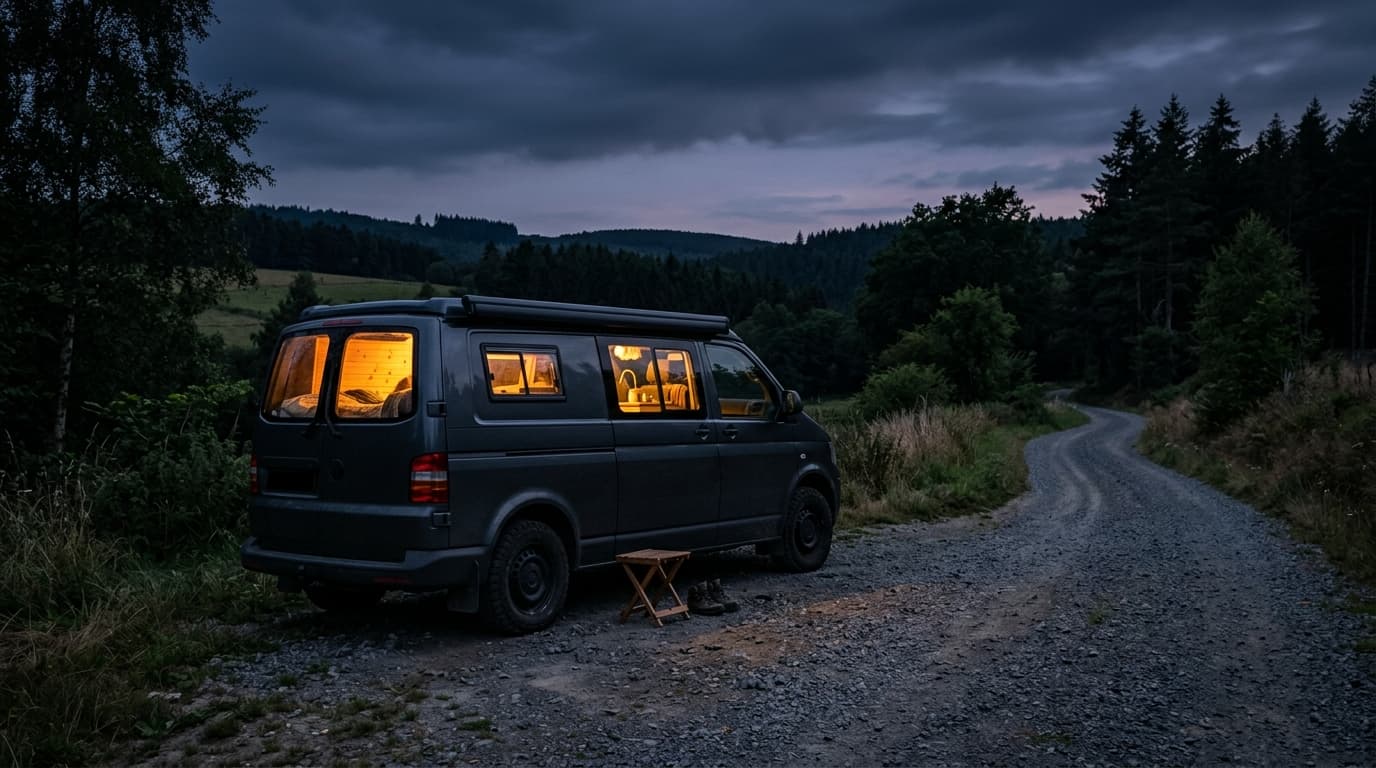
Sleeping in a legally parked campervan is not prohibited by any Belgian federal text. Camping on the public road is. Between the two, the line comes down to six moves everybody makes without thinking, and the penalty is decided in a municipal bylaw nobody reads before leaving.
Is sleeping in your van legal in Belgium?
Yes, on one condition: the vehicle must be legally parked.
No provision of the road code penalises spending the night in a stationary vehicle. A campervan follows exactly the same parking rules as a car: it parks where parking is allowed, pays the meter where parking is paid, sets the blue disc where the disc is required. Asked by Belgian broadcaster VRT, the federal police went down to the most ordinary detail: putting a mattress in the back of your car and sleeping on it is not banned either, except while driving.
The municipality, however, can ban it. A general police bylaw may prohibit sleeping in a vehicle across the whole municipal territory, provided the ban is general and does not target motorhomes alone. Those bans exist, they are rarely signposted on site, and they are the only real unknown of your night.
Where is the line between sleeping and camping?
Belgian law separates parking from camping, and the line sits lower than most people assume. Parking, in the sense of the code, means staying immobile longer than needed to load, unload or let someone in or out. Camping is something else, and it is banned on the public road in all three Regions.
The six moves that turn "parked" into "camping":
- sliding chocks under the wheels to level the van
- lowering the stabilisers or the corner steadies
- rolling out the awning
- putting a table, chairs or a groundsheet on the pavement
- running a power cable to a bollard, a wall or a hedge
- emptying grey water or the toilet cassette anywhere other than a designated service point
None of these is needed in order to sleep. All of them are visible from fifty metres down the street. That is exactly what an officer looks at before deciding whether to walk on or knock on the window.
Checking a municipality's police bylaw in five steps
Ten minutes of preparation beats a fine, and the method is identical across the 581 municipalities in the country.
- Identify the exact municipality of the spot. A seafront car park may fall under Knokke-Heist and the next one under Bruges. A municipal map, not your satnav, settles it.
- Find that municipality's general police bylaw. Most publish it as a PDF under "Règlements communaux" or "Veiligheid". On Walloon portals built by IMIO, it almost always sits under "Je trouve, Règlements communaux".
- Read three entries only: camping, lodging or accommodation, and occupation of public space. That is where the sentence that concerns you sits. In the City of Brussels it is article 34, and it runs to two paragraphs.
- Look at the signage once you are there. An E9h sign reserves the bay for campervans and motorhomes. A height restriction sign, a 2-metre bar at a car park entrance, a no-parking sign between 22:00 and 06:00: those three decide faster than any bylaw.
- When in doubt, call the local police zone. Not the federal police, not the tourist office: the police zone, which enforces the bylaw and knows which verge causes trouble. The number is on the municipal website.
Brussels, Wallonia, Flanders: three regimes that do not say the same thing
Competence is split, which is what makes French pages unusable here. Parking is federal, camping is regional, and banning sleeping is municipal.
| Where you are | Text that applies | Regime |
|---|---|---|
| City of Brussels | Article 34 of the general police bylaw | Lodging, sleeping or camping for 24 consecutive hours at most on public space, and 24 hours at most on private land without the mayor's permission |
| Other Brussels municipalities | Each municipality's own general police bylaw | Variable; some ban motorhome parking in specific zones |
| Wallonia | Article D 249/1 of the Walloon Tourism Code | Camping banned on public roads, except on motorhome service areas; banned within one hundred metres of a drinking water catchment and on listed sites |
| Walloon forests | Article 19 of the Forestry Code | Temporary residence banned outside areas marked out by the Nature and Forests Department, often one night per area |
| Flanders | Municipal bylaws, on top of the federal code | Sleeping allowed wherever parking is legal, unless a general municipal ban applies; camping banned on the public road |
Two surprises in that table for anyone arriving with French reflexes. First: the City of Brussels caps the use of a motorhome as lodging at 24 hours including on private land, which rules out lending your driveway to friends for a long weekend. Second: Wallonia expressly allows camping on motorhome service areas, making them the only place on public land where you may legally lower the steadies.
How much does a night cost, depending on where?
From zero to twenty-two euros, and the free option is not always the one you would expect. The amounts below were recorded on 6 September 2026 from the official pages of the municipalities concerned.
| Place | Legal status | Recorded cost | Time allowed |
|---|---|---|---|
| Public road, legal parking | Sleeping tolerated unless the municipality bans it, camping banned | 0 €, meter aside | Per municipal bylaw |
| Herbeumont municipal aire, 30 pitches | Motorhome service area | Free, water and electricity on request at the tourist office | 72 hours |
| Chimay motorhome aire | Motorhome service area | 15 € per 24 hours, no access to the sanitary block; waste water discharge 8 € | 24 hours, renewable |
| Chimay municipal campsite, touring pitch | Licensed campsite | 22 € a night for 2 people, vehicle and pitch included, 5 kWh of electricity included | Unlimited |
| Chimay municipal campsite, monthly pitch | Licensed campsite | 300 € a month for 2 people, plus 25 € meter rental and actual consumption | 1 month |
The number that matters: in Chimay, the motorhome aire comes to 450 € for thirty nights, against 325 € for a monthly pitch at the municipal campsite next door, electricity meter included and sanitary block thrown in. The crossover sits around the twentieth night. Stay more than three weeks in one place and the service area becomes the most expensive line in the table, a calculation nobody runs because the two tariffs never appear on the same page.
A 2.50-metre van does not park where a saloon parks
The code bans parking within 20 metres before a traffic light or a road sign. The exemption covers vehicles whose height, load included, does not exceed 1.65 metres, when the lower edge of the sign sits at least 2 metres above the carriageway. A California, a Nugget, a converted Ducato all exceed 1.90 metres.
So the empty space in front of a traffic light is legal for the saloon ahead of you, and not for you.
What happens if someone knocks on the window?
Rarely a disaster, often an unpleasant wake-up, sometimes a bill.
A parking offence handled as a municipal administrative sanction costs 58 € in the first category and 116 € in the second, amounts set by the royal decree of 9 March 2014 according to the severity of the risk created for road safety. Camping where the police bylaw bans it falls under a separate administrative fine that can reach 350 € for an adult. Above 70 €, you have the right to be heard by the sanctioning officer if you ask within thirty days.
What we would avoid: arguing the bylaw on the spot, at midnight, in pyjamas. Retract the steadies, say thank you, move on.
Can you sleep on private land or on someone's property?
With the owner's agreement, in principle yes, and it is the safest option. It still carries two limits that most host networks never mention.
In Wallonia, land occupied habitually or occasionally by more than three shelters, or used by more than ten people at a time for camping and caravanning, requires a caravanning permit under the decree of 4 March 1991. A producer hosting two vans on a summer evening stays below the threshold. The same producer hosting four every weekend does not, and it is the host who is in breach, not you. In the City of Brussels, article 34 caps the use of a motorhome as lodging at 24 consecutive hours on private land, unless the competent authority says otherwise.
Which van size parks most easily?
The medium van, by a distance. A California, a Nugget or a Marco Polo fits a standard parking bay, clears most 2-metre height bars once the roof is down, and goes unnoticed in town. A 6-metre large van offers the volume and the fixed bed, but loses both of those advantages.
If the project is still at the vehicle stage, our comparison of the best medium vans in Belgium sorts the bases by size and payload, the guide to which van to convert into a camper compares the panel vans worth converting, and the camper conversion approval procedure covers what changes at the DIV and on road tax. And if size is the deciding factor, the city van or medium van comparison settles it on load volume and overall height.
Sources: City of Brussels, page «Stationnement des motorhomes et camping-cars» and article 34 of the general police bylaw, consulted on 6 September 2026; Union of Walloon Towns and Municipalities, note by Arnaud Ransy «Camping en Wallonie: puis-je planter ma tente n'importe où?», article D 249/1 of the Walloon Tourism Code, article 19 of the Forestry Code and the decree of 4 March 1991 on caravanning sites; VRT NWS, «Hier mag je overnachten en kamperen in je auto, camper of mobilhome», updated 5 February 2025, on the parking versus camping distinction, the E9h sign and the 20-metre rule; royal decree of 9 March 2014 on municipal administrative sanctions for stopping and parking offences; Royal Syndicat d'Initiative de Herbeumont, municipal motorhome service area; City of Chimay, municipal campsite and motorhome aire tariffs. Municipal bylaws change from one season to the next: the local police zone remains the only source that binds the administration for a given spot.
Fourgons moyens comparator
Compare all fourgons moyens side by side.
Compare now →
Frequently asked questions

Damien, 44 ans, a géré pendant douze ans la flotte d'utilitaires d'une PME de second œuvre dans la région de Namur : achats, entretien, revente, et les galères de carrosserie qui vont avec. Il a vu passer des dizaines de Trafic, Transporter et Master, et il sait ce qui casse, ce qui se revend bien et ce qui coûte cher à l'usage. Il a lancé ce site pour comparer les utilitaires sur ce qui compte vraiment en Belgique : charge utile réelle, volume utile, TVA récupérable et coût au kilomètre — pas la brochure du concessionnaire.