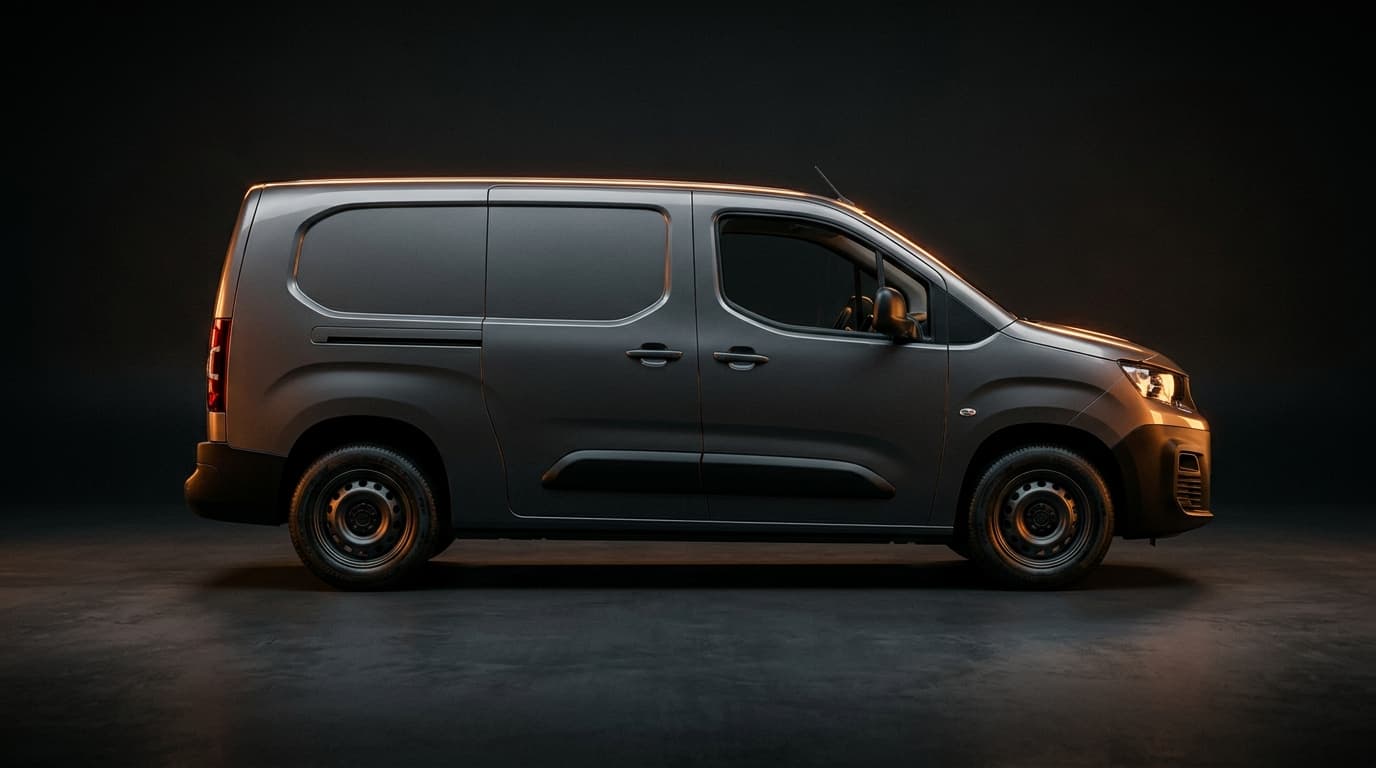
An N1 vehicle is a vehicle designed to carry goods whose maximum authorised mass (MAM) does not exceed 3,500 kg. It is the category of almost every van, from the Kangoo to the 3.5-tonne large van. But N1 does not yet mean a van for tax purposes: you also need the right load area.
What exactly is an N1 vehicle?
It is one of the European type-approval categories, copied word for word into the Belgian technical regulation, the Royal Decree of 15 March 1968. The letter gives the use, the number gives the weight. M for people, N for goods, O for trailers.
The Belgian text puts into N1 "dual-purpose vehicles fitted out to carry goods, tractors and vans" whose maximum mass stays under 3,500 kg. The van itself (camionnette) is defined in one line: "a lorry whose cab is integrated into the body". Your city van is one. So is a chassis cab, if it stays under 3.5 tonnes.
Everything starts from the certificate of conformity issued by the manufacturer. The category is not a box you tick when buying, it is a property of the vehicle as it was type-approved.
N1, N2, N3: where are the weight limits?
At 3.5 tonnes and 12 tonnes, on the maximum authorised mass, never on the actual weight on the day.
| Category | Maximum authorised mass | Licence | Examples |
|---|---|---|---|
| N1 | up to 3,500 kg | B | city van, medium van, 3.5 t large van, pickup |
| N2 | 3,501 to 12,000 kg | C1 up to 7,500 kg, C above | uprated large van, delivery truck |
| N3 | over 12,000 kg | C | lorry, semi-trailer tractor |
A large van offered at 3.5 t and at 4.1 t therefore changes category from one version to the next, with the same body. The heavy version leaves the B licence, gets a speed limiter and loses the 120 km/h motorway limit.
A recent exception blurs the line: some electric vans up to 4,250 kg can be driven on a B licence, under conditions. We cover it in our article on the B licence and 4.25-tonne electric vans.
How many seats can an N1 keep?
Six passenger seats at most, plus the driver. And a weight condition hardly anyone knows about.
For a multi-purpose vehicle to remain in category N, the Royal Decree requires P − (M + N × 68) > N × 68: P is the maximum authorised mass, M the mass in running order, N the number of seats excluding the driver, and 68 kg the conventional weight of a passenger. In workshop terms, the mass available for goods must exceed that of the passengers. Rearranged, the formula gives a simple benchmark: the gap between MAM and mass in running order must exceed 136 kg per passenger seat.
| Seats excluding driver | Minimum gap, MAM − mass in running order |
|---|---|
| 1 | over 136 kg |
| 2 | over 272 kg |
| 4 | over 544 kg |
| 5 | over 680 kg |
| 6 | over 816 kg |
This is our own calculation from the text. A two-seat city van always passes; a six-passenger crew cab still needs more than 816 kg of margin, and that is often where the best-equipped versions fall short. A seat does not count if the manufacturer has made its anchorages physically unusable.
Is every N1 a van for the tax office?
No. This is the costliest trap in the whole glossary. The European category opens the door; the DIV, the Regions and the federal tax administration then look at the fit-out. All three Regions publish matching criteria, summarised by Flanders on its light goods vehicle page, by Wallonia in its procedure converting a vehicle into a commercial vehicle, updated on 23 July 2026, and by Brussels in its sheet on converting an M1 into an N1:
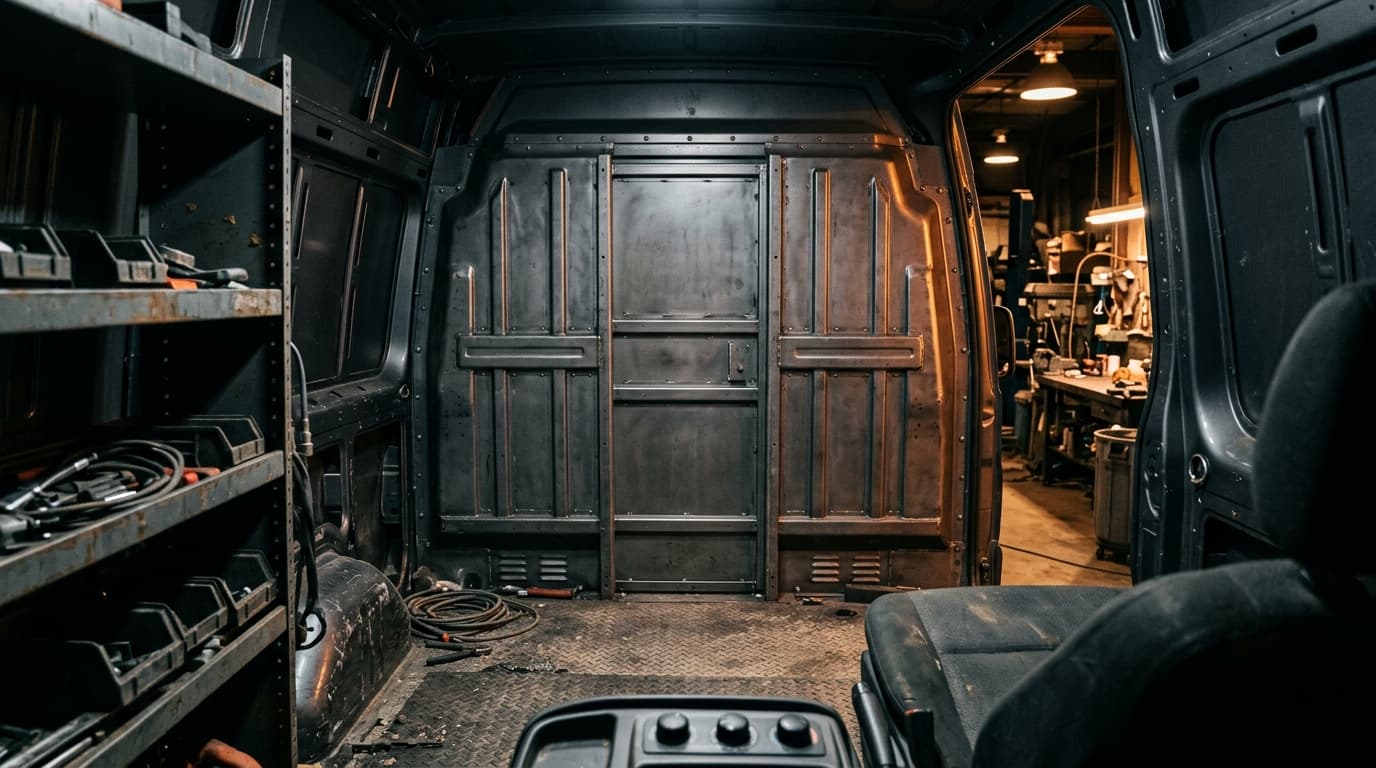
- a load area of at least 50% of the wheelbase, measured with the seats in place;
- a flat, rigid floor fixed to the body over its whole surface;
- no seat or anchorage point in the load area, anchorages being welded or blanked with a welded, riveted or bonded plate;
- a load stop at least 20 cm high across the full width behind the seats, Flanders requiring a complete partition;
- a loading opening at least 60 cm high with one row of seats, 80 cm and 12,800 cm² with two rows (Brussels criterion);
- for a conversion, the manufacturer's prior approval.
On the fleet I saw an MPV bought "as a van" whose certificate said M1. The seller acted in good faith, the bench folded, the floor was flat. It had simply never been approved as N1, and the VAT deducted at 100% had to be corrected. Read the certificate before signing, not the brochure. Crew cabs are covered in our article on fitting rear seats in a van.
What does N1 change for road tax?
A lot, and differently in each Region. A van is taxed on its MAM, not on fiscal horsepower like a car.
In Wallonia, the official schedule for commercial vehicles, valid from 1 July 2026 to 30 June 2027, charges neither registration tax nor eco-malus. Brussels also taxes by weight, in 500 kg bands. Flanders starts from a base rate of €25.68 per 500 kg band since 1 July 2026, adjusted for the Euro standard, the particulate filter and, up to 2,500 kg, CO₂, with no BIV; it has announced a 30% cut on 1 January 2027.
| Van MAM | Wallonia, annual tax (surcharge included) | Flanders, base rate before adjustment |
|---|---|---|
| 1,001 to 1,500 kg | €63.76 | €77.04 |
| 1,501 to 2,000 kg | €85.01 | €102.72 |
| 2,001 to 2,500 kg | €106.26 | €128.40 |
| 2,501 to 3,000 kg | €127.51 | €154.08 |
| 3,001 to 3,500 kg | €148.76 | €179.76 |
The Flemish column is our band-by-band calculation, and the final amount depends on the adjustments. The number that counts: a 3.5-tonne large van costs under €150 a year in Wallonia, where a car of comparable power would pay several times more.
On VAT the line is federal: a car is capped at 50% deductible VAT, a van can reach 100% in exclusively business use. The full calculation is in our article on the real cost of a van.
Do private owners keep the van rate?
In Flanders, not for a new pickup. Since 1 January 2023, a pickup registered to the national register number of a person with no self-employed activity is taxed as a car, BIV included; vehicles registered before that date keep the commercial rate. The Walloon schedules we checked make no such distinction. In Brussels we found none either.
Classes I, II and III: what are they for?
Emission standards, and nothing else. N1 is split by reference mass, roughly the weight of the vehicle ready to drive: up to 1,305 kg for class I, up to 1,760 kg for class II, above that class III. Each class has its own Euro 6 limit: 0.08 g/km of nitrogen oxides for diesel in class I, 0.105 in class II, 0.125 in class III, according to the TransportPolicy.net summary. A panel city van usually sits in class II, a medium or large van in class III. Neither licensing nor tax takes it into account.
Where do you find the category on the vehicle papers?
In box J of the registration certificate, and on the certificate of conformity. Both must match the actual fit-out. The annual roadworthiness test, which an N1 faces from its first year, checks that they do; our guide to the van roadworthiness test explains the procedure.
Nine situations, nine answers
| Situation | Likely category | What to do |
|---|---|---|
| Two-seat panel city van | N1 | Nothing, check box J |
| Five-seat MPV sold "as a commercial" | Usually M1 | Read the certificate before deducting VAT |
| Crew-cab van, six seats in total | N1 if the weight margin is enough | Check the gap between MAM and mass in running order |
| Van with seven passenger seats | M1 | Car taxation, no 100% deduction |
| Large van uprated to 4.1 t | N2 | C1 licence, limiter, 90 km/h on motorways |
| Double-cab pickup, short bed | Car for tax if the bed is under 50% of the wheelbase | Measure the bed before buying |
| Pickup registered since 2023 to a private owner in Flanders | N1, taxed as a car | Budget for BIV and car road tax |
| SUV converted into a commercial vehicle | N1 after approval | Manufacturer's approval, then inspection |
| N1 van converted into a camper | Motorhome after approval | See our guide to converting a van into a camper |
To compare the city vans that keep the most payload at 3.5 tonnes, our city van ranking sorts them model by model, and the article on payload on a B licence explains the MAM minus kerb weight calculation.
Sources: Royal Decree of 15 March 1968 on the technical conditions for vehicles, article 1, version consulted on codedelaroute.be on 23 October 2026; SPW Finances, road tax schedule for commercial vehicles from 1 July 2026 to 30 June 2027; Wallonia, procedure "Transformer un véhicule en utilitaire", updated 23 July 2026; be.brussels, converting an M1 car into an N1 van; Vlaanderen.be, road taxes for light goods vehicles and for pickups, consulted on 23 October 2026; TransportPolicy.net, EU light-duty emission standards. This article is for information and does not replace advice from the DIV or your accountant.
Fourgonnettes & ludospaces comparator
Compare all fourgonnettes & ludospaces side by side.
Compare now →
Frequently asked questions

Damien, 44 ans, a géré pendant douze ans la flotte d'utilitaires d'une PME de second œuvre dans la région de Namur : achats, entretien, revente, et les galères de carrosserie qui vont avec. Il a vu passer des dizaines de Trafic, Transporter et Master, et il sait ce qui casse, ce qui se revend bien et ce qui coûte cher à l'usage. Il a lancé ce site pour comparer les utilitaires sur ce qui compte vraiment en Belgique : charge utile réelle, volume utile, TVA récupérable et coût au kilomètre — pas la brochure du concessionnaire.