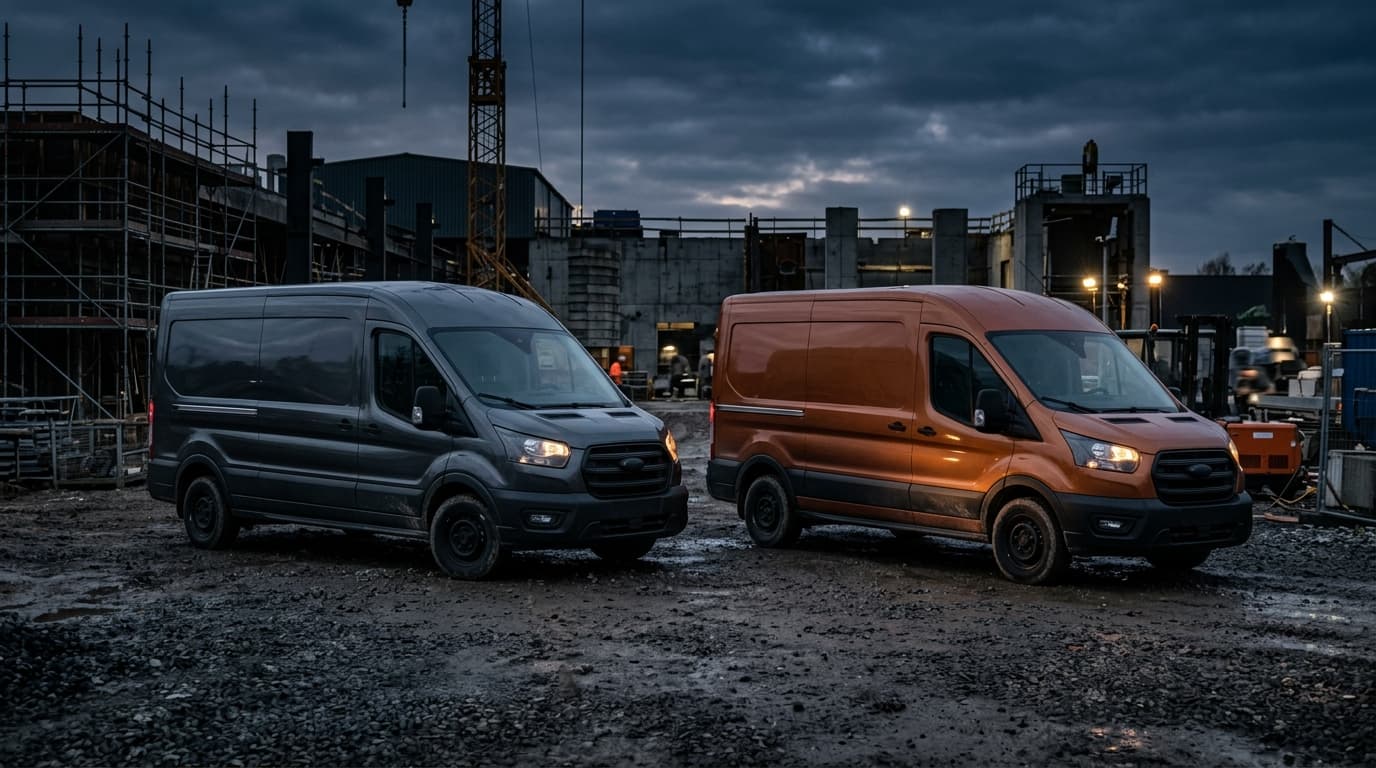
A diesel medium van uses 6.8 to 7.4 l/100 km on paper, and more like 7 to 9 litres in a tradesperson's real life. Fully loaded, add about 13%. At the Belgian maximum price of 14 October 2026, 2.428 euros a litre, every hundred kilometres costs between 16.50 and 20.60 euros including VAT.
I wanted to know where those gaps come from. Manufacturers publish their type-approved figure, owners log their fill-ups, and between the two there are two litres nobody explains when you sign the order form. So we went back to three sources: the ADAC technical catalogue for official values, public fuel logs kept over tens of thousands of kilometres, and an independent lab's measurements of the effect of load.
The official figures: 6.8 to 7.4 l/100 km on paper
For diesel medium vans sold in Belgium, WLTP type-approval gives a tight range. Here are the values taken on 25 October 2026 from the ADAC technical catalogue, which reproduces manufacturers' type-approval data.
| Model and version | Power, gearbox | WLTP combined | WLTP CO₂ | Payload | Of which 28% in the test |
|---|---|---|---|---|---|
| Renault Trafic L1H1 3.0 t Blue dCi 150 (since 04/2025) | 150 hp, 9-speed automatic | 6.8 l/100 km | 180 g/km | 1,084 kg | 304 kg |
| Mercedes Vito Mixto compact 116 CDI (since 04/2024) | 163 hp, 6-speed manual | 7.0 l/100 km | 185 g/km | 775 kg | 217 kg |
| Opel Vivaro Cargo M 2.0 BlueHDi (01/2024 to 09/2025) | 145 hp, 6-speed manual | 7.4 l/100 km | 194 g/km | 943 kg | 264 kg |
| Opel Vivaro Cargo M 2.0 Diesel (11/2022 to 01/2024) | 145 hp, 6-speed manual | 7.1 l/100 km | 185 g/km | 1,102 kg | 309 kg |
The last column is our own calculation; more on that just below.
Two remarks on this table. The Vivaro shares its 2.0 BlueHDi with the Peugeot Expert, Citroën Jumpy and Toyota Proace: their figures sit within a whisker of each other. And the Ford Transit Custom is missing, because ADAC publishes no WLTP value for its panel van versions; the only rated entry is the nine-seat 170 hp Kombi, at 8.0 l/100 km, a heavier and more powerful vehicle that does not compare.
The figure that matters: 0.6 litres between the best and the worst on the list. That is small, and it is the first lesson of this investigation.
WLTP already carries 28% of the payload
People often say type-approval figures are measured "empty". For commercial vehicles, that has been wrong since WLTP arrived. LeasePlan's white paper on light commercial fleets and WLTP, published in the third quarter of 2019, puts it simply: a light commercial vehicle is always tested with 28% of its payload, except some multi-stage vehicles.
On a Trafic with 1,084 kg of payload, that is about 300 kg on board during the test. That is a plumber with his toolbox, a few pipes and a water heater. It is not a tiler's van full of adhesive bags.
This regulatory detail explains why the gap between type-approval and the road is smaller on a van than on a saloon. It also explains why it still exists: the test knows nothing about a roof rack loaded with ladders, motorway driving at 120 km/h into a headwind, or a fifteen-stop day.
How much fuel does a van use in real life?
To find out, you need fill-ups. Not a two-day press test: fill-ups, logged one by one over months. The German site Spritmonitor publishes fuel logs that owners keep voluntarily, with mileage, litres and often AdBlue. We kept three medium vans tracked over a distance that means something.
| Vehicle logged | Year | Distance tracked | Average | Most and least frugal fill-up |
|---|---|---|---|---|
| Ford Transit Custom 320 L2H2 2.0 EcoBlue 131 hp, manual | 2024 | 55,052 km | 6.53 l/100 km | 5.46 to 7.71 l |
| Renault Trafic dCi 120 L1H1, manual | 2021 | 43,331 km | 8.51 l/100 km | 7.48 to 9.80 l |
| Renault Trafic 2.0 Blue dCi converted into a camper, manual | 2024 | 10,892 km | 6.86 l/100 km | 2.72 to 10.39 l |
The result surprised me. The best log is a Transit Custom that beats every WLTP figure in the previous table, over 55,000 kilometres, which rules out a lucky streak. The worst is a previous-generation Trafic that exceeds its rating by more than a litre and a half. Between them, two litres per 100 km. Over 25,000 km a year, at the 14 October price, that is just under 1,000 euros excluding VAT.
These logs say nothing about how the vans were driven or loaded. One owner's log is one owner's log. But the sample shows what fleet managers know from experience: on a medium van, the gap between two uses weighs more than the gap between two models.
For a broader measurement, you have to go back to 2017. The British lab Emissions Analytics ran a series of vans on its EQUA road cycle, part of the route with half the payload on board. The result, published by Fleet News on 26 May 2017: every van tested did worse than its official figure, by 17.1% on average, with gaps from 5.3% to 38.8%. That was in the NEDC era, a gentler cycle than today's WLTP, and I found no equivalent campaign published since on WLTP-rated vans. The logs above show in any case that the gap still exists, in both directions.
Fully loaded, the bill rises by about 13%
The same Emissions Analytics campaign measured the effect of a van filled to its maximum payload: 11.2% less distance per litre on average than the same van empty. Converted to litres per 100 km, that is about 12.6% more fuel.
Applied to our figures, it gives this. A Trafic rated at 6.8 litres would rise to around 7.7 litres fully loaded. Real use already at 8.5 litres would climb towards 9.6 litres.
The American test cited by the same lab points the same way. A Nissan NV200 loaded with 513 kg of cement bags, for a maximum payload of 667 kg, went from 25 to 22 miles per US gallon over a 142 km city and highway route, according to Emissions Analytics: about 14% more fuel for three quarters of the payload.
In practice, on a building site, the maximum load is rarely there all day. The van leaves full in the morning and comes back almost empty. But a tradesperson who permanently drives with 600 kg of tools and stock on board pays that 13% every day without seeing it, because his van never runs empty. The first litre saved is often in the load area.
How much does 100 km cost in Belgium, with or without VAT?
The reference is the maximum diesel price set by the FPS Economy (SPF Économie) under the programme agreement with the oil sector. On 14 October 2026 it fell to 2.428 euros a litre, after 2.494 euros on 26 September, according to Paris Match Belgique and DH, which reported the announcement. It is a national ceiling: the same in Brussels, Wallonia and Flanders, and stations may charge less.
Excluding VAT, that litre is worth 2.007 euros. Here is what it gives.
| Consumption | Typical situation | Cost per 100 km incl. VAT | Cost per 100 km excl. VAT | Over 25,000 km, excl. VAT |
|---|---|---|---|---|
| 6.5 l | Well-driven Transit Custom, real log | €15.78 | €13.04 | €3,261 |
| 6.8 l | Trafic Blue dCi 150, WLTP figure | €16.51 | €13.64 | €3,411 |
| 7.4 l | Vivaro 2.0 BlueHDi, WLTP figure | €17.97 | €14.85 | €3,712 |
| 8.5 l | Tradesperson's use, real log | €20.64 | €17.06 | €4,264 |
| 9.6 l | Same use, van fully loaded | €23.31 | €19.26 | €4,816 |
Calculated at the maximum price of 14 October 2026. It moves every week: between 26 September and 14 October, the 6.6 cent drop is worth about 140 euros a year on a van at 8.5 litres and 25,000 km.
The excl. VAT column is the one that counts for a self-employed person or a company. On a vehicle that qualifies as a light goods van for tax purposes, VAT on fuel is recoverable in line with actual business use, without the 50% cap on passenger cars; we cover the conditions and justification methods in our article on the real cost of a van in Belgium. A private buyer who gets a van for leisure pays the incl. VAT column.
AdBlue: a quarter of a litre per 100 km
Every recent diesel medium van uses it. The Transit Custom logged above shows 0.26 l/100 km of AdBlue over 49,041 km. With a 20-litre tank, according to the ADAC sheet for the panel van Transit Custom, that is one AdBlue fill roughly every 7,700 km.
The camper Trafic's log shows only 0.06 l/100 km over 23,000 km. I would be wary of that figure: an owner who did not log every AdBlue top-up mechanically underestimates consumption.
The cost stays modest next to diesel. The real risk lies elsewhere: an empty AdBlue tank prevents the engine from restarting, and the warning light comes at the worst moment.
Which medium van uses the least fuel?
On paper, in our sample, the Renault Trafic Blue dCi 150 with the EDC automatic gearbox, at 6.8 l/100 km. The Mercedes Vito 116 CDI follows at 7.0 litres, and the Vivaro and its Stellantis twins close the list at 7.4 litres.
I would not choose a van on 0.6 litres of type-approval. At 25,000 km a year, that gap is worth about 300 euros excluding VAT. Payload, volume, load area access and engine reliability weigh more over five years, and that is what our medium van ranking compares.
For a van that mostly drives in town with frequent stops, diesel consumption becomes a secondary question: electric does better there, and our article on the electric medium van puts figures on real range. For a van that eats motorway miles loaded, diesel keeps the edge, and that is where use makes the difference.
Six habits that push consumption up
- A load area that is never emptied: tools, site offcuts and stock sleep on board. Every hundred kilos is paid for at every kilometre.
- A permanently loaded roof rack: ladders and pipes on the roof spoil the aerodynamics of an already tall vehicle. Our guide to van roof racks also covers the maximum roof load.
- Motorway driving at 120 km/h: a van nearly two metres tall pushes a lot of air, and consumption climbs faster than speed.
- Rounds made of short trips with a cold engine, which add diesel particulate filter regenerations.
- Under-inflated tyres, especially when loaded: the recommended laden pressure is on the label in the door pillar.
- An engine idling during deliveries to keep the heating or the radio on.
None of these habits costs much on its own. Added up over a year, they make the difference between the Transit Custom's log and the Trafic dCi 120's.
Sources: ADAC, technical catalogue (Autokatalog), sheets for the Renault Trafic Kastenwagen L1H1 3.0 t Blue dCi 150, Mercedes-Benz Vito Mixto compact 116 CDI, Opel Vivaro Cargo M 2.0 BlueHDi and 2.0 Diesel, Ford Transit Custom Kastenwagen 300 L1 and Kombi 320 L2, accessed on 25 October 2026; LeasePlan, white paper on preparing light commercial vehicle fleets for WLTP and RDE, Q3 2019; Spritmonitor, public fuel logs no. 1471915, 1390147 and 1533140, accessed on 25 October 2026; Emissions Analytics, EQUA results reported by Fleet News, 26 May 2017, and 'Weighing the cost of a new van', 2015; FPS Economy, maximum price of B7 diesel on 26 September and 14 October 2026, via Belga, DH and Paris Match Belgique. Spritmonitor logs are kept by individual owners, not controlled tests; I have not checked them beyond their internal consistency.
Fourgons moyens comparator
Compare all fourgons moyens side by side.
Compare now →
Frequently asked questions

Damien, 44 ans, a géré pendant douze ans la flotte d'utilitaires d'une PME de second œuvre dans la région de Namur : achats, entretien, revente, et les galères de carrosserie qui vont avec. Il a vu passer des dizaines de Trafic, Transporter et Master, et il sait ce qui casse, ce qui se revend bien et ce qui coûte cher à l'usage. Il a lancé ce site pour comparer les utilitaires sur ce qui compte vraiment en Belgique : charge utile réelle, volume utile, TVA récupérable et coût au kilomètre — pas la brochure du concessionnaire.