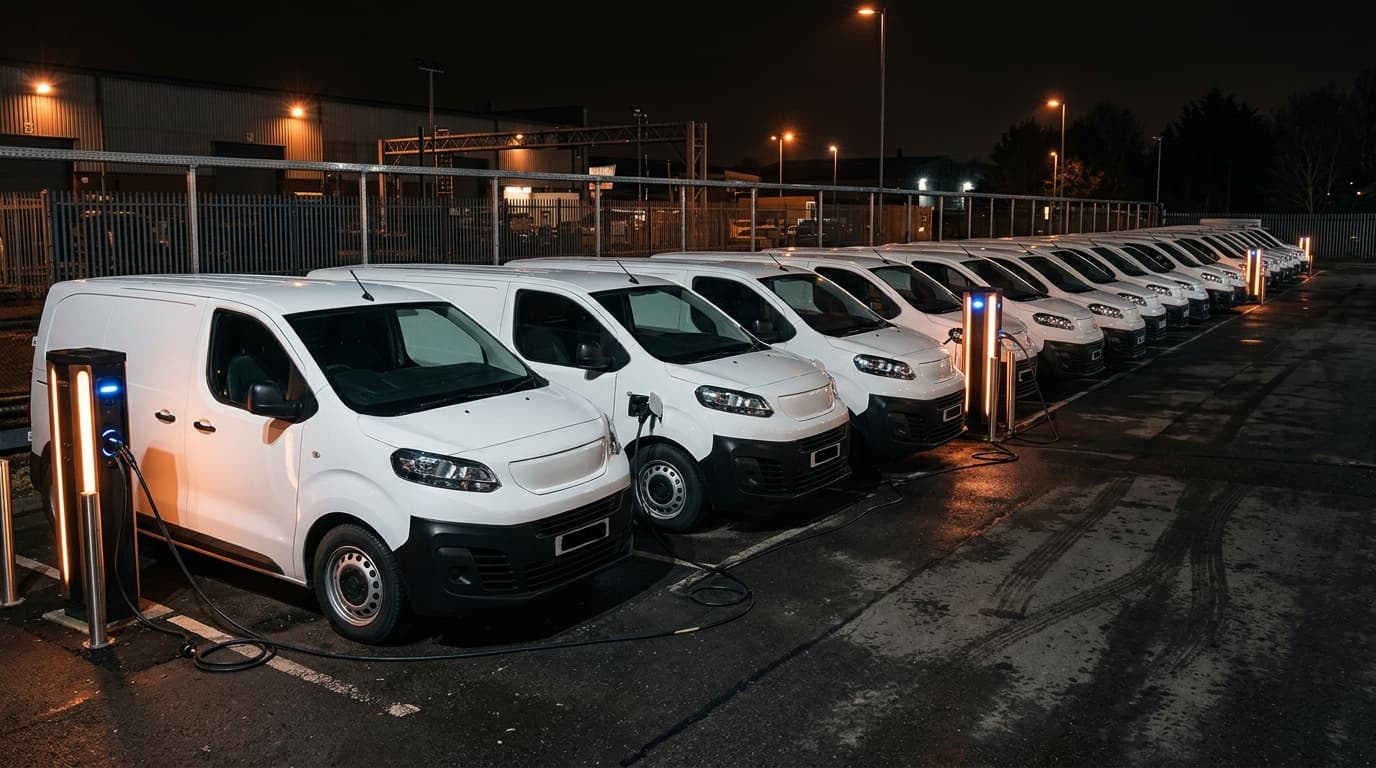
On a depot, the question is not how many chargers to fit but how much power to connect. Four large electric vans coming home at night need roughly 134 kWh back. Spread over eleven hours, that is 12 kW. Four unmanaged chargers pull 44 kW at once.
How many charge points for a fleet of four vans?
One charge point per vehicle that sleeps at the depot. That part is simple.
The rest is not, because the reflex is to multiply charger power by charger count and ask the grid operator for a connection to match. That is how the owner of a small firm ends up with a substation upgrade quote for four vans.
Turn the sum around and start from the energy. A 120 km daily round, counting 28 kWh per 100 km (a figure a large electric van holds when empty on mixed roads and comfortably exceeds when loaded in winter), uses 33.6 kWh. Times four vehicles, that is 134 kWh to put back into the batteries between 19:00 and 06:00 the next morning.
The number that counts: 134 kWh divided by 11 hours gives 12.2 kW. A standard three-phase SME connection takes that without complaint.
Do you really need 22 kW per charge point?
No, and two reasons stack up.
The first is the vehicle. A charger never charges faster than the van's on-board charger accepts on alternating current. The Ford E-Transit and its 68 kWh battery top out at 11 kW, the Renault Master E-Tech at 7.4 kW as standard with 22 kW optional, the Mercedes eSprinter at 11 kW. Plugging a standard Master into a 22 kW charger does not fill it one minute faster.
The second is the network bill, and it is distinctly Belgian. In Flanders the capacity tariff has applied since 2023: the operator records the highest power measured over any quarter of an hour in the month, averages it over the last twelve months and multiplies by a fixed rate. Fluvius sets out the mechanism on its capacity tariff page and bills a 2.5 kW floor even when the real peak is lower. The 2026 rate sits around €53 per kilowatt per year excluding VAT.
| Depot of 4 vans, 134 kWh to deliver per night | Peak power drawn | Charging done by | Annual cost of the peak (Flanders, ≈ €53/kW) |
|---|---|---|---|
| 4 chargers at 11 kW, no management | 44 kW | around 22:00 | ≈ €2,330 |
| 4 chargers at 11 kW, capped at 15 kW | 15 kW | around 04:00 | ≈ €795 |
| 2 piloted dual chargers, overnight | 12 kW | around 06:00 | ≈ €636 |
Same energy, same fleet, same mileage. Between the first and the last line there is €1,694 a year and a load-balancing controller.
Fitting a depot charger: the seven-step procedure
Allow six to ten weeks between the decision and the first vehicle plugged in, most of it administrative.
- Read the subscribed power at the meter (30 minutes). It is on the bill and on the main breaker. That is the ceiling everything has to fit under, workshop lighting and compressor included.
- Add up the real energy of your rounds (1 hour). Daily mileage per vehicle, observed consumption, arrival time and departure time. This table decides everything else.
- Ask an accredited installer for a study (1 to 2 weeks). They check the board, cable cross-sections, earthing and the room left for residual current protection.
- Choose between load management and a bigger connection (varies). A load-balancing system almost always costs less than raising your subscribed power, and it goes in without roadworks.
- Fit the chargers and the metering unit (1 to 3 days). The charger, the cabling, and the meter that reads site consumption so charging can adapt in real time.
- Have the installation inspected (1 week). An accredited body issues the conformity report before use. For a non-domestic installation it is valid five years, against twenty-five for a domestic one.
- Declare the chargers to the grid operator (30 seconds each). A legal duty, and the step everyone skips.
Am I required to fit charge points?
One European directive, three transpositions, three rules. All have applied since 1 January 2025, existing buildings included.
| Wallonia | Brussels | Flanders | |
|---|---|---|---|
| Threshold, non-residential building | more than 20 spaces | 10 spaces and above | more than 20 spaces |
| Charge points required | at least 1 | 10 % of spaces, minimum 2 | at least 2 |
| Pre-cabling or ducting | 1 space in 5 | per the ratio | 1 in 4 (new build and major renovation) |
| SME exemption | yes, SMEs under recommendation 2003/361/EC | none | none |
| Stated penalty | EPB administrative fine | administrative fine | €2,000 per missing point, €1,000 per space without ducting |
| Next deadline | transposition of directive 2024/1275 | 20 % of spaces on 1 January 2030 | 1 January 2027 for existing buildings |
Two lines matter. The Walloon PEB decree and the order of 11 January 2023 exempt SMEs in the European sense, which covers almost every Walloon construction firm. And in Brussels a charge point of at least 50 kW counts as five: a depot with 25 spaces owes three, and one rapid charger settles it.
Three Regions, three thresholds, three penalties. The only thing they share is the date they came into force.
What support is left in 2026?
The good years are over, and it is worth saying plainly. The enhanced deduction that took publicly accessible charge points to 200 % and then 150 % of costs expired on 31 August 2024.
What remains is the investment deduction reformed in 2025, where charging infrastructure sits on the carbon-emission-free transport thematic list: 40 % for the self-employed and small companies, 30 % for large ones, on a new investment of at least €1,000 used in Belgium. The split in rates is due to disappear from tax year 2027 in favour of 40 % across the board.
The Regions no longer subsidise a charge point on its own. Brussels is the exception, and it is the best news in the file for anyone buying a van: the Electric Utility Vehicle grant from Brussels Economy and Employment covers 5 to 40 % of eligible spending, up to €16,000 per electric vehicle, charge point included, capped at three vehicles and three charge points per calendar year and €48,000 in total. The application goes in within six months of the purchase invoice, and the charger invoice cannot precede the vehicle invoice by more than three months. That invoicing order fails applications.
Elsewhere, nothing for a van: the Flemish Ecologiepremie+ only targets rapid charging for buses and trucks, and Wallonia points to the Easy'Green loan, which is financing.
Which charge point for a depot?
Two criteria come before the brand: load balancing and metering.
Load balancing, because that is what turns four 11 kW chargers into a 12 kW installation. The Alfen Eve Double Pro-line delivers 22 kW three-phase across two Type 2 sockets and steers charging by talking to the digital meter or an external meter over Modbus TCP/IP, according to the manufacturer's datasheet. Belgian maker Smappee, based in West Flanders, applies the same logic on its EV Base, up to two times 22 kW with dynamic balancing across the whole site.
Metering next, because a depot mixes uses. A built-in MID meter and an RFID reader separate a company car's charging from a fleet van's, allow internal recharging, and produce a clean statement for the accounts.
The DC charger, for its part, almost never earns its place here. A van asleep for eleven hours has no use for it.
The five mistakes that inflate the bill
They all come back to the same thing: sizing on the charger rather than on the use.
- Adding up charger power. Four times 11 kW is not the power to subscribe, it is the peak to avoid.
- Buying 22 kW for vehicles that charge at 7.4. The van's on-board charger is the real ceiling, and it is printed on the spec sheet.
- Forgetting the rest of the depot. Compressor, vehicle lift, workshop heating: the month's peak often happens at 08:00, not overnight.
- Skipping the declaration to the grid operator. Thirty seconds, a legal duty, and a smoother file the day you ask for more power.
- Invoicing the charger before the vehicle in Brussels. The grant requires the opposite order within a three-month window.
Our verdict
When I ran the fleet, electrification always stalled on the connection quote, and nobody, at the installer or at the grid operator, ever started by asking what time the vehicles came back in the evening. Everything was sized off the catalogue.
A van depot is the single best case there is for charging: the vehicles all come back to the same place, they stay eleven hours, and you know their mileage to the kilometre. On the Belgian market, the difficulty is neither the charger nor the vehicle. It is getting people to accept that subscribed power is calculated over eleven hours, not three.
If you are still choosing vehicles, our comparison of the best electric vans in Belgium sorts by real range and payload, the electric or diesel fleet piece gives the cost per kilometre, the guide to which medium van for a fleet sorts by size class, and the comparator filters on consumption and payload.
Sources: Fluvius, "Capacity tariff" and "How the capacity tariff is billed" pages; Cellule Mobilité AKT for Wallonia, "PEB regulations on charge points for electric vehicles" (PEB decree of 17 December 2020, Walloon government order of 11 January 2023 published in the Belgian Official Gazette on 17 March 2023, article 54/8 of the electricity decree of 15 October 2022); order of the Government of the Brussels-Capital Region of 29 September 2022 setting charge point ratios for car parks; Vlaams Energie- en Klimaatagentschap (VEKA), charging infrastructure obligations from 1 January 2025 and administrative fine amounts; Brussels Economy and Employment, "Electric Utility Vehicle grant" fact sheet; directive (EU) 2024/1275 on the energy performance of buildings; Alfen (Eve Double Pro-line) and Smappee (EV Base) datasheets; Ford, Renault and Mercedes-Benz manufacturer data for battery capacities and AC charging power. Pages consulted on 29 August 2026. Grant amounts and network tariffs change every year: check your own position with your grid operator and your accountant before committing to works.
Utilitaires électriques comparator
Compare all utilitaires électriques side by side.
Compare now →
Frequently asked questions

Damien, 44 ans, a géré pendant douze ans la flotte d'utilitaires d'une PME de second œuvre dans la région de Namur : achats, entretien, revente, et les galères de carrosserie qui vont avec. Il a vu passer des dizaines de Trafic, Transporter et Master, et il sait ce qui casse, ce qui se revend bien et ce qui coûte cher à l'usage. Il a lancé ce site pour comparer les utilitaires sur ce qui compte vraiment en Belgique : charge utile réelle, volume utile, TVA récupérable et coût au kilomètre — pas la brochure du concessionnaire.