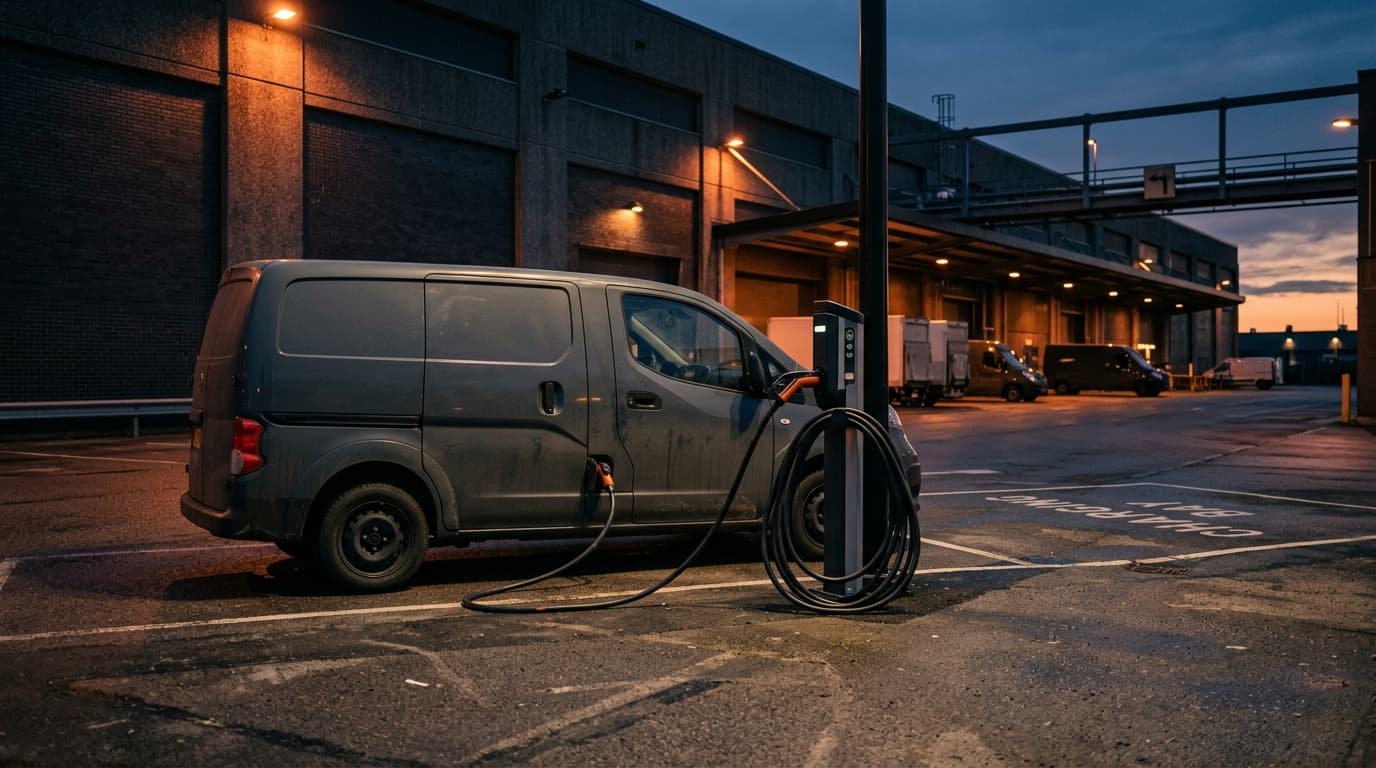
For an electric van in Belgium, the purchase that makes sense is a Mode 3 Type 2 cable, three-phase, four to seven and a half metres long. The cable that comes with the vehicle is a Mode 2 unit, built for emergencies rather than for a working week. And in Brussels, a question of neutral conductor sometimes decides for you.
Type 2, Mode 2, Mode 3: three words that settle everything
The type describes the plug. The mode describes the intelligence.
Type 2 is the European plug standardised under EN 62196, fitted to the charging flap of every electric van sold in Belgium. Type 1 was Japanese and American, Type 3 disappeared along with the earliest leased Zoés. On a new van, the question no longer arises.
The mode says nothing about the plug. It says where the box sits that controls the charge, watches the temperature and cuts the supply on a fault. In Mode 2 that box is inside the cable, the large black brick halfway along the cord supplied with the vehicle. In Mode 3 it has gone: the charge point does the controlling, and the cable is only a conductor with two identical Type 2 plugs. Mode 4 is DC rapid charging, where the cable is attached to the charger and you buy nothing.
Two figures to anchor the scale. A Mode 2 cable on a household socket delivers 1.8 to 2.3 kW. A Mode 3 cable at 32 A three-phase reaches 22 kW. A factor of ten.
Four ways to plug in an electric van in Belgium
| Connection | Mode | Supply side | Current | Power | Covered by RGIE chapter 7.22 |
|---|---|---|---|---|---|
| Emergency cable on a household socket | 2 | Schuko 230 V | 8 to 10 A | 1.8 to 2.3 kW | outside scope |
| Mode 2 cable on a blue CEE socket | 2 | CEE 16 A single-phase | 16 A | 3.7 kW | outside scope |
| Portable charging box on a red CEE socket | 2 | CEE 16 A three-phase 400 V | 16 A | up to 11 kW | outside scope |
| Mode 3 cable on a wallbox or public charger | 3 | Type 2 socket | 16 to 32 A | 3.7 to 22 kW | the charge point is subject to it |
The last column is the one that actually matters to a Belgian sole trader, and nobody publishes it. The first three rows escape the chapter of the electrical code that governs charge points, simply because they run through an ordinary socket outlet.
Is the cable supplied with the van enough?
To get you out of trouble, yes. To work with, no, and the arithmetic is blunt.
A large electric van now carries 68 to 110 kWh of battery. Plugged into a household socket at 2.3 kW, it needs thirty to forty-eight hours for a full charge. Your van spends the weekend on the yard and leaves on Monday half full.
The Mode 2 cable still earns its place, and not as a second-rate one: it is the only piece of kit that saves you on an isolated site, at a customer's house, in a farmyard. Mennekes, which invented the Type 2 plug and distributes in Belgium, states a maximum of 3.7 kW on its Mode 2 cables, with detection of both AC and DC residual currents, multi-stage temperature management, and automatic current reduction when the plug heats up. That last function is no gimmick: the wall socket in an older building is almost always the weak link.
Single-phase or three-phase: which Type 2 cable to order?
A cable produces no power. It only lets power through.
Three ceilings stack up, and the lowest one wins: the van's onboard charger, the charge point you plug into, and the cable. A 32 A three-phase cable in front of a van whose onboard charger caps at 7.4 kW single-phase will not save a single minute. We ran the same arithmetic from the charger side in our guide to equipping a depot for an electric van fleet, and it reads the same way here.
So why buy 32 A three-phase anyway? Because the price gap between 20 A and 32 A is small next to the cost of a van, because the cable is the one link in the chain that will outlast three vehicles, and because an undersized cord holds you back the day you find a 22 kW charger free at the right hour.
The Belgian Mennekes catalogue gives the formats actually on offer: 20 A three-phase at four metres (part 36292), 20 A three-phase at seven and a half metres (36245), 32 A three-phase at seven and a half metres (36247), plus a coiled four-metre version capped at 11 kW that never touches the ground. The manufacturer quotes up to 22 kW at 400 V and 32 A depending on the variant, the vehicle and the charge point.
In Brussels, 88 % of the grid has no neutral
Here is the piece of information missing from every page written for France, and it changes the answer for a Brussels tradesperson.
The regional regulator says so itself. On its page about connecting electric vehicles at home, Brugel writes that the vast majority of the Brussels grid is, for historical reasons, 3x230 V without a neutral, and that only 12 % of the Sibelga grid runs on 3x400 V with a neutral. The same document files charging at 11 and 22 kW under four-wire connections, meaning 3x400 V with a neutral present.
Translated for a sole trader who parks the van outside his house in Schaerbeek or Anderlecht: the 32 A three-phase cable he has just bought will do nothing until the consumer unit can feed it. Worse, some vehicles and some charge points flatly require a neutral to start charging, and refuse to begin without one.
Two ways out, neither of which is solved by something bought online. Either Sibelga modifies the connection to 400 V with a neutral, provided a four-wire network runs nearby, which means changes to the installation. Or an autotransformer is fitted immediately upstream of the charge point to build 3x400 V with a neutral out of 3x230 V. Both routes go through a certified electrician before the vehicle is ordered, not after.
The wrong order gets expensive fast: order the van, then the charge point, then discover there is no neutral.
Wallonia and Flanders also have stretches of 3x230 V grid inherited from the same era, but no operator there publishes a comparable share to Sibelga's. ORES, RESA and Fluvius all refer you to a case-by-case check at the connection point. The 12 % figure is therefore a Brussels figure and does not transfer to Namur or Ghent: the only method that works everywhere is to read the voltage on the consumer unit and have it confirmed by the grid operator.
RGIE chapter 7.22 says nothing about the Mode 2 cable
The Royal Decree of 10 July 2022, published in the Belgian Official Journal on 16 August 2022, added a chapter 7.22 to part 7 of Book 1 of the RGIE, the Belgian general regulation on electrical installations, devoted entirely to the supply of road electric vehicles. It builds on international standard IEC 60364-7-722 and applies to conductive charge points whose installation or replacement began on or after 1 November 2022.
Its most structural requirement fits on one line: a dedicated circuit for each connection point, with its own protection against indirect contact and overcurrent. Spurring a charge point off an existing socket circuit is not a shortcut, it is a non-conformity.
Then comes the sentence nobody picks up. Cohezio, an approved Belgian occupational prevention service, set out the scope of the new chapter when it appeared, and notes that inductive charge points and charging systems that work through a standard socket outlet are not covered by chapter 7.22. They remain subject to the other rules of Book 1, and to nothing else.
Put plainly, the most fragile connection of all, a Mode 2 cable on a site socket, is the one that escapes the regime written for charging. The installation is of course still bound by the general regulation, and a conformity inspection can perfectly well flag an unsuitable socket. But no text obliges you to run a dedicated circuit for the socket you push your emergency cable into. Caution there is on you.
Do you need 32 A, and how long a cable?
Four metres is enough on a wallbox mounted opposite the charging flap. Seven and a half metres earns its keep as soon as the van parks at an angle, the flap sits front left and the charger sits behind, or two vehicles share one point. Beyond that, copper gets heavy, runs warmer and coils badly in a van.
Recorded on 20 September 2026 at Mennekes and Juice Technology
Two manufacturers publish enough technical detail to be quoted without guesswork.
On the plain cable side, Mennekes documents on its Belgian page its Mode 3 formats at 20 and 32 A three-phase, its coiled four-metre version capped at 11 kW, and its Mode 2 cables at 10 A and 16 A over four metres, limited to 3.7 kW, rated IP44 on the connection devices and IP67 on the charging module.
On the portable box side, the official data sheet for the Juice Booster 3 air quotes 1.4 to 11 kW AC, a rated current of 6 to 16 A, a supply of 230 V single-phase or 400 V three-phase, a Type 2 coupling to EN 62196, IP67 protection, a built-in residual current device rated 6 mA DC and 30 mA AC, an operating range of minus 30 to plus 50 °C, and a weight of 700 grams without cable for 1.8 kg with. Declared conformity: IEC 62752, 62196 and 61851-1, Modes 2 and 3. The same manufacturer quotes 22 kW for the Juice Booster 2, which has no connectivity.
A box of that kind ticks a box a plain cable cannot: it turns a red CEE site socket into an 11 kW charge point, and it replaces a wallbox when the vehicle sleeps somewhere different every night. For a fleet that comes home to a depot, the calculation runs the other way, and we set it out in our depot guide.
How much does a Type 2 cable cost in Belgium?
Neither manufacturer publishes a Belgian price. Mennekes points to its distribution network, and Juice Technology shows CHF 1,299 for the Booster 3 air Basic Set on its Swiss storefront, recorded on 20 September 2026, which is not a Belgian retail price. So compare on current rating, number of phases, length and certification. Not on a figure that moves from one distributor to the next.
Six checks before you order
- The maximum AC current the onboard charger accepts, read from the data sheet of the exact version rather than the model page.
- The number of phases at your usual charge point, and whether a neutral is present, confirmed by the grid operator.
- The length measured between the vehicle's charging flap and the charge point, with the flap sitting front left on a good share of vans.
- The standards quoted: EN 62196 for the plug, IEC 61851-1 for the charging process, IEC 62752 for any Mode 2 box.
- The ingress protection rating of the module, IP67 as soon as it lies on a building site floor or stays outdoors overnight.
- The locking of the cable at both ends: an unlocked Type 2 cable disappears from a public charger in three seconds.
Our verdict
When I ran the fleet, the cable was the accessory nobody mentioned at order time and everybody hunted for six months later, usually in the evening, usually in the rain. We bought one per vehicle, always the cheapest, and replaced them twice as often.
A van is kept five to seven years. The cable moves from one vehicle to the next without losing any of its value, provided it was bought a notch above the need of the moment. On the Belgian market, the real trap is neither the brand nor the current rating: it is finding out after delivery that the charge point cannot give what the van is able to take.
If you are still choosing the vehicle, our comparison of the best electric vans in Belgium sorts by real range and payload, and the electric city van guide drops down one size class.
Sources: Brugel, "Raccordement des véhicules électriques à domicile" (breakdown of the Sibelga grid, 12 % on 3x400 V with a neutral, 11 and 22 kW charging as four-wire connections, autotransformer) ; Royal Decree of 10 July 2022 adding chapter 7.22 to part 7 of Book 1 of the RGIE, published in the Belgian Official Journal on 16 August 2022 ; Cohezio, "Installation de bornes de charge pour les voitures électriques : que dit désormais le RGIE ?" (scope of chapter 7.22, standard IEC 60364-7-722, exclusion of charging through a socket outlet, dedicated circuit requirement) ; Mennekes Belgium, "Câble de recharge voiture électrique type 2" page (Mode 3 formats at 20 and 32 A three-phase, coiled 11 kW version, Mode 2 cables at 3.7 kW, IP44 and IP67 ratings) ; Juice Technology AG, Juice Booster 3 air Basic Set product sheet (1.4 to 11 kW, 6 to 16 A, 230 V or 400 V, Type 2 EN 62196, IP67, residual current device 6 mA DC and 30 mA AC, 700 g without cable, conformity to IEC 62752, 62196 and 61851-1). Pages consulted on 20 September 2026. Onboard charger ratings change from one model year to the next: check the data sheet of the exact version, and have the voltage and the presence of a neutral confirmed by your grid operator before committing to any work.
Utilitaires électriques comparator
Compare all utilitaires électriques side by side.
Compare now →
Frequently asked questions

Damien, 44 ans, a géré pendant douze ans la flotte d'utilitaires d'une PME de second œuvre dans la région de Namur : achats, entretien, revente, et les galères de carrosserie qui vont avec. Il a vu passer des dizaines de Trafic, Transporter et Master, et il sait ce qui casse, ce qui se revend bien et ce qui coûte cher à l'usage. Il a lancé ce site pour comparer les utilitaires sur ce qui compte vraiment en Belgique : charge utile réelle, volume utile, TVA récupérable et coût au kilomètre — pas la brochure du concessionnaire.