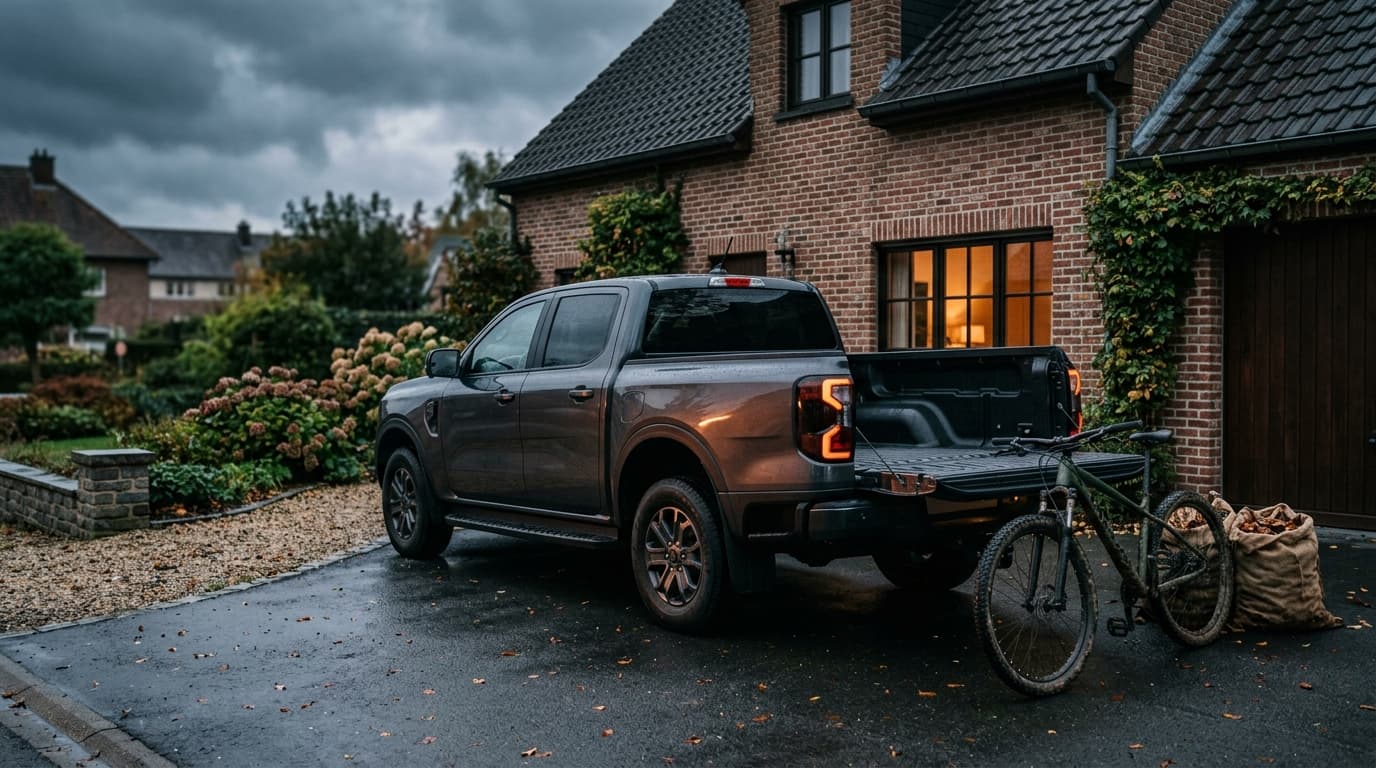
For a Belgian landscaper, the right commercial vehicle comes down to one question: do you mostly carry loose material, or do you tow machinery over difficult ground? In the first case, a tipper wins. In the second, a 4×4 double-cab pickup does better. Often, the double-cab tipper covers both.
Which commercial vehicle for a landscaper, in short?
Start from your typical day, not the vehicle. A landscaper carries three things: a crew, machinery on wheels (ride-on mower, tiller, sometimes a mini-excavator on a trailer) and loose materials (soil, gravel, chippings, green waste). No vehicle does all three perfectly; the right choice is the one that fits your dominant task.
The double-cab pickup ticks the most boxes for a small outfit. Four-wheel drive to get onto muddy ground, four to five seats, an open bed and a hitch rated up to 3,500 kg. The chassis-cab tipper, on the other hand, wins as soon as you load and unload loose material all day: it empties by tipping, not by shovel.
The number that matters: in 2025, 70,797 light commercial vehicles were registered in Belgium, up 7.6% according to FEBIAC, around 88% of them diesel. The trade stays on diesel, for a simple reason: towing and on-site range.
Pickup or tipper: which one for a landscaper?
Tipper if you dump loose material every day, pickup if you tow and drive off-tarmac. That is the central trade-off, and it turns on your volume of green waste and materials more than on price.
The tipper — a chassis-cab such as a Renault Master, Ford Transit or Iveco Daily fitted with a body that tips — unloads a tonne of soil or grass in ten seconds. On a landscaping job where you clear waste continuously, that is time saved on every trip. In single-cab form, it also offers the biggest payload and the longest bed of the lot.
The pickup goes where the van gets stuck. On soaked ground, a lawn to be laid, a sloped access, the four-wheel drive of a Ford Ranger or a Toyota Hilux gets through where a front-wheel-drive tipper spins. It also tows heavier, and it keeps a comfortable cab for driving between jobs. Its weak point: the bed does not tip from the factory, and payload is a notch below a single-cab tipper.
In the field, the three-person firm that builds gardens and clears little waste often takes a double-cab pickup; the one that does heavy maintenance, mows large areas and clears trailers of green waste picks the tipper. Many end up with a double-cab tipper, which combines the crew and the tipping discharge, at the cost of reduced payload.
Which pickups hold up on load and towing?
The Belgian market's four references sit close together: Ford Ranger, Toyota Hilux, Volkswagen Amarok and Isuzu D-Max. All quote up to 3,500 kg of braked towing and around a tonne of payload in double-cab form, with selectable four-wheel drive.
The Ranger dominates the segment — one in four pickups registered in Belgium is a Ranger, and Ford finished 2025 as the number 1 light commercial vehicle brand in Belux. It quotes up to around 1,250 kg of payload depending on version. The Hilux leans on the reputation for reliability of its 2.8 diesel with 204 hp and 500 Nm, an argument that counts when the vehicle works every day. The Amarok, now a technical cousin of the Ranger, stands out for its smoother 3.0 V6 TDI on the road, at the cost of higher engine size and fuel use. The D-Max plays the card of simple ruggedness and a lower entry price, with payload above a tonne on some trims.
| Double-cab pickup | Braked towing (up to) | Payload (order of magnitude) | Typical engine |
|---|---|---|---|
| Ford Ranger | 3,500 kg | ~1,000–1,250 kg | 2.0 EcoBlue diesel |
| Toyota Hilux | 3,500 kg | ~1,000 kg | 2.8 D-4D 204 hp |
| Volkswagen Amarok | 3,500 kg | ~1,000 kg | 2.0 / 3.0 V6 TDI |
| Isuzu D-Max | 3,500 kg | >1,000 kg | 1.9 diesel |
What we would avoid: choosing on the towing spec alone. The quoted 3,500 kg is a technical capacity; what you can legally tow depends on your licence and the combination's GVW, not on the brochure. To separate the four beyond the figures, our Ranger, Hilux or Amarok for a tradesperson comparison goes into detail.
Which tipper to shift green waste?
A tipper on a 3.5 t chassis-cab: Renault Master, Ford Transit, Iveco Daily, Fiat Ducato or Peugeot Boxer, bodied as a tipper. For dense towns and tight access, a small carrier such as a Piaggio Porter helps, with a more modest load and footprint.
The point of a tipper is mechanical: the body tips and empties the load with no manual handling. For a landscaper who dumps three trailers of grass a day, that changes the fatigue and the number of trips. The single cab maximises bed length and payload; the double cab carries the crew but shortens the body and adds kerb weight.
On budget, count €30,000 to €45,000 excl. VAT for a new chassis-cab, plus €3,000 to €8,000 excl. VAT for the tipper bodywork fitted by a coachbuilder. It is an investment, but the tipper resells well on the used professional market: the segment is sought after and depreciation stays contained.
At resale, a well-kept single-cab tipper finds a buyer fast — landscaping, groundwork and roofing firms are always after this type of vehicle. A double-cab pickup also resells easily on the professional side, less easily to private buyers since the regions closed the leisure tax loophole.
Which licence to tow a landscaper's trailer?
The B licence is enough as long as the sum of the GVWs of the vehicle and trailer stays under 3,500 kg. Above that, you need code 96 (up to 4,250 kg) or the BE licence (up to 7,000 kg). For a pickup that tows heavy, it is almost always the BE.
The maths is quick. A pickup has a GVW of about 3,000 to 3,230 kg. Hitch it to a 2,000 kg plant trailer and the combination already reaches over 5,000 kg: beyond B, beyond code 96. Even a 1,500 kg trailer pushes most pickups above the 4,250 kg of code 96. In practice, as soon as you carry a loaded mini-excavator or plant trailer, plan for the BE licence.
Code 96 is not a separate licence: it is an entry obtained after seven hours of training, which allows a combination of 3,500 to 4,250 kg. The BE requires a practical test. The line is drawn on the sum of maximum authorised masses, not on what you actually load on the day of a check.
On the Belgian market, this constraint shapes the choice of vehicle as much as the tipper does. If the whole crew must be able to drive, a pickup that requires the BE can be a problem: a mower and a light trailer behind a van with a lower GVW may stay within B96. Check the combination's GVW before buying the trailer, not after.
Is a landscaper's commercial vehicle 100% deductible?
Yes, and this is where professional status changes everything. A self-employed or incorporated landscaper, with a number at the Crossroads Bank for Enterprises, keeps the fiscal van regime that the private buyer has lost since the regional reforms.
In concrete terms, a light commercial vehicle — fiscal van or pickup — assigned to the business opens VAT deduction at 100% of professional use, against 50% maximum for a car. The vehicle costs (depreciation, fuel, maintenance, insurance, leasing) are 100% deductible for professional use. Above all, these vehicles escape the CO₂-based tapering that erodes the deductibility of cars: in 2026, a light commercial vehicle stays fully deductible, whether petrol, diesel, hybrid or electric. Add a flat road tax of roughly €35 to €150 and no registration tax.
The trade-off comes down to one word: proof. For a light commercial vehicle, the administration does not assume professional use — it is up to you to demonstrate it, with a trip log and job sheets to back it up. Mixed use is calculated pro rata. It is exactly the reverse of the private buyer's pickup, which now pays a car's rate for lack of a business number.
The number that matters: between a diesel passenger car taxed on its CO₂ and a light commercial vehicle that is 100% deductible, the tax cost gap over four years runs into thousands of euros for a vehicle that covers a lot of ground. For a landscaper doing 25,000 km a year, that is not an accounting detail, it is a line in the cost per kilometre.
Is an electric commercial vehicle suitable for a landscaper?
In 2026, rarely, as soon as towing is involved. The electric offer is growing on the van side, but towing capacity and range under load are not yet at the level of a diesel work vehicle.
A fully electric pickup like the Maxus T90 EV exists and starts around €54,990 excl. VAT, but its towing capacity stays modest against the 3,500 kg of a diesel Ranger or Hilux. On the van side, an e-van handles the city and short rounds, but range drops when you load the vehicle and add a trailer — precisely the working regime of a landscaper. Add the charging to manage between two distant sites, and the sums do not yet add up for a firm that tows.
Where electric holds up today: urban maintenance without a heavy trailer, small areas, town centres under low-emission zones. A compact electric van runs cleanly there and gets the same tax benefits as a diesel. To tow a mini-excavator over muddy ground, though, diesel remains the safe choice — and will stay so until electric towing improves.
Our verdict
There is no single landscaper's vehicle, there are two, and the choice turns on what you carry most. The double-cab pickup is the generalist's tool: crew, traction, towing, difficult access. The tipper is the loose-material specialist's tool: it empties itself, carries more, and resells well. Many firms settle it by taking a double-cab tipper, accepting a little less payload.
Before signing, make three concrete checks. The GVW of the vehicle-plus-trailer combination, to know which licence is needed and who can drive. The real payload once the tipper or fit-out is fitted, not the bare chassis figure. And your tax situation: self-employed or incorporated, the commercial vehicle is 100% deductible, which changes the cost per kilometre. To frame the need, the guide to vans in Belgium places each segment, the pickup or van comparison sets the right criteria, and the pickup comparator sorts by payload and towing.
Sources: FEBIAC (70,797 light commercial vehicles registered in Belgium in 2025, +7.6%; diesel share); Ford Belux (Ranger number 1 in light commercial vehicles 2025, one pickup in four); Belgian Federal Public Service Finance and Accountable (fiscal van definition, 100% deductibility, recoverable VAT, no CO₂ tapering for LCVs in 2026); Moniteur Automobile (technical criteria for the light commercial vehicle, €35–150 flat road tax); link2fleet ("Du neuf pour les LCV et pick-up, côté fiscal?", 30-10-2025: no change for LCVs in 2026); Belgian FPS Mobility and Moniteur Automobile (B licence, code 96 and BE, thresholds 3,500 / 4,250 / 7,000 kg); manufacturer data from Ford, Toyota, Volkswagen and Isuzu (braked towing up to 3,500 kg, payload).
Pick-up comparator
Compare all pick-up side by side.
Compare now →
Frequently asked questions

Damien, 44 ans, a géré pendant douze ans la flotte d'utilitaires d'une PME de second œuvre dans la région de Namur : achats, entretien, revente, et les galères de carrosserie qui vont avec. Il a vu passer des dizaines de Trafic, Transporter et Master, et il sait ce qui casse, ce qui se revend bien et ce qui coûte cher à l'usage. Il a lancé ce site pour comparer les utilitaires sur ce qui compte vraiment en Belgique : charge utile réelle, volume utile, TVA récupérable et coût au kilomètre — pas la brochure du concessionnaire.