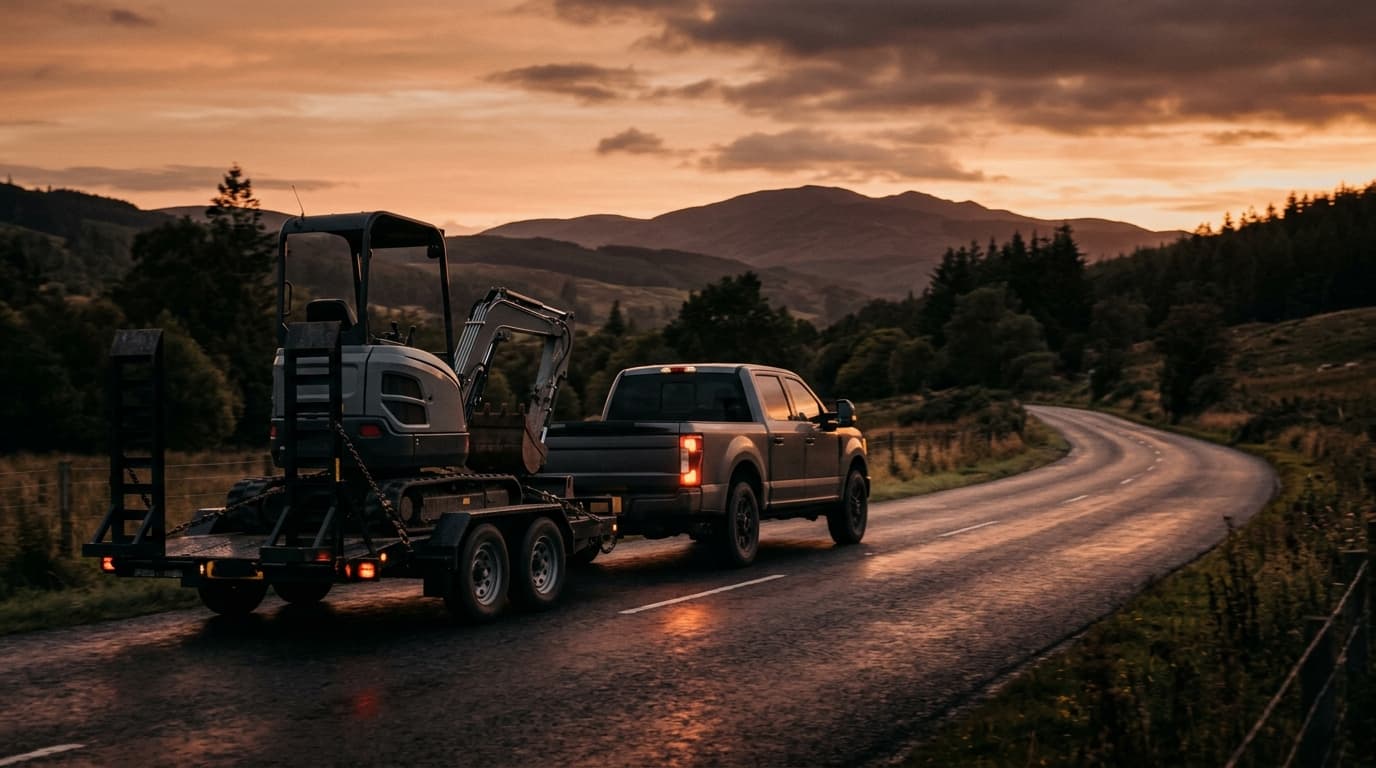
Gross train weight is the maximum mass of everything that rolls coupled together: the pickup, its occupants, its load bed, the trailer and what it carries. The manufacturer sets it at type approval. On most pickups sold in Belgium it is lower than the maximum authorised mass plus the towing capacity, which forces a choice between a full bed and a full trailer.
Gross train weight in one line
The French acronym is PTRA, poids total roulant autorisé, inherited from the old French registration document. The European registration certificate calls it the maximum permissible laden mass of the combination, field F.3. You will also see MTRA. Same thing.
Mass acronyms all look alike. They do not measure the same thing.
| Acronym | Full name | What it caps | Certificate field |
|---|---|---|---|
| MAM (MMA, PTAC) | Maximum authorised mass | The vehicle alone, laden, occupants included | F.1, or F.2 if an adapted MAM exists |
| Kerb weight | Mass in running order | The vehicle ready to drive, 75 kg driver included | G |
| Payload | MAM minus kerb weight | What cab and bed can still take | Calculated, not printed |
| Towing capacity | Maximum towable mass | The trailer alone, braked (O.1) or unbraked (O.2) | O.1 and O.2 |
| Gross train weight (PTRA) | Maximum combination mass | Laden vehicle plus laden trailer | F.3 |
The last line is the only one that looks at the whole combination. It is also the one brochures forget.
Why isn't gross train weight MAM plus trailer?
Because the manufacturer does not calculate it that way. Gross train weight is a type-approval value in its own right: it depends on what the engine, gearbox, clutch, brakes and cooling can handle on a climb with the whole train behind, not on what the chassis carries at rest. On a pickup the driveline is sized to pull and the chassis to carry, and the two limits do not match.
That is the argument of this article, and the spec sheets bear it out. A double cab pickup sold in Belgium shows roughly 3,100 to 3,300 kg MAM and 3,500 kg braked towing. If gross train weight were the sum, it would sit around 6,600 to 6,800 kg. The published figures are lower.
The obvious objection: a manufacturer quoting 3,500 kg towing is not lying. True. It quotes a trailer capacity, not a simultaneous trailer and bed capacity. Both figures are correct on their own, and that is exactly the problem, because buyers read them together.
Isuzu D-Max: 520 kg in the bed with 3.5 t behind
The D-Max is the clearest case because its masses are published in full. Parkers' table for the generation launched in 2021 gives every 4x4 version a MAM of 3,100 kg, a braked towing capacity of 3,500 kg and a gross train weight of 6,000 kg.
Do the subtraction. 6,000 kg of combination minus 3,500 kg of trailer leaves 2,500 kg for the laden pickup. A manual double cab weighs 1,980 kg empty. That leaves 520 kg for passengers, tools and everything in the bed. With an automatic gearbox on the upper trims, kerb weight rises to 2,030 kg and the margin drops to 470 kg.
| Isuzu D-Max 4x4 (2021 generation) | Advertised payload | Load available with 3,500 kg attached | Loss |
|---|---|---|---|
| Double cab, manual (1,980 kg kerb) | 1,120 kg | 520 kg | 600 kg |
| Double cab, upper trim, automatic (2,030 kg kerb) | 1,070 kg | 470 kg | 600 kg |
| Extended cab (1,960 kg kerb) | 1,140 kg | 540 kg | 600 kg |
| Single cab (1,895 kg kerb) | 1,205 kg | 605 kg | 600 kg |
The right-hand column does not move, and that is normal: 3,100 + 3,500 = 6,600 kg, 600 kg above the gross train weight. You lose those 600 kg from the bed as soon as the trailer is full, whatever the cab.
On site, it looks like this. A groundworks contractor hitches a 2.7 t mini excavator on an 800 kg plant trailer: 3,500 kg behind. Two workers in the cab, 150 kg. About 370 kg remain for spare buckets, the plate compactor, fuel cans and the toolbox. That is where it pinches.
Ranger, Hilux, Amarok: three spec sheets, three ways of saying it
The new-generation Ford Ranger follows the same logic. On the Wildtrak 2.0 EcoBlue, Select Car Leasing reports a 6,500 kg gross train weight for 3,500 kg towing and 1,037 kg payload, with the conclusion that you can max out the bed or the trailer, not both. With 3.5 t behind, the laden pickup must fit within 3,000 kg, occupants included.
The current Volkswagen Amarok shares its technical base and production line with the Ranger. Same architecture, same reasoning, but check F.3 on the actual vehicle: approved masses vary from one engine to another.
The Toyota Hilux is the telling case. Toyota UK's official technical specification gives 3,210 kg MAM for the double cab, 3,500 kg towing and a kerb weight of 2,105 to 2,340 kg depending on version. It does not give the gross train weight. Checked on 29 September 2026, no public range page shows it either. The first two figures add up to 6,710 kg: if your certificate shows less in F.3, the difference comes out of your bed, kilo for kilo.
- D-Max: gross train weight published, 6,000 kg, 600 kg less than MAM plus trailer.
- Ranger Wildtrak 2.0: reported at 6,500 kg, laden pickup limited to 3,000 kg with 3.5 t attached.
- Amarok: same base as the Ranger, values to be read on the vehicle's own documents.
- Hilux: gross train weight missing from the manufacturer sheet consulted, so read it on the vehicle.
Where do you find it on a Belgian registration certificate?
In field F.3, when it is filled in. On a light commercial vehicle registered in Belgium, it is not always.
Satellic, which runs the kilometre charge for the three Regions, had to solve this for its own customers. Its guide to reading the Belgian certificate says that if the combination mass (F.3) is missing, you take the towable mass O.1 and add it to the MAM, F.1, or F.2 if an adapted MAM appears there. That is a declaration method for the toll, and it gives an upper value. To know what the manufacturer really allows, two documents count: the manufacturer's plate, riveted in the door frame or under the bonnet, whose second mass line is the combination, and the certificate of conformity (COC) handed over at purchase.
It takes thirty seconds. Open the driver's door and read the four lines on the plate. The first is the MAM, the second the gross train weight, the last two the axle loads. If the second line is blank, do not hitch anything until the dealer or importer has given you the value in writing.
Is gross train weight really checked at the roadside?
Less often than MAM, admittedly. A pickup with a trailer does not cross a weighbridge every morning, and that is the argument you hear on every site.
It does not hold up, for two reasons. The first is mechanical: a combination above its gross train weight overheats its clutch and brakes on a descent, which is exactly the scenario the limit exists for. The second is legal. After an accident, the assessor rebuilds the masses from delivery notes, the machine's weight and the certificate, and a proven excess gives the insurer grounds to recover from the driver. I handled that file once, for a plant trailer and a pickup whose plate nobody had read. Never again.
Now the nuance. For a tradesperson towing a 1,500 kg trailer, gross train weight never bites: 4,500 kg remain on a D-Max, far more than the pickup's MAM. It only becomes the real constraint above roughly 2.5 t behind a laden double cab. In other words, precisely in the situation you bought a pickup for rather than a small van.
What about a Trafic, a Vito or a Transit Custom?
Same reading, different stakes. On a medium van such as the Renault Trafic, Mercedes Vito, Peugeot Expert, Citroën Jumpy or Ford Transit Custom, gross train weight depends on the engine, the gearbox and the towbar fitted. No generic figure applies to your vehicle: it is F.3, the plate or the COC.
On these vans the licence usually bites before the gross train weight. A 3 t medium van towing more than 750 kg leaves category B, as explained in our article on towing a trailer with a van.
The same rule in all three Regions, except for Viapass
Gross train weight belongs to European type approval and the federal highway code. Nothing changes between Wallonia, Brussels and Flanders: not the definition, not the roadworthiness test, not the licence. Only one regional scheme uses the combination mass: the kilometre charge run by Viapass on behalf of the three Regions.
| Situation | Kilometre charge | Same rule in all three Regions |
|---|---|---|
| Pickup of 3.5 t MAM or less towing a trailer, even above 3.5 t combined | Not liable | Yes |
| N1 pickup or van with a fifth wheel, semi-trailer tractor body (code BC) | Liable since 1 January 2018 | Yes |
| Rigid vehicle over 3.5 t MAM with a trailer | Liable, declared on the combination mass | Yes |
The first line comes from the Viapass table of vehicles outside the scope of the charge: an articulated combination is only liable if the towing vehicle itself shows more than 3,500 kg MAM. The second, less known, was reported by link2fleet when the scope widened in 2018. A pickup with a fifth wheel for a gooseneck horse or caravan trailer therefore needs an OBU, while the same pickup with a tow ball does not.
Our verdict
On the fleets I managed, pickups were bought for two reasons at once: carrying and towing. Gross train weight says you cannot do both to the maximum on the same day, and nobody had written that into the specification.
The method is one subtraction. Gross train weight minus laden trailer, minus the pickup's kerb weight: the result is what you can put in the cab and the bed. If you are still choosing the vehicle, the pickup ranking and the van comparison tool set payloads side by side, and our guide to payload and the category B licence explains how to read the masses on the certificate.
Sources: Parkers, dimensions, payloads and towing capacities of the 2021-generation Isuzu D-Max (MAM, kerb weights, 6,000 kg gross train weight); Select Car Leasing, Ford Ranger Wildtrak 2.0 EcoBlue review published 14 December 2023 (6,500 kg gross train weight, 1,037 kg payload); Toyota UK, official Hilux technical specification (MAM, kerb weights and towing capacity, no gross train weight); Satellic, vehicle registration guide and reading of the Belgian registration certificate (fields F.1, F.2, F.3 and O.1); Viapass, table of vehicles outside the scope of the kilometre charge; link2fleet, extension of the kilometre charge to N1 semi-trailer tractors under 3.5 t from 1 January 2018. Checked on 29 September 2026. Masses vary between versions: the only value that applies to your vehicle is the one on its certificate, its manufacturer's plate or its COC.
Pick-up comparator
Compare all pick-up side by side.
Compare now →
Frequently asked questions

Damien, 44 ans, a géré pendant douze ans la flotte d'utilitaires d'une PME de second œuvre dans la région de Namur : achats, entretien, revente, et les galères de carrosserie qui vont avec. Il a vu passer des dizaines de Trafic, Transporter et Master, et il sait ce qui casse, ce qui se revend bien et ce qui coûte cher à l'usage. Il a lancé ce site pour comparer les utilitaires sur ce qui compte vraiment en Belgique : charge utile réelle, volume utile, TVA récupérable et coût au kilomètre — pas la brochure du concessionnaire.