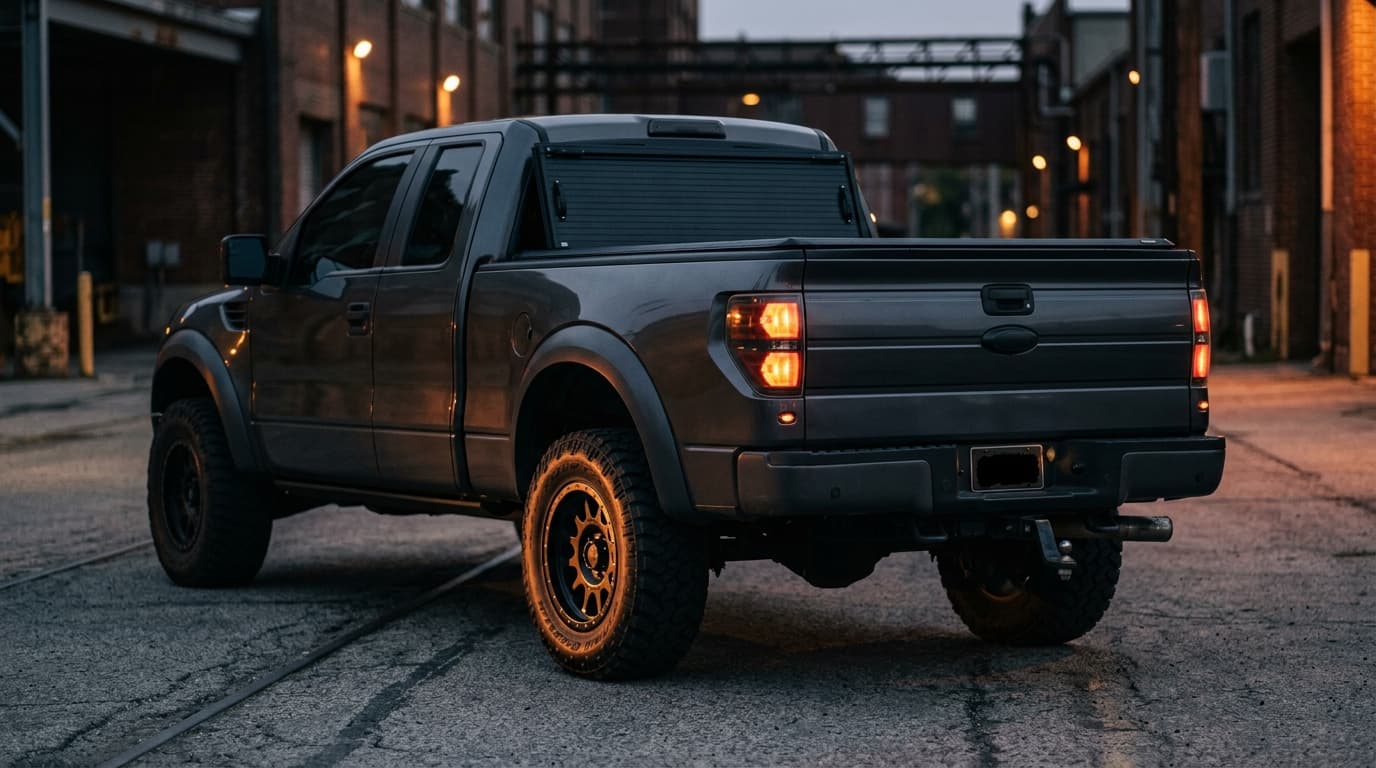
A hardtop closes the bed over its full height and turns it into a locked box. A tonneau cover closes it level with the bed sides and keeps the pickup silhouette. The first wins on volume and security, the second on access, weight and administrative peace of mind. What you carry decides it.
Four ways to close a bed, one that changes the silhouette
The soft roll-up cover winds towards the cab, held by clips or a side rail, and folds away in ten seconds. It keeps out rain and prying eyes. Not a crowbar.
The hard tonneau is a one-piece panel, composite or aluminium, lifting as a block on gas struts. Serious weather sealing, locking through the tailgate latch, full access once raised.
The aluminium roller shutter slides into a canister mounted against the cab. It is the only solution that leaves the bed half open and locked at the same time, with nothing to remove.
The hardtop is a different animal. A full canopy, usually glazed, rising to cab roof height and closing the bed into an enclosed volume. That is no longer a lid, it is added bodywork.
Hardtop or tonneau cover: the table that decides
| Criterion | Soft roll-up | Hard tonneau | Aluminium shutter | Hardtop |
|---|---|---|---|---|
| Usable loading height | Level with bed sides | Level with bed sides | Level with bed sides | Full canopy height |
| Partial opening | Yes, by rolling the fabric | No, all or nothing | Yes, at any position | Tailgate glass, side doors on some models |
| Locking | Token at best | Through the tailgate latch | Barrel lock on the canister | Its own lock plus the tailgate |
| Load sticking out above | Removes completely | Two people to lift off | Comes off with the canister | Heavy removal, two people minimum |
| Overall vehicle height | Unchanged | Unchanged | Unchanged or nearly | Raised to cab roof level |
| Roof rails over the bed | No | Rarely | No | Yes, designed in by the maker |
| Named in the Belgian tax definition | Yes, "tarpaulin" | Yes, "flat horizontal cover" | To be confirmed | No |
The last row is the one no shop will show you, and it is the only one specific to Belgium. More on it below.
A hardtop wins as soon as you load upright
A Belgian double cab pickup leaves the factory with a short bed, because the cab ate the length. Closing that bed level with the sides means resigning yourself to loading flat.
The hardtop unlocks vertical volume. A tool chest stacked on another, a compressor standing up, piled sacks, a crate half a metre tall: none of that fits under a hard tonneau, and all of it fits under a canopy. On second-fix sites, that is the difference between two runs and one.
The price of that volume is paid elsewhere. The canopy closes the bed upwards, so the vehicle grows, and a pickup that just squeezed under a 2 metre car park barrier no longer does. The same arithmetic set out in our piece on roof loading rules for vans applies here without changing a comma.
Which tonneau cover keeps the bed usable?
The aluminium roller shutter, nine times out of ten.
Its quality comes down to one gesture: you open it thirty centimetres to grab a strap, close it, lock it, and the whole thing took four seconds. A hard tonneau forces you to raise the entire panel, which rules out parking against a wall, and a soft cover forces you to unroll then re-clip it every time. When you open the bed fifteen times a day, that detail decides everything.
The shutter has two flaws worth knowing before you sign. The roller canister eats ten to fifteen centimetres of bed length against the cab, which is a lot on an already short double cab. And aluminium slats are noisy on cobbles, a point nobody mentions in the showroom and everybody discovers on the first Monday.
Does a hardtop cost you the light commercial tax status?
This is the question worth the most money, and the one French pages answer beside the point.
Article 4 of the Code of Taxes Assimilated to Income Taxes describes a double cab pickup as a vehicle made of a cab fully separated from the load area and of an open loading platform. The text accepts that this platform be covered by a tarpaulin, by a flat horizontal cover, or by a load protection structure. The tarpaulin and the hard tonneau are therefore named. The hardtop is not, and that third wording, deliberately broad, is exactly the kind of drafting that gets argued in an inspection office rather than on a forum.
The other two tax criteria do not move. The length of the load area must reach at least 50 % of the wheelbase, and that floor must stay horizontal, fixed, with no anchorage points for benches, seats or belts. Fitting a canopy above it touches neither. Moniteur Automobile sets out these conditions and the advantages attached: no registration tax, a flat annual road tax of roughly 35 to 150 euros depending on mass, 100 % deduction of business use and VAT recoverable in the same proportion.
And there is a trap upstream that empties the question of its stakes for a share of buyers. The favourable pickup regime is regional, and two regions out of three have closed it.
| Pickup registered by | Wallonia | Flanders | Brussels |
|---|---|---|---|
| Self-employed listed in the CBE, or a company | Flat light commercial tax | Flat light commercial tax | Flat light commercial tax |
| Private individual, strictly private use | Taxed as a car since 2022 | Taxed as a car since 1 January 2023 | No equivalent restriction found on 18 September 2026 |
For a private buyer in Wallonia or Flanders, the hardtop debate is already settled: there is no tax status left to lose. For a self-employed buyer, it stands in full. The VAT and deduction arithmetic is in our piece on the real cost of a van.
Does it need a new roadworthiness test after fitting?
Not for a canopy bolted onto the bed rails.
The Belgian "tuning" regime published by GOCA covers only M1 passenger cars. A pickup registered as N1 falls outside it. The general rule, however, applies to everyone: any fundamental intervention on the chassis or the bodywork must be certified by the manufacturer or its official representative. A hardtop clamped on brackets is not a fundamental intervention. A hardtop fixed by drilling into structure is.
How much does a hardtop weigh, and where does that weight go?
Nobody publishes it. That is the most frustrating finding of the whole file, and it takes three minutes to verify: Alu-Cab, Carryboy, Aeroklas, Truckman, Mountain Top and RSI all offer canopies for the Hilux, Ranger, Amarok and D-Max on the European market, and none of their public pages checked on 18 September 2026 states a mass in kilograms. So we quote no figure, because an invented weight on a vehicle whose payload is already tight would be worse than no answer at all.
What remains is a rule of mechanical common sense, and it is enough to decide. A glassfibre canopy weighs considerably more than a fabric cover, it sits entirely behind the rear axle, and that mass comes off the payload printed on the certificate of conformity. On a double cab whose stated payload sometimes drops below a tonne, that is not an accounting detail.
Five lines to demand on the order form before signing:
- The canopy mass in kilograms, written plainly, not "approximately"
- The load allowed on the hardtop roof rails, as set by its maker
- The exact fixing method, brackets or drilling, with manufacturer approval if drilling is involved
- The measured overall height of the equipped vehicle, to compare against your depot access
- Whether the high-level brake light and the rear wiper are carried over
Load security depends on none of these accessories
One point worth writing plainly, because it gets confused with the rest.
Closing a bed protects against theft and rain. It secures nothing. A load sliding around under a hardtop is still an unsecured load, with the same consequences under emergency braking and the same offence at a roadside check. The forces involved, the straps and the method are set out in our piece on securing a load in a van, and nothing written here replaces them.
Our verdict
Across the fleets I ran, the hardtop was always bought for a good reason and regretted for a bad one. The good reason is kit that will not lie flat. The bad surprise is almost always height: the vehicle no longer fits the depot, or no longer clears the barrier at a client's car park, and nobody had taken a tape measure to it.
On site, the call comes down to two questions. Do you carry bulky items upright, yes or no. Do you open the bed more than ten times a day, yes or no. Two yeses means a hardtop with side doors. Two noes means a roller shutter, and you will never think about it again.
If the vehicle is not chosen yet, our comparison of single and double cab layouts shows how much bed length each row of seats costs you.
Sources: Code of Taxes Assimilated to Income Taxes, article 4, definition of the light commercial vehicle and of the double cab pickup, version published by the Public Service of Wallonia; Moniteur Automobile, "Quelle fiscalité pour les utilitaires à usage particulier ?", tax conditions for light commercial vehicles, the Walloon exception of 2022 and the Flemish pickup regime since 1 January 2023; Auto Contrôle Technique, Transformations and tuning page, scope limited to category M1 and the manufacturer certification requirement for any fundamental intervention on chassis or bodywork. All checked on 18 September 2026.
Pick-up comparator
Compare all pick-up side by side.
Compare now →
Frequently asked questions

Damien, 44 ans, a géré pendant douze ans la flotte d'utilitaires d'une PME de second œuvre dans la région de Namur : achats, entretien, revente, et les galères de carrosserie qui vont avec. Il a vu passer des dizaines de Trafic, Transporter et Master, et il sait ce qui casse, ce qui se revend bien et ce qui coûte cher à l'usage. Il a lancé ce site pour comparer les utilitaires sur ce qui compte vraiment en Belgique : charge utile réelle, volume utile, TVA récupérable et coût au kilomètre — pas la brochure du concessionnaire.